Ages of Religion
Follow into
Save into
Follow into
I recently wrote a commentary on an interesting book, Modeling Religion: Simulating the Transformation of Worldviews, Lifeways, and Civilizations, by Wesley J. Wildman and F. LeRon Shults (published in 2024). This work can be classified as “transdisciplinary” because the authors cross multiple disciplinary boundaries, romping over such fields as philosophy, demography, and computational science. And they ask “Big Questions” that, indeed, require a transdisciplinary approach.
As longtime readers of this blog know, a central question of my research is the Great Holocene Transformation. During the Holocene (the current geological epoch that started c.11,700 years ago) the scale of human societies have been utterly transformed—from small groups of hundreds or a few thousand of foragers to huge empires and nation-states with populations of millions (and even over a billion, in two cases). This transformation also involved dramatic changes of social complexity, including economic organization, information systems, sophisticated forms of governance—and evolution of religious ideas and practices.
Wildman and Shults (W&S) argue that several of those religious changes were so momentous that they should be called “civilizational transformations,” because they resulted in shifts of worldviews and lifeways — the whole fabric of social life. In the book they identify three such transitions: Neolithic, Axial, and Modernity.
The first and last of those are uncontroversial. But what about the Axial transformation? If we look at the religious landscape of the Earth around 5,000-3,000 years ago (that would be “pre-Axial” times), we will see that it was dominated by “primary religions,” using the terminology of the German Egyptologist Jan Assmann. Examples include the Eurasian polytheisms (e.g., Mesopotamian, Greek, Norse) and the Indigenous religions of the American civilizations (e.g., Mayan, Inca, Aztec).
But these religions were not precisely primary, because the religious landscape before the Neolithic Revolution was quite different, or at least this is what W&S argue. This part is quite speculative, because we really know very little about the religions of hunters and gatherers during the Pleistocene and early Holocene and how they changed as a result of the adoption of farming ways. W&S use the famous archaeological site of Çatalhöyük in Southern Turkey (7500 BC—5600 BC) as the inspiration for their theory, but archaeologists cannot agree among themselves about how to interpret the excavation results there.
Consider the case of the famous Çatalhöyük “goddess”:
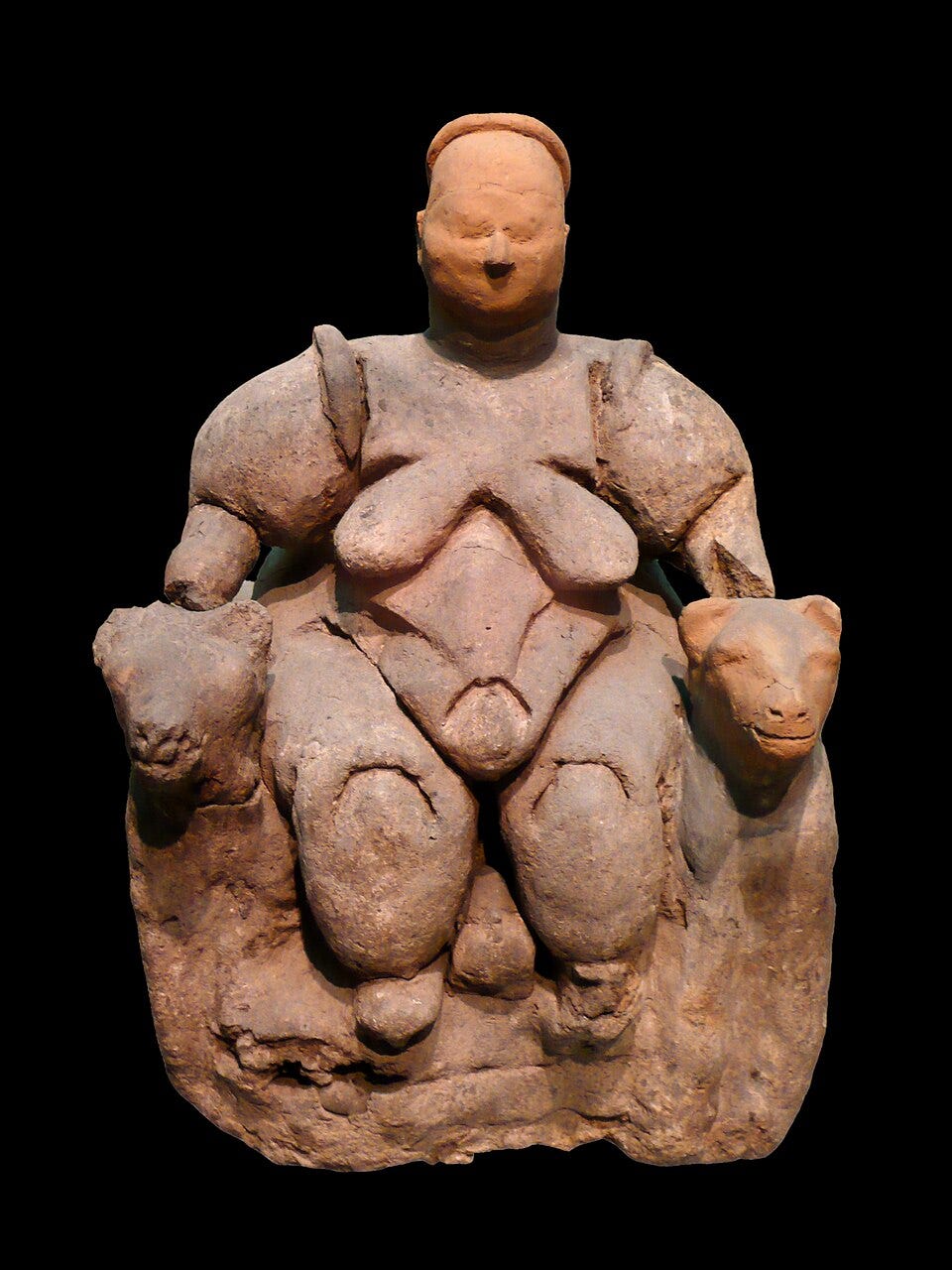
Statue of seated woman flanked by two lionesses, discovered in Çatalhöyük Source
The original excavator, James Mellaart, interpreted it as a representation of Mother Goddess, which to him indicated that the Çatalhöyük society was a matriarchy. But a later archaeologist working on this site, Ian Hodder, violently disagreed. He wrote, “The figurine can be interpreted in a number of ways – as a woman turning into an ancestor, as a woman associated with death, or as death and life conjoined (see the details in the Religion section of the Wikipedia article). We are really on shaking grounds when we try to infer people’s belief in such deep past. The first transformation proposed by W&S, from pre-Neolithic beliefs to primary religions, is very speculative.
We are on much firmer empirical grounds with the second civilizational transformation of W&S — the Axial one. Jan Assman refers to religions stemming from this transition as “secondary.” Examples include Buddhism, Islam, Christianity, as well as Jainism, Manichaeism, and Zoroastrianism. A more descriptive, although abstruse (“difficult to comprehend because complex and intellectually demanding”; “abstruse” is an abstruse word 🙂), is the distinction made by Alan Strathern in his book Unearthly Powers. Instead of “primary” and “secondary,” he distinguishes between “immanentisms”, in which you ask, or manipulate deities to advance your goals in this world, and “transcendentalisms”, which seeks salvation or escape from this world.
I’ve written before about the civilizational transformation of the Axial Age (see The Pivot of History). The reason we have much more evidence about it (unlike the Neolithic transition) is because by that time, 800-200 BC, several regions of the world have acquired writing and we have many texts. Furthermore, a great help for pre-literate periods is provided by abundant iconography, which allows us to build much less controversial reconstructions of people’s beliefs.
Let me give you an example.
We know a lot about the Aztec religious beliefs, but what can we infer about the Mesoamerican religion before them? One of the recurrent themes in Aztec art is flowers and butterflies, reflecting Mexica belief that warriors killed in battle would spend part of their afterlife in an idyllic “flower world” before being reincarnated as birds and butterflies. Although no texts survived from the Teotihuacan times (first to seventh centuries CE), in contrast to the Aztec period, there is quite a lot of murals. Here’s a wall painting in Tepantitla, one of Teotihuacan’s apartment complexes:
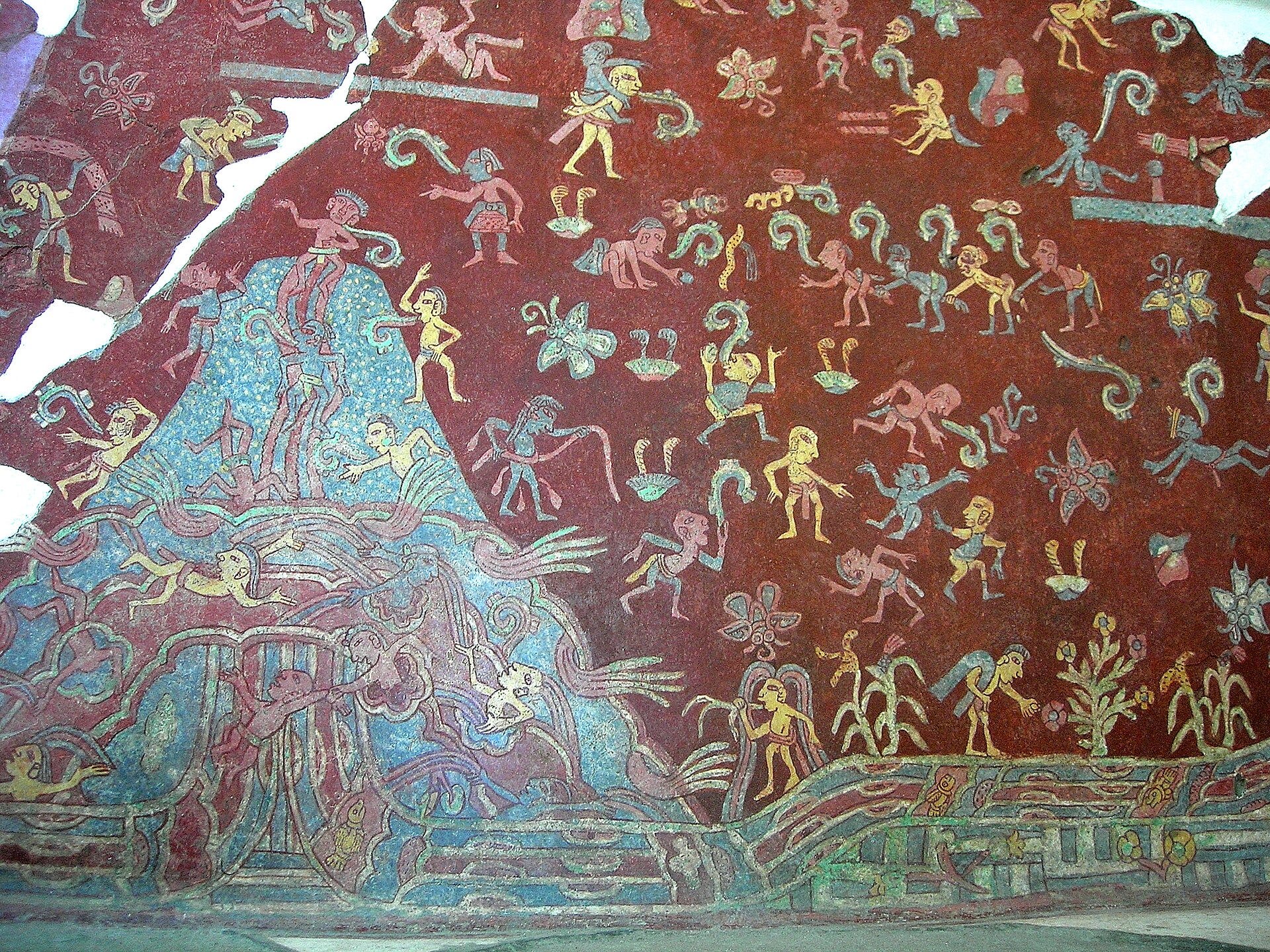
Tepantitla Mountain Stream mural Teotihuacan (Luis Tello) Source
Archaeologists pretty much agree that this is a depiction of the Flower World, or something very similar. In other words, similar religious beliefs probably existed in Mesoamerica a thousand years before the Aztecs!
During the post-Axial period we have plenty of texts and other kinds of information that attest to how thoroughly the transcendentalist religions have replaced pre-Axial ones. In fact, in several cases we have detailed quantitative data on religious conversion to Christianity or Islam. I analyzed these data in my first book on Cliodynamics, Historical Dynamics. Here are the trajectories of conversion to Islam in Iran and Spain:
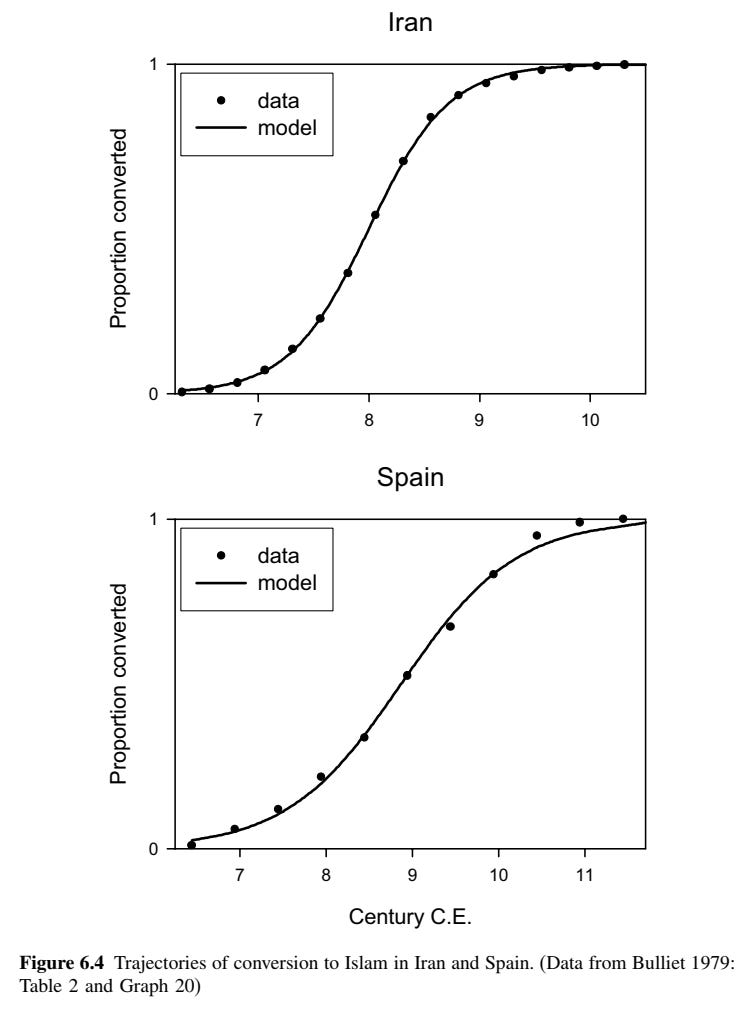
The model (the logistic equation) fits these data remarkably well.
By the eighteenth century all major empires had one of the (post)Axial faiths as their official religion and more than half of the global population professed Christianity, Islam, Hinduism, or Buddhism (today this proportion is over 75 percent).
But the eighteenth century also initiated the third religious revolution — Modernity, with supernatural religious beliefs starting to lose ground to secular worldviews. This civilizational transformation is quite incomplete (and, I would add, may never be as complete as the Axial transition). Currently, the non-religious people are only 16 percent of the global population. But in other ways — science and technology, economics and standards of living — of course, the world has changed a lot.
So there you have it. Three civilizational transformations and four religious ages. Naturally, there is a lot of nuance, but an interesting view at the macro-historical level.