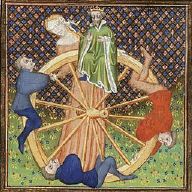
The idea that states and empires are “organism-like” in that they are born, grow, age, become senile and then die, has very long historical roots, going back at least to the Antiquity (for example, in the work of Polybius). The second century Roman historian Florus, explicitly compared Rome to an organism going through the stages of infancy, youth, manhood, and old age.
During the Middle Ages the clearest formulation of this idea is due to Ibn Khaldun (I discussed him at length in my book War and Peace and War). As we move towards modernity we see similar ideas expressed by Machiavelli and Vico. In the twentieth century, the discourse shifted from states to civilizations, with notable proponents of the idea that civilizations age and die expressed by Oswald Spengler and Arnold Toynbee.
Most recently, social scientists started to put this hypothesis to quantitative tests. A pioneer in this was Rein Taagepera, who published a dataset of growth-decline curves for empires, focusing on the extent of territory controlled and how it changed over time. This approach allowed him to define explicit criteria for the imperial rise, fall, and duration. As an example, here’s how this approach works for Qing Dynasty China:
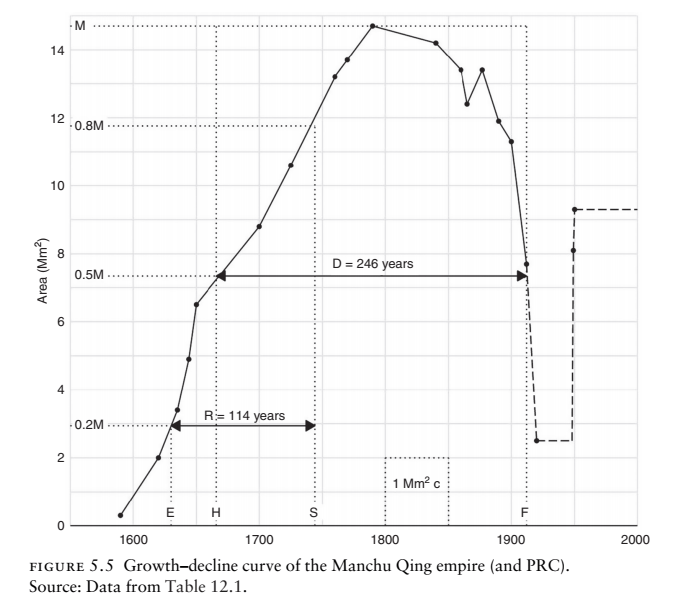
Source: Chapter 5 in Taagepera, Rein, and Miroslav Nemčok. 2024. More People, Fewer States: The Past and Future of World Population and Empire Sizes. Cambridge University Press.
Finally, two articles used the methods borrowed from demography to analyze the life spans of states and empires:
- Arbesman, Samuel. 2011. “The Life-Spans of Empires.” Historical Methods 44(3): 127–129.
- Scheffer, Marten, Egbert H. van Nes, Luke Kemp, Timothy A. Kohler, Timothy M. Lenton, and Chi Xu. 2023. “The Vulnerability of Aging States: A Survival Analysis across Premodern Societies.” PNAS 120(48): e2218834120.
In particular, Scheffer et al. analyzed two datasets, MOROS, which they put together, and Seshat, which was, of course, developed by my colleagues and myself.
So, the idea of imperial birth/death cycles and statistical approaches to testing it empirically are not new. The problem is, how do we define start and end points? What does it mean that a state “died”? Currently the best study (Scheffer et al. 2023) valiantly struggles with this question, but, in the end, has to rely on a set of heterogeneous criteria, suffering from reliance on subjective judgment.
This is especially clear to me in their use of Seshat data, which I know intimately from inside out. Seshat polities in the Equinox2020 data release, the empirical unit that Scheffer et al used in both constructing their dataset and as a comparison to MOROS results, were not defined with the view of using them in a demographic analysis. Our choices of start and end dates for Seshat polities were determined by various pragmatic issues stemming from the needs of data collection to answer such questions as, what has been long-term patterns of change during the Holocene? Studying oscillations around those long-term patterns is a different question and requires a different approach to data collection. As a result, using polity durations extracted from Seshat-Equinox 2020 introduces a lot of unnecessary error into the longevity analysis of Scheffer et al.
But an analysis of polity durations is still theoretically interesting and, as I will say more below, has practical utility. Acknowledging that polity start and end points can be defined in a variety of ways (which will affect the analysis results), here’s the approach that my team has settled on (these data will be eventually published as part of the forthcoming the Seshat-Andromeda data release in 2027 or 2028).
First, we are only concerned with states, defined as polities with the Specialization of Governance index greater than 0.5 (for details how this indicator, Gov, which varies between 0 and 1, is measured see our article Disentangling the evolutionary drivers of social complexity).
Second, unlike previous approaches, we start with an explicit theoretical justification on how to define start/end times. This justification is provided by the structural-demographic theory. As related in End Times, complex human societies organized as states have been around for ~5,000 years. For a while, they can experience periods of relatively high internal peace and order, roughly a century long. However, seemingly inevitably (at least, in the past) they eventually enter periods of high social unrest and political disintegration—End Times. Paradigmatic examples include French and Russian revolutions, as well as American Civil War. The theory, thus, proposes that state-level societies experience a cycle consisting of alternating integrative and disintegrative phases. Because the characteristic duration of these phases is roughly a century, the typical length of the overall cycle is, very roughly, around 200 years. In our book Secular Cycles we provide details on eight such cycles in Ancient Rome and Medieval and Early Modern England, France, and Russia.
It’s important to keep in mind that the theory doesn’t imply strict periodicity. The process generating these oscillations is dynamic, and various external and internal factors my both make the overall cycle shorter, or longer. A catastrophic loss in war can also end a state by external conquest. Still, paraphrasing Toynbee, great empires usually die not by murder but by suicide — internal, rather than external factors play the dominant role.
This cliodynamic theory, thus, proposes a pragmatic way of defining the life cycle of states and empires. We need to collect quantitative data on internal instability, and then use objective criteria to identify “end times” — periods of spiking instability. We can then identify PolitiCycles as periods starting with relatively peaceful stretches and ending with periods of high sociopolitical instability (remember, “peaceful” here refers only to absence of internal wars; whether polities fight external wars is an entirely separate question). How much variation there is in the observed lengths of both integrative and disintegrative phases becomes an empirical question.
Our results will be interesting not only for clarifying historical state dynamics. I expect that they will allow to make educated guesses about future geopolitical dynamics. For example, China is now in an integrative phase, as indicated by most demographic-structural variables, (see Well-being and Immiseration in Contemporary China). Judging from historical patterns, how long might we expect this phase, characterized by internal peace and order, to last?
Alternatively, USA has now entered a disintegrative period. When might we emerge from our current crisis and enter into the next integrative period?
What’s important also is not only how long such phases last on average, but also how much variation there is around averages. And even more importantly, what structural factors (such as constitutional arrangements characterizing a state) and how decisions by the governing elites (such as implementing reforms) affect the length of disintegrative phases?
These questions are among the most important of those on which our team at the Complexity Science Hub in Vienna is currently working. The first step in answering them is to collect quantitative data on internal instability, which will allow us to identify “end times” and thus delineate PolitiCycles. We’ve been at it since the beginning of the year and we wrote about our efforts, heavily aided by AI, in a series of posts on this Substack (see The Feverish Library and preceding entries).
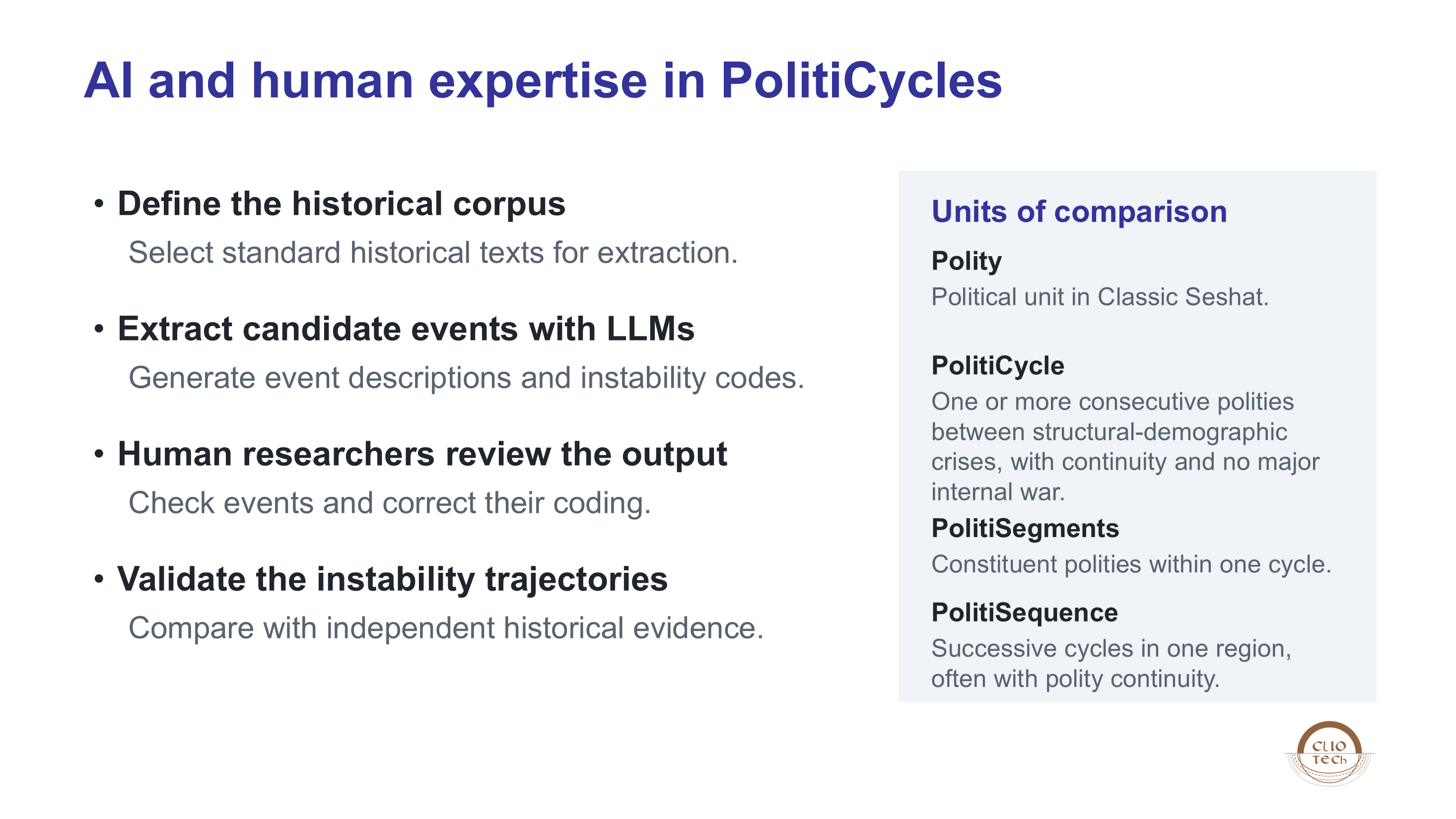
For those of you who are interested in the details of our approach, here is an infographic explaining our overall approach and definitions:
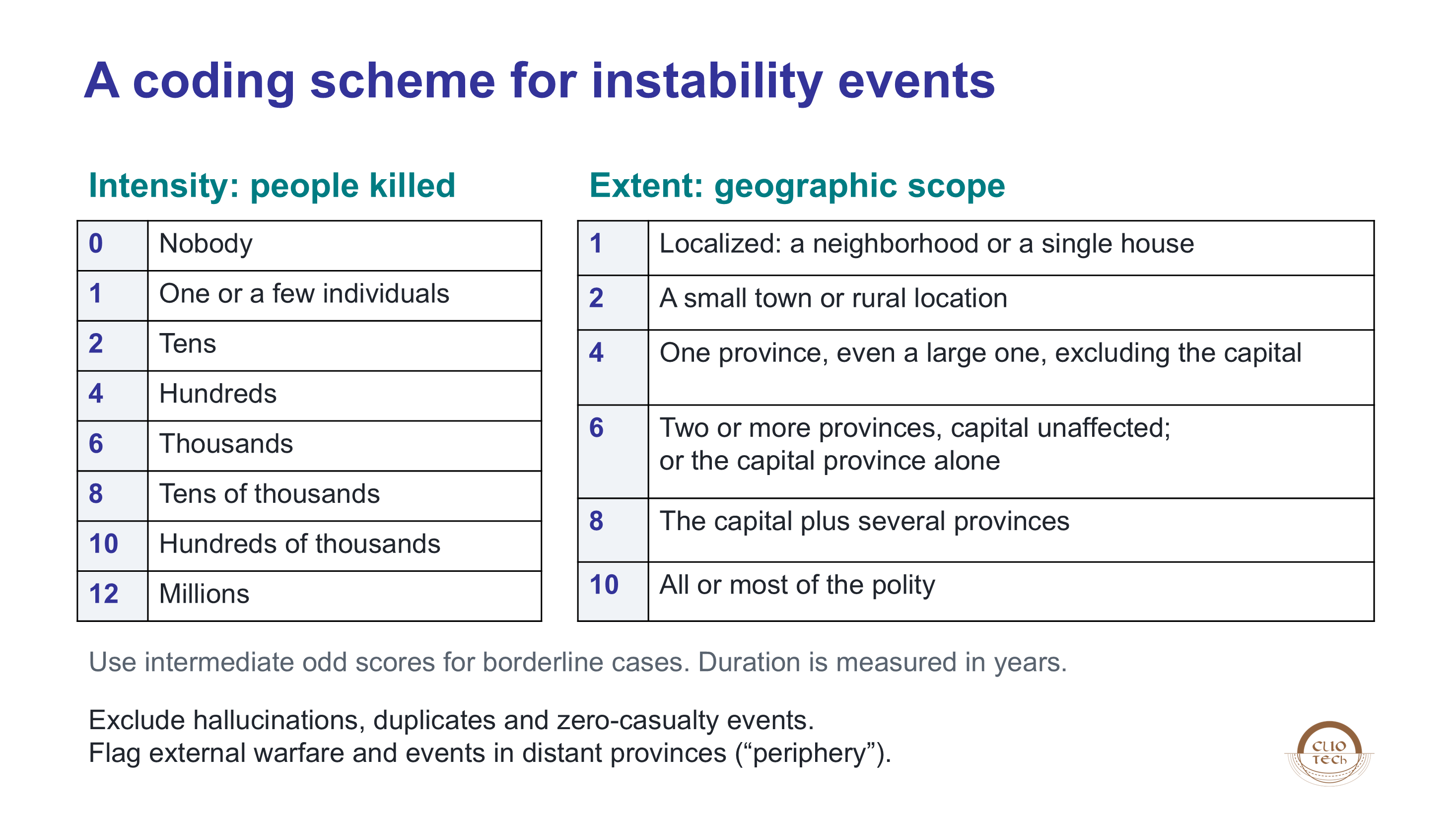
Next, clearly not all instability events are created equal. Lengthy civil wars engulfing the whole polity and killing masses of people are much more consequential, compared to an urban riot or local peasant rising. We capture these three dimensions, by duration (in years), intensity, and extent. The last two characteristics are explained in this infographic:
Currently we are getting pretty close to finishing the collection of these data, and we will be analyzing them in the next few months. In Part II (forthcoming) I will illustrate this approach on the example of France.