What Came First in Human Evolution: Intelligence or Culture?
Follow into
Save into
Follow into
I read Yuval Noah Harari’s Sapiens soon after its publication. Despite the hype I found it quite boring. I didn’t learn anything new from the book (and what new I saw was mostly wrong, as others have commented). The intellectual infrastructure of Sapiens was very much 20th century, failing to profit from the insights brought by the new discipline of Cultural Evolution. So, I didn’t bother analyzing Harari’s argument further.
But yesterday, thanks to a repost by Joe Henrich, I found such an analysis by the Canadian philosopher Joseph Heath on his Substack, Harari vs. Henrich.

The Heath’s post deals with four distinctive characteristics of humans. Here’s how he defines them.
Human beings have four distinct qualities (traits, capabilities, behaviours, etc.) that make us quite different from other animals. These are fairly obvious, but there is unfortunately an entire subgenre of academic pedantry that involves challenging items on the list, saying “other animals do that too!” because there are of course similar capabilities to be found elsewhere.* So in the list below I have added the qualifications needed to disarm these objections and pick out what is absolutely distinctive about humans.
1. Intelligence. Humans possess superior intelligence, not just with respect to instrumental tasks, but also in the ability to engage in mathematical, hypothetical/counterfactual, and logical reasoning.
2. Language. Humans employ complex grammatical speech, with propositional differentiation providing context-independent representation of states of affairs.
3. Cooperation. Humans exhibit a distinctive form of ultrasociality, involving complex cooperation among large groups of genetically unrelated individuals.
4. Culture. Humans engage in domain-general transmission of learned behaviours, producing a large body of cultural artifacts and knowledge that exhibits cumulative improvement over time.
Harari’s argument in Sapiens, according to Heath, is that intelligence evolved first (with the Cognitive Revolution c. 70,000 years ago), followed by language, cooperation, and culture. Thus, the sequence is 1—2—3—4. This is the exact opposite of the account of human evolution developed by cultural evolutionists, such as Rob Boyd and Pete Richerson. The best popular book, which explains the sequence, 4—3—2—1, is Henrich’s book The Secret of Our Success: How Culture Is Driving Human Evolution, Domesticating Our Species, and Making Us Smarter (it’s a great read, heartily recommended).
Pointing out that the two explanations, Harari vs. Henrich, are mirror-opposites of each other, is a great insight (and shows why we need philosophers). I strongly recommend that you read Heath’s deconstruction of the Harari argument before you continue with my post. In particular, why our evolutionary sequence couldn't start with our superior intelligence? (Hint: the oversized human brain is so energetically and developmentally expensive — human females face very high risks during childbirth — that it’s not clear selection for what could overcome these costs.)
In my post I will expand a bit on the sequence proposed by cultural evolutionists (including myself, as I am a member of this field). As Heath correctly says, we argue that culture was the primary, original adaptation that provided the basis for the evolution of the other three traits (cooperation, language, and intelligence). Culture is socially transmitted information. Other animals also have culture, but humans are unique in that our stocks of socially transmitted information have been massively cumulative.
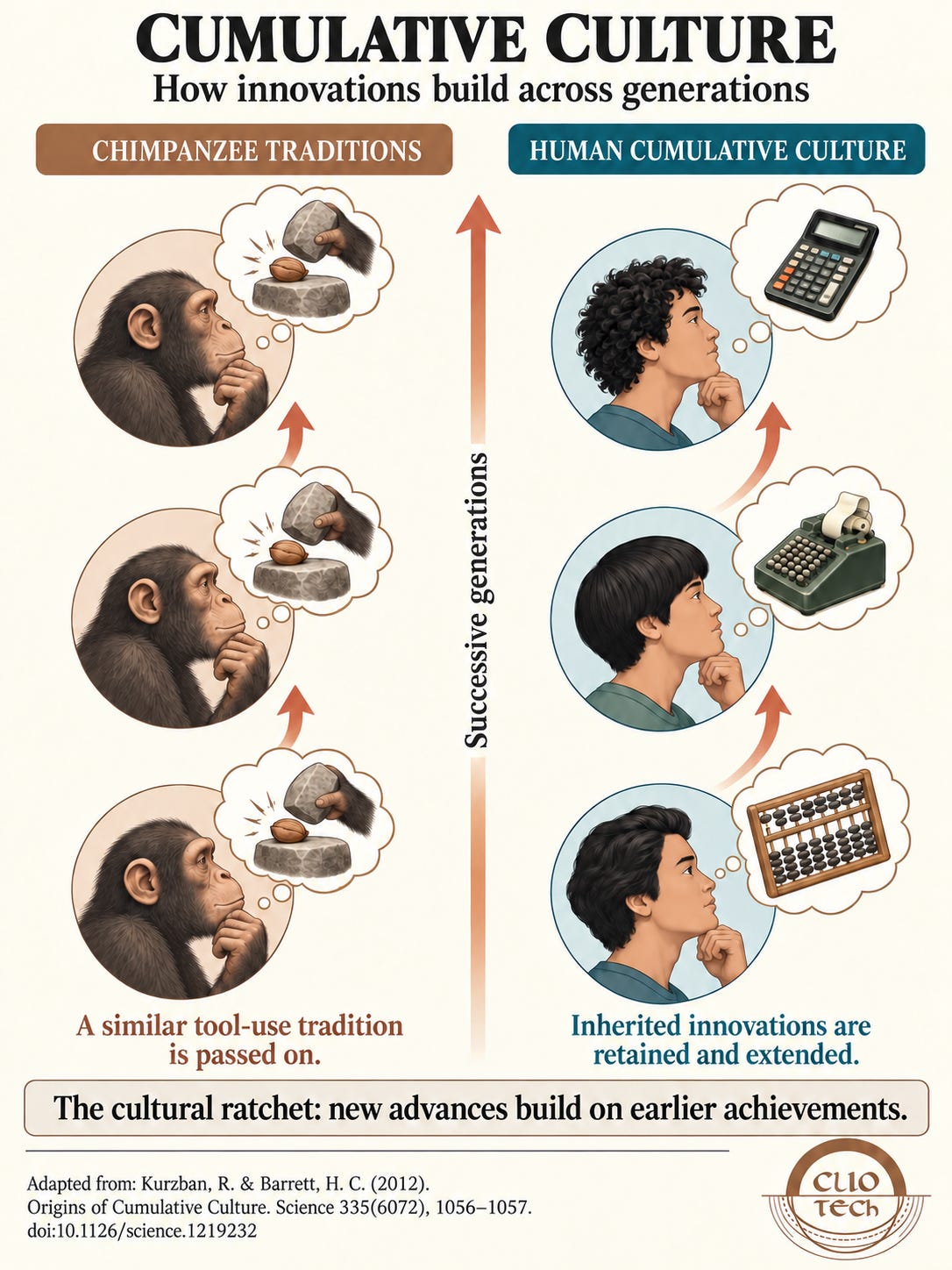
The key basis for the possibility of cumulative culture, as Heath writes, “was the emergence of imitativeness. Human infants got really good, not just at copying what other people do, but at mindlessly copying others – repeating the exact behaviours that they observe.”
But Heath doesn’t explain what were the selection forces that drove the evolution of human capacity for “mindless” imitation that enabled cumulative culture. This explanation was developed by Pete Richerson and Rob Boyd some years ago, which they continue on refining. Two weeks ago I participated in a workshop, organized by Russ Genet and Pete Richerson, Major Evolutionary Transitions: Biological, Human, and Planetary (UC Davis, September 15-17, 2026). In his talk, titled External Influences on the Evolution of Human Culture, Richerson gave an update on this work. Here’s the key slide, which shows how global climate fluctuated over the past 100,000 years:
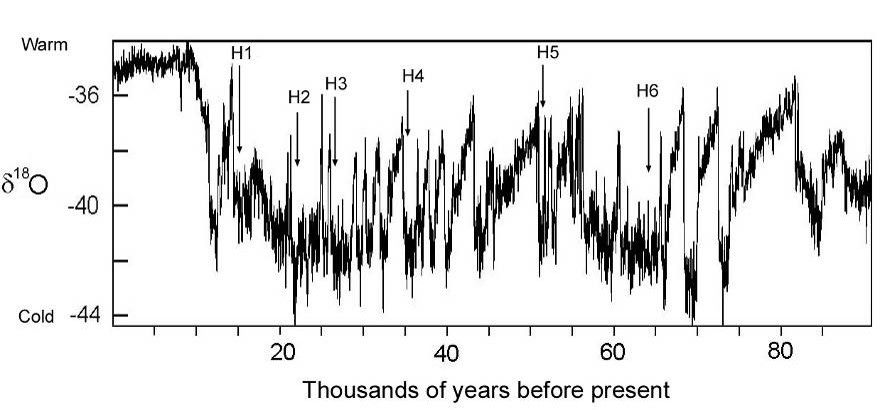
Millennial and sub-millennial scale variation from Greenland GRIP core (slide by Peter Richerson, based on data in Ditlevsen et al. 1993).
The most recent period (on the left of the chart), the Holocene (last 11,700 years), has had remarkably stable (and warm) climate. By contrast the preceding geological epoch, Pleistocene, was the time of violent climatic chaos, with recurrent ice ages separated by relatively warm (but brief) interglacial periods. The argument of Richerson and Boyd is that adapting to such violently changing conditions by means of genetic evolution couldn’t work for humans with our relatively long generation times. Genetic evolution, simply, is not fast enough to track rapidly changing environment.
Cultural evolution, on the other hand, while not instantaneous, was fast enough to enable humans to evolve culturally transmitted behaviors that enabled them to survive during the Pleistocene. Although just barely — several times our species was on the brink of extinction. A recent article, A structured coalescent model reveals deep ancestral structure shared by all modern humans, estimates that the numbers of all humans on Earth during the Pleistocene could fall as low as a few thousand, or even less.
Early in his post, Heath throws down the gauntlet, challenging theorists to translate their verbal theories into mathematical models (a methodological challenge with which cliodynamicists heartily agree):
What makes the field of human evolutionary theory so interesting right now is that, deep down, we really don’t know how any of these capabilities evolved. At some level they must have been adaptive, but nobody really understands specifically why or how any of it was adaptive. On the other hand, we know a great deal about how it could not have evolved, because so many bad theories have been proposed over the years, which have not stood up to careful scrutiny. Typically they start out as speculative theories, until someone comes along and says “show me a model of how that could have evolved,” and someone takes the bait, starts building a model... and then realizes that it couldn’t have evolved that way. Indeed, it has turned out to be so difficult to produce an evolutionary model that could plausibly explain any the items on the above list that formal modeling has been where the most interesting action has occurred over the past several decades of research.
Well, as it happens the explanation linking Pleistocene climatic chaos to the evolution of human culture has been translated into a formal mathematical model by Boyd and Richerson:
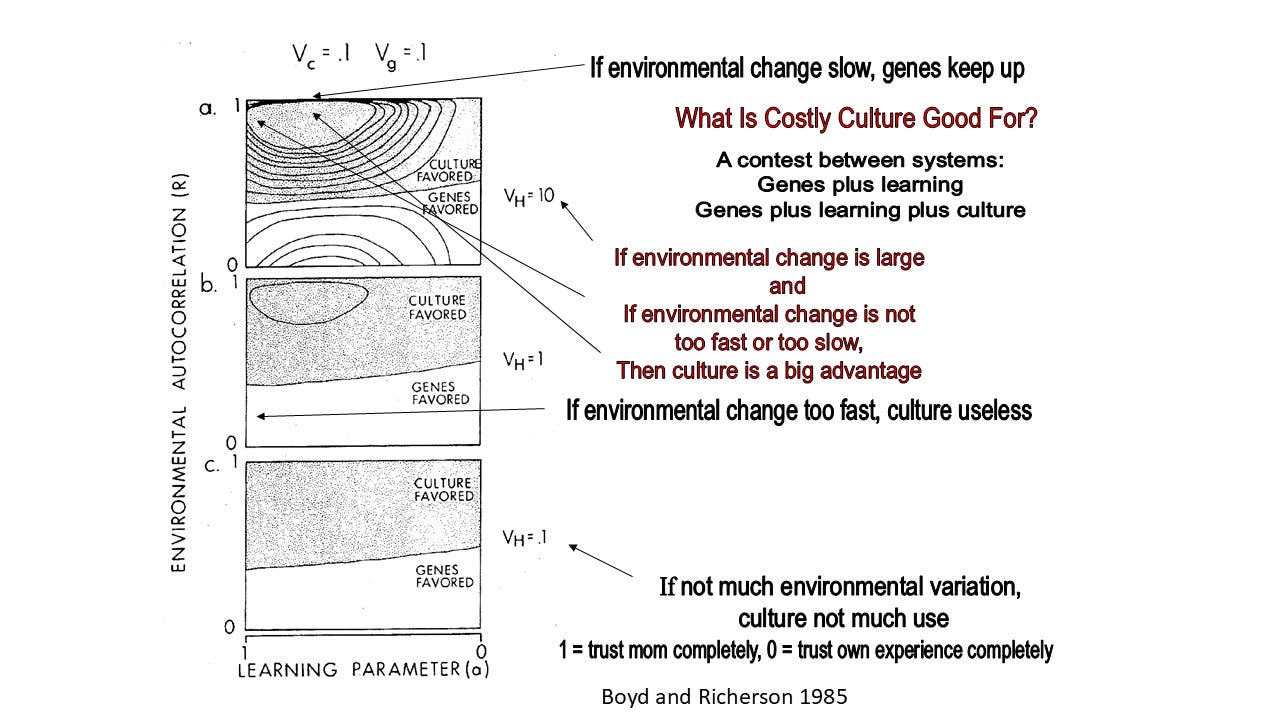
In other words, Boyd and Richerson built the model… and realized that “it” could have evolved this way.
Note that cumulative culture doesn’t require language, because social information can be transmitted simply by observing and imitating behaviors of other people. In fact, the next adaptation, which cumulative culture made possible, was not language but cooperation.
The long story is in my book Ultrasociety, so here’s the TL;DR version. Cooperation produces collective benefits, but is privately costly. It’s difficult for it to evolve because “agents” are tempted to free-ride on the efforts of others. The general mechanism by which cooperation evolves is multi-level selection. What many non-specialists don’t realize is the key importance of variation. For cooperation to evolve, variation within groups should be minimized, while variation between groups needs to be maximized. And that’s precisely what “mindless” imitation of other group members does. OK, this is probably still a bit cryptic, so if you are interested in a fully developed explanation I refer you to my book.
The causal chain that cultural evolutionists argue for, thus, starts with the Pleistocene climatic chaos that drove the evolution of culture. Culture enabled the evolution of cooperation by concentrating variation at the between-group level, while minimizing it within groups. Next, as cooperation deepens and becomes more complex, it needs much more sophisticated means of communication, which is a strong selection force for language. Finally, massively cumulative culture, cooperation among increasingly large groups, and capacity for sophisticated communication drove the evolution of intelligence — this trait comes last, not first as Harari (and twentieth century thinkers thought).
To elaborate on the connection between cooperation in large groups and intelligence, consider that cooperation is hard to sustain because of the temptation by people to free-ride. A huge chunk of our cognitive capacities is devoted to keeping track of who is a good cooperator, and who is not, as well as remembering all the gossip (language!) about what Anne did to Sam, and how Karen imposed (or not) sanctions on defectors. (This explanation often goes by the name Machiavellian intelligence hypothesis).
We humans are smart not because we excel in individual cognitive ability, but due to our social intelligence. This is the secret of our success as Henrich’s book explains.
And once human acquired culture, cooperation, language, and intelligence, the Pleistocene ended and we experienced the Great Holocene Transformation. But I don’t need to repeat this story here, as I’ve written about it extensively on this Substack before.