Cliodynamics and AI: the mid-2026 update
Follow into
Save into
Follow into
We live in interesting times. As I see it, there are two major forces shaping our present and future. The first one is that most of the world is in polycrisis. But we’ve been there before. Previous wave of instability, the Age of Revolutions, I think, provides us with a pretty good idea of how to survive the current wave.
The second force, technological evolution, is much more concerning. I am most worried, and we all should worry, about the evolution of AI. It has the potential to change our societies and affect human life in ways that have no precedents in history.
In a recent post, Darwin’s Machines: How do we assess the risk of AI?, my friend Gavin argues convincingly that a “speciation” event, in which AI evolves into a new life form is pretty much inevitable (read the details in his blog). I agree with him, but my guess is that we, humans, are reasonably safe for 5-10 years and, hopefully some years beyond.
This belief comes from my increasing involvement with the latest and best AI models. Earlier in Summer, I started using Claude (at the level of $20/month). But last week I switched subscription to ChatGPT (using GPT-6 Astra light), with OpenAI racing ahead of Anthropic (although probably not for long).
I am both amazed at how good the AI got and impressed how it is still quite stupid in many ways.
As a reminder, my original writing (on this Substack, as well as generating drafts of my new books) is done completely by myself. And my advice to all writers, especially to those just starting their writing careers, is to do the same. Never use AI to generate first drafts. (It’s OK to use AI to write things like annual reports, as most of them are not read by other humans, anyway.)
I can’t tell exactly how, but it is instantly clear to a sophisticated reader when a text was written by AI. It’s also clear to software that checks for such things. I recently asked a colleague to run my posts on this blog through two such checkers. One said that my texts are entirely me, the second estimated that 1-2% was due to a machine. In actuality, I write everything on this blog, from scratch, myself. And if there is a quote from AI, I clearly indicate it. An additional advantage for me is that it’s actually faster for me to write everything myself. It takes more time to prompt AI and then rewriting its output. So I am ahead in both quality and efficiency.
Of course, I am in good position because I’ve written millions of words before AI. This is how you become a fast writer. And that corpus of my work provides a basis for comparison with my recent writing.
I have no doubt that machine-checking for AI is being continuously gamed. Both AI writers and AI checkers continue to get better in this runaway evolutionary arms race. But until AI becomes equal, or even exceeds, humans in creativity, which is some years in the future, one wouldn’t need a machine to see that the text was generated by another machine.
Returning to both the smarts and the stupidity of AI, last week I used ChatGPT to generate several infographics for a talk I’d be giving later this month. For two of the simpler tasks, the model did great — it took 2 or 3 iterations to get what I wanted.
But for a more complicated one, which involved drawing a map, the experience was different. I asked ChatGPT to draw this map based on two specific blog posts I’d written. The first iteration was amazing — it really got the idea and made a pretty good translation of my text into an image. But there were several problematic issues that I tried to fix. I went through seven iterations, and by the last two the image was actually getting increasingly worse. It was like the model dumbed down. (So I gave this task to a member of my team to complete. Humans are still indispensable.).
Apologies about being so verbose, but actually the main point I wanted to make in this mid-week post is to bring to your attention a new review of the state of Cliodynamics. This review was done by Michael Logies who has no special expertise in science (he is a German dentist). What he did was use AI to synthesize all articles published by the journal Cliodynamics (so far, 198 of them). To be more precise, Michael used “an AI-assisted human-machine workflow.” Read the details of procedure on his web site.
I went through the second edition of this work. To be absolutely honest, I was amazed at how good, and useful!, this survey of our field turned out to be. I haven’t yet read some of the more recent articles, since stepping down as Editor-in-Chief. And I have forgotten some articles that I read years ago. Human memory is fallible. Reading about all of them in this compendium was extremely useful to gain an eagle’s view of Cliodynamics — even for me, and I am one of the founders.
The book organizes articles in several themes. It’s not necessarily how I’d do it, but it’s quite logical and helpful in navigating different strands of cliodynamic research.
At the same time, there were several amusing stupidities committed by the AI. Specifically, it hallucinated several first names of article authors. Now, I can see how it could confuse Timothy and Thomas. But why did it call one author, whose name is Oscar, “Magaalma”?? LOL. (These errors have been fixed in the current version — third edition).
An additional limitation, of course, is that this compendium only includes articles published in Cliodynamics, while most of our hard-hitting articles have been published in other journals. But this will be addressed in future iterations, either by Michael or by us. I periodically think that it would be good to have a textbook on Cliodynamics. But writing textbooks is boring (at least, for me) and I always have more exciting projects to pursue. So perhaps we’ll do an AI-assisted textbook.
And there you have it. AI has become very powerful but it still can’t do the job alone. We are in a sweet spot when the best results are produced by a human-machine collaboration. Perhaps if we continue “racing with the machines” rather than “racing against the machines,” we can postpone the AI Doom farther in the future?
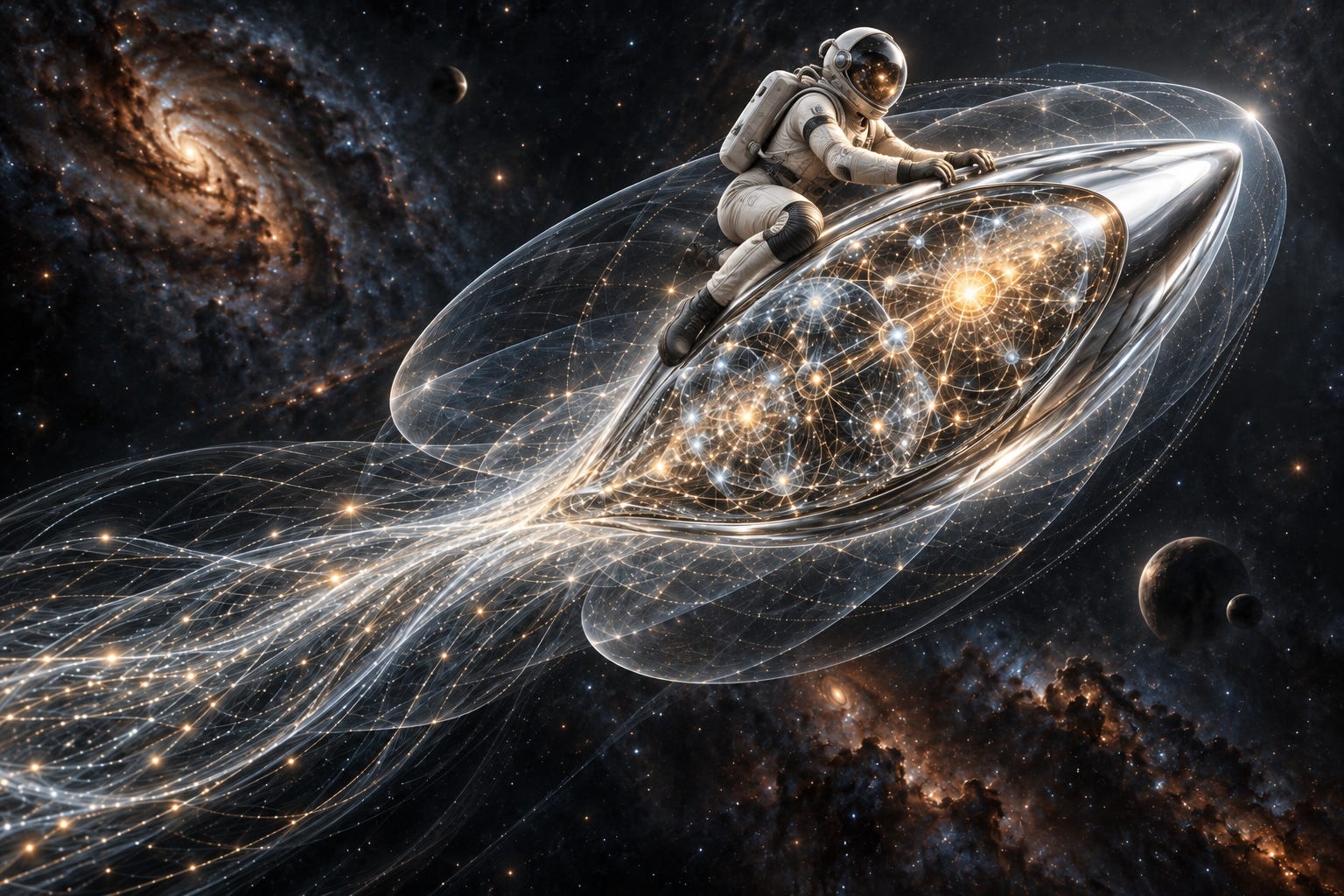
Racing with the Machine. I generated this image with ChatGPT by prompting it to use the idea of Minds in Iain Bank’s Culture Series. Then I asked it to add a human rider. Not perfect, but hopefully gets my point across.