Artificial Scientists Are Not as Good as Human Scientists
Follow into
Save into
Follow into
Last month (September 2026) I was struck by two similar news. In each case, an AI company made a claim that their AI made an important scientific advance. See the infographic for details (created with the help of AI 🙂).
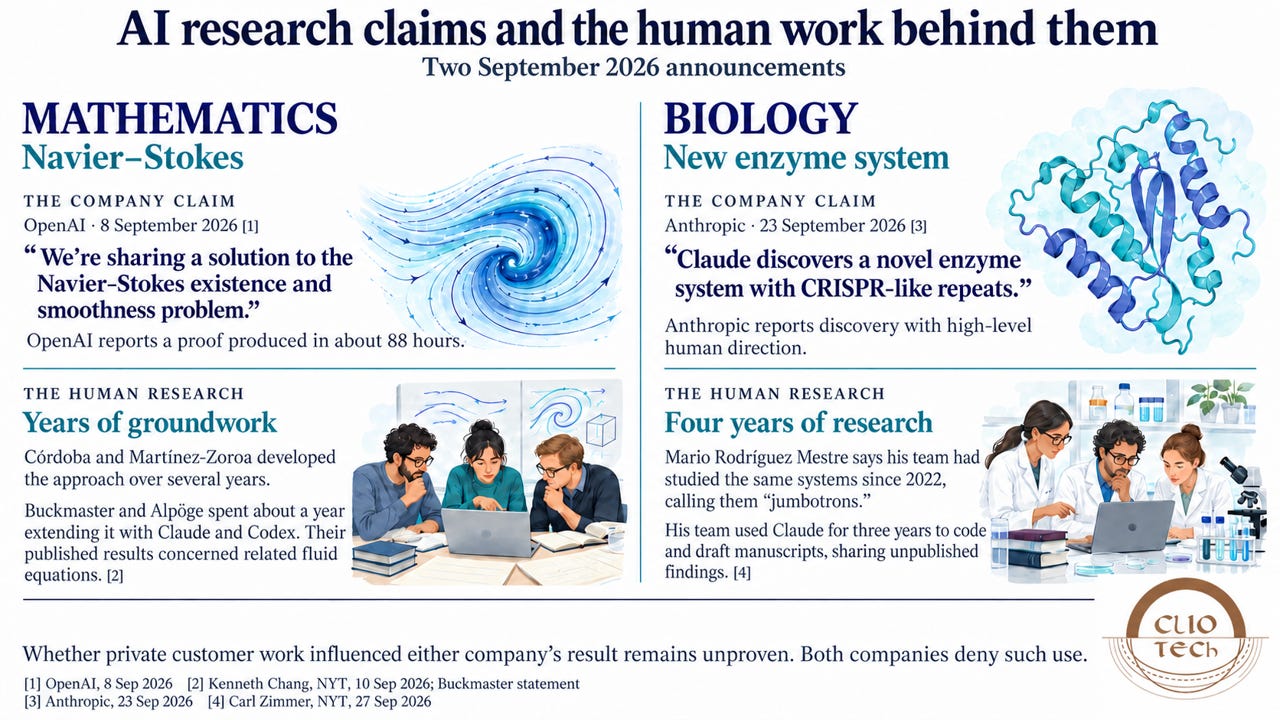
Following these announcements, some commentators used them as evidence that AI now can do original research.
I take a different view. Almost immediately it was reported that in both cases there were teams of human researchers who’ve already worked on each problem intensively for several years. And who used AI to help with their work. Naturally, the AI companies deny that the work by human scientists helped their AI agents to make the discoveries. On the other hand, they can’t prove that somehow, perhaps in an inadvertent or “diffuse” manner, human thinking on how to solve these problems didn’t help the AI.
Even more importantly, these AI advances stood “on the shoulders of giants”: it was humans that developed both mathematics and molecular biology, the paradigms within which the AI models operated. Most importantly, it was humans who defined the research questions. I’ve trained a number of PhD students over the years and when I start with them, I always tell them that the key skill they have to develop is how to ask an interesting and important question that their subsequent work will address. As my interaction with both Claude and ChatGPT over the past months shows, the current crop of AI is unable to do it well.
It would be good for Anthropic and OpenAI to acknowledge their debt to human scientists, and give them appropriate credit, rather than trying to scoop them.
And to reiterate what I said in a previous post, I continue to use LLMs in my work, because I’ve already seen an order of magnitude increase in the work efficiency by my team and myself. The two examples above show that today science advances most effectively when humans work with machines. And I have no problem with the AI models learning from my prompts if this moves the field forward. Although I hope that AI will acknowledge such inputs in case they make, in the future, substantial advances in Cliodynamics.