More on the War over War

Follow into
Save into
Follow into
Long-time readers of this blog (and its precursor) know that I write about warfare a lot. This is not because I am a warmonger in any shape or form. Unlike some, I don’t think that war is good for anything. Competition between societies, on the other hand, is necessary, but it’s most productive when it doesn’t involve killing people (more on this in my book, Ultrasociety: How 10,000 Years of War Made Humans the Greatest Cooperators on Earth). One of the most important ultimate goals driving my research is the need to abolish wars. But to do that, we need to study warfare (see my 2012 blog post, Why Social Scientists Need to Study War).
Unfortunately, at least half of social anthropologists and archaeologists in the United States equate the study of war with advocacy for it. They feel uncomfortable with discussing violence in past societies, which for them has become a cultural taboo. As a result, they tend to ignore or even deny any evidence for violent conflicts in the past, even when it stares them in the face. Lawrence Keely called this attitude “the pacification of the past” (see his book War Before Civilization: The Myth of the Peaceful Savage).
Attempting to publish results of our research in anthropological journals has become like a game of Russian roulette. If one of the reviewers occupies ideological, anti-science space, they kill your submission. So, you have to try again with a different journal, until by luck you get all reviewers who are on the pro-science side of the barricades. This is a really unproductive attitude — if your aim is to abolish war, you need to study it. It turns out that incidence of warfare repeatedly waxed and waned in different time periods and various regions. Understanding why is the necessary basis for abolishing war in the contemporary world.
Some years ago I wrote a series of post on these questions, see here:
As an example of such a highly controversial topic, consider the case of the Tripolye culture. Initially, these people lived in multiple small settlements spread over the landscape. But gradually they moved to a fewer, larger settlements with big gaps between them. They also built concentric ramparts, ditches, and walls around those “megasites.”

Reconstruction of the main occupation phase of the Maidanetske mega-site, c. 3800 BCE.
Why did they go to such trouble? To me the explanation is obvious. This culture found itself on the steppe frontier, confronted by early steppe pastoralists belonging to the Sredny Stog and Yamnaya cultures. In a pattern that would recur again and again through human history, the raiding pressure from the steppe dwellers forced nearby farmers to organize for defense, which drove up social scale of their societies and forced them to build protective structures. In the end, it didn’t save them and they were overrun by migrating early Indo-Europeans.
But the majority of anthropologists deny this explanation, instead coming up with a variety of rival explanations. Some say these structures delineated ritual, cosmological, and symbolic spaces. Others claim it was a kind of livestock corral.
Such attitudes that lead social scientists to “pacify the past” may be waning, though, but for an unfortunate reason. In recent years, we saw resurgence of collective violence, from large-scale wars between great powers to small-scale infighting in failing, or failed states.
The current situation in West Africa provides us with such a sad “natural experiment” confirming the steppe frontier theory that I used to explain the Late Tripolye above. For details, see a recent blog article by Olivier Walther and Steven M. Radil, The resurgence of fortified landscapes in West Africa.
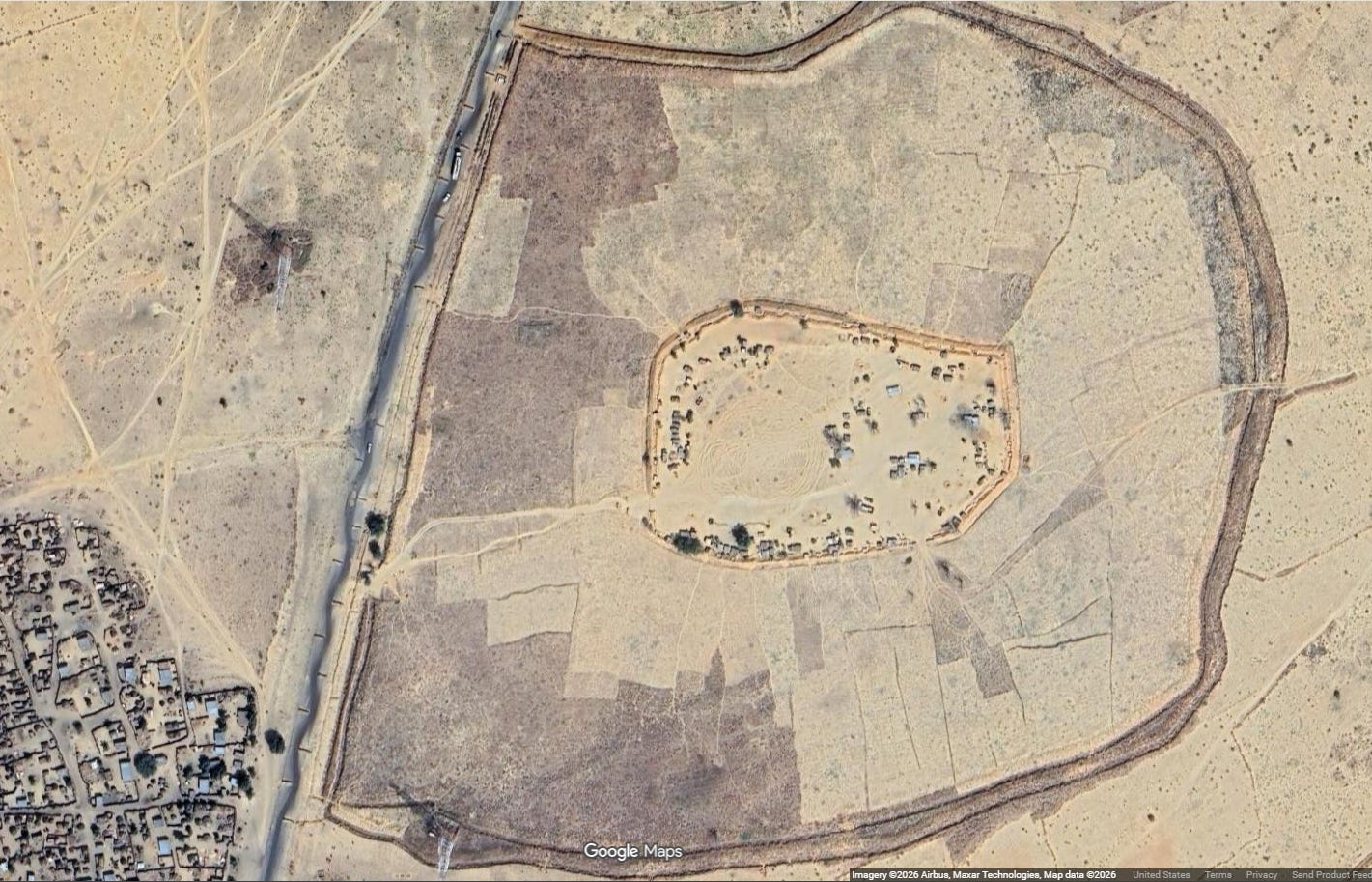
West African states respond to insurgencies by building city walls and fortifying borders. These initiatives aimed at controlling the movement of jihadist groups. Source
Here are the main points:
- The primary role of these structures is to slow offensives by militants who are highly mobile using vehicles such as motorcycles and pickup trucks. By forcing attackers to dismount, the defenses guard against suicide attacks, which have killed nearly 4,500 people in West Africa from 2011 to 2024.
- All urban agglomerations in northeastern Nigeria with more than 10,000 inhabitants are now surrounded by earthworks large enough to be visible on satellite images.
- The exceptions are towns abandoned following battles between the government troops and jihadist insurgents.
- Cities are not the only places to be fortified. West African governments have also embarked on extensive programs to fortify their borders. For example, nearly 200 kilometers of the Cameroonian border are now fortified by trenches. This development is a direct analog of “long walls” historically built by China, Iran, and Russia to protect their populations from steppe pastoralists.
The authors conclude:
This history tells us that the current wave of fortification of West African cities and borders is an inevitable response to the rise in political violence in the region.
It is difficult to imagine how government forces could respond to repeated attacks by jihadist groups without fortifying major population centers and without attempting to prevent these groups from infiltrating across their borders.