

Art by Thomas Cole via Wikimedia Commons
Sometime in the mid-2010s, just as liberalism was getting replaced by “progressivism”, the conservatism that I had grown up with was getting replaced by something we then called the “alt-right”. Whereas the old conservatism was based on Christian faith, libertarian economics, and flag-waving patriotism, the alt-right saw America as a white racial nation-state, rejected the idea of free markets, and was basically irreligious and isolationist.
Over the course of two Trump presidencies and one Biden interregnum, the alt-right matured and grew into what I now call the New Right. In doing so, it basically took over from conservatism as the guiding ideology of the GOP base — though not (yet) of the GOP as a whole. Whereas the alt-right was a naked white-power movement, the New Right sees things in broader “civilizational” terms. It has embraced the idea of Christianity, not as a faith or a lifestyle, but as a tribal affiliation defining ingroup and outgroup. Its foreign policy matured into something concrete — a desire to wield American policy on behalf of “Western Civilization”.
At the grassroots level, the New Right also added some new components. It merged with the Covid antivax movement to become skeptical of modern medicine, public health, and life science in general. It partially merged with the incel movement, telling young men that their sexual frustration was the fault of progressivism. It veered even more strongly into antisemitism, probably feeling liberated to do so by rising antisemitism on the left in the wake of the Gaza war. And it added a strong component of anti-Indian hatred, seeing Indians as a uniquely vulnerable target among recent immigrant groups.
Anyway, it’s too early to say that this movement has failed. Yes, the Democrats won one midterm election, but Trump is still the President, and he has shown zero inclination to reverse course on any of his most New Right-aligned policies. He has made Stephen Miller, the ultimate anti-immigration crusader, his chief of staff, and posted a picture of himself hugging Vladimir Putin with the caption “My Friend”. Meanwhile, the New Right still has a fairly robust online presence.
But it’s impossible to deny that the winds have shifted. The midterms made it clear that even if the New Right sticks around for the long term, it won’t have a monopoly on power. That will make it essentially impossible for it to follow through on its long-term agenda. Basically, the notion that wokeness and internal disputes would cause the Democrats to permanently collapse as a party has been falsified.
Already, some prominent figures are backing away from the New Right. Elon Musk, who once stood on a stage and declared himself “Dark MAGA”, now says he’s not even MAGA at all, and is instead a political moderate:
And the CEO of Palantir is calling himself a Democrat:
Meanwhile, Bo French, the Texas candidate who lost an election after complaining about Indian fans at a UT football game, has been kicked out of his country club.
The New Right’s online activists and commentators are in a state of deep despair:
Others are tweeting ever more histrionic demands for a civil war that absolutely no one seems interested in actually fighting:
What enthusiasm still does exist on the New Right tends to be concentrated on the movement’s most extreme fringe, which focuses on getting attention by bashing Trump and MAGA and saying ridiculous, extremist stuff. For example, Politico reports on the “Christ is King” conference, run by a guy named Joel Webbon:
[F]or Webbon, the problem was also that MAGA hadn’t gone far enough. He wanted even harsher deportation policies. He wanted a total repudiation of Israel. He wanted to curtail women’s right to vote, to criminalize abortion and homosexuality, and to expel Jews and non-Christians from public office…The event attracted a notorious set of online agitators, including conspiracist Alex Jones and Nick Fuentes, the 28-year-old white nationalist and antisemite, who made a rare public appearance as a guest speaker…
There are, in Webbon’s telling, few “guys” capable of leading this faction…He did put forward a few “guys” who might fit the bill, naming electoral losers like [James] Fishback, one of the weekend’s main draws, who recently lost [a gubernatorial primary] to a MAGA-backed candidate by 37 points in Florida…Webbon also went on to name Bo French, the far-right candidate for Texas Railroad Commissioner who ultimately lost by some 670,000 votes to a Democrat after making anti-immigration a centerpiece of his campaign.
(There are also various loonies from overseas.)
These are all signs of a movement that’s on the way down. It may return someday — communism sort of did, after all — but its hopes of transforming America over the next few decades are fading. It’s not over yet, but it’s looking more and more that way.
A big part of the reason for that failure, of course, is that Americans simply do not buy what the New Right wants to sell them. Regular Americans generally like (legal) immigration, and they don’t see racial and religious heritage as an important determinant of who is a real American. It’s very hard to sell people a product they don’t want.
But there are also various strategic errors that the New Right made. To be clear, I’m glad these mistakes were made; I have zero desire to see a movement like the New Right hold power in my country. I just think it’s interesting and instructive to think about what the mistakes were.
One choice that wasn’t a mistake was to hitch the movement to Donald Trump. A lot of people in the New Right are going to blame their failure on Trump’s mistakes — his Iran War, his corruption, and his reluctance to do anything about inflation. But without the assistance from Trump’s personal charisma and idiosyncratic broad appeal, it’s doubtful that the New Right would ever have escaped the basement of the internet in the first place; the Republican establishment would have kept it locked in a box, the way they did with similar insurgencies from Pat Buchanan and the John Birch Society in past eras. Trump was actually the most effective leader the New Right could have chosen.
Instead, the New Right’s weakness mostly sprang from the fact that it was an online movement.
Reactionary impatience
Rightists will tell you that American culture has been completely captured by the left. And when you ask how this was accomplished, they’ll tell you about the “long march through the institutions” — a strategy that a German leftist described in the 1960s. Basically, the idea was for leftists to infiltrate universities, the media, the bureaucracy, and every other institution. Rightists believe, rightly or wrongly, that this plan was actually put into effect, and that this explains why university professors, media elites, civil servants, and so on tend to be left-wing today.1
One might imagine that the New Right would try to execute a similar long-term strategy to win back the culture. Indeed, right-wing movements have been known to do something like this — the Federalist Society has been able to keep the American judiciary in rough ideological balance.
But the Federalist Society is part of the old conservative movement; the New Right has not shown much interest in executing a long-term strategy of institutional capture. Instead, they put most of their eggs in the basket of the Trump presidency, apparently hoping that either Trump would win the whole culture for them in a few years, or that he’d turn America into some kind of quasi-dictatorship that allowed his successors to continue the project of culture war and race war into the indefinite future. In terms of direct cultural appeal, the New Right mostly limited themselves to shouting online.
This demonstrates the extreme impatience of the New Right. Part of this is probably just inherent to rightist movements in general — there’s a reason that they’re called “reactionary”. Rightism tends to be strongly motivated by fear — the conceit is usually that if extreme measures are not taken right now, everything good in the world will be destroyed. The belief in imminent destruction doesn’t exactly lend itself to a patient long-term strategy of institutional takeover.
But part of the reason has to be the movement’s online roots. For people whose defining cultural expression consists of memes and Twitter mobs, the strategy of patiently infiltrating PhD programs over the course of 30 years must sound like hell. Virality and online conflict give instant gratification; winning a presidential election is only slightly less instantaneous. Institutional takeover requires a patience that was definitely present in 1985 among sad-sack leftist grad students with nothing to lose, but is in short supply among today’s online politics junkies.
This is why when Trump fades from the political scene and fails to be replaced by an eternal dynasty of rightist caudillos, the New Right will feel like they have nothing.
The New Right couldn’t make alliances
Politics is the art of making strategic alliances. The old conservative movement was very effective at this. Uniting the interests of Christian conservatives and libertarians took some doing. And conservatives worked heroically to include Catholics in a movement once dominated only by Protestants, leading to the Reagan Revolution and the exodus of Italian, Polish, and Irish voters from the Democrats to the GOP.
MAGA itself made strategic alliances in its successful 2024 comeback campaign. Co-opting RFK, Jr. — formerly a well-known progressive — into the fold was detrimental to the nation, but was also a stroke of political genius. Trump even allied with Tulsi Gabbard, using their shared fondness for Russia.
Trump’s 2024 campaign also offered the GOP its chance for the biggest ethnic realignment since Reagan. Trump won primarily thanks to the exodus of large numbers of Hispanic and Asian voters from the Dems to the GOP. These voters were frustrated by “woke” progressive attitudes toward race, and swayed by Trump’s promises to tame inflation.
But no sooner had these nonwhite voters handed Trump the presidency than the New Right started attacking them. From Bo French’s anti-Indian rants to Stephen Miller’s encouragement of racial profiling in ICE raids, rightists in power spit on the very people they needed in order to build long-lasting support. Meanwhile, rightist intellectuals continued to say dismissive and mean things about minority voters:
This spectacular failure to repeat Reagan’s conversion of “white ethnics” will come back to haunt the right in the future. Already, many Hispanic Trump supporters shifted back to the Dems in the midterms, while others stayed home in disgust.
As I wrote in a post back in September, this tendency to attack and exclude potential allies will ultimately doom the New Right:
It’s this pathological inability to understand alliances and coalition-building that will ultimately doom the New Right…[T]his is a movement built to exclude and divide and splinter — both because of the querulous personalities of rightists themselves, and because of the intransigence of a racial ideology that abhors any impurity. If they ever managed to see off the Hispanics and the Asians, the rightists would start in on the Greeks and the Italians, and so on. There’s no victory in sight — only eternal conflict. These are not nation-builders; they are nation-dismantlers.
Ultimately, I think this tendency probably also flows from the New Right’s online origins. On platforms like Twitter/X, attention is the only currency that matters, and denouncing people gets more attention than patiently building durable alliances.
The sales pitch to young men was fundamentally flawed
Right-wing movements have always appealed to men by portraying themselves as more manly than their opponents. Trump and MAGA had many different appeals to masculinity, including winning the favor of “podcast bros” like Joe Rogan who had the ears of many American men. That was smart, and had the potential to be durable.
But the New Right often appealed to men by promoting “incel” ideas. For those who are unacquainted with incel ideology, the idea is that if women are free to choose their own partners, all the women will go for a few highly desirable men (“chads”), leaving the vast majority of men celibate and frustrated. The New Right married this idea to anti-feminist politics — it promised to reduce women’s status and independence in society, in order to force them to accept lower-status men as partners, thus making the distribution of sex more egalitarian.
The spread of incel ideas among the New Right explains the recent rightist uproar over the part of Grand Theft Auto 6 in which you have to buy flowers for your girlfriend:
The idea is that in a society free of progressive values, men would never have to woo women by buying them flowers or doing nice things for them; they would just demonstrate their superior status and power as men, and women would offer themselves up. (Apparently these rightists know little or nothing about courtship in the 19th century, or the 1950s, but that’s beside the point.)
This absurd message had more appeal than you might expect. Sexual frustration is a powerful motivator for many naive young men, and the idea that right-wing politics could lead to more sexual success was a seductive one. The only problem with this is that it wasn’t actually true — or at least, there wasn’t enough truth in the story to actually make a difference to men’s lives. If you couldn’t get a date in 2024, you couldn’t get a date in 2026 either.
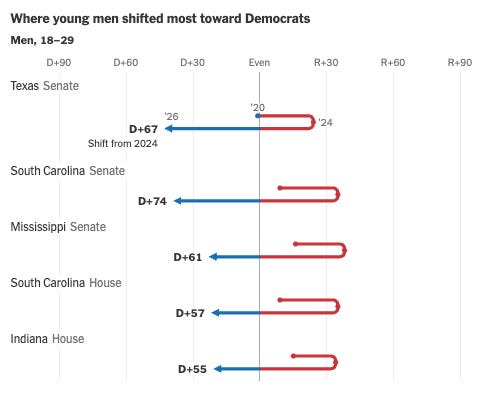
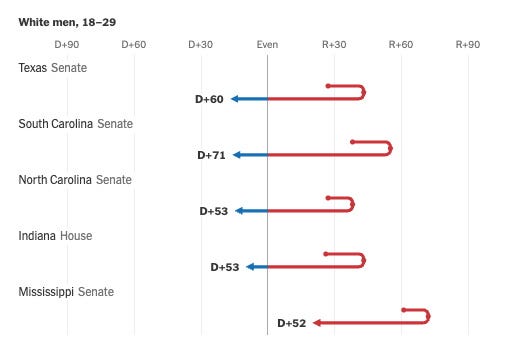
I suspect that there is only so long that you can appeal to men by calling them sexless losers. It only takes most of them a short time to wake up and realize that supporting right-wing politicians has no chance of improving their sex lives, now or 20 years from now. By 2026, young men’s flirtation with the political right was ending:
Source: NYT via Derek Thompson
Source: NYT via Derek Thompson
These numbers are partially due to differential turnout; a lot of former Trump supporters simply stayed home in 2026. But withdrawing in disgust is also a way of showing a lack of support. The New Right’s message to young men — crafted for an extremely online audience, in order to get attention in online forums filled with frustrated young rejects — simply didn’t have what it takes to hold the attention or retain the allegiance of America’s young men.
The New Right is fundamentally parasitic on Western Civilization
The online world is an ephemeral place. Attention comes and goes, the news cycle turns over, memes become boring and stale. A social movement that arises from this impermanent space will inevitably have difficulty carrying out any change that requires more than a couple of years. Thus it was with the New Right. I wrote back in 2025 that the Trump movement itself was destined to be ephemeral, because it built no lasting institutions:
Trump’s movement has been around for a decade now, and in all that time it has built absolutely nothing. There is no Trump Youth League. There are no Trump community centers or neighborhood Trump associations or Trump business clubs. Nor are Trump supporters flocking to traditional religion; Christianity has stopped declining since the pandemic, but both Christian affiliation and church attendance remain well below their levels at the turn of the century. Republicans still have more children than Democrats, but births in red states have fallen too.
In Trump’s first term, the attempts at organized civic participation on the Right were almost laughably paltry. A few hundred Proud Boys got together and went to brawl with antifa in the streets of Berkeley and Portland. There were a handful of smallish right-wing anti-lockdown protests in 2020. About two thousand people rioted on January 6th — mostly people in their 40s and 50s. And none of these ever crystallized into long-term grassroots organizations of the type that were the norm in the 1950s.
For a very few people, the first Trump term was a live-action role-playing game; for everyone else, it was a YouTube channel.
And in Trump’s second term so far? Nothing. Even the rally numbers are way down. National conservatives who might have gone out to meet each other in 2017 are hunkering at home alone in their living rooms, swiping back and forth between X and OnlyFans and DraftKings, pumping their fists in the air as they read about how Elon Musk [is] firing people or Trump is cutting off aid to Ukraine. “You can just do things”, except almost zero of Trump’s supporters are actually doing anything except passively cheering for their notional team…[T]he thumos is all secondhand.
The MAGA movement, you see, is an internet thing. It’s another vertical online community — a bunch of deracinated, atomized individuals, thinly connected across vast distances by the notional bonds of ideology and identity. There is nothing in it of family, community, or rootedness to a place. It’s a digital consumption good. It’s a subreddit. It is a fandom.
I don’t think I’d change a word of that.
The New Right claims to be the champions of Western Civilization, but in fact their movement is a parasite on the actual Western Civilization that birthed them. They are not the kind of people who could ever build Notre Dame; they could only post memes of Notre Dame to win a fleeting argument on the internet.
The real bones of Western Civilization — the things that have always made it mighty — are its institutions. They are courts, corporations, bureaucracies, markets, churches, universities, charities, armies, and so on. They are fundamentally cooperative, long-lasting, constructive things. They require great cooperation to build, and they work by fostering ongoing, productive cooperation among the people who sustain them.
The New Right are not institution-builders; they are institution-mockers. They are squalling children, cradled in the bosom of Western Civilization, shaking their tiny fists and throwing a tantrum because they were asked to do real work to sustain their priceless inheritance. Throwing a tantrum because someone asked them to court women with flowers. Throwing a tantrum because someone expected them to work alongside industrious Indian engineers. Throwing a tantrum because they didn’t like the color of the faces they saw at a football game they didn’t even attend. Tantrums as a lifestyle, tantrums as a video game, tantrums as the ultimate form of decadent, useless consumption.
No civilization will ever be built, or rebuilt, by the hands of such men.
But it would be arrogant to believe that the New Right are unique in this regard. The woke movement of the 2010s built more offline institutions than the New Right did, but ultimately proved more interested in dismantling every facet of American culture and society. The leftist movement of the 2020s is barely less online than the New Right, and even more focused on tantrums as the praxis of change.
Social media has given us the ability to spend our entire lives playing a video game that looks like reality. “Press A to throw tantrum.” Almost everything that looks like a movement these days is simply the spectacle of a large mass of consumers playing these video games and calling it politics. The real, hard, slow work of building institutions is still being done, to some extent, but the people doing it are not the people dunking on you on X, or ranting for attention on TikTok, or filling the ears of D.C. staffers with nonsense and poison.
The truth is undoubtedly more complicated. There are plenty of other reasons these institutions tend to lean the left. Education polarization has been happening all across the globe. Universities and the civil service tend to be filled by people who didn’t want to go into the private sector. And so on.