We’re excited to announce our new show In-Context Cooking where guests cook while chatting about cool topics.
For our first episode, we have the Founder & CEO of SemiAnalysis Dylan Patel. Dylan went from anonymous Silicon Twitter chip poster and rural Georgia beekeeper to one of the most cited analysts in AI infrastructure, advising top labs, hyperscalers, hedge funds, and semiconductor giants while tracking everything from GitHub commit share to semiconductor fab bottlenecks.
This Substack is reader-supported. To receive new posts and support my work, consider becoming a free or paid subscriber.
Dylan joins us in the kitchen to recreate restaurant-style chicken fried rice while unpacking Taiwan endgames, export controls, Nvidia’s paranoia advantage, why Amazon and Google are about to light $200B/year on fire (intentionally), and why the biggest AI risk might not be China but voters.
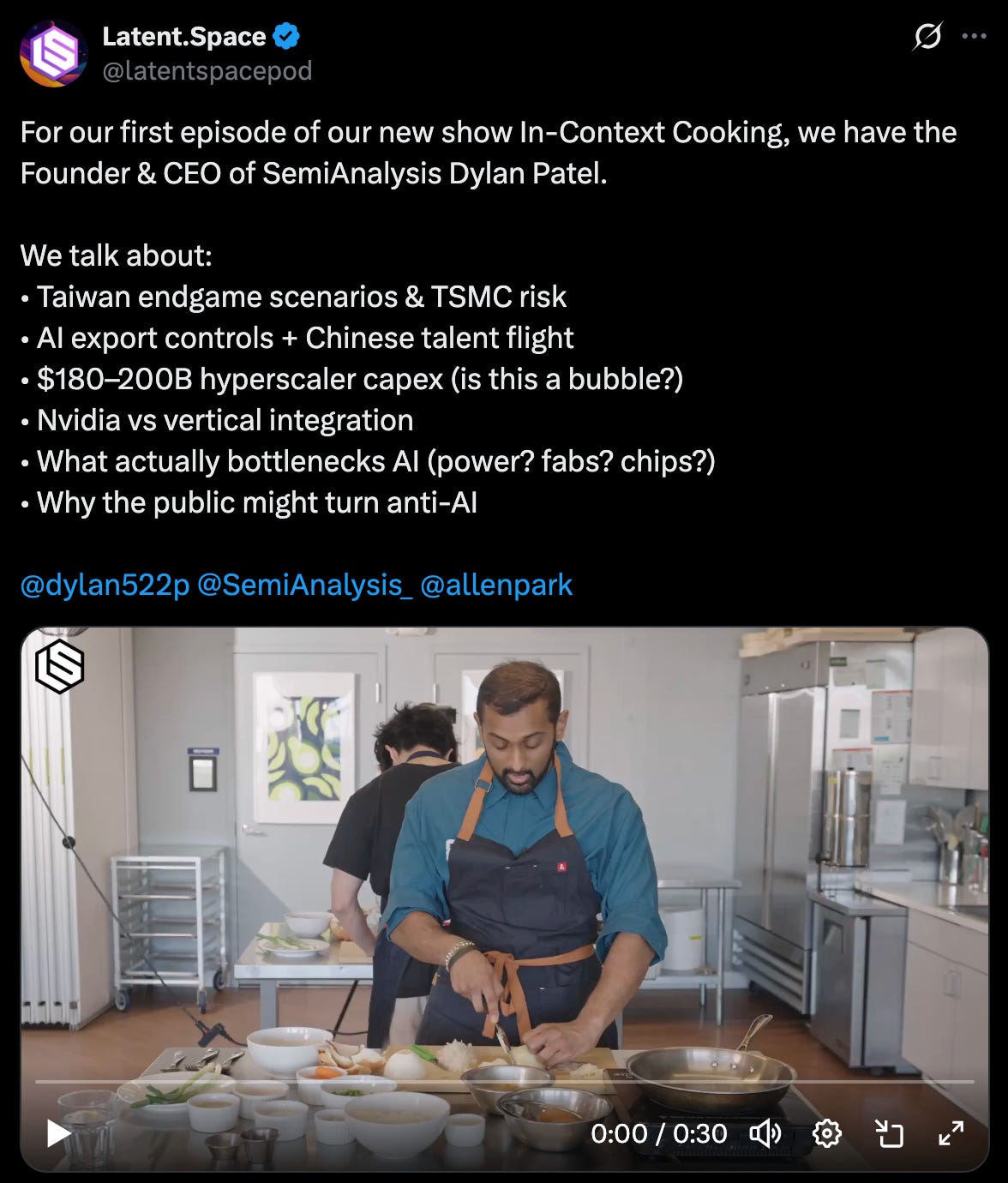
https://x.com/latentspacepod/status/2027132644161716490
We discuss:
- Dylan’s origin story: rural Georgia → Minnesota beekeeper → anonymous chip blogger → building SemiAnalysis into a 60-person global research firm
- Starting a Substack because “I could do better”: anonymous WordPress posts, Silicon Twitter, Doug’s push to charge, and turning consulting into a company
- Taiwan endgame scenarios: status quo vs. KMT vs. DPP vs. political destabilization, why a “soft” takeover is more plausible than invasion, and how U.S. export controls still bind TSMC regardless of party
- Export controls & AI sovereignty: Dario-style hard containment vs. Nvidia-style ecosystem leverage, whether chips or models matter more, and how far behind China really is
- AI escape velocity: why Claude Code adoption jumping from 2% → 4% of GitHub commits in a month matters, and why coding agents are the first real trillion-dollar unlock
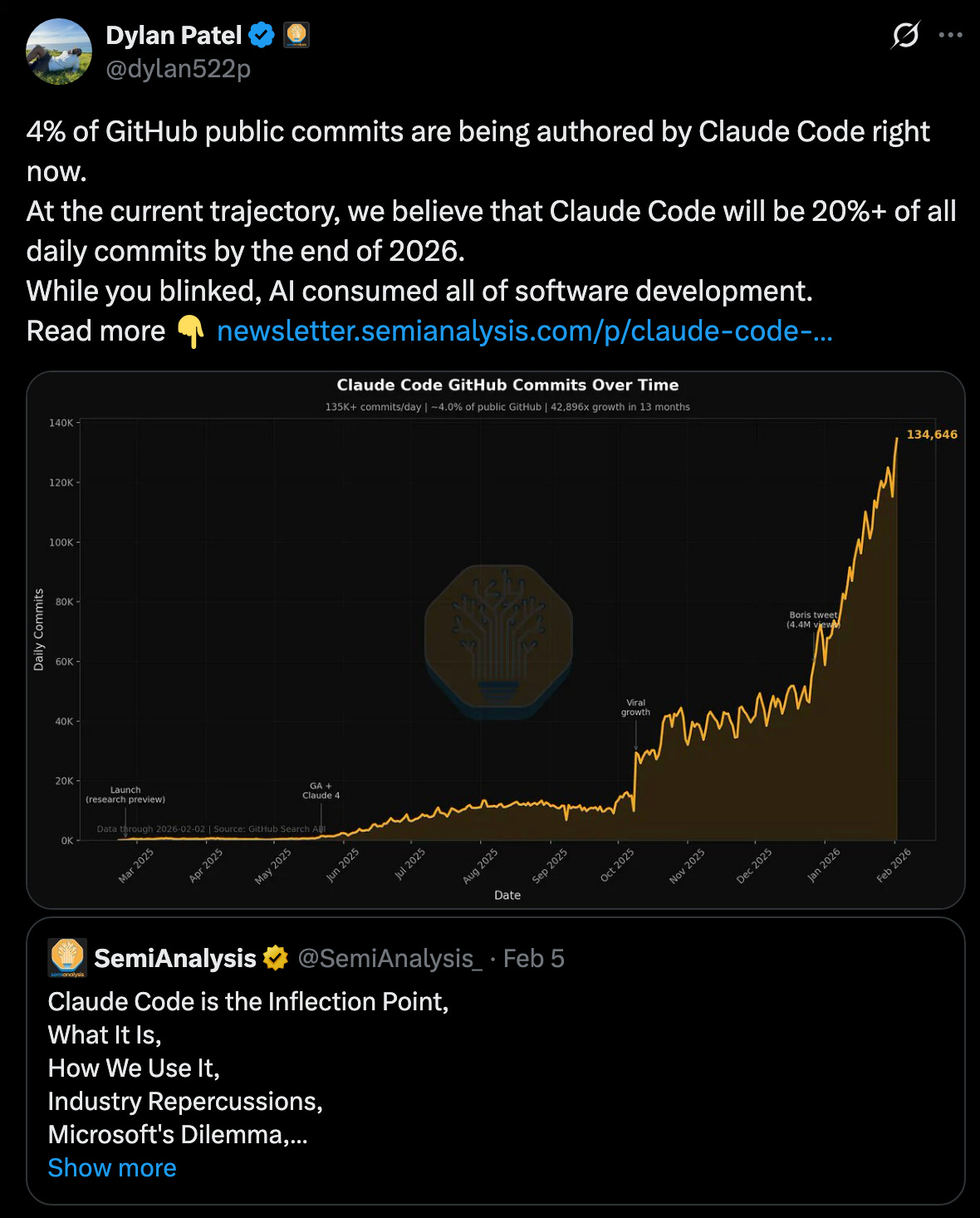
https://x.com/dylan522p/status/2019490550911766763
- The hyperscaler capex explosion: $180B (Google) and $200B (Amazon) in AI infrastructure, why the market hates it, and why Dylan thinks profits disappear by 2027
- The innovator’s dilemma at planetary scale: why Meta, Microsoft, Google, and Amazon must spend or die which is Pascal’s Wager for digital god
- Debt-financed AI clusters: Meta’s Louisiana buildout, leverage as strategy, and what happens when the most profitable companies ever stop caring about free cash flow
- The coming AI backlash: general public hostility, labor displacement, income inequality optics, and why “anti-AI” could become a winning political platform
- Nvidia vs. vertical integration: Jensen Huang’s paranoia, embracing heterogeneity (CPX, GPUs, Groq), and why moats are shallower when everyone has $200B
- Where the real bottleneck is: from CoWoS shortages (2023) to data centers and power (2024–25) back to semiconductor fabs (2026+)
- Energy improvisation: diesel generators, reciprocating engines, breaking grid constraints and why fabs, not data centers, now bottleneck growth
- Capital vs. labor in the AI era: trillions in developer wages, automation of knowledge work, and whether GDP growth will accrue to people or infrastructure
- Fried rice technique: velveting chicken, day-old rice, wok envy on induction, forgetting the soy sauce, and the eternal MSG debate
Show Notes:
- Transistor Radio Episode 43
- Claude Code is the Inflection Point (SemiAnalysis article)
- “This is crazy”: Anthropic CEO blasts AI chip sales to China (Axios)
- Artificial Analysis Coding Index
- “Only the Paranoid Survive” by Andy Grove
—
Dylan Patel
SemiAnalysis
Timestamps
00:00 – Intro
00:16 – Guest Introduction
01:16 – Guessing the Dish
01:46 – From Beekeeper to Semiconductor Powerhouse
03:08 – Starting the SemiAnalysis Blog
05:37 – Part 1: Cooking
05:45 – Velveting Chicken & Talking Taiwan/TSMC Endgames
06:52 – China, Taiwan & Semiconductor Geopolitics
10:57 – AI Talent, Export Controls & U.S. China Tensions
18:19 – Is AI a Bubble? Hyperscaler CapEx Explosion
22:26 – Claude Code, GitHub Commits, & AI Adoption Acceleration
24:54 – Why Markets Hate $200B AI Spending
30:26 – The Hyperscaler Innovator’s Dilemma
38:49 – Who Wins the Chip War? Nvidia vs Vertical Integration
41:52 – Jensen Huang & The Paranoid Founder Advantage
45:32 – What’s the Real Bottleneck in AI Progress?
49:01 – The Semiconductor Fab Constraint
50:55 – Part 2: Tasting
52:01 – Slop vs Technique: Flavor Philosophy Debate
53:02 – Hiring at SemiAnalysis & AI Infrastructure Alpha
54:24 – Final Verdict: Whose Fried Rice Wins?
Transcript
[00:00:00] Dylan Patel: I’m not crying because of the, because of the AI [00:00:03] researchers leaving. I’m crying because Run. I promise. I swear to God, if [00:00:06] Uncle Roger finds this video, I’m gonna cry. It’s about to be [00:00:09] sweeter than Pan to express. [00:00:12] Wait, what do you vote? What do you vote? [00:00:15]
[00:00:15] Allen Park: Hey guys. Welcome to In-Context Cooking, where we [00:00:18] take one dish, taste it, and try to recreate it with [00:00:21] minimal health.
Today we have a very special guest. [00:00:24] The founder and CEO of semi analysis is Dylan [00:00:27] Patel. Welcome, Dylan.
[00:00:27] Dylan Patel: Hello. Thanks for having me.
[00:00:29] Allen Park: Yeah, thank you for being here. [00:00:30] I guess the question to start off is how would you rate [00:00:33] yourself on a scale of one to 10 of one being awful? 10. 10. 10. [00:00:36] 10. Okay. So you’re an amazing cook.
So look, [00:00:39] as a cook, how would you rate yourself on a [00:00:42] scale of one to 10?
[00:00:42] Dylan Patel: Uh, I’d probably like. Five or [00:00:45] six.
[00:00:45] Allen Park: Okay. Five or six is not bad. I feel like you
[00:00:47] Dylan Patel: have maybe three. Maybe three. Lemme, lemme [00:00:48] revise.
[00:00:49] Allen Park: Okay. So low expectations and then [00:00:51] overdelivering, you’re gonna overdeliver, the presentation
[00:00:53] Dylan Patel: is great, just not
[00:00:53] Allen Park: the
[00:00:53] Dylan Patel: [00:00:54] plate.
[00:00:54] Allen Park: Okay. Okay. Honestly, like we will work with three [00:00:57] or five, whatever, but yeah, I guess in front of us, [00:01:00] we’ll, we have a bunch of ingredients. Do you have an idea of what we’re gonna make? I feel like it’s kind [00:01:03] of. Just looking off of it.
[00:01:04] Dylan Patel: Eggs, [00:01:06] eggs, rice, chicken. This is like
[00:01:08] Allen Park: very,
[00:01:08] Dylan Patel: [00:01:09] this is like very like, yeah.
Anything, [00:01:12] anything. But then the right side, you know, like the peas really throw me off.
[00:01:14] Allen Park: [00:01:15] Yeah.
[00:01:15] Dylan Patel: The ginger though. So I and soy sauce. Okay, so this is like fried rice.
[00:01:17] Allen Park: [00:01:18] Okay. Yeah. So today we have [00:01:21] chicken fried rice, which will be recreating, [00:01:24] uh, this is restaurant chicken fried rice. So we’ll try to [00:01:27] recreate it as close as possible.
Mm-hmm. Based off tasting it. So here’s a [00:01:30] spoon for you. Cheers.
[00:01:31] Dylan Patel: Cheers. [00:01:33]
[00:01:34] Allen Park: That was, that was very [00:01:36] good.
[00:01:36] Dylan Patel: I’m shocked it’s still warm.
[00:01:37] Allen Park: Yeah.
[00:01:37] Dylan Patel: I assume this has been sitting here for an [00:01:39] hour.
[00:01:39] Allen Park: Yeah, we nuked it a lot and then kept it [00:01:42] as is. So, yeah. Just to get started, do you wanna introduce yourself? I know [00:01:45] that, um, you went to Minnesota briefly [00:01:48] after, and was it, you were a beekeeper for two years.
You [00:01:51] did a lot of these kind, like side quests. You have like a lot of, [00:01:54] but now you’re, you know, the leading voice [00:01:57] on, um, chips and everything that, you know, whether it be hedge [00:02:00] funds or even people in ai.
[00:02:01] Dylan Patel: So I did live in Minnesota briefly after [00:02:03] college. Um, I’m from rural Georgia. [00:02:06] Um, yeah, we, uh, I did [00:02:09] beekeep for like a, a year and a half basically.
I feel like I’ve just [00:02:12] kind of, sort of went through a lot of life. Uh, just next step, next [00:02:15] step, next step. Doesn’t seem like there’s a clear, immediate path.
[00:02:17] Allen Park: Yeah. [00:02:18]
[00:02:18] Dylan Patel: Uh, looking back, I can spin a narrative like, oh, obviously I [00:02:21] would be doing this. Yeah. Because my interest when I was eight [00:02:24] was this, and my interest when I was 12 was this.
Mm-hmm. But, uh, you know, [00:02:27] like moderating forms related to chips. Yeah. But, you know, I thought it was just like a [00:02:30] serendipitous thing, you know?
[00:02:30] Allen Park: Yeah.
[00:02:31] Dylan Patel: Um, but then [00:02:33] eventually sort of everything culminated. And like [00:02:36] blogging and doing consulting and doing research, [00:02:39] being interested in AI and data science, being interested in chips, and then it all sort of like [00:02:42] culminated in like, oh my God, everything blew up all together.
And, [00:02:45] and so I guess right time, right moment.
[00:02:47] Allen Park: Yeah.
[00:02:47] Dylan Patel: Maybe, [00:02:48] maybe some foresight to have your passion be. The thing that [00:02:51]everyone cares about now.
[00:02:51] Allen Park: Yeah. No, I think it turned out very great. You [00:02:54] know, doing amazing. And rumor has it, [00:02:57] you started your substack because you read Doug’s [00:03:00] and thought you could do a lot better, and he was like, Hey, you should start a substack.
Is that [00:03:03] true or is there more behind that story? [00:03:06]
[00:03:06] Dylan Patel: Yeah, so what, what happened was I, um, I had an [00:03:09] anonymous blog
[00:03:09] swyx: mm-hmm.
[00:03:10] Dylan Patel: On the internet for many years. [00:03:12] Yeah. Uh, I was moderating Reddit and all these things anonymously mm-hmm. [00:03:15] For around like hardware, Nvidia and tele and v this kind of stuff. [00:03:18]And I was posting all this stuff.
And I had an [00:03:21] anonymous Twitter in the sil in silicon Twitter, right? Yeah. Which people on like [00:03:24]teapot and like tech Twitter, don’t understand.
[00:03:25] Allen Park: Yeah.
[00:03:26] Dylan Patel: [00:03:27] Um, and so I was doing this anonymously, [00:03:30] Doug, Doug started posting and I was like, well, this is [00:03:33] interesting, but like, I think I could do it a lot better. And then he is like, dude, why are you [00:03:36] like, why are you like posting on WordPress, right?
Mm-hmm. Like, do it, do [00:03:39] it non anonymously. Do it on Substack and start charging for it. So then, [00:03:42]but then I was like, too, I was like, hi. I was like, I’m not gonna charge for this. I’m so [00:03:45] great. And then, and then one day I was like, you know what? Screw this. I’m gonna start [00:03:48] charging for it. ‘cause Doug told me too many, many times.
Yeah. Um, and [00:03:51] then a few years go by and then Doug, Doug joins the company. [00:03:54] Um, so it was, it was really a great moment that, yeah, full circle. He told [00:03:57] me to, uh, do it because otherwise it might still just be [00:04:00] like a, a niche anonymous blog where I’m still just doing random [00:04:03] consulting rather than actually, uh, you know, a company with 60 [00:04:06] people.
[00:04:06] Allen Park: Gotcha. Okay. So at that time you were still doing consulting, right? [00:04:09] And you just had a separate blog, A thousand million. Well,
[00:04:10] Dylan Patel: it was consulting related to the [00:04:12] blog in the industry.
[00:04:13] Allen Park: Gotcha. Okay. Yeah, that’s amazing. I [00:04:15] guess now we could kind of look at the ingredients and maybe try [00:04:18] little, so here we have ginger, [00:04:21] garlic, carrots, cheese.
We’re gonna, we’re just gonna eat
[00:04:22] Dylan Patel: the whole garlic. [00:04:24]
[00:04:24] Allen Park: Yeah. We could all take a piece. And then this I think [00:04:27] is, and we also have tasting spoons of refund. Try. Um, I think this [00:04:30] is sugar. Yeah.[00:04:33]
So
[00:04:35] Dylan Patel: sweet. [00:04:36] Okay. Let’s see. I really hope this is a salt.
[00:04:38] Allen Park: Okay. It’s [00:04:39] sugar. Yeah. So this is sugar. And we’ll know ‘cause [00:04:42] everything will be laid out for you exactly like this. Um, [00:04:45] so we’ll have to eyeball and we’ll be going fast. This, I don’t think we need taste. [00:04:48] I’m pretty sure this is MSG baking powder.
[00:04:50] swyx: Oh
[00:04:50] Allen Park: [00:04:51] yeah.
So I’m What kind
[00:04:51] Dylan Patel: of, what kind of fried rice does have?
[00:04:53] swyx: M mss [00:04:54]
[00:04:54] Allen Park: g Yeah.
[00:04:54] swyx: Oh yeah,
[00:04:54] Allen Park: that’s, that’s true. We YouTuber [00:04:57] Uncle Roger. Yes. But yeah, we sauce here [00:05:00]baking powder, sugar, onion. Of course. I think this is
[00:05:02] Dylan Patel: one, [00:05:03] if, if he discovers this, he’s gonna roast. The fuck.
[00:05:04] Allen Park: Yeah, he will. But hopefully, [00:05:06] you know, he will give us some grace, [00:05:09] but Okay.
And then eggs. Salt. Yeah.
[00:05:11] Dylan Patel: Wait, is that [00:05:12] the tactic? Intentionally don’t put m ms. G in your rice.
[00:05:14] Allen Park: [00:05:15] Yeah.
[00:05:15] Dylan Patel: So rage bait Uncle Rogers.
[00:05:16] Allen Park: Yeah. This is also short green rice, which [00:05:18] is also a red flag, but we just have it. And this is [00:05:21] day old. So this is the important [00:05:24] ingredient to have the day old, not fresh.
[00:05:25] Dylan Patel: Why does that matter?
[00:05:25] Allen Park: Um, it’s a little [00:05:27] drier and it’ll make the fried rice, just like the [00:05:30] grains be a little more separated compared to being a motion mess. But [00:05:33] yeah. I think we’re good. Are you ready to show off your cooking skills?
[00:05:35] Dylan Patel: [00:05:36] Sure.
[00:05:36] Allen Park: Great. Let’s get started. [00:05:39] Dylan, are you ready to make some [00:05:42] fried rice?
[00:05:43] Dylan Patel: Absolutely.
[00:05:44] Allen Park: Okay. So the first [00:05:45] thing, let’s grab the chicken and then we just need to [00:05:48]marinate it, so, or velvet it rather.
So take the [00:05:51] cornstarch, it’s one of the white powders that we saw [00:05:54] before, and the baking powder. And then [00:05:57] add like a spoonful, maybe half a spoon of corn [00:06:00] starch, um, to the chicken. [00:06:03]And then just a hint of the baking powder. [00:06:06] Um, and so [00:06:09] yeah, once we add that
[00:06:11] Dylan Patel: a pinch or what [00:06:12] are we talking?
[00:06:12] Allen Park: I just did like, yeah, a pinch or like a very [00:06:15] small amount with my spoon.
And then we can add a [00:06:18] little bit of salt and soy [00:06:21] sauce. I think this is salt. Make sure it’s salt [00:06:24] and not sugar.
[00:06:24] Dylan Patel: Yeah.
[00:06:25] Allen Park: Okay. There’s a little bit of salt [00:06:27] and then soy sauce. And so what we [00:06:30] wanna do is we wanna mix it kind of vigorously. [00:06:33] So it just looks like
[00:06:34] Dylan Patel: you said salt and soy sauce,
[00:06:35] Allen Park: olive, [00:06:36] yeah. Um, just like a little bit of each to give it some [00:06:39] flavor because we’re gonna marinate it and yeah, we just wanna [00:06:42] mix it vigorously so that it looks like a slop of chicken.[00:06:45]
But I [00:06:48] guess one question on my mind that you’ve also discussed about [00:06:51] is end game scenarios with araki, [00:06:54] or in this case Taiwan to N-T-S-M-C, I guess, like [00:06:57] have you thought about what that would look like? [00:07:00]
[00:07:00] Dylan Patel: Bro wants to make fried rice and talk about China [00:07:03] politics. Let’s go
[00:07:04] Allen Park: indeed. Very on [00:07:06] topic.
[00:07:06] Dylan Patel: It’s vaguely racist.
[00:07:08] Allen Park: [00:07:09] Just, just vaguely, just vaguely,
[00:07:10] Dylan Patel: vaguely racist. Yeah. [00:07:12] Um, okay, so, so endgame scenarios are, are kind of [00:07:15]insane, right? Mm-hmm. Like, um, there, there’s, there’s a [00:07:18] variety of things that one could, uh, that could happen.
[00:07:20] Allen Park: Yeah.
[00:07:20] Dylan Patel: [00:07:21] Um,
[00:07:21] Allen Park: such as,
[00:07:22] Dylan Patel: so, so in, [00:07:24] in, in some cases, right? It’s like. You know, status quo is [00:07:27] the best, right?
Mm-hmm. Um, you know, no war [00:07:30] happens. I’m done with the, uh, chicken, by the way. Okay. No war happens [00:07:33]
[00:07:33] Allen Park: and just start cutting the onion to like small dices, but continue. [00:07:36]
[00:07:36] Dylan Patel: We have no war, no invasion. There’s no blockade. [00:07:39] Yeah. Sort of status quo. China continues to, China [00:07:42] continues to, you know, industrialize itself with [00:07:45] the industry that Taiwan has, but there’s no, there’s no major [00:07:48] event that occurs.
[00:07:49] Allen Park: Mm-hmm.
[00:07:49] Dylan Patel: You know, that’s sort of [00:07:51] option one, option two, which is what a lot of people. Seem [00:07:54] to, like, think is the best, which is Taiwan actually, like [00:07:57] more stringently claims. It’s independent. [00:08:00] Yeah. At least a lot of like westerners and, and then that seems like the, like [00:08:03] actually a poor option. Um, just because that, [00:08:06] that, uh, potentially causes China to, uh, move, [00:08:09] move much more, um, aggressively on Taiwan.
Mm-hmm. [00:08:12] And sort of like, there’s like another set of options which is like, okay, well [00:08:15] what if, what if China moves close or Taiwan moves closer to China, [00:08:18] um, in a political way. Right? And so like, that’s an [00:08:21] example of that is like, hey, like they elect. The KMT. [00:08:24] Mm-hmm. Um, and the KMT ends up, [00:08:27] uh, winning. So there’s two parties in Taiwan, the D-P-P-K-M-T.
Yeah. [00:08:30] Um, if the DDPP [00:08:33] wins, they’re sort of, they cont they have won for the last decade and they’re sort of [00:08:36] more pro us, more anti-China, more, more [00:08:39] Taiwan independence. Okay. Um, and then there’s sort of like the [00:08:42] last scenario, which is just a full on invasion.
[00:08:43] swyx: Yeah.
[00:08:44] Dylan Patel: Um, [00:08:45] or, or at least a, a, a political [00:08:48] coup or takeover of some sort.
And so there’s like a [00:08:51] variety of options possible. Um, what I think is most [00:08:54] likely, um, is that there is some sort [00:08:57] of political coup or action mm-hmm. [00:09:00] That, um, destabilizes Taiwan in some way.
[00:09:02] swyx: Mm-hmm. [00:09:03]
[00:09:03] Dylan Patel: Um, but doesn’t act doesn’t necessarily [00:09:06] lead to an invasion, a full scale, um, [00:09:09] invasion. And so sort of, this is the best of the both worlds for at least [00:09:12] China.
Right. Like they don’t have to actually enter an [00:09:15] invasion. Yeah. Uh, but they get to continually creep more and more on Taiwan [00:09:18] without actually having to deal with the repercussions of a war. [00:09:21] And subsequent blockades and so on and so forth.
[00:09:23] Allen Park: Mm. [00:09:24]
[00:09:24] Dylan Patel: The like kind of galaxy brain thing for an American [00:09:27] to want is for actually the Taiwanese, um, [00:09:30] government, uh, the pro-US party to lose.[00:09:33]
Right.
[00:09:33] Allen Park: Oh, interesting.
[00:09:34] Dylan Patel: Um, so you want KMT to [00:09:36] win? Yeah. Um, and, and if KMT wins, then that means China will [00:09:39] be placated more. Yeah. And you don’t have Taiwan [00:09:42] fully move into China’s orbit.
[00:09:44] Allen Park: Mm-hmm.
[00:09:44] Dylan Patel: [00:09:45] Um, but you do have the government sort of placated in [00:09:48] China. Yeah. Um, at the same time, uh, even if, even if the [00:09:51] KMT wins, it’s not like TSMC starts disobeying [00:09:54] American export restrictions because mm-hmm.
The way American export restrictions are [00:09:57] upheld is that Taiwan utilizes American banking [00:10:00] systems. American equipment industries. Yeah. And so they’ll [00:10:03] still have to uphold any US export restrictions. So sort of like, you [00:10:06] know, China’s placated by the fact that they have a friendly government in [00:10:09] power, and yet China doesn’t actually have any of the [00:10:12] chips, and the US continues to get to access the chips,
[00:10:14] Allen Park: I guess, for [00:10:15] export controls as well.
So. I know that right now [00:10:18] there’s like stances, for example, Dario right is very [00:10:21] anti, uh, China having access to things. [00:10:24] Um, and I think supposedly one of the top [00:10:27] researchers, SHNU also left because of that. There could [00:10:30] be maybe a lot
[00:10:30] Dylan Patel: of, he left, he left, uh, inro. He
[00:10:32] Allen Park: left one [00:10:33] of the top labs.
[00:10:33] Dylan Patel: Got it. Got it.
[00:10:34] Allen Park: And I guess, do you have opinions on [00:10:36] like, if the US takes how
[00:10:36] Dylan Patel: much of the dice, by the
way?
[00:10:38] Allen Park: You could just cut [00:10:39] a dice like half and then after that just start cutting the [00:10:42]carrots to like a similar size. Do you have any thoughts [00:10:45] on, you know, the danger of maybe a lot of Chinese [00:10:48] talent fleeing due to the very staunchly, [00:10:51] anti-Chinese stance that a lot of these air labs or top [00:10:54] figures may take?
Or do you think this is a, like a non-issue? [00:10:57]
[00:10:57] Dylan Patel: You know, um, I’m, I’m not crying because of [00:11:00] the, because of the AI researchers leaving. I’m crying on dead, I [00:11:03] promise. No, but it would be, it’d be a travesty, right? [00:11:06] If like a lot of like Chinese researchers left. Yeah. Um, [00:11:09] American labs. You know what, I think it’s probably like, like.
Half [00:11:12] or at least a third of researchers [00:11:15] at labs are Chinese.
[00:11:16] Allen Park: Mm.
[00:11:16] Dylan Patel: Um, so obviously there’s [00:11:18] like a level of like, you know, why, why are you anta Don’t antagonize [00:11:21] too much.
[00:11:21] Allen Park: Yeah.
[00:11:22] Dylan Patel: Um, at the same time, [00:11:24] there is a level of like, you know, this is, [00:11:27] this is the greatest, uh, technology to ever, [00:11:30] uh, fall into humanity’s hands.
Mm-hmm. [00:11:33] Um, you know, obviously we think we’re the good guys and by we, I [00:11:36] mean Americans. Um, and so Americans think that they should [00:11:39] control it and maybe, maybe Anthropic thinks they’re the good guys, not [00:11:42] Americans as a whole, um, but whatever the, whatever the [00:11:45] moral justification is, like, you know, whether it’s, [00:11:48] Hey, we’re the good guys and AI’s gonna be super powerful, or, and we’re [00:11:51] the only ones who can steward it, or, Hey, AI would be a great weapon, so let’s [00:11:54] make sure we’re the only one with that weapon.
Um, there’s [00:11:57] certainly some level of control that needs to be had.
[00:11:59] swyx: Mm-hmm.
[00:11:59] Dylan Patel: Right [00:12:00] now the question is like, where do you, where does that control, like start [00:12:03] and stop, right? Mm-hmm. Um, ‘cause one could say, okay, well let’s just [00:12:06] control the chips. Um, uh, or let’s just [00:12:09] control the ai. But then it’s like, okay, well then you let them buy the chips and [00:12:12] they’re able to, they’re able to do everything they want to [00:12:15] do anyways.
[00:12:15] swyx: Yeah.
[00:12:16] Dylan Patel: Right. And this is, this has existed across many [00:12:18] technologies, right. Um, you know, China, China has great [00:12:21] engineering. You only remove one piece of the puzzle. They’re able to [00:12:24] re-engineer that last. A bit of the puzzle, you know, that’s, that’s [00:12:27] one context, right? And so, so that, that is like some [00:12:30] people’s argument, right?
Mm-hmm. So for example, if you look at [00:12:33] Nvidia or you look at like David Sachs, I think [00:12:36] their argument is like, you know, hey, um, you know, [00:12:39] we should not let them have the models, but we should let them have the chips and everything [00:12:42] else because then, uh, they’re still relying on American [00:12:45]ecosystem, American talent, American, um, [00:12:48] you know, technology.
Yeah. American platforms, [00:12:51] event resources. The other argument is like, Hey, like look, this stuff, [00:12:54]um. You know, if, if they don’t have access to our [00:12:57] models, but they have access to our chips, that alone gives them, [00:13:00] um, shoot. [00:13:03] Um,
[00:13:03] Allen Park: yeah.
[00:13:03] Dylan Patel: That alone gives them all the control and [00:13:06] capabilities they need, uh, to, [00:13:09] to basically, um, be on [00:13:12] par or just slightly behind.
Mm-hmm. Right. And so we see that in the current regime [00:13:15] today, right? Yeah. China has effectively. [00:13:18] Uh, great access to chips. Um, not as much, [00:13:21] not completely unfiltered access. Right. They either have to [00:13:24] rent it mm-hmm. Or they have to smuggle it, or there’s some chips that are [00:13:27] allowed. Um, and, and China’s not that far behind, right?
You look [00:13:30] at like Kim k, k two, five, uh, agent [00:13:33] swarms, and it’s like, well, this is like not [00:13:36]worse than Codex by a marginal amount. Maybe 5.3, right? Yeah. But [00:13:39] 5.2, it’s like not worse than Codex by a mar, like a [00:13:42] large amount.
[00:13:42] Allen Park: Mm-hmm.
[00:13:43] Dylan Patel: Um. And so there [00:13:45] is, there is like an argument to be made that like, hey, current [00:13:48] regime ha does not have the US leading in AI by enough.[00:13:51]
[00:13:51] Allen Park: Mm.
[00:13:51] Dylan Patel: Right?
[00:13:51] Allen Park: Mm-hmm.
[00:13:52] Dylan Patel: Um, and, and that’s sort of the argument that [00:13:54] like Ario would make, I think, is that look like current [00:13:57] regime of export controls, China is, is still way [00:14:00] caught up. Uh, China is still, [00:14:03] um, you know, not that far behind. Yeah. Um, and it would be [00:14:06] disastrous if they are, um, in, in, [00:14:09] in, in that, in their eyes, right?
Mm-hmm. And so the question is how does [00:14:12] one, how does one, um. Write that circle. [00:14:15] Right? So one could either a antagonize China [00:14:18] more. Yeah. Ban more things. Um, does that risk a [00:14:21] Taiwan evasion or does that, um, does that lead [00:14:24] to something, say, say catastrophic? Does [00:14:27] that, does that alienate researchers in, in America?
Um, that’s [00:14:30] one argument. Another one is like, well look, let’s, is like, we’ve got like two years, right? [00:14:33] You know, AI 27 bros. Right? Um, and I’m not [00:14:36] fully there, right, in terms of AI 27, but I’m pretty bullish on AI [00:14:39] generally. Yeah. And so then the other agreement is like, look, we only have a few years. [00:14:42] Until the, um, capabilities of [00:14:45] AI accelerate GDP growth.
And it’s, it’s, by the [00:14:48] way, am I cooking something? Am I cutting something else?
[00:14:49] Allen Park: Um, yeah. [00:14:51] Okay.
[00:14:51] Dylan Patel: Oh, you did mash sticks, huh?
[00:14:52] Allen Park: So you, you [00:14:54] can start cutting. We need to mince the garlic and then the ginger, [00:14:57] um, the garlic and the ginger has to be a lot [00:15:00] finer.
[00:15:00] Dylan Patel: Okay.
[00:15:01] Allen Park: Um,
[00:15:02] Dylan Patel: um, I. [00:15:03]
[00:15:03] Allen Park: Yeah, continue.
[00:15:04] Dylan Patel: I felt, I felt a little awkward just [00:15:06] talking and not doing anything.
Okay. And I feel like, [00:15:09]
[00:15:09] Allen Park: so we’re just cutting all the vegetables
[00:15:10] Dylan Patel: already. Yeah. Yeah. Sounds good. [00:15:12] Sounds good. The one stance that like a lot of like, [00:15:15] um, folks have is that, you know Yeah. Like, let’s, let’s [00:15:18] be more anti-China, um, [00:15:21] ‘cause there’s only a few years left. Mm-hmm. [00:15:24] And so, like, you know, until like super powerful AI [00:15:27]systems and those super powerful AI systems will make next generation AI [00:15:30] systems, right?
Mm-hmm. And that’s like. That’s like a lot of [00:15:33] the, um, argument that like, let’s say the [00:15:36] Dario’s of the world would make. Yeah. Um, and I’m sympathetic to that [00:15:39] argument to some degree as well. Right. Okay. Um, if we start looking at [00:15:42] like, Hey, um, this [00:15:45] year Google’s spending two, uh, Amazon’s spending $200 [00:15:48] billion.
Google’s spending $180 billion. On, on [00:15:51] AI infrastructure primarily. Right?
[00:15:52] Allen Park: Yeah.
[00:15:52] Dylan Patel: Um, this is, [00:15:54] you know, four x what they were doing just not too long ago.
[00:15:56] Allen Park: Mm-hmm. [00:15:57]
[00:15:57] Dylan Patel: Um, and if they get returns on that of any degree, then we’re talking [00:16:00] about trillions of dollars of economic value Yeah. Being added, [00:16:03] um, in, in just the next, uh, [00:16:06] handful of years.
[00:16:06] Allen Park: Yeah.
[00:16:07] Dylan Patel: And so, you know, the, the, the [00:16:09] risk here is that like, okay, um, whatever AI [00:16:12] is capable of doing, it’s obviously adding hugely to, to the [00:16:15] economy and. You wanna do [00:16:18]anything and everything you can to slow China down. We’ve never had an exp explos [00:16:21] explosive growth like this. Mm-hmm. We’re on the cusp of it.
Right, right. Right [00:16:24] now we only have like, you know. Um, you know, the AI industry [00:16:27] maybe does 50 bill of revenue. Mm-hmm. Um, you know, [00:16:30] across and, but like, we’re seeing it explode. Right. [00:16:33]Philanthropics, you know, adding two, 3 billion of revenue a month now. Mm-hmm. Versus they were [00:16:36] just adding a few hundred million of revenue a month earlier.
Um, so [00:16:39] clearly we’re in the takeoff period. Yeah. Um, and so, [00:16:42] so the argument there is that like, let, let’s just limit them [00:16:45] completely.
[00:16:45] swyx: Mm-hmm.
[00:16:45] Dylan Patel: Um. So they don’t end up [00:16:48] with, um, all the, all these super powerful AI systems. [00:16:51] I, I, I, I’m, I’m, I’m a little bit like, you know, [00:16:54] it’s, it’s hard to rationalize, you know, in every specific like [00:16:57] argument just because like you.
You know, I could, I could, [00:17:00] I could argue, or I could steelman, uh, any of the arguments. Right? [00:17:03]Yeah. Actually. Okay. No. Maybe, maybe, maybe China [00:17:06] is, um, should be sold our chips because at [00:17:09]the end of the day, they’re still relying on our chips now for their AI [00:17:12] systems.
[00:17:12] Allen Park: Mm-hmm.
[00:17:12] Dylan Patel: Um, and, and then they have less incentive to invade [00:17:15] Taiwan.
Yeah. And if they invade Taiwan, then, you know, all of a sudden, [00:17:18] um, the whole party stops and we can’t do anything. And when you think [00:17:21] about what’s the capability of, uh, China versus [00:17:24] the US to, um. [00:17:27] To, to have a, a vertical supply chain [00:17:30] in, um, chips or AI or in [00:17:33] really anything. Mm-hmm. Uh, the China, China has by far the most [00:17:36] advanced, uh, supply chain in semiconductors if you [00:17:39] just look at China itself.
Mm-hmm. Right. In which case, like [00:17:42] if the, the lifeblood of AI is compute to some extent, [00:17:45] uh, to a large extent, then China would win if we didn’t [00:17:48] have Taiwan. Right?
[00:17:49] Allen Park: Yeah.
[00:17:49] Dylan Patel: And maybe that timescale would be way [00:17:51] longer because Taiwan is so far ahead in the production capacity. [00:17:54] And China doesn’t have the equipment ecosystem like the rest of the [00:17:57] world does.
Um, but at the end of the day, that’s, that’s [00:18:00] exactly like sort of the argument that that one would make [00:18:03] is his hay. Like, you know, if you push China too [00:18:06] far, now they might invade, um, [00:18:09] they might invade Taiwan and that ends up with. [00:18:12] With this catastrophic scenario.
[00:18:13] Allen Park: Yeah. Double clicking on something you [00:18:15] mentioned already with these big AI labs and even [00:18:18] hyperscalers, somewhat overextending on, [00:18:21] um, future spend with these data centers.[00:18:24]
Would there ever be something that would prompt [00:18:27] you to get a little concerned? ‘cause it seems right now we’re in a very, [00:18:30] um, acceleration type of moment for AI where [00:18:33] still adoption for what even like cloud code and a lot of [00:18:36] these great tools, um, isn’t as mainstream, but. Are [00:18:39] there things that if you see happening in the [00:18:42] next, what, six months or year that would kind of [00:18:45] concern you in terms of where the future lies [00:18:48] of these companies maybe overextending a little too much and [00:18:51] whether concerns of being in a bubble may [00:18:54] actually have some merit to it?
[00:18:55] Dylan Patel: I mean, I think, I think sort of, not [00:18:57] answering your question, but talking about something else I wanna talk about Yeah. Which I’d love to do. [00:19:00] Um,
[00:19:01] Allen Park: that’s fair.
[00:19:01] Dylan Patel: Is, is sort of like you mentioned [00:19:03] like these doomsdayers and these believers. I think the [00:19:06] biggest risk is actually just like the general public hates ai.
[00:19:08] Allen Park: Mm.
[00:19:08] Dylan Patel: [00:19:09] Right. Um, you know, I think, I think if you go literally [00:19:12] anywhere, the general public absolutely [00:19:15] hates AI so much. They, they have [00:19:18] literally no, um, [00:19:21] they don’t, yeah. They, I mean, like, you know, you go to your [00:19:24] random artist and they like hate ai. You go to your random, like person in [00:19:27] rural America, they’re like, screw ai.
It’s like, you know, taking [00:19:30] all the water. Um, you know, completely like nonsense [00:19:33] arguments. Yeah. But like, it doesn’t matter. [00:19:36] Um, so when you look across the ecosystem, you’ve got that [00:19:39] problem.
[00:19:39] swyx: Mm-hmm.
[00:19:40] Dylan Patel: Um, and so like, and then you’ve got the [00:19:42] doomsdayers, right? There’s also the general public, which like doesn’t quite understand [00:19:45] ai or maybe they do, um, you know, and, [00:19:48] and, and they’re just like so worried about ai, like taking, taking her [00:19:51] gers and like all sorts of other things.
Right. Um, [00:19:54] and so taking Gers, I think, I think that’s, that’s [00:19:57] another aspect of this that’s like quite interesting is, um. [00:20:00] You know, general public hates it. Um, yeah. The [00:20:03] doomsdayers, you know, look, I’m, I’m, I’m, I’m a, I’m a bit of a [00:20:06] to, uh, live in the moment person to like, [00:20:09] think, you know, Hey, what exactly is alignment mean?
And, [00:20:12] and does AI kill us all? Um, you know, [00:20:15] obviously there’s huge risk to that. Mm-hmm. Uh, that’s not what I’m [00:20:18] an expert in, so I don’t, I don’t really care to opine too [00:20:21] much. Um, but, [00:20:24]um. A as as far as like, you know, is is it a [00:20:27] bubble? Are people, are people, are we, are we doing too much? Mm-hmm. Like, [00:20:30] what’s going on?
Are you good? [00:20:33] Um, is there a bubble? Are we doing too much? Um, [00:20:36] you know, the question is, um, [00:20:39] you know, if, if AI model progress slows down, then of [00:20:42] course we’re in a bubble. Yeah. That’s, that’s obvious. Um, [00:20:45] but you know, the, the, the way that progress is accelerating, [00:20:48] uh, so fast, right? Um, you know, you, you, you [00:20:51] see it, uh, month on, month on month, right?
I mean, you [00:20:54] know, the new models are coming out every month, every week, almost [00:20:57] it feels like nowadays. Yeah. Um, or new capabilities, right? Just think [00:21:00] about like, like this year so far, right? [00:21:03]Um, you know, obviously Claude 4.5 came out and Claude [00:21:06] Code came out, uh, last year. [00:21:09] But adoption really uptick in the beginning of this year.
[00:21:12] Um, and so we saw a huge uptick, uh, just in this [00:21:15] month, uh, just in January. It went from, uh, 4% [00:21:18] of um, or 2% of, uh, [00:21:21] commits on GitHub to 4% of GitHub commits were done by [00:21:24] cloud code. Yeah, right. That does not mean, you know, a lot of people use cloud code without [00:21:27] having cloud commit for them. So you’re like, you’re talking about [00:21:30] like, or, and then they use Codex, they use cognition, they use, you know, [00:21:33] or sorry, Devon, they use all these other platforms.
They use GitHub, [00:21:36] copilot, they use Codex. You know, we’re probably at 10% or so of total [00:21:39] code as being committed, um, or written by ai, if not [00:21:42] more.
[00:21:42] swyx: Mm-hmm.
[00:21:42] Dylan Patel: Um, but at least for Claude code itself, it went from two to [00:21:45] 4% in one month.
[00:21:46] swyx: Mm-hmm.
[00:21:46] Dylan Patel: Right. Um, [00:21:48] this, this acceleration is, is like. [00:21:51] I think it’s the thing that we’ve all been waiting for.
Yeah. Um, ‘cause [00:21:54] like find people who are using chat GPT. That’s great. Find people who are [00:21:57] using like image gen. That’s great. These were not like things that [00:22:00] add trillions of dollars to the economy. These are social networks. These [00:22:03] are like, you know, he’ll help me on my, uh, homework. These are like, [00:22:06] chill things.
[00:22:06] Allen Park: Yeah.
[00:22:07] Dylan Patel: Um, but now we’re, we’re in the [00:22:09] stage where it’s like, no, no, no. Like these are trillions of dollars of, [00:22:12] uh, economic value that could be added. Um, and if [00:22:15] you think about worldwide software developer wages, $2 trillion in [00:22:18] wages, you end up with, uh, a pretty [00:22:21] incredible amount of, um, [00:22:24] spend that could happen.
Um, I feel like it’s my [00:22:27] worst interview ever because I’m, I’m, I’m like so focused on [00:22:30] chopping garlic and not cutting up off my fingers. Um. [00:22:33] I wonder if people are gonna like, trash me for my [00:22:36] lack of claw like grip. Because like I’ve tried to [00:22:39] do it, but then I’ve failed and I’ve done like more dangerous cutting [00:22:42] grips.
[00:22:42] Allen Park: Mm-hmm.
[00:22:43] Dylan Patel: I, I do wonder how, how, [00:22:45] how vicious is, is the audience.
[00:22:47] Allen Park: We’ll see. [00:22:48]
[00:22:48] Dylan Patel: Um,
[00:22:49] Allen Park: but yeah, you’re talking about claw coded [00:22:51] option and GitHub commits to being significantly more, especially [00:22:54] this, uh, past like couple months [00:22:57] and like the, uh, [00:23:00] value that cloud code will have towards the economy. Do you wanna [00:23:03] elaborate more on that or was that a finished
[00:23:04] Dylan Patel: Yeah, yeah.
I mean, I think, I think [00:23:06] like there’s, there’s quite a bit of, [00:23:09] um, I’m definitely claw gripping now. You know, [00:23:12] this is, I gotta make up for it now that I’m cognizant. [00:23:15] Um, I. [00:23:18] So I think, I think, um, the adoption [00:23:21] of AI has been so accelerated over the last [00:23:24] month. Yeah. You know, just, just think about everything that’s happened in the last month.
We’ve had [00:23:27] Claude Code happen, we had Claude Bot, we had, uh, malt [00:23:30] book. Uh, now we have, uh, you know, we had Kim K 2.5 [00:23:33] swarms. We had Codex, um, [00:23:36] 5.3, which is, you know, a significant step up as well. [00:23:39] Um, and seems better in some specific areas. [00:23:42] And, and these are, these are, there’s so many areas, right? Mm-hmm. And it’s like, [00:23:45] um, at least internally, like at my company, we’ve, we’ve [00:23:48] completely, um, flipped over, right?
Like about, about a third [00:23:51] of the company’s engineers, about a third of the company’s hedge fund people, and about a third of the company is [00:23:54] like passionate individuals. Mm-hmm. Um, you know, and so [00:23:57] the X hedge fund people, they are, they’re all in on cloud code [00:24:00] now too, right? They scrape data, they do pro, they do financial [00:24:03] modeling, they do proforma financial modeling with cloud [00:24:06] code as the assistant.
Um, and so there’s a variety [00:24:09] of like, sort of like, um, [00:24:12] you know, I think, I think like we, we’ve hit like sort [00:24:15] of escape velocity and all these things. And so, [00:24:18] you know, over the last month or over the last two weeks, we’ve had, [00:24:21] um, you know, the hyperscalers report earnings. Mm-hmm. [00:24:24] Um, and everyone’s stocks have gone down, right?
Mm-hmm. Um, [00:24:27] Google announced 180 billion of CapEx. The stock went [00:24:30] down and then Amazon announced 200 billion of CapEx and their stock went [00:24:33] down, like, I wanna say like 10%. So the market hates it, [00:24:36] but they don’t realize, like, you know, these [00:24:39] CapEx decisions are because they see the light at [00:24:42] the end of the tunnel tunnel, if you will.
Right? Yeah. Um, the amount of, [00:24:45] the amount of adoption is just insane. So now that we’ve had these [00:24:48]companies like report earnings and they disclose what their plans are for the [00:24:51] year, and they’re much higher than almost anyone predicted. [00:24:54] Mm-hmm. Um, you, you, you’ve got, you’ve got. [00:24:57] You’ve got the market just hating it.[00:25:00]
Um, yeah. And, and, and, [00:25:03] and, and so that, that, that brings like this interesting conundrum, [00:25:06] which is that like, okay, the market is mad, they’re spending all this money [00:25:09] on compute CapEx. Yeah. But these companies know much better than, [00:25:12] than than you, right? Like, and by you I mean the [00:25:15] investor. Yeah. Right. Um, in reality, they’re spending this much because [00:25:18] they see insane amounts of demand, [00:25:21] right?
Mm-hmm. Um, you know, and Andro doesn’t just add [00:25:24] $2 billion of revenue in one month. Uh, you [00:25:27]know, with without having, you know, huge demand. [00:25:30] Mm-hmm. Um, and they’re doing it at positive margins, right?
[00:25:32] Allen Park: Yeah.
[00:25:32] Dylan Patel: [00:25:33] Um, and they’re doing it, you know, and, and, and when they go to everyone, they’re like, go look guys. [00:25:36] We need more compute.
We need more compute. We need more compute. Um, and [00:25:39] so, so it, it’s, it’s, you know, after three years [00:25:42] straight of everyone of the AI lab saying we need more compute, [00:25:45] the hyperscalers are now seeing it’s not just we need more compute. ‘cause [00:25:48] we wanna train bigger models and we wanna do more research. It’s [00:25:51] actually, we need more compute because we need, we need to serve our users, [00:25:54] right?
Mm-hmm. Um, we need to add hundreds [00:25:57] of millions of dollars or billions, actually billions of dollars of [00:26:00] compute, right? If philanthropic added two and a half billion of revenue, um, [00:26:03] and their gross margin is 40%. They added like one and a half billion dollars [00:26:06] of compute in one month. Mm-hmm. Right. To just to serve [00:26:09] that.
You extrapolate that line out a little bit and you’re like, holy [00:26:12] crap. You know, they actually need hundreds of billions of dollars of [00:26:15] compute. Um, okay, fine. Well we, we need to build this. [00:26:18] All right. ‘cause it’s a front run of, you know, you build it and then they can rent it. [00:26:21]
[00:26:21] Allen Park: Yeah.
[00:26:21] Dylan Patel: Um,
[00:26:22] Allen Park: so the bet here is [00:26:24] that growth will continue to accelerate and the amount of.
[00:26:27] Money that Anthropic and open Eye makes will just continue to go up. [00:26:30]
[00:26:30] Dylan Patel: Yeah, exactly. And, and, and, and I don’t, [00:26:33] you know, like, look, the party can stop at some point, like, you know, [00:26:36] that’s for sure. Mm-hmm. Um, at any point, you know, I think my [00:26:39]favorite thing was, uh, I, I tweet, I tweeted about like, people were [00:26:42] like, oh, who expected this CapEx?
And then I was like, [00:26:45] well, we did. Right? And then someone replies, [00:26:48] the whale watcher told you that you’re gonna see whales. Wow. [00:26:51] Surprising. I was like, wow, that’s a pretty good, uh, [00:26:54] uh, reply to me, you know? But like, anyways, like, it’s like, yeah. [00:26:57] You know, you know, obviously, obviously I’m the whale watcher here.
[00:27:00] Um mm-hmm. You know, we see the CapEx coming. [00:27:03]
[00:27:03] Allen Park: Yeah.
[00:27:03] Dylan Patel: So the market doesn’t like it, but it’s clearly obvious that it’s [00:27:06] needed. Mm-hmm. Um, and, and, and now the [00:27:09] discussion is sort of like, you know, I think a couple years ago I said the [00:27:12]hyperscalers would have no free cash flow. Yeah. Right. IE they would [00:27:15] not have any, uh, they would not be generating profits and [00:27:18] buying back their stock in a short amount of time.
[00:27:20] Allen Park: [00:27:21] You could also transfer your onions and some veg to the [00:27:24] bull white bull on your left, I believe, or right.
[00:27:26] Dylan Patel: [00:27:27] Yes. Um,
[00:27:27] Allen Park: so on my cutting board, I just have garlic, ginger in the green [00:27:30] part of the scallions. So leave the green part for a [00:27:33] garnish for later. So just keep it on. [00:27:36] Um, I guess at what point do [00:27:39] you think the market would [00:27:42] be, um, satisfied or okay with [00:27:45] this?
[00:27:45] Dylan Patel: I think, I think the market is gonna get really mad [00:27:48] at the hyperscalers. Um, they haven’t really yet. Um, [00:27:51] mm-hmm. But we saw the, we saw the signs of it at the beginning, uh, [00:27:54] about mid last year. Right.
[00:27:55] Allen Park: Okay.
[00:27:55] Dylan Patel: Um, for example, [00:27:57] Oracle peaked when they announced within a week after [00:28:00]announcing, uh, the open A, that they’re gonna do, you know, 300 plus [00:28:03] billion dollars of deals with, uh, open ai.
[00:28:05] Allen Park: Mm-hmm. [00:28:06]
[00:28:06] Dylan Patel: Um, and the market really, [00:28:09] uh, peaked, uh, around then. [00:28:12]
[00:28:12] Allen Park: Mm-hmm.
[00:28:14] Dylan Patel: Um, [00:28:15] and, and, and then like since then they’ve gone down. [00:28:18] And, and like other darlings that were like doing AI [00:28:21] infrastructure like, uh, have also peaked, right? Mm-hmm. [00:28:24] So now we’ve got this like, interesting, um, [00:28:27] conundrum where now the [00:28:30] hyperscalers are starting to say how much CapEx they’re gonna do.
[00:28:33] Yeah. Um, [00:28:36] and, and, and, and so when we, when we think about like, Hey, [00:28:39] what’s gonna, what’s gonna end up happening is. You know, these hyperscalers are [00:28:42] gonna keep spending, right? Mm-hmm. What is their biggest advantage? Right? [00:28:45] It’s, it’s, it’s that they can build the most infrastructure in the world. Mm-hmm. [00:28:48] They’ve built the organization to build, uh, infrastructure [00:28:51] faster than anyone else.
Um, [00:28:54] wow. This like, got kicked, cooked super fast.
[00:28:56] swyx: Show the [00:28:57] cameras. [00:29:00]
[00:29:00] Dylan Patel: It’s just eggs, bro. [00:29:03] Um, I just don’t generally use an, uh, induction, right? [00:29:06]
[00:29:07] Allen Park: Yeah. They heat up very fast. [00:29:09] So just as a heads up.
[00:29:10] Dylan Patel: Yeah. Um, so, so, [00:29:12] so the hyperscalers are, you know, have been the most profitable [00:29:15] companies to ever exist in the Humana, in humanity.
Mm-hmm. Right? Whether [00:29:18] it’s meta through ads, uh, whether it’s, [00:29:21] um, Google through search, uh, whether it’s Amazon through [00:29:24] AWS and, uh, amazon.com, [00:29:27] um, so on and so forth, right. Uh, Microsoft [00:29:30] through, you know, windows Plus Office 3 6 5 plus [00:29:33] Azure, right? Um, they, they’ve all been the most profitable [00:29:36] companies. Am I, am I gonna continue with the onions and such?
[00:29:38] Allen Park: Yeah. [00:29:39] Or so are the eggs cooked?
[00:29:40] Dylan Patel: Yeah.
[00:29:40] Allen Park: Okay. You could put the [00:29:42] eggs on the plate.
[00:29:43] Dylan Patel: Yeah. Already done.
[00:29:44] Allen Park: Okay. And [00:29:45] then now add some oil and then Yeah. Add all the veggies.
[00:29:47] Dylan Patel: Yeah.
[00:29:47] Allen Park: Yeah. [00:29:48] But make sure not to add too many onions. ‘cause there’ll probably be [00:29:51]more onions and carrot’s. Another thing just try to have like an [00:29:54] even balance of vegetables.[00:29:57]
[00:29:57] Dylan Patel: Yeah.
[00:29:58] Allen Park: Yeah. And [00:30:00] then, yeah. So just get some color [00:30:03] on the veg.
[00:30:04] Dylan Patel: Um, do you, do you, uh, tend [00:30:06] to, um. Do you tend to do the [00:30:09] carrots and onions at the exact same time?
[00:30:10] Allen Park: Yeah. Like doing ‘em [00:30:12] all together is probably just easiest. So [00:30:15] carrots, onions in the white part of the scallions. [00:30:18]
[00:30:18] Dylan Patel: Okay. Um,[00:30:21] [00:30:24]
so, [00:30:27] so the hyperscalers have been the most profitable companies ever?
[00:30:29] Allen Park: Yeah. [00:30:30]
[00:30:30] Dylan Patel: Um, and now they’re, they’re about to face like sort of this like. [00:30:33] Interesting conundrum, right? Yeah. There’s a huge innovator’s dilemma here, [00:30:36] whether it’s, you know, meta, meta doesn’t own the [00:30:39] platform. Um, and, uh, wherever [00:30:42] people’s eyeballs are is where people are gonna like, [00:30:45] uh, spend their cash.
Um, or in, [00:30:48] in, in the case of Google, right? Hey, AI can disrupt search. Or in the [00:30:51] case of Microsoft, right? Productivity, uh, suite [00:30:54] is where they make all the money, right? Mm-hmm. Um, office 3, 6, 5, [00:30:57]windows, et cetera. But things like cloud code, quad bot, [00:31:00] and, and future iterations of it, just take a little imagination, we’ll [00:31:03] displace those immediately.
Mm-hmm. Right? Um, you know, you’ve [00:31:06] got like, you know, same with Amazon, right? AWS is, is. [00:31:09]Is, is a general purpose, [00:31:12] uh, you know, AI infrastructure or sort of infrastructure [00:31:15] play. Uh, but there’s a lot of risk with everything [00:31:18] else, um, with everyone getting disrupted quite heavily. Mm-hmm. And [00:31:21] so they’ve got this, this, this dilemma where they could get, um, [00:31:24] disrupted heavily.
Um, at the same time, they’ve also got, [00:31:27] uh, they’ve also got this challenge [00:31:30] with regards to. Um, potentially, you [00:31:33] know, being beaten, right? So they, they have to invest hugely in ai. They have [00:31:36] to try and win ai.
[00:31:37] swyx: Yeah.
[00:31:37] Dylan Patel: Um, and if they don’t, [00:31:39] then they’re really, really screwed. Um, but right [00:31:42]now the demand for AI is insatiable.
[00:31:44] swyx: Mm-hmm.
[00:31:44] Dylan Patel: And they [00:31:45] can get pretty good returns just by building infrastructure and renting it out [00:31:48] to the labs. Uh, but they’ll obviously get way better returns [00:31:51] if they, uh, if they have AI models in house. So they need to [00:31:54] spend like crazy to do this. Um, and [00:31:57] at the same time, um, if everyone else is like, sort of, it’s [00:32:00] like, um, it’s Pascal’s wager, right?
[00:32:03] Mm-hmm. Um, if I don’t spend like crazy and others do I [00:32:06] lose, right? If I don’t believe in God, right, digital God coming [00:32:09] then and others do and it happens, then I’m, I’m a loser, [00:32:12] right? Yeah. Um, and so they both got this [00:32:15] dilemma and the only solution is I have to spend more and [00:32:18] more, you know, until, uh, uh, to, to keep up in the [00:32:21] race.
And so, you know, this year’s announcements of [00:32:24] $180 billion of CapEx from Google and 200 from [00:32:27]Amazon, right. Which is, you know, four x what they were just [00:32:30] doing a few years ago.
[00:32:31] swyx: Mm-hmm.
[00:32:31] Dylan Patel: Um, is, is [00:32:33] quite incent intense. Uh, but in addition to that, [00:32:36] we’re looking at um, we’re looking at this like [00:32:39] skyrocketing in the next few years.
Yeah. Right. There’s no [00:32:42] reason why Google will have any profit, uh, in [00:32:45] 27 at all. Right? In terms of cash flow. They will just spend [00:32:48] every dollar they make on, on AI infrastructure. [00:32:51] Um, and I think that’s at least my belief, um, and, [00:32:54] and AI models and so on and so forth, because that, that’s basically my [00:32:57] belief and the market hasn’t fully woken up to this [00:33:00] realization.
Mm-hmm. Um, we’ve been saying it for a couple years. Um, in fact, we [00:33:03] even did a piece, uh, last year, which was like, how [00:33:06] much debt can the hyperscalers borrow? Right? Because at some point, [00:33:09] you know, they, they have to lever up on building [00:33:12] capacity, right? So an example of this is meta, right? Meta is not [00:33:15] as large as Google and Amazon, but they wanna be in the race.
[00:33:17] Allen Park: Yeah.
[00:33:17] Dylan Patel: [00:33:18] Um, and so they’ve already started taking some debt on to build their data center. [00:33:21] Now, obviously they have a tremendously profitable business that could pay it [00:33:24] off. Uh, they just have to stop spending the money, [00:33:27] um, on CapEx, that it’s not necessary. Uh, but, but Zuckerberg has [00:33:30]woken up and fully realizes this.
How much do I wanna cook the onions [00:33:33] and carrot carrots?
[00:33:33] Allen Park: Just get some color on it and then just put it [00:33:36] in the plate with the eggs. [00:33:39]
[00:33:39] Dylan Patel: Okay? Um. And so, so you’ve [00:33:42] seen some hyperscalers, such as, uh, meta, [00:33:45]they’ve, they’re already taking debt on for their largest AI cluster in [00:33:48] Louisiana.
[00:33:48] Allen Park: Mm-hmm.
[00:33:49] Dylan Patel: Um, you know, they’re taking like $40 billion of debt [00:33:51] on for that.
Uh, but they’re in the market to take on much, much [00:33:54] more. Um, Google and Amazon haven’t taken on debt yet for AI [00:33:57] infrastructure, but they will. Right. Mm-hmm.
[00:33:58] Allen Park: Yeah.
[00:33:59] Dylan Patel: And, and so [00:34:00] I think, I think people really realize and [00:34:03] panic and, and, and probably this year when [00:34:06] they see all of these companies doing exactly this, right?
Yeah. Are they [00:34:09] gonna, you know, what ends up happening, uh, when the most profitable [00:34:12] companies that have ever existed, which have compounded at double [00:34:15] digits for, uh, over a like a decade and a half [00:34:18]
[00:34:18] Allen Park: Yeah.
[00:34:18] Dylan Patel: Now all of a sudden say, we’re not gonna, we don’t care about profit [00:34:21] anymore. We’re just building pixie dust, right?
... [Content truncated due to size limits]