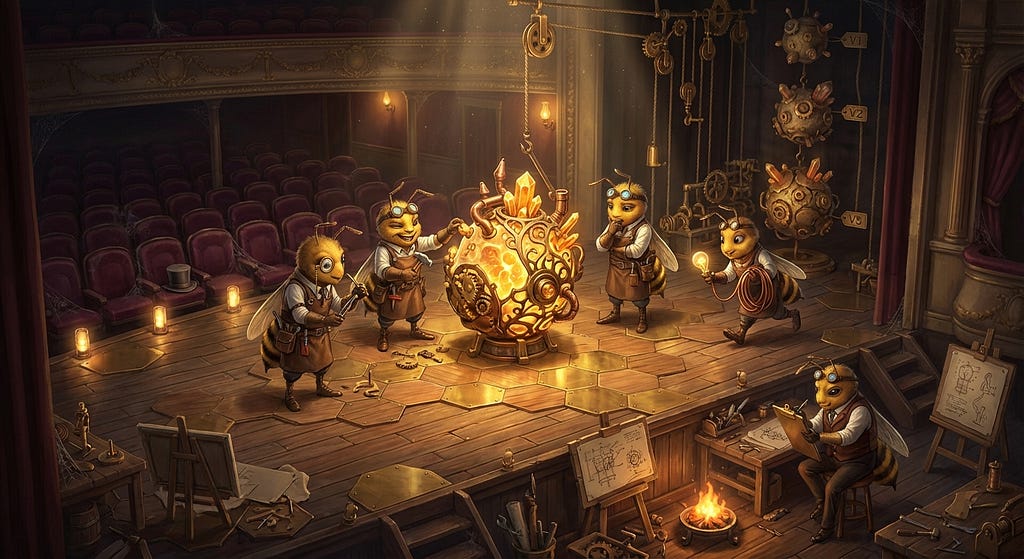
As you’ve probably noticed, something is happening over at Anthropic. They are a spaceship that is beginning to take off.
This whole post is just spidey-sense stuff. Don’t read too much into it. Just hunches. Vibes, really.
If you run some back-of-envelope math on how hard it is to get into Anthropic, as an industry professional, and compare it to your odds of making it as a HS or college player into the National Football League, you’ll find the odds are comparable. Everyone I’ve met from Anthropic is the best of the best of the best, to an even crazier degree than Google was at its peak. (Evidence: Google hired me. I was the scrapest of the byest.)
Everyone is gravitating there, and I’ve seen this movie before, a few times.
I’ve been privileged to have some long, relatively frank conversations with nearly 40 people at Anthropic in the past four months, from cofounders and execs, to whole teams, to individuals from departments across the company: AI research, Engineering, GTM, Sales, Editorial, Product and more. And I’ve also got a fair number of friends there, from past gigs together.
Anthropic is unusually impenetrable as a company. Employees there all know they just need to keep their mouths shut and heads down and they’ll be billionaires and beyond, so they have lots of incentive to do exactly that. It’s tricky to get them to open up, even when they do chat with you.
But I managed. People usually figure out I’m harmless within about 14 seconds of meeting me. I have developed, in my wizened old age, a curious ability to make people feel good, no matter who they are, with just a little conversation, making us both feel good in the process. (You probably have this ability too, and just don’t know how to use it yet.)
By talking to enough of them, and getting their perspectives in long conversations, I have begun to suspect that the future of software development is the Hive Mind.
Happy But Sad
To get a proper picture of Anthropic at this moment, you have to be Claude Monet, and paint it impressionistically, a big broad stroke at a time. Each section in this post is a stroke, and this one is all about the mood.
To me it seems that almost everyone there is vibrantly happy. It has the same crackle of electricity in the air that Amazon had back in 1998. But that was back in the days before Upton Sinclair and quote “HR”, so the crackle was mostly from faulty wiring in the bar on the first floor of the building.
But at both early Amazon and Anthropic, everyone knew something amazing was about to happen that would change society forever. (And also that whatever was coming would be extremely Aladeen for society.)
At Anthropic every single person and team I met, without exception, feels kind of sweetly but sadly transcendent. They have a distinct feel of a group of people who are tasked with shepherding something of civilization-level importance into existence, and while they’re excited, they all also have a solemn kind of elvish old-world-fading-away gravity. I can’t quite put my finger on it.
But I am starting to suspect they feel genuinely sorry for a lot of companies. Because we’re not taking this stuff seriously enough. 2026 is going to be a year that just about breaks a lot of companies, and many don’t see it coming. Anthropic is trying to warn everyone, and it’s like yelling about an offshore earthquake to villages that haven’t seen a tidal wave in a century.
The Vibe Mind
Everyone you talk to from Anthropic will eventually mention the chaos. It is not run like any other company of this size. Every other company quickly becomes “professional” and compartmentalized and accountable and grown-up and whatnot at their size. I don’t think Anthropic has bothered with any of that crap yet.
I mean sure, yes, for their production systems, they are of course very serious and appropriately frowny-faced and have lots of world-class SREs and scaling engineers. Buuuut, you know. The tail that wags their dog is Claude in its various incarnations, and that’s the Work Generator that keeps the hive buzzingly happily along.
So when I generalize and say Anthropic is completely run by vibes, I’m sure there are exceptions at the periphery, where it makes sense to have hardened interfaces with the rest of the world, whether it’s production, or GTM, or product marketing. And the company is probably a bit more “normal” at those edges.
But at the core, they are self-evidently in the middle (or maybe beginning) of a Golden Age, which I’ll talk about in the next section. And it’s very churny and frothy there.
The employees often describe it as a hive mind run on vibes, so this isn’t me putting words in their mouths. They are observing it too. Organizations reflect their leaders, so it’s clearly being directed by leadership, and I’m sure it’s intentional. Not all the bees are the same size, and there are clearly some graph nodes spread through the hive mind that are keeping it stable.
But if you interfere with the hive mind operation, upsetting that balance, you’ll gently be pushed out to the edges, and maybe beyond. The centrifuge will spin you away to the periphery, carried by a wave of vibes.
It feels fragile, and it may have scaling ceilings we’re all unaware of. But they have kept it going so far, and I have some thoughts about how they’re managing it.
How To End a Golden Age
I’m going to share something with you here that’s orthogonal to the Hive Mind, but Anthropic is demonstrating this other property so clearly that we need a time-out to examine it together.
A Golden Age is a period of intense innovation, category creation, velocity, and productivity that lasts typically several years. Golden Ages at companies have the property of attracting all the greatest talent in the industry, very quickly. That’s happening at Anthropic right now.
I was at Amazon during their Golden Age, still going strong when I left in 2005. And I was at Google during their Golden Age, which lasted until April 2011. After that I watched Google ossify and become siloed and effectively incapable of cross-functional work, while Amazon continued to execute and innovate.
If you need a third Golden Age example, Microsoft had many of the greatest minds in the industry gathered together in the early 2000s, to figure out the future of software development on the CLR with C#/.NET, because they’d lost the Java lawsuit. It was the best thing that could have happened to them, and for a few years it was magical, and they produced stuff that shaped the entire industry. For a few years they were thought leaders. Many wound up fleeing to Google after it came crashing down.
I spent years wondering why and how it happened at Google. But I didn’t figure it out until I saw what is currently happening at Anthropic. That’s when it clicked.
Google had killed their innovation machine on the vine when they switched their focus to profits, which caused a shift in the ratio of work to people.
Google’s motto under their original CEO Eric Schmidt was, “Let a Thousand Flowers Bloom.” Schmidt’s explanation was that he was “generating luck” by encouraging innovation and taking a lot of bets, hoping some would pay off. It was something Google could afford to do, because they were rolling in money, in the new greenfield of the web.
When Larry Page took over as CEO in April 2011, his motto was: “More Wood Behind Fewer Arrows.” He felt–and rightly so–that the unfettered, unsupervised 20% work and Labs activity hadn’t produced any real hits. So Larry put big constraints on what work would get funded, and 20% work gradually died away. From that point on, the company turned “political,” lost most of their innovation engine, and the Golden Age was over.
Was it killing 20% work that caused the crash? Not directly. As a counterexample, Amazon never had 20% work. Their Golden Age of innovation and excitement lasted a pretty long time, much longer than after I left in 2005. So it wasn’t that. What did they have that Google didn’t?
One clue is something my colleague Jacob Gabrielson told me when he was a Principal Engineer at Amazon in maybe 2015-ish, when Google had become hardened like concrete. I told him that people often fought over projects at Google, and Jacob told me that it never happened at Amazon, because, as he put it, “Everyone here is always slightly oversubscribed.”
So now you see how the magic starts and ends. During Golden Ages, there is more work than people. And when they crash, it is because there are more people than work.
I realize I’m mixing units, but otherwise it gets grammatically awkward. You get the idea.
Larry Page told the company in April 2011, when he became CEO, “stop working on new stuff, we’re only going to do X, Y, and Z.” And they kept every single engineer, but cut the amount of work by a solid 50% or more. You could no longer work on any problem you wanted. And there wasn’t really enough to go around.
That was the beginning of the end. As soon as there wasn’t enough work, people began to fight over the work that was left. It kicked off a wave of empire building, territoriality, politicking, land grabs, and, as Lydia Ash taught me, Cookie Licking–a phrase folks at Microsoft had invented to accuse people of claiming work that they will never actually get around to doing.
That badness is normal operating behavior for a lot of companies out there today. One person described being at Microsoft as being a molecule in a metal, with your elbows tightly locked together with everyone else’s. Ironically, all the Microsoft cookies appear to be licked now.
At Anthropic, they are smack in the middle of a Golden Age, where there is far more available work than there are people to do it, on pretty much all fronts. It’s like they’re on the surface of an expanding sphere.
So despite the chaos, and the inevitable growing pains (not dissimilar to when I was at Amazon during their Get Big Fast phase just after their IPO), there is never a reason to fight over work. There is infinite work.
And so everyone gets many chances to put their ideas in the sun, and the Hive Mind judges their merit.
The Small Version
My strong suspicion is that Anthropic is operating the way all successful companies will soon operate within a few short years, despite it being so very different from how most operate today.
My suspicion arises from a second data point. Yes. I have diangulated on the answer from two data points. I bet you didn’t know you could do that. Well I did it. If my diangulation trick doesn’t convince you, fair enough. The Hive Mind may be an anomaly unique to Anthropic. I’m just trying to extrapolate from the data points we do have.
My friends Ajit Banerjee, Ryan Snodgrass, and Milkana Brace are a little 3-person startup called SageOx. They spend their time in a little apartment in Kirkland, about a mile from me, above a coffee shop bakery, alternating between coding and sleeping, for weeks on end. They don’t bother to put their shoes on when they walk down to get coffee.
They’re all level 7 to 8 on my Dev Evolution to AI chart. I got the sense this is also true for essentially all the engineers at Anthropic, and probably half their business people too.
SageOx are the ones that told me that an external fourth contributor overseas wasted a bunch of time acting on 2-hour-old information, because everything is moving so fast. They’re also the ones that told me you need full transparency at all times, at their speeds, or nobody will ever see what you are doing and you’ll fall irretrievably behind.
So they all turn their volume way up and announce everything they’re doing at all times. “I AM GOING DOWN TO GET A DONUT NOW,” they will say, and someone will yell from the nap couch, “GET ME A DONUT.” “I AM ALSO DELETING THE DATABASE.” “OK.”
A lot of engineers like to work in relative privacy, or even secrecy. They don’t want people to see all the false starts, struggles, etc. They just want people to see the finished product. It’s why we have git squash and send dignified PRs instead of streaming every compile error to our entire team.
But my SageOx friends Ajit and Ryan actually want the entire work stream to be public, because it’s incredibly valuable for forensics: figuring out exactly how and why a teammate, human or agent, got to a particular spot. It’s valuable because merging is a continuous activity and the forensics give the models the tools and context they need to merge intelligently.
So at SageOx they all see each other’s work all the time, and act on that info. It’s like the whole team is pair programming at once. They course-correct each other in real time.
They showed me a demo yesterday, very impressive actually, and we had a big debate over whether developers would be comfortable with their entire workstream made visible to the rest of the company. SageOx records even their own conversations at all times, and the transcripts are automatically uploaded and versioned, and they have the full work history of what every human and agent has done, forever. It’s fully transparent: a necessity for a hive mind.
The consensus was, most developers would be really uncomfortable with that.
Why? Because it’s the death of the ego. Everyone can see all your mistakes and wrong turns. Everyone can see exactly how fast you work. There is nothing you can hide, nothing to hide. You have to be a happy bee.
So I gave them some advice on making work hideable, because it’s gonna take some time for devs to adjust to working in fish bowls.
Anyway, seeing SageOx do this, operating a hive mind with three people, made me immediately think of Anthropic. SageOx are not focused on profits either; they’re focused on discovery. They are trying to find PMF by inventing it, since this is a new category. They are working together as a mini-hive mind, automating their own work in a tight self-reinforcing loop.
Building for yourself is the only way to give your product a nonzero chance of success in the new world. Build something just for yourself, and make sure you love it so much that you know it’s how other people should be working.
I see far too many AI-native startup founders today trying to guess what people might want, and building things that will never succeed. They build for enterprises, little agent workbenches that provide personas and helpers and RAG-like stuff, or they’ll build orchestrators for “normie developers” trying to make agents safe. And it’s all just… ugh. Wrong side of the Bitter Lesson.
They’re not building for themselves, so they can’t see it.
The Settlers of Catan inventor Teuber famously built new games for his own family to playtest for years, before they finally found the formula for Catan through many iterations. I like to think of them sitting around and testing out new variations of games as being very similar to how modern AI devs are building software.
The Campfire Model
Rather than a bunch of traditional departmental silos, Anthropic and SageOx both look to me like they are building together around a campfire, at least in contrast with how most people are currently thinking about agentic development.
I started seeing this analogy when we were discussing evolutionary design at the Thoughtworks unconference offsite in Deer Valley, Utah this weekend, which Martin Fowler was kind enough to invite me to. Absolutely lovely event, I got to meet so many brilliant people from around the world and the industry. It was a privilege to be there.
At one of the breakouts we were discussing Spec-Driven Development, which completely mystified me. I’d heard of it, but many people were using the term to describe a spectrum of different development practices, nearly all of which felt like waterfall to me at best, and Intentional Programming v2 at worst. Few of us found any SDD model very compelling when comparing them to our own personal development practices.
Instead, at our breakout session about SDD, we realized we mostly prefer what we were calling Exploratory Development or Evolutionary Development, where rather than making a big complex spec, everyone sits around a campfire together, and builds.
The center of the campfire is a living prototype. There is no waterfall. There is no spec. There is a prototype that simply evolves, via group sculpting, into the final product: something that finally feels right. You know it when you finally find it.
As evidence of this, Anthropic, from what I’m told, does not produce an operating plan ahead more than 90 days, and that is their outermost planning cycle. They are vibing, on the shortest cycles and fastest feedback loops imaginable for their size.
And the result, they tell me, is something like improv.
Improv at Scale
Anthropic’s Hive Mind is described by employees as “Yes, and…” style improvisational theater. Every idea is welcomed, examined, savored, and judged by the Hive Mind. It’s all based on vibes. There is no central decision-making authority. They are just trying everything, and when magic happens, they all just kind of realize it at once.
They’re making forward progress via mashups and exploration at the frontier of software development and knowledge work using AI. They’re finding their way like a floodfill search.
This reminds me of pure functional data structures, which are like append-only logs. Pure functional data structures are emerging not just at the organizational level in 2026, but also in DevOps. Ledgered, versioned, pure-functional databases like Datomic and Dolt are going to become increasingly valuable for mistake-prone agentic workflows. I’ll talk more about this in a future post.
With this accretive development model, it’s like Anthropic engineers are sculpting together with clay. It feels like there are a bunch of campfires at Anthropic, and they swarm around the fires (various in-flight products), changing their shapes as people try new variations and mashups.
Someone there told me that Claude Cowork was launched publicly 10 days after they first had the idea. When magic happens there, it happens very fast.
They are generating luck, exactly what Eric Schmidt had wanted. But they are doing it much, much faster than Googlers could, because they are all 10x to 100x as productive as engineers who are using Cursor and chat today, and roughly 1000x as productive as Googlers were back in 2005. (And in 2005 we were honestly pretty badass compared to programming back in 1986 when I started; it has been nice gradually turning into a wizard over the last 40 years.)
So to me, Anthropic feels like a quivering mass implementing Multi-Armed Bandit on ideas at a super high velocity. Everyone gets their chance, since you can implement anything and people will try it out.
But the hive mind will also eject anyone who’s not acting like a happy worker bee in the swarm. You need to contribute your ideas in the right ways. It’s the death of the ego. These were the exact words of someone who’s been there since the early days.
Sound familiar?
I think it really is kind of like improv. It’s a team sport. It doesn’t work to come in guns blazing, and make it about yourself.
So we’re seeing real power in the “Yes, and…” model.
And yet, most companies arrived at where they are by learning how to say No.
This is shaping up to be a problem.
More To Come
I have plenty more thoughts on the subject, but unfortunately precious little time or space. I have a huge blog-post backlog to get through, not to mention equally huge maintainer responsibilities now. There are literally whole companies using Gas Town, it’s pretty nuts.
If I’ve convinced enough people of the hive mind as an operating model, then maybe I can write more about how you might go about turning your existing company into one.
A little bird from… somewhere, in Sales, told me that all companies are asking variations of just the same two questions. They bluster and bluff and try to act informed, but they are all terrified. When you cluster their questions, they break down into, “Will everything be OK?” and “Will we be here in five years?”
The default answer, I’m afraid, is No. If you do nothing, you’re almost certainly going to get overrun. If you have an Atom Moat, then you stand a pretty good chance of weathering the storm, if you execute well. Just a chance, mind you: It’s a moat, not a force field. But atoms are a pretty good moat. If you make beer, or work with humans, or ship stuff, say, then you’ve got a bit more time to work with, maybe, to find your feet in the AI era.
If you have a strictly online or SaaS software presence, with no atoms in your product whatsoever, just electrons, then you are, candidly, pretty screwed if you don’t pivot. I don’t think there are any recipes for pivoting yet; this is all new, and it’s all happening very fast.
But there is a yellow brick road: spending tokens. This golden shimmering trail will lead your company gradually in the right direction. Your organization is going to have to learn a bunch of new lessons, as new bottlenecks emerge when coding is no longer the bottleneck. You need to start learning those bespoke organizational lessons early. The only way to know for sure that you’re learning those lessons is if people are out there trying and making mistakes. And you can tell how much practice they’re getting from their token spend.
I don’t work for anyone, I’m not associated with any company, and I’m not selling anything. I’m not even recommending any particular course of action, other than… learn AI. Now’s the time. Just start.

Start
You have a lot of work ahead of you. Build the campfire. Turn your product into a living prototype. Consider building some hives within your company, and giving them space to innovate.
And then pivot like hell to your new PMF, whatever that may be. Good luck. It’s gonna be a crazy year. May the best… whatever… win.

p.s. come join us at the Gas Town Discord, which you can find at gastownhall.ai — see you there!