
There has been, for most of my life, a malaise around education.
The mood is one of infinite pessimism. No intervention works. Somehow, no one ever has been educated, or ever will be educated.
Or maybe current education just sucks.
Because we do know what works, at least in broad strokes, from the cognitive science of learning: things like spaced repetition and keeping progression in the zone of proximal development, and all sorts of other techniques that sound fancy but are actually simple and sensible. They just aren’t implemented.
In fact, a new study showed that education faculty (i.e., the people at education colleges who are supposed to train teachers) may have no better understanding of the science of learning than faculty of any other subject. According to the study (Cuevas et al., 2025):
Surprisingly, education faculty scored no better in pedagogical knowledge than faculty of any other college and also showed low metacognitive awareness…. The implications for colleges of education are more dire in that they may be failing to prepare candidates in the most essential aspects of the field.
So I think there will be a revolution in my lifetime. And what I personally can contribute is to constantly harp on how not everything in education is necessarily dismal and opaque and impossible; there have been great educations in the past.
So right now I am in The Free Press (one of the largest Substacks, with ~1.5 million subscribers) arguing that we should bring back “aristocratic tutoring” in some modern cheaper form, and talking about my own experience teaching reading.
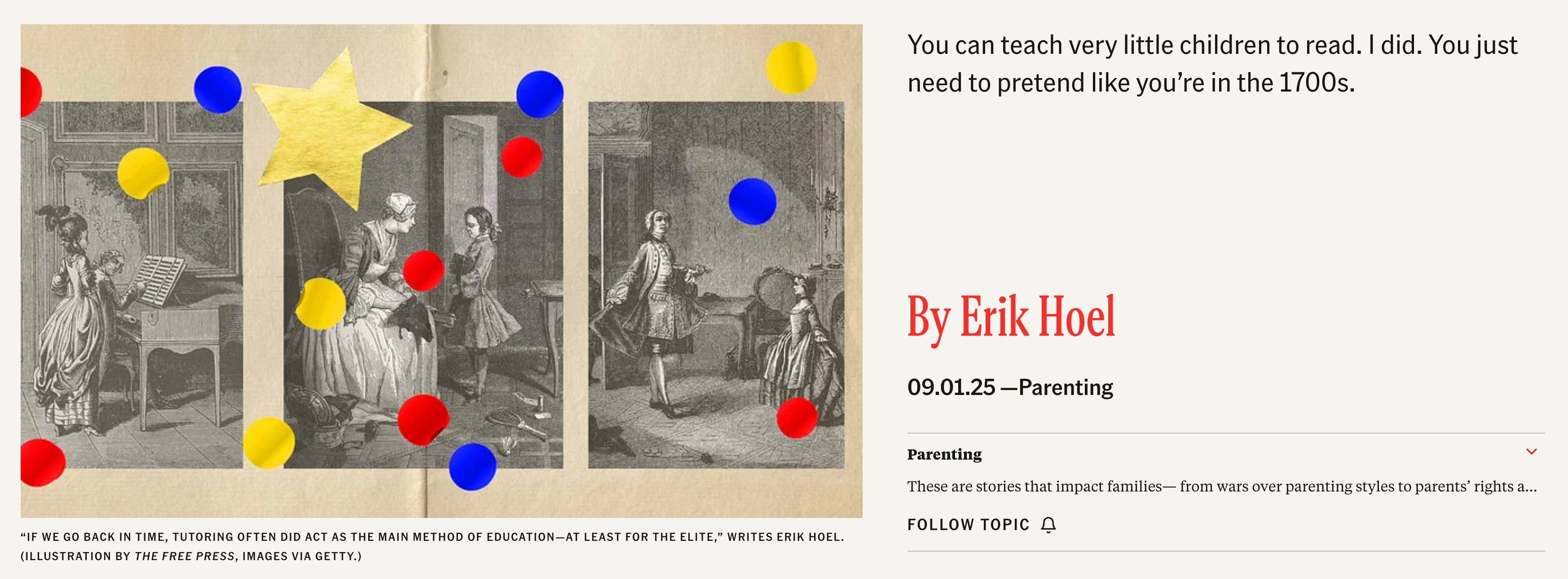
Those who’ve read my Aristocratic Tutoring series and my Teaching (Very) Early Reading series will certainly be familiar with a lot of what’s in there, as it draws from those directly. However, by virtue of being compact, and tying together a lot of strands that have been floating around here in various pieces, I think it’s worth checking out.
In The Free Press article, I say:
Right now is the most exciting time in child education since Maria Montessori started her first school over 100 years ago.
A lot of this is due to excitement around programs like Alpha School and Math Academy.
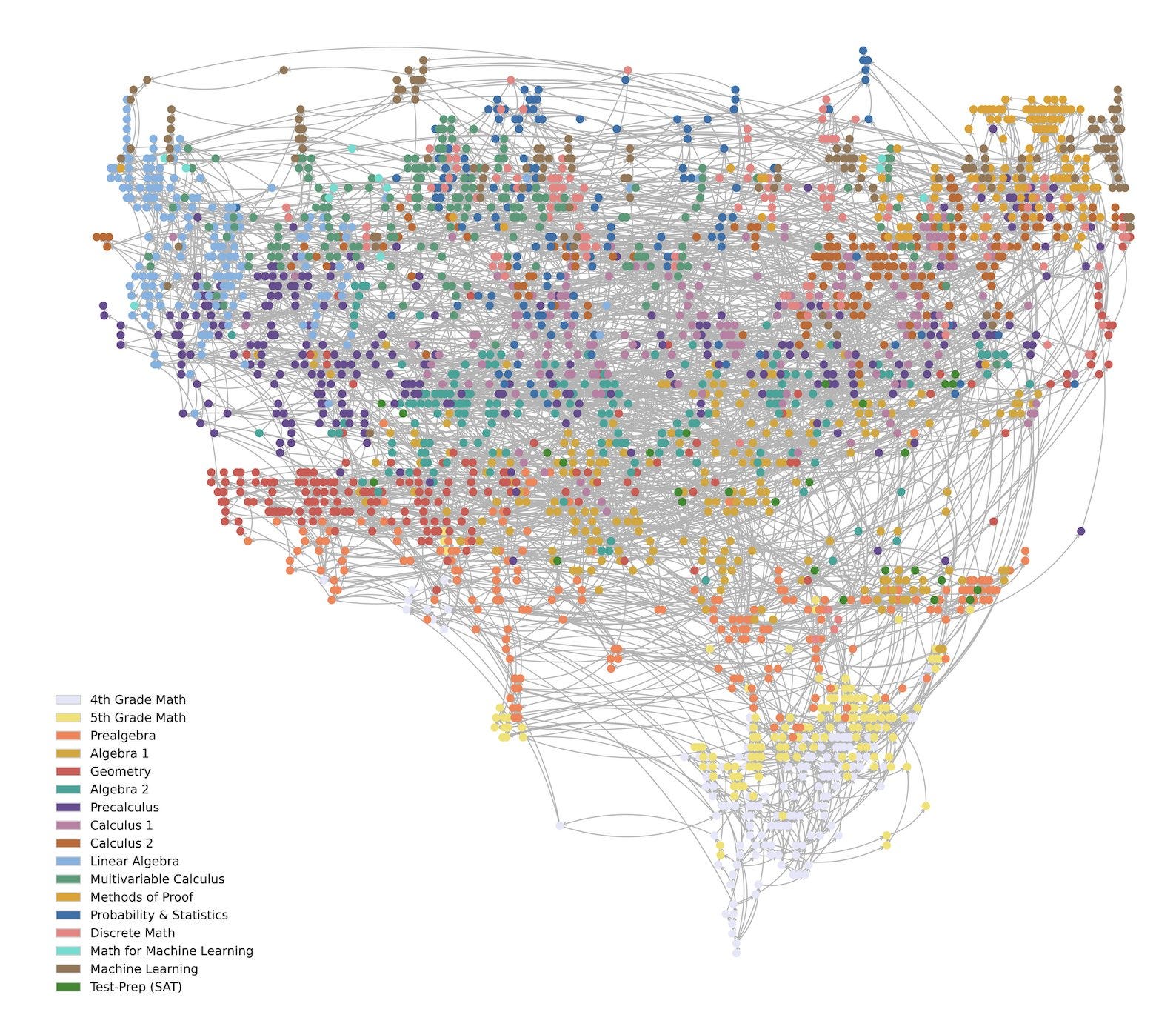
A visualization of Math Academy’s complete knowledge graph
However, I didn’t get a chance to talk about the more somber story, i.e., what I think the realistic outcome is.
I think, in the future, adaptive curricula plus some sort of background AI that surveys and tracks overall progress, will indeed form the core of a lot of subjects for most students. However, I also think you probably need a superintelligent AI agent to outstrip a good human tutor. That’s a very high bar. That most likely means that AI and ed-tech eats education from the bottom up.
The good news is that this frees up resources and increases variance, letting schools and tutors focus on what humans can add above and beyond adaptive curricula and AI (and gives kids more time back for themselves).
Is this the best of all possible worlds? Probably not, no. But honestly, almost anything would be better at this point, given what we know is achievable via the science of learning, and where things currently stand in implementation.