By the late 19th century, engineer Octave Chanute had reached the top of his field—but he left it to pursue a secret hobby. Chanute, who was born on this day in Paris in 1832, oversaw railroad construction in the West and helped bring about the explosive growth of cities there. Meanwhile, he obsessed over crewed flight for decades, at the time a highly experimental pursuit. But to protect his career and his family’s social status, he kept this interest hidden until he retired from his chief engineer job at the New York, Lake Erie & Western Railroad Company in the 1880s.
Nautilus Members enjoy an ad-free experience. Log in or Join now .
That was when Chanute finally decided to dig into the latest developments from the fledgling field of aviation. He published the authoritative book Progress in Flying Machines in 1894, which explored all the attempts so far that people had made to soar through the skies. Meanwhile, he worked on his own design for a flying machine and corresponded with fellow enthusiasts around the world.
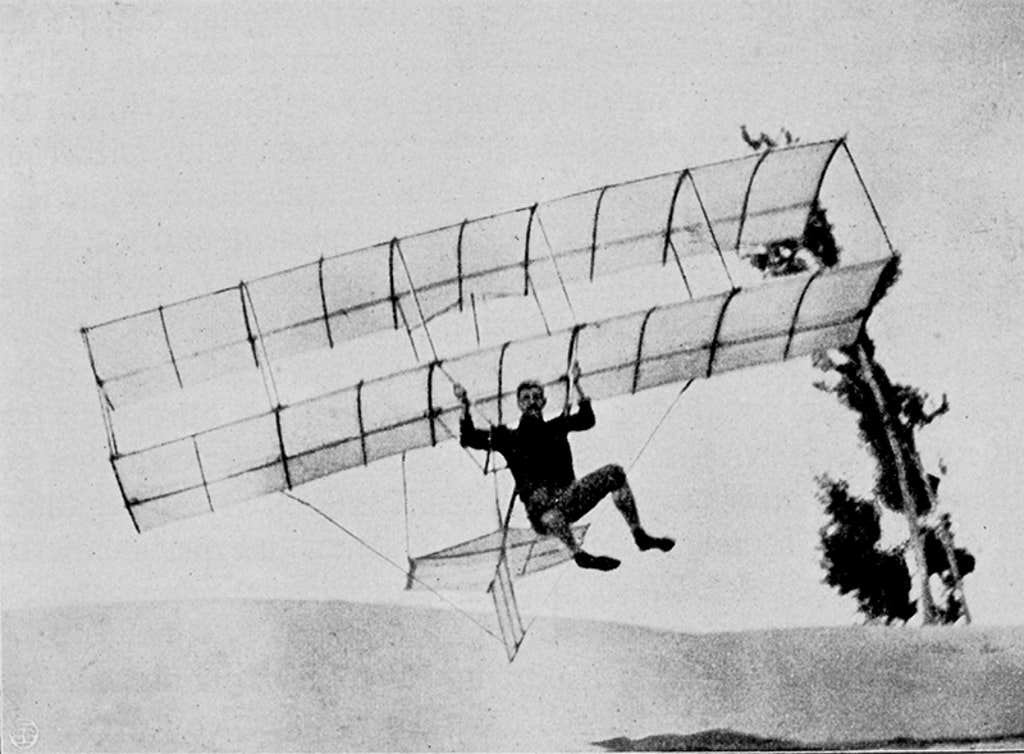
PIONEERING PLANE: Chanute’s biplane during a test in 1896. Photo courtesy of Wikimedia Commons.
ADVERTISEMENT
Nautilus Members enjoy an ad-free experience. Log in or Join now .
Chanute believed that, because nature gives birds the ability to fly, we too could harness natural forces like wind to travel the skies. He leaned on his engineering experience, calculating how a flying machine’s wings would interact with the air around them.
He took inspiration from German engineer Otto Lilienthal, who had come up with nearly 20 models for gliders—fixed-wing aircraft that stay aloft with the help of rising currents of air, similar to birds like owls and hawks. Lilienthal reported success in his experiments, and Chanute decided to improve these designs with new models of his own.
In August 1896, Chanute and a group of flying enthusiasts tested out his glider model at the Indiana Dunes on Lake Michigan. This aircraft incorporated a bracing system called a Pratt Truss, which Chanute had used when building railroad bridges. It consisted of steel wires that supported stacked sets of wings and offered both stability and flexibility.
ADVERTISEMENT
Nautilus Members enjoy an ad-free experience. Log in or Join now .
Read more: “The Father of Modern Metal”
During these tests, the bottom wing kept getting caught in the sand during takeoff, frustrating the team. So they removed it, creating a biplane. Chanute realized that the operator could move their body backward or forward to manipulate the little aircraft.
After hundreds of flights, the longest covering 359 feet over 14 seconds, it became clear that Chanute had created the most successful glider yet. His plane paved the way for future aeronautical pioneers, who still had to figure out how to effectively propel and manipulate these newfangled machines.
ADVERTISEMENT
Nautilus Members enjoy an ad-free experience. Log in or Join now .
Wilbur and Orville Wright adapted Chanute’s bracing system in their first aircraft, a steerable kite that they constructed in 1899. The trio began exchanging letters in 1900, and Chanute became a mentor to the brothers. The next year, Chanute visited Kitty Hawk, North Carolina, to check out the Wrights’ model in person, and continued stopping by over the next few years. They had a spat in 1905 over the future of flight, as the Wrights hoped to keep their ideas secret while Chanute thought aviation innovations should be freely disseminated. Just as the Wrights tried to mend their relationship with Chanute, he died at 78 years old in 1910.
Wilbur Wright delivered a eulogy for Chanute the next year: “His labors had vast influence in bringing about the era of human flight. No one was too humble to receive a share of his time. In patience and goodness of heart he has rarely been surpassed. Few men were more universally respected and loved.” 
Enjoying Nautilus? Subscribe to our free newsletter.
ADVERTISEMENT
Nautilus Members enjoy an ad-free experience. Log in or Join now .
Lead image: Octave Chanute / Wikimedia Commons