Before there was Charles Darwin, there was Erasmus.
Nautilus Members enjoy an ad-free experience. Log in or Join now .
The English pioneer of evolutionary theory is thought to have taken inspiration from his paternal grandfather Erasmus, whom he never got the chance to meet. Erasmus, who died seven years before Charles was born (on this day in 1809), was a well-regarded poet, physician, and philosopher, among other specialties. But his influence on his grandson’s groundbreaking ideas has only recently come to light.
Erasmus was known as an excellent physician, even sought out by King George III, and he championed abolitionism and women’s suffrage. He likely grew interested in evolution thanks to his friend Josiah Wedgwood, an English potter and abolitionist who eventually became Charles Darwin’s maternal grandfather. Wedgwood sent Erasmus mammoth bones that had been dug up from a canal in England, and they didn’t appear to come from any known species. Erasmus was intrigued, and wondered if they were from an extinct creature—a revelation that eventually convinced him that all species evolve over time.
ADVERTISEMENT
Nautilus Members enjoy an ad-free experience. Log in or Join now .
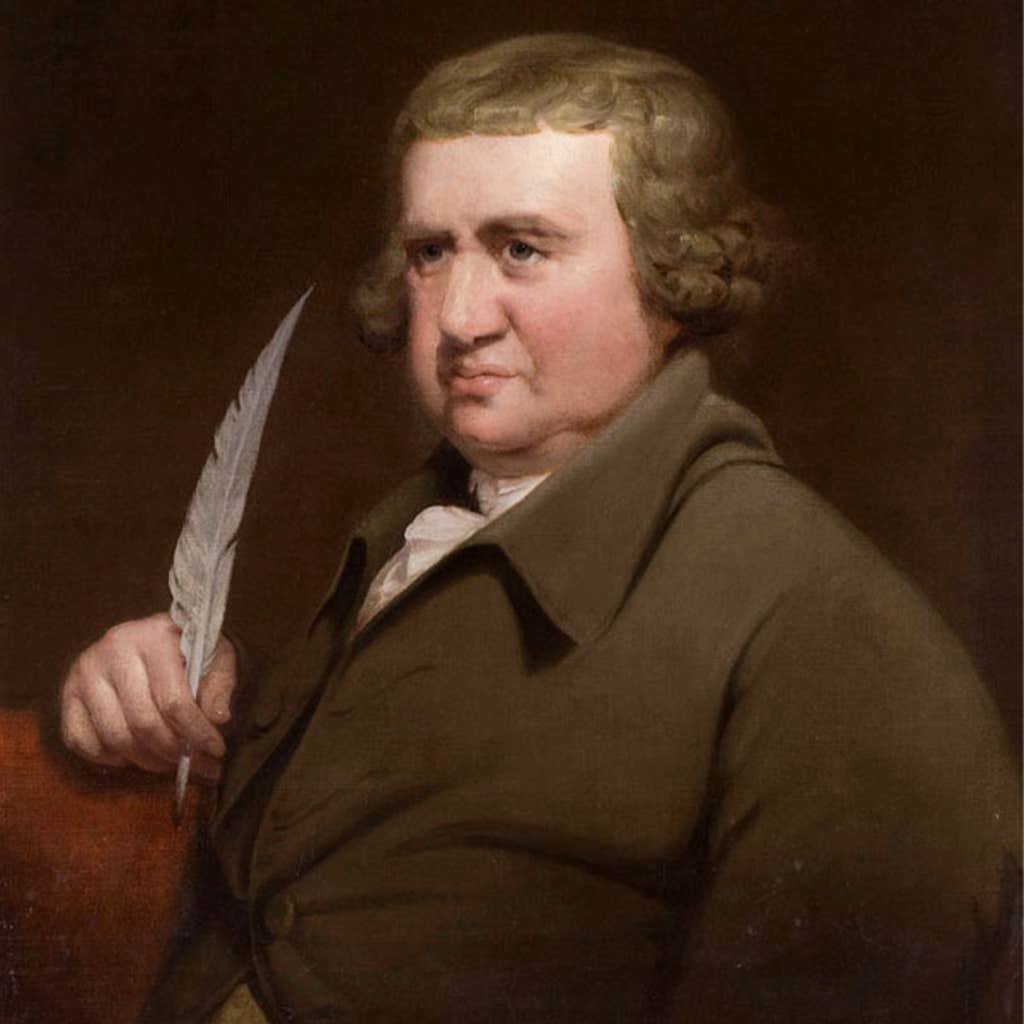
GRANDPA KNOWS BEST: Erasmus Darwin penned ideas that seem to have sparked Charles’ curious investigations of our origins. Painting by Joseph Wright of Derby; courtesy of Wikimedia.
Erasmus went on to study domesticated and wild animals and worked in his wide-ranging knowledge on fields such as paleontology, comparative anatomy, and embryology. Around 1770, he sparked his first controversy with the coat of arms he had painted on his carriage. It featured three scallop shells and a Latin phrase meaning “all from shells,” which suggests that life evolved from a single organism.
For his first notable foray into evolutionary theory, he alluded to his developing ideas in an erotic poem. In The Loves of the Plants, published around 1789, he argued that “a vegetable passion … was visible in a wide variety of erotic behaviors in plants, from the chaste intercourse of a romantic plant pair, to female plant parts entertaining multiple male suitors, to even wilder orgiastic fare,” wrote J.P. Daly of Stanford University.
ADVERTISEMENT
Nautilus Members enjoy an ad-free experience. Log in or Join now .
At the time, botany was popular among England’s upper classes, so this work received much fanfare. In his poem, Erasmus drew on Carl Linnaeus’ taxonomic system and implied that sexual reproduction links humans and nature.
Read more: “The Seeds That Sowed a Revolution”
Erasmus eventually proposed one of the first formal theories on evolution in Zoonomia, a two-volume medical work that was published between 1794 and 1796. He suggested that the world had existed for far longer than 6,000 years, as was popular belief at the time, and that all life on Earth came from one origin. “Would it be too bold to imagine, that in the great length of time since the Earth began to exist, perhaps millions of ages before the commencement of the history of mankind, would it be too bold to imagine, that all warm-blooded animals have arisen from one living filament,” he wrote.
ADVERTISEMENT
Nautilus Members enjoy an ad-free experience. Log in or Join now .
He also laid the groundwork for the idea of the survival of the fittest, noting that all creatures encounter “three great objects of desire”: They must reproduce, eat, and remain safe, prompting what his grandson called “sexual selection” a century later.
These ideas sparked condemnation, and Erasmus was seen as a heretic for questioning God and the existing theories of creation. At the time, bloody revolutions like that of France were viewed in connection with the “godlessness of evolutionary ideas.” In the last years of Erasmus’ life, such criticism forced him out of the public conversation.
But Erasmus took things even further with his last poem, The Temple of Nature, which was published posthumously in 1803—he died in 1802 at the age of 70. In it, he lays out the progression of society, moving from hunting to agriculture to commerce and eventually philosophy. Erasmus was quite ahead of his time, asserting that life progressed from the simplest, microscopic forms to plants and animals. He also delved into the evolution of language among humans, which he thought enabled us to communicate and satisfy our needs.
ADVERTISEMENT
Nautilus Members enjoy an ad-free experience. Log in or Join now .
Over the past decade, researchers have illuminated the overlooked impacts Erasmus had on his grandson. While Charles denied this in public, it’s now known that he read and likely built upon Erasmus’ work. For example, Charles made over two dozen annotations in The Temple of Nature and is also known to have read Zoonomia. Ultimately, researchers have highlighted “the enormous similarity between the evolutionary thought of Charles Darwin and that of his grandfather,” suggesting that Erasmus played a long-neglected role in developing this world-defining school of thought. 
Enjoying Nautilus? Subscribe to our free newsletter.
Lead image: Wikimedia Commons
ADVERTISEMENT
Nautilus Members enjoy an ad-free experience. Log in or Join now .