Nearly all students (92%) now report using AI in their academic work. This is up from 66% just one year ago. In many ways, this gives students hands-on experience with tools they’ll use in their future careers. In other ways, it accentuates questions for educators about how to preserve learning, critical thinking, and academic integrity.
Educators and institutions face a difficult challenge: distinguishing between AI that supports learning and AI that shortcuts it. But that challenge is not just philosophical; it’s practical. Without visibility into how AI is used during the writing process, instructors are often left to evaluate final submissions and police AI use rather than assess the writing process and how AI may have assisted.
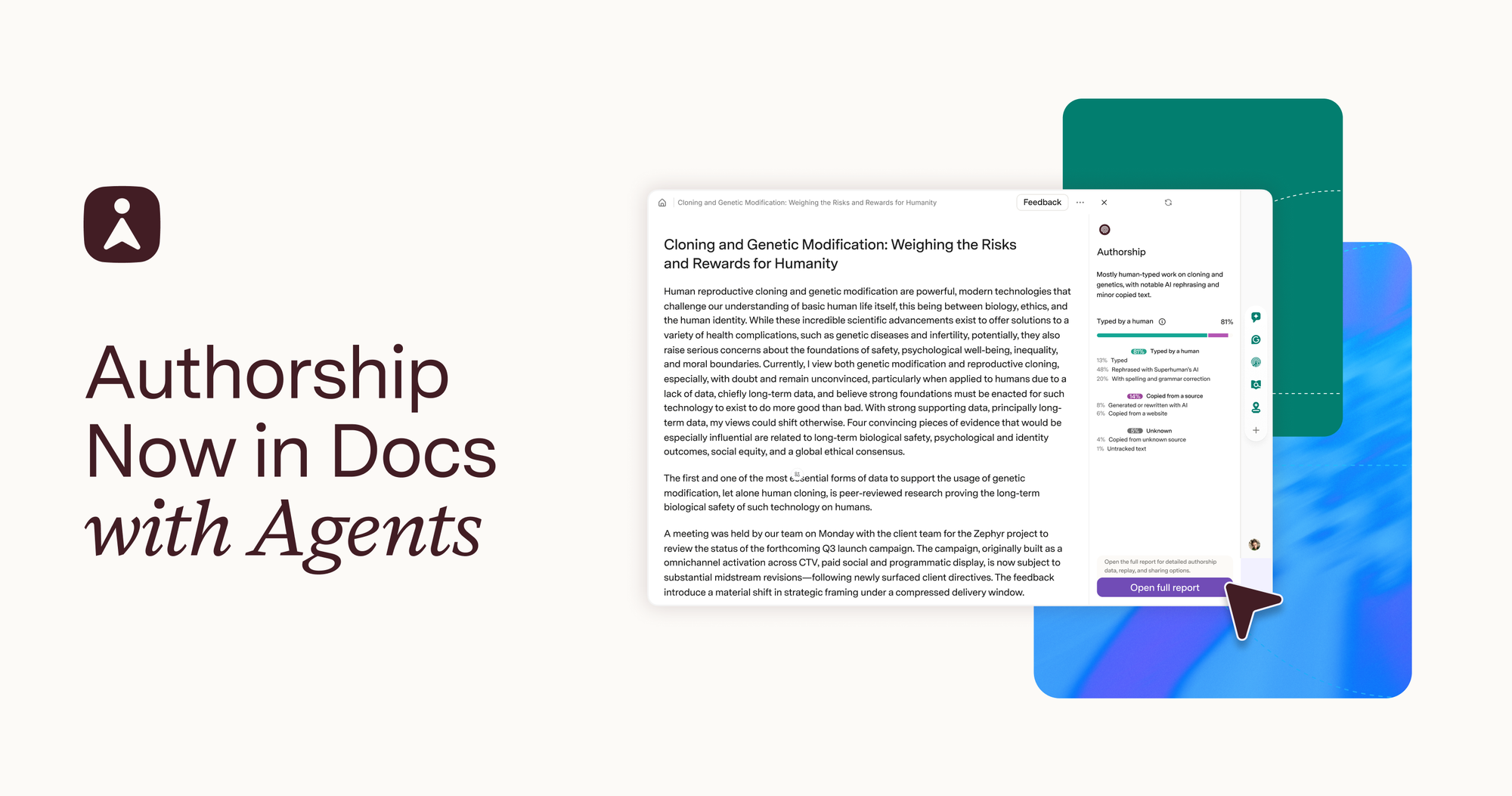
Superhuman is committed to helping educators by creating tools that give them the visibility they need while helping students gain real-world experience with responsible AI. We took a meaningful step toward this with the launch of our award-winning product, Authorship. Today, we’re building on that foundation by embedding Authorship and our Superhuman AI writing agents directly into a single writing surface, docs.
What that means
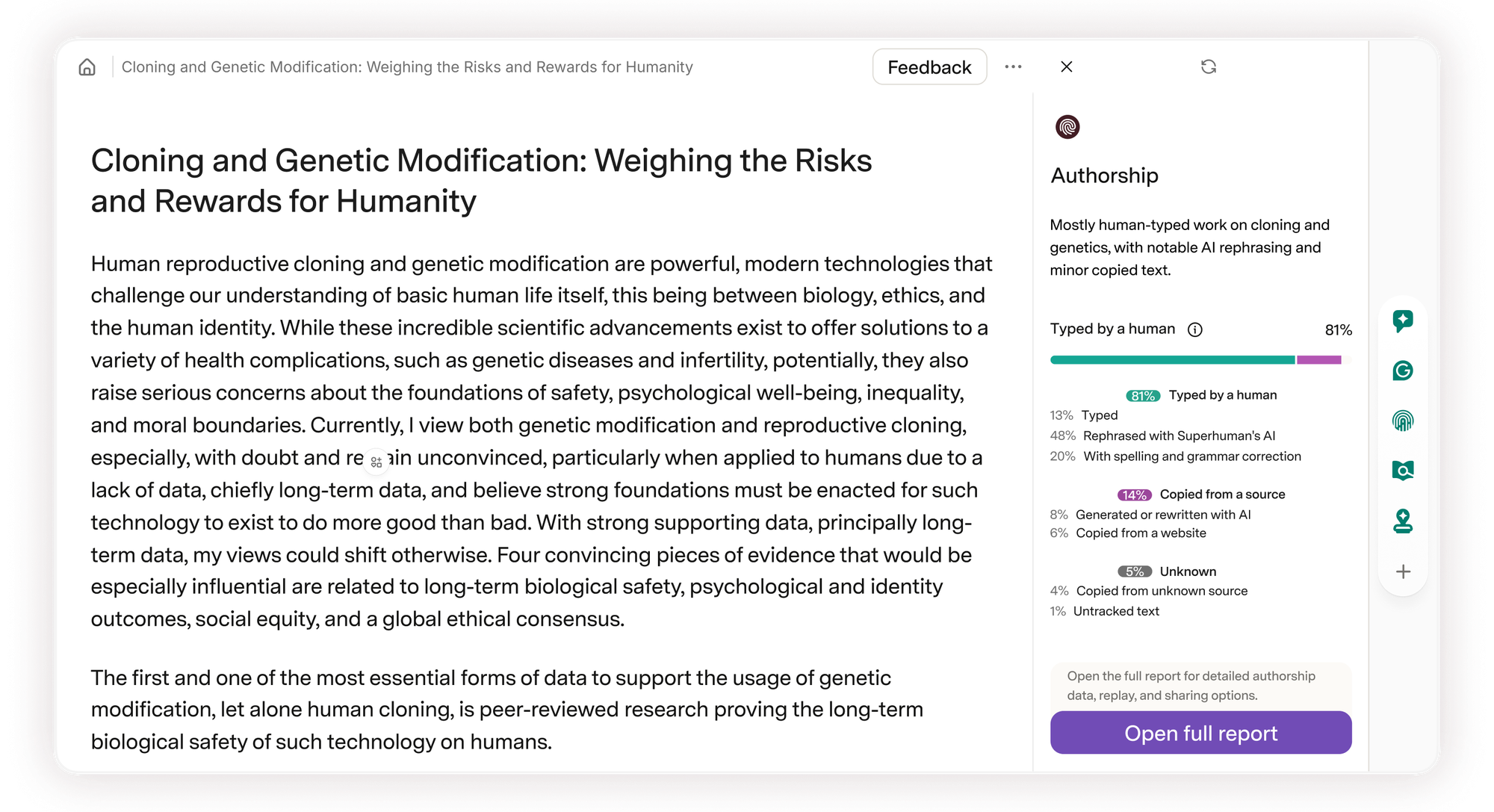
With Authorship and Superhuman AI writing agents integrated into docs, writing and AI assistance now live together in a unified experience designed specifically for education.
Transparency by default
Authorship automatically documents students’ use of AI, providing a clear record of how writing develops. Transparency is enabled by default, while institutions maintain flexibility to adapt settings as policies and teaching practices evolve.
Agent-specific and AI Chat attribution
Authorship can attribute how writers use specific Superhuman AI agents and AI Chat. This allows students to review and understand their own AI use before sharing Authorship reports with instructors, giving them greater visibility and agency. At the same time, instructors get to observe how AI was used and collaborated with.
Institutional control
Administrators and instructors can configure which AI agents are available by institution, department, or course, ensuring AI use aligns with academic policies and learning goals.Together, these capabilities create a transparent, institutionally approved environment for AI-assisted writing.
The visibility to meet education’s nuanced approach to AI
One of the biggest challenges educators face today is that most AI policies treat all AI use the same. But not all AI use serves the same purpose. With agent and AI-level chat attribution, educators can now distinguish among different types of AI support across activities such as research assistance, idea generation, revision feedback, and proofreading.
This enables institutions to move beyond blanket restrictions toward more nuanced conversations about which types of AI use support learning and which may undermine it.
To date, students across K–12 and higher education have generated more than 5 million Authorship reports, giving instructors clearer insight into how work was developed, not just what it looks like at submission. The impact has been tangible. At Rowan-Cabarrus Community College, for example, the introduction of Authorship contributed to a 96% reduction in academic integrity violations in a single semester.
Since launch, Superhuman’s specialized AI agents have been used by hundreds of thousands of students to improve their writing, strengthen their arguments, and challenge their thinking. Now, with Authorship in docs with agents, students can continue to get the help they’ve come to expect from Superhuman’s AI agents, while educators gain new visibility to drive productive conversations about learning, reasoning, and growth.
Faculty no longer have to ask, *“*Did AI write this?” They can instead focus on the writing process:
- How did the student develop their ideas?
- Where did AI support brainstorming versus revision?
- How did the student’s thinking evolve over time?
For students, this creates a safer, seamless, more trustworthy environment to use AI responsibly.
For institutions, it enables responsible adoption and strengthens trust without sacrificing integrity, instructional autonomy, or control.
The foundation for something bigger
Agent-specific attribution, powered by Authorship, gives educators a firm foundation as they rethink assessment in the era of AI. This release reflects a broader shift in education we’re investing in: moving beyond transparency as a feature toward AI that is genuinely embedded in how students learn and write.
Get started
Authorship with AI agents in the AI Editor is now available in open beta. Existing Grammarly for Education customers can enable it today by switching it on in their admin settings. For help piloting or configuring it for your institution, your Grammarly contact can assist.