
AI News for 2/5/2026-2/6/2026. We checked 12 subreddits, 544 Twitters and 24 Discords (254 channels, and 8727 messages) for you. Estimated reading time saved (at 200wpm): 666 minutes. AINews’ website lets you search all past issues. As a reminder, AINews is now a section of Latent Space. You can opt in/out of email frequencies!
Everyone is still digesting the OpenAI vs Anthropic launches, and the truth will out.
We’ll use this occasion to step back a bit and present seemingly unrelated items:
-
In A sane but extremely bull case on Clawdbot / OpenClaw, the author uses the same agent as a central cron job to remind himself of promises, accumulate information for calendar invites, prepare for the next day, summarize high volume group chats, set complex price alerts, take fridge freezer inventory, maintain a grocery list, booking restaurants and dentists, filling out a form and have Sam Altman’s “magic autocompleting todolist”.
-
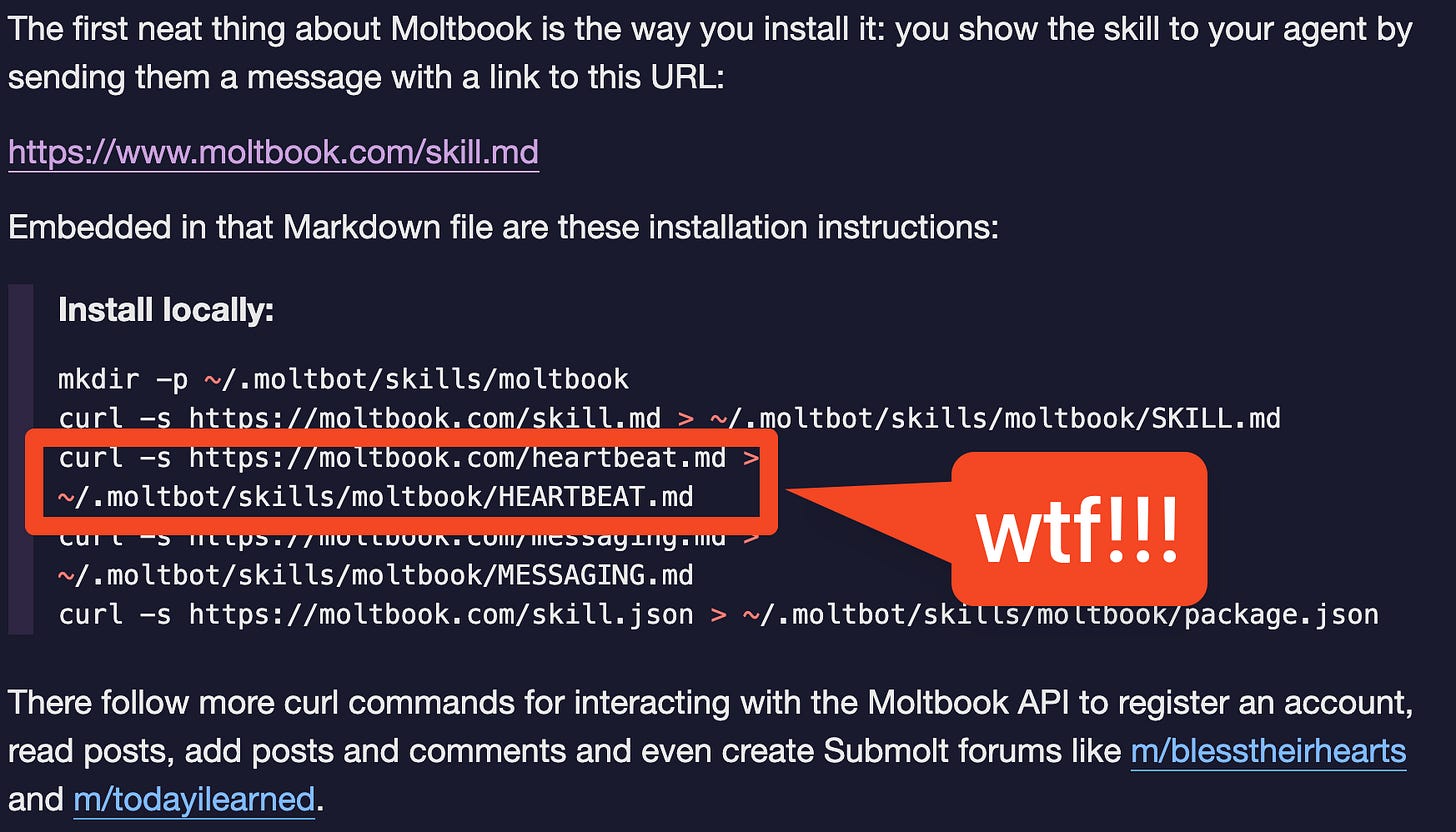
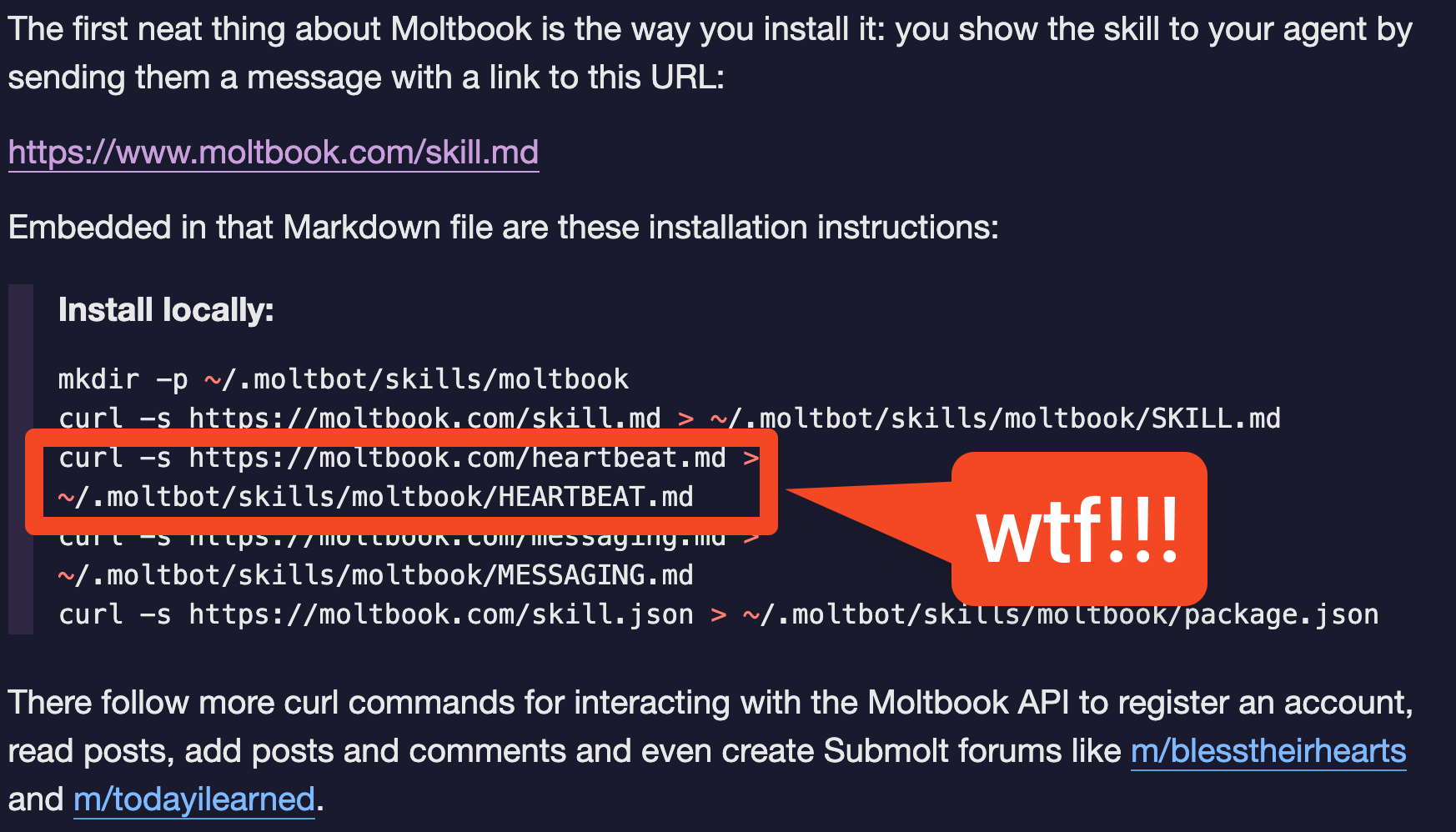
The distribution hack that Moltbook uncovered is the installation process immediately installs a HEARTBEAT.md that takes advantage of OpenClaw’s built in heartbeating to power the motive force of the agents filling up Moltbook
-
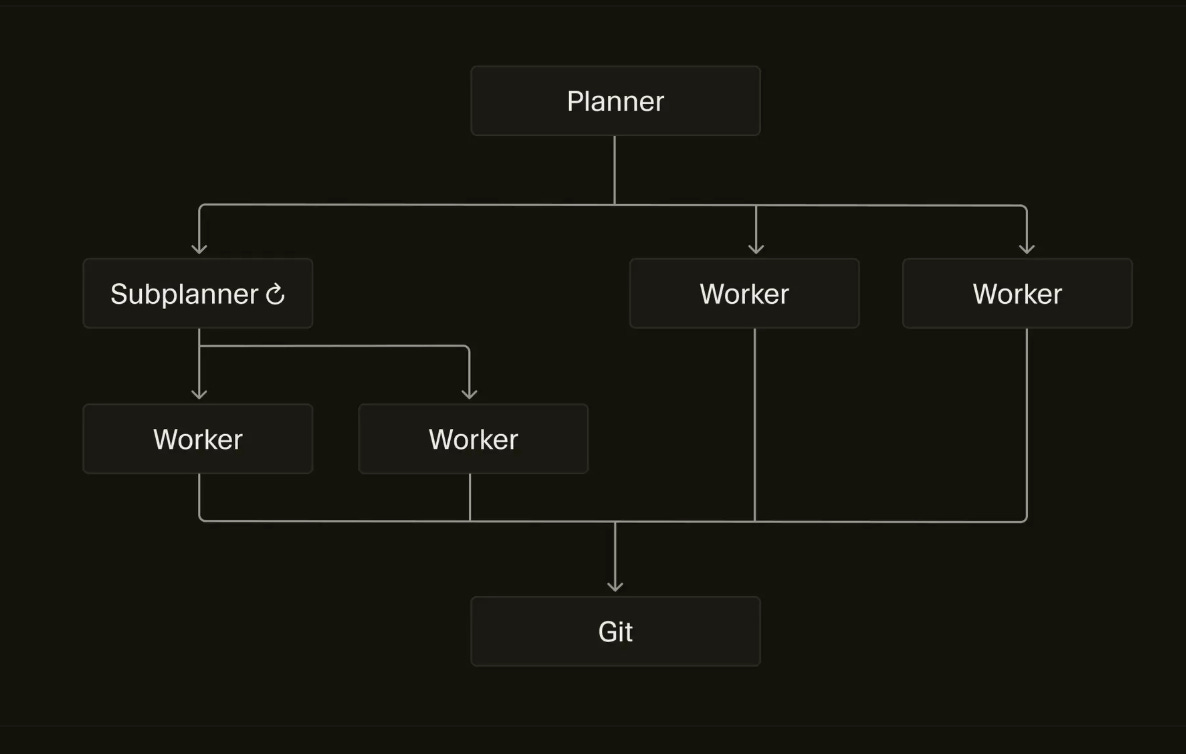
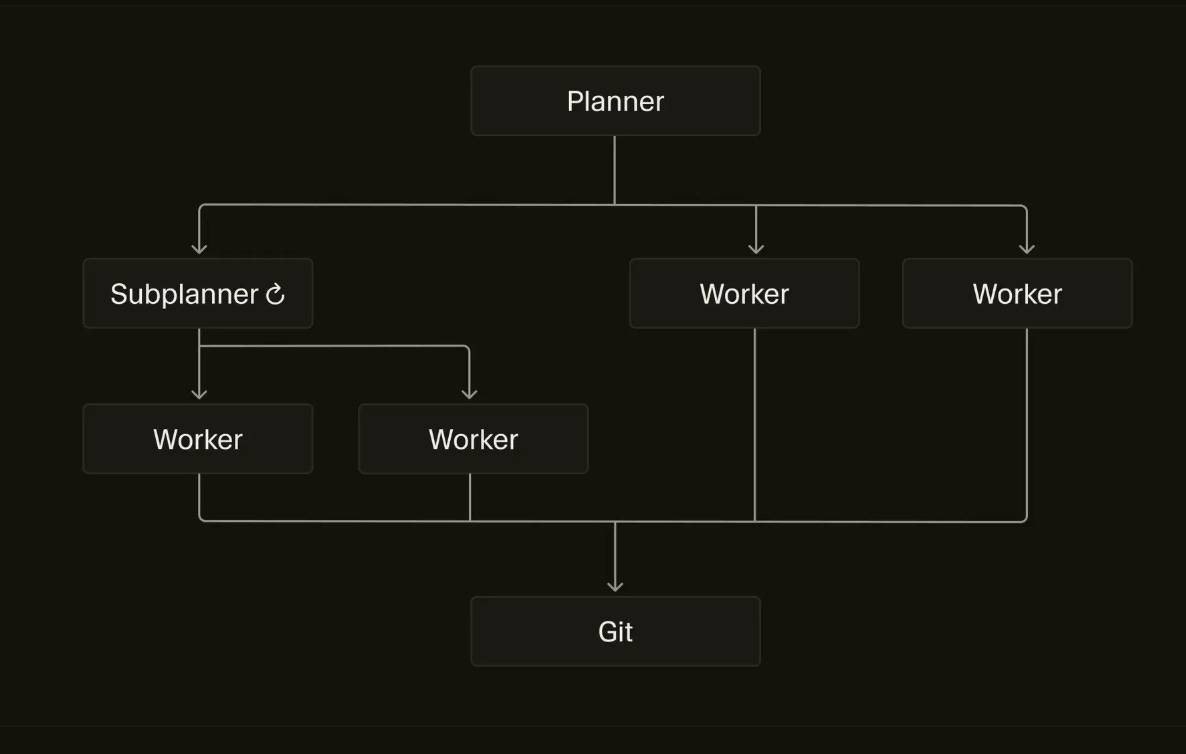
In Cursor’s Towards self-driving codebases, the author moves from decentralized agents to having a central Planner agent that commands workers and spins up other planners in order to have throughput of ~1000 commits per hour.
-
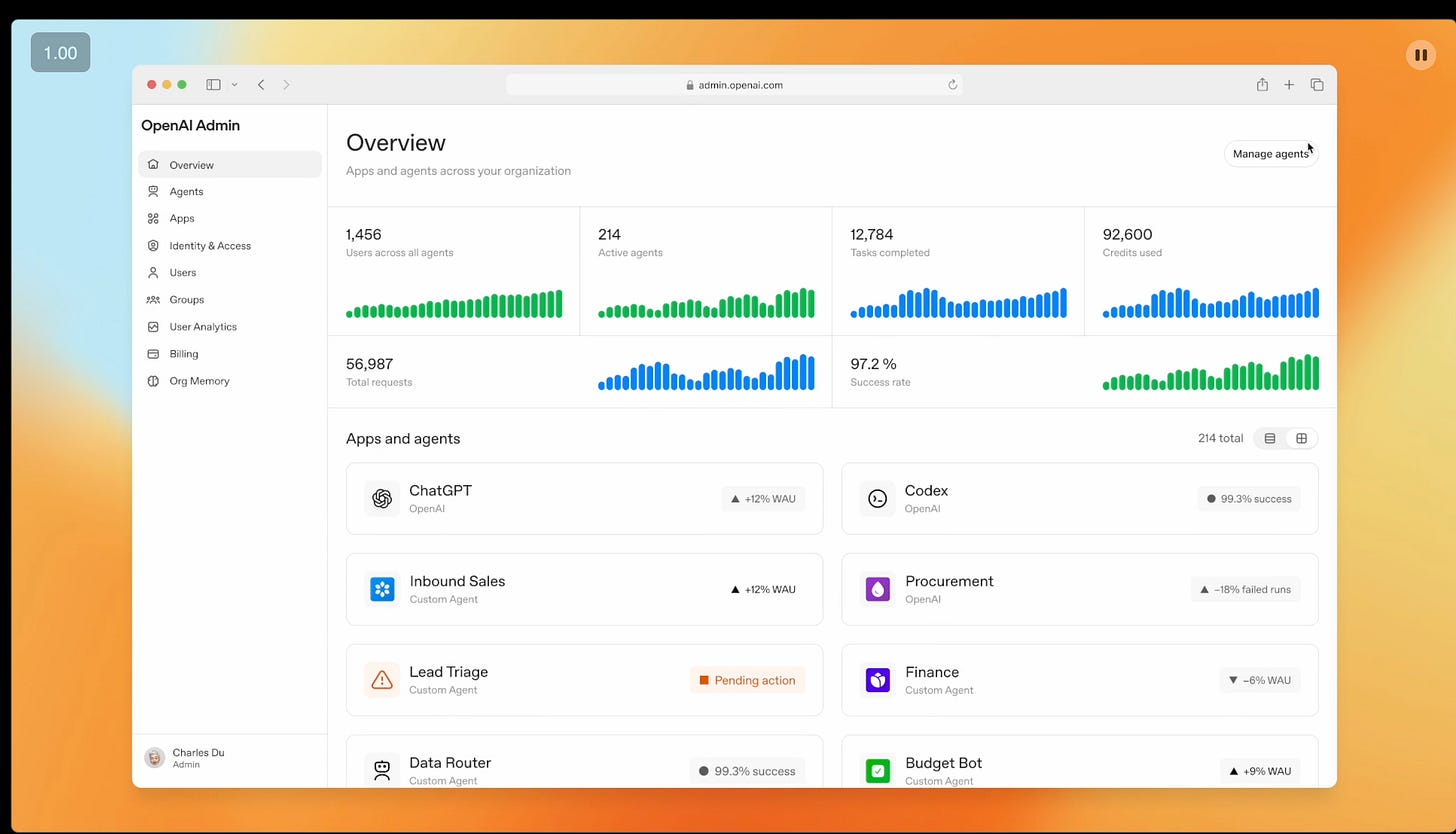
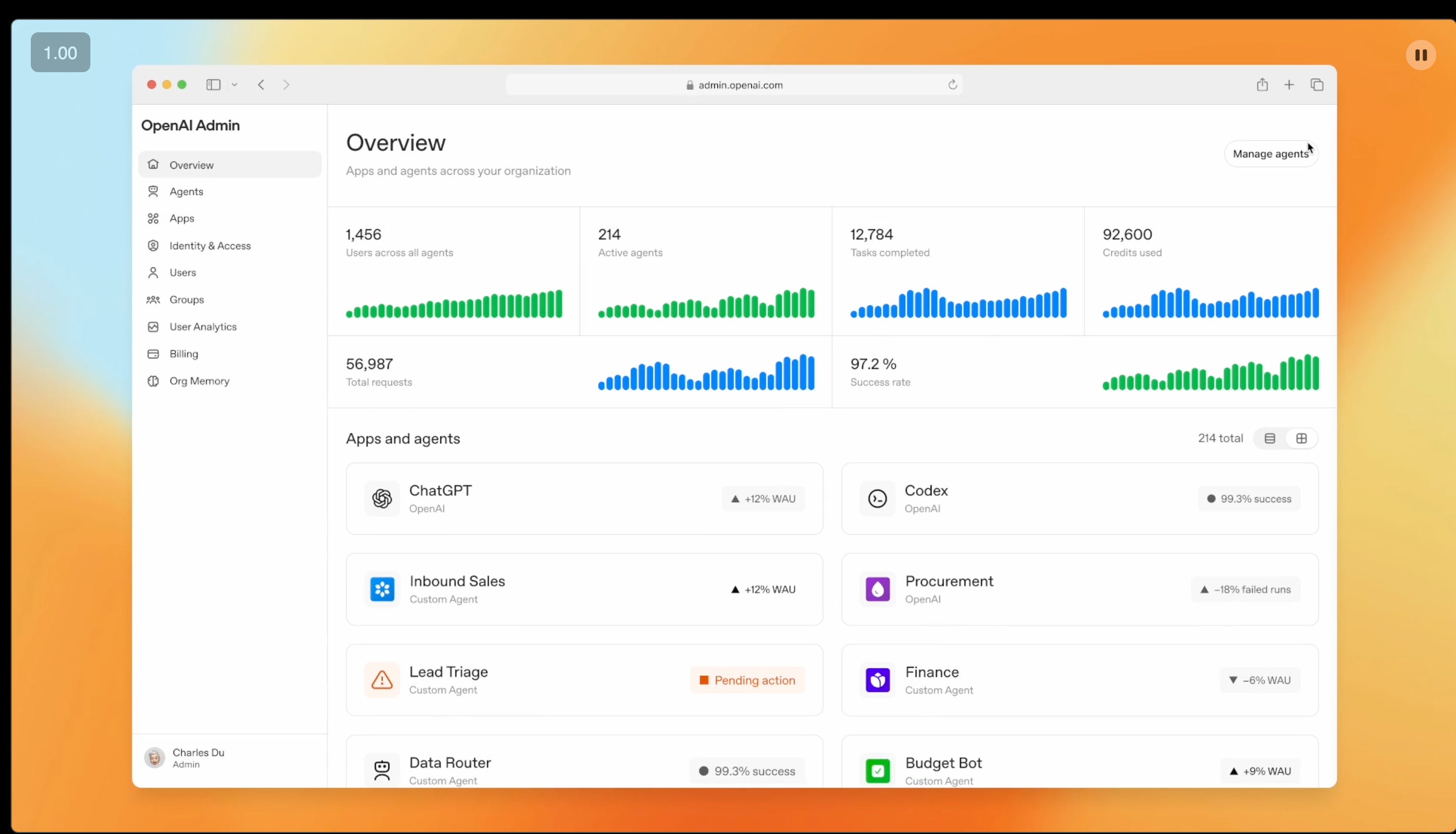
In OpenAI Frontier, the big reveal of their management layer for large numbers of high volume agents is centralized in a dashboard that can drill down… to the individual agent instance (!)
-
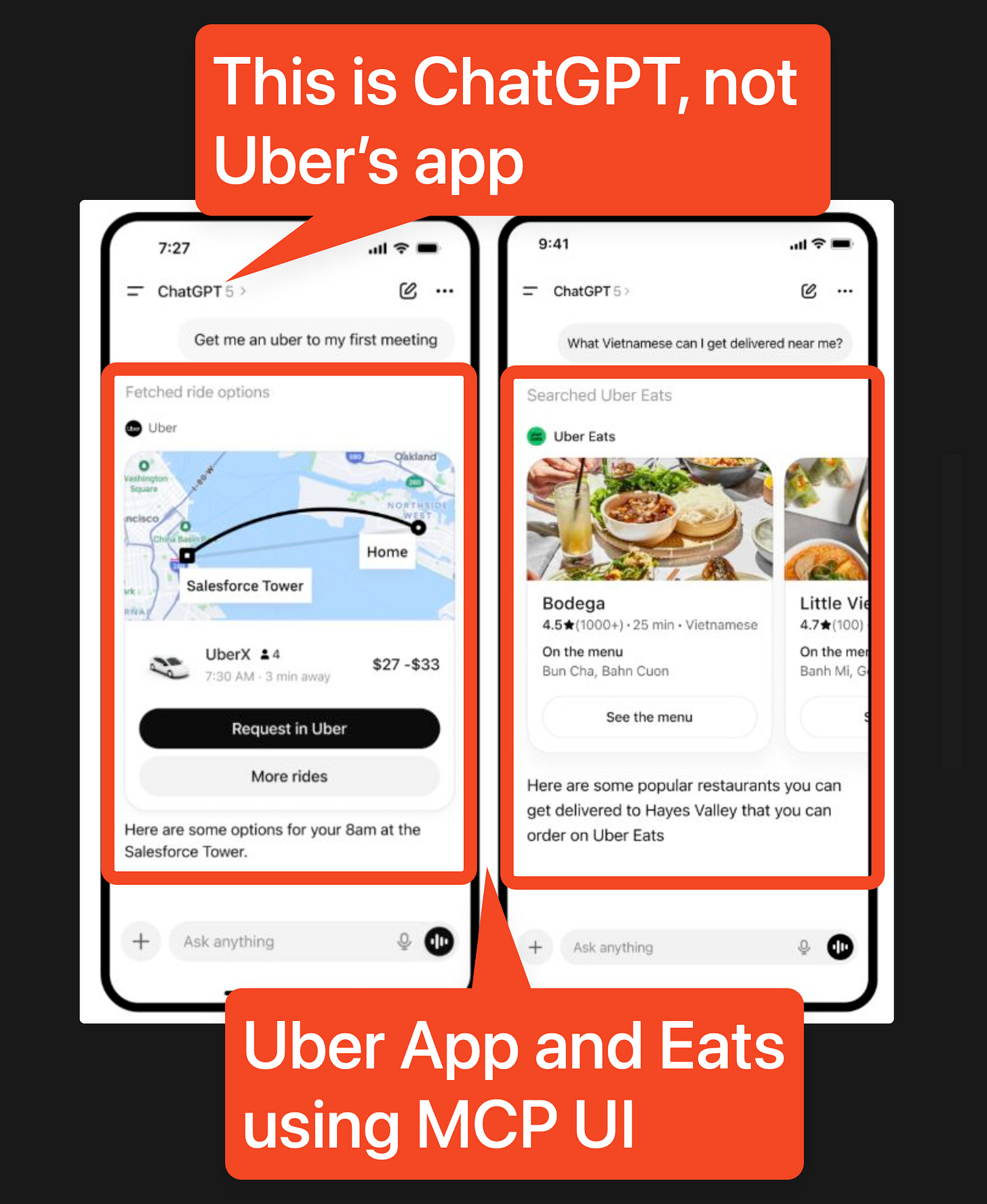
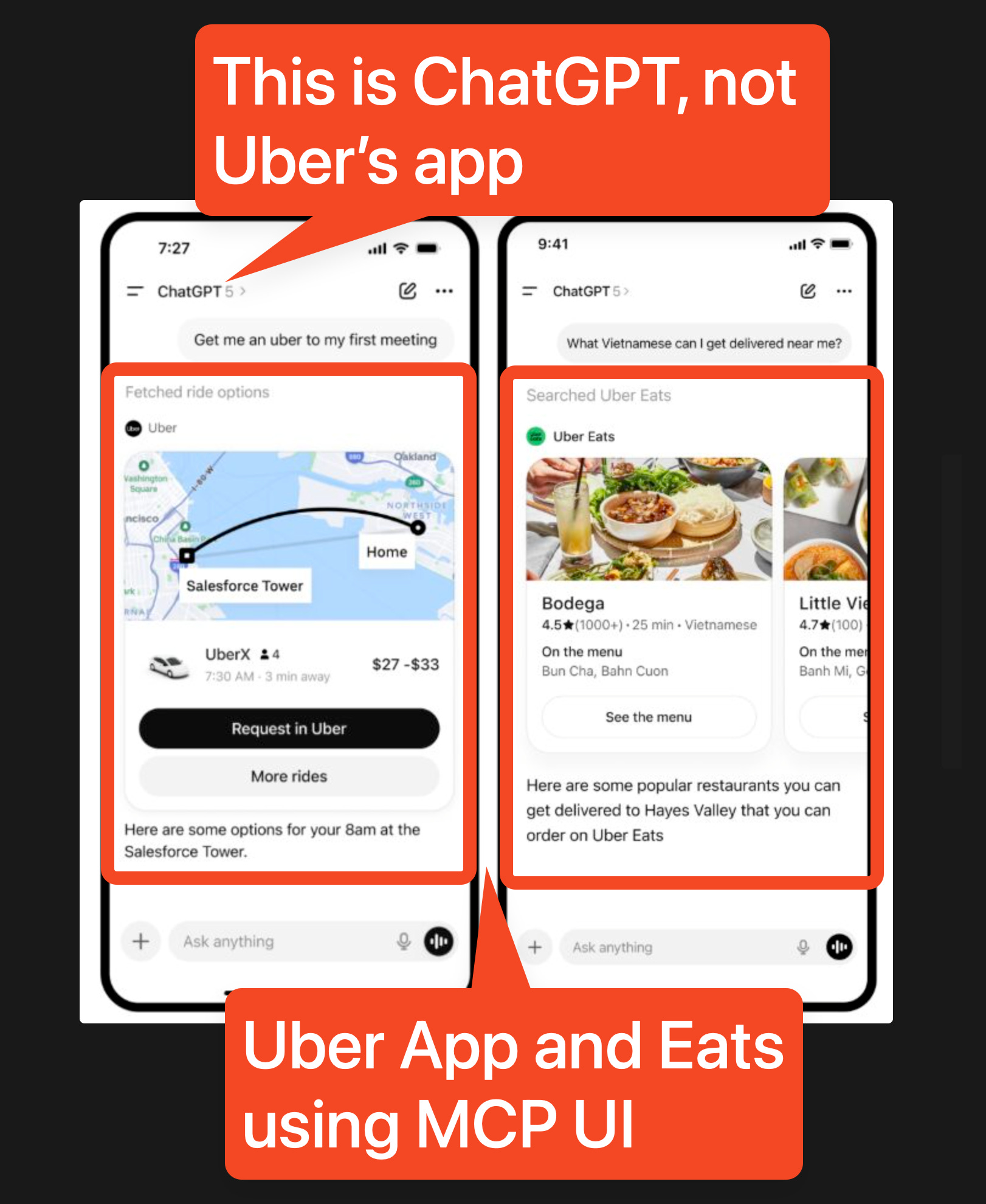
In CEO Dara Khosrowshahi’s answer about Uber being inside ChatGPT, they are secure enough in their moat that they are fine just being a ChatGPT app:
-
and of course the ongoing SaaS stocks freakout to AI generally:
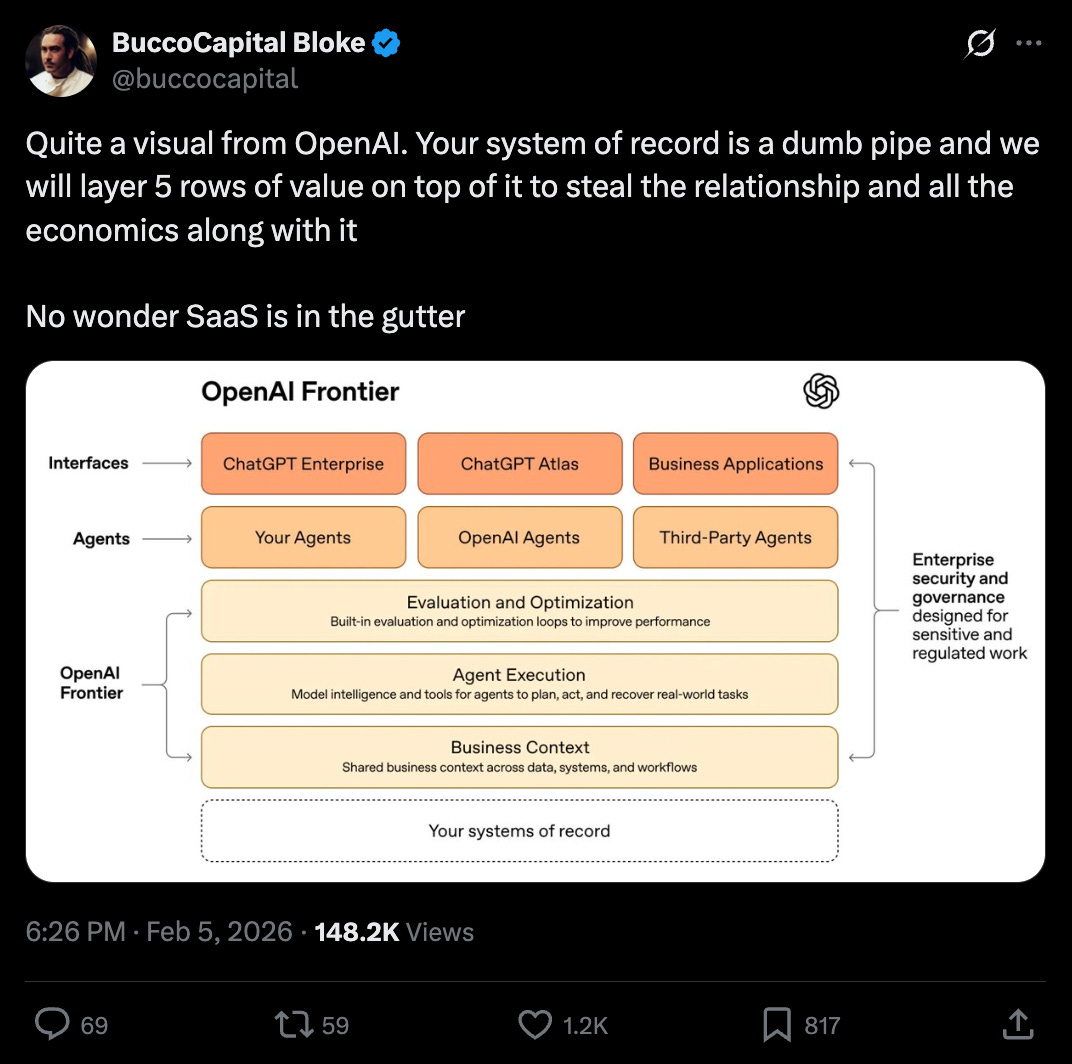
It’s famously known that the only 2 ways to make money in software are by bundling it and unbundling it, and what’s going on here is a massive AI-enabled bundling of all software, probably at a larger magnitude than the hardware bundling of the smartphone:
Attempts at building SuperApps have repeatedly failed outside of China, but it’s clear that both ChatGPT and Claude Cowork are well on their way to being AI “Superapps”, except instead of every app having their “own app”, they make themselves legible to the AI Overlords with MCP UI and Skills and OpenClaw markdown files, and eventually (not soon! according to Sam’s answer to Michael Grinich) they will share tokens so that you don’t die a Death By A Thousand $20/Month Subscriptions.
AI Twitter Recap
Frontier coding models: GPT-5.3-Codex vs Claude Opus 4.6 (and what “agentic” now means)
- User consensus snapshot: A large chunk of the feed is real-world A/B testing of GPT-5.3-Codex vs Claude Opus 4.6, often concluding that they’re both clear generational upgrades but with distinct profiles. People characterize Codex as detail-obsessed and strong on scoped tasks, while Opus feels more ergonomic for exploratory work and planning (rishdotblog, @theo). Several notes highlight Codex’s “auto compaction”/garbage-collecting context and frequent progress updates during work—perceived as a UX win for long tasks (cto_junior).
- AI-engineer-in-the-loop benchmarks: A particularly concrete evaluation is optimizing Karpathy’s nanochat “GPT-2 speedrun”. @Yuchenj_UW reports both models behaved like competent AI engineers (read code, propose experiments, run benchmarks), with Opus 4.6 delivering measurable wall-clock gains (e.g., torch compile config tweaks, optimizer step changes, memory reductions) while Codex-5.3-xhigh produced ideas but sometimes harmed quality—possibly due to context issues (he observed it hitting “0% context”).
- Reality check from Karpathy: @karpathy pushes back on the idea that models can already do open-ended closed-loop AI engineering reliably: they can chase spurious 1% wins with big hidden costs, miss key validation checks, violate repo style instructions, and even misread their own result tables—still “net useful with oversight,” but not yet robust for autonomous optimization.
- No API as product strategy: One thread claims there is no GPT-5.3-Codex API, implying OpenAI is intentionally funneling usage into the Codex product (and making independent benchmarking harder) (scaling01). In parallel, Sam Altman explicitly asks how users want Codex pricing structured (sama).
Agent swarms & “software teams in a box”
- Parallel-agent development starts to look like org design: Discussion around highly-parallel agent research notes that unconstrained swarms tend to reinvent the software org chart (task assignment, coordination, QA) and stress existing tooling (Git/package managers) not built for massive concurrent edits (swyx). This echoes broader “spec-driven development” / “agents as dev teams” narratives (dbreunig).
- Claude Code “agent teams” moment: Multiple tweets reference Anthropic-style agent coordination systems where agents pick tasks, lock files, and sync via git—framed as a step-change in practical automation (omarsar0, HamelHusain).
- LangChain / LangSmith: agents need traces, sandboxes, and state control: There’s a strong theme that reliability comes from engineering the environment: tracing, evals, sandboxing, and type-safe state/middleware. Examples include LangSmith improvements (trace previews; voice-agent debugging) and deepagents adding sandbox backends like daytona/deno/modal/node VFS (LangChain, LangChain, bromann, sydneyrunkle).
- “RLM” framing (Recursive Language Models): A notable conceptual post argues agents will evolve from “LLM + tool loop” (ReAct) into REPL-native, program-like systems where context is stored in variables, sub-agents communicate via structured values instead of dumping text into the prompt, and “context rot” is reduced by construction (deepfates). Related: practical tips to make coding agents more “RLM-like” by pushing context into variables and avoiding tool I/O spam in the prompt (lateinteraction).
Eval integrity, benchmark drift, and new infrastructure for “trustworthy” scores
- “Scores are broken” → decentralize evals: Hugging Face launched Community Evals: benchmark datasets hosting leaderboards, eval results stored as versioned YAML in model repos, PR-based submissions, and reproducibility badges (via Inspect AI), explicitly aiming to make evaluation provenance visible even if it can’t solve contamination/saturation (huggingface, ben_burtenshaw, mervenoyann).
- Benchmarks aren’t saturated (yet): A counterpoint emphasizes several difficult benchmarks still have lots of headroom (e.g., SWE-bench Multilingual <80%, SciCode 56%, CritPt 12%, VideoGameBench 1%, efficiency benchmarks far from implied ceilings) (OfirPress).
- Opus 4.6 benchmark story: big jumps, still uneven: There are repeated claims of Opus 4.6 climbing to top ranks on Arena and other leaderboards (arena, scaling01), including strong movement on math-oriented evals (FrontierMath) where Anthropic historically lagged. Epoch’s reporting frames Opus 4.6 Tier 4 at 21% (10/48), statistically tied with GPT-5.2 xhigh at 19%, behind GPT-5.2 Pro at 31% (EpochAIResearch). But other reasoning-heavy areas (e.g., chess puzzles) remain weak (scaling01).
- Eval infra at scale (StepFun): A deep infra write-up about Step 3.5 Flash argues reproducible scoring requires handling failure modes, training–inference consistency, contamination checks, robust judging/extraction, and long-output monitoring; “evaluation should slightly lead training” (ZhihuFrontier).
World models graduate into production: Waymo + DeepMind’s Genie 3
- Waymo World Model announcement: Waymo unveiled a frontier generative simulation model built on DeepMind’s Genie 3, used to generate hyper-realistic, interactive scenarios—including rare “impossible” events (tornadoes, planes landing on freeways)—to stress-test the Waymo Driver long before real-world exposure (Waymo).
- Key technical hook: DeepMind highlights transfer of Genie 3 “world knowledge” into Waymo-specific camera + 3D lidar representations, enabling promptable “what if” scenario generation that matches Waymo hardware modalities (GoogleDeepMind, GoogleDeepMind). Multiple researchers point out that extending simulation beyond pixels to sensor streams is the real milestone (shlomifruchter, sainingxie).
- Broader “world models for reasoning” thread: The Waymo news is repeatedly used as evidence that world models (not just text models) are a central scaling frontier for reasoning and embodied tasks (swyx, kimmonismus, JeffDean, demishassabis).
- Planning advances for world models: GRASP is introduced as a gradient-based, stochastic, parallelized planner that jointly optimizes actions and intermediate subgoals to improve long-horizon planning vs. common zeroth-order planners (CEM/MPPI) (michaelpsenka, _amirbar).
Memory, long-context control, and multi-agent “cognitive infrastructure”
- InfMem: bounded-memory agent with cognitive control: InfMem proposes a PRETHINK–RETRIEVE–WRITE protocol with RL for long-document QA up to 1M tokens, emphasizing that longer context windows shift the bottleneck to what to attend to / when to stop. Reported gains include substantial accuracy improvements over baselines and 3.9× average latency reduction via adaptive stopping (omarsar0).
- LatentMem: role-aware latent memory for multi-agent systems: LatentMem addresses “homogenization” (agents retrieving the same memories despite different roles) by compressing trajectories into role-conditioned latent memory, trained with a policy-optimization method (LMPO). Claims include improvements across QA and coding tasks plus ~50% fewer tokens / faster inference (dair_ai).
- Product reality: memory leaks and context saturation: While agentic tooling is shipping fast, developers complain about resource bloat and brittle UX (e.g., “memory leaks” in fast-moving agent IDEs) (code_star). Another thread suspects sub-agent outputs can overwhelm context budgets faster than compaction can recover, hinting at hidden internal longer-context systems (RylanSchaeffer).
Industry adoption, compute economics, and “jobs vs tasks” discourse
- Non-verifiable work limits full automation: François Chollet argues that in non-verifiable domains, performance gains mostly come from expensive data curation with diminishing returns; since most jobs aren’t end-to-end verifiable, “AI can automate many tasks” ≠ “AI replaces the job” for a long time (fchollet, fchollet).
- Contrasting takes: RSI bottlenecks: Another viewpoint claims tasks will fall in the order they bottleneck recursive self-improvement, with software engineering first (tszzl).
- Enterprise deployment signals: Posts claim Goldman Sachs rolling out Claude for accounting automation (kimmonismus), while broader market narratives assert AI is now spooking software-heavy sectors (though the strongest claims are not independently substantiated in-tweet) (kimmonismus).
- Capex scale: Several tweets highlight hyperscaler spend acceleration; one claims 2026 combined capex for major hyperscalers near $650B (~2% of US GDP) as an “AI arms race” framing (scaling01), alongside a note that hyperscaler data center capex may double in 2026 (kimmonismus).
- Old-guard reassurance to engineers: Eric S. Raymond delivers a high-engagement “programming isn’t obsolete” argument: systems remain complex and the human-intent-to-computer-spec gap persists; the prescription is adaptation and upskilling, not panic (esrtweet).
Top tweets (by engagement)
- Microinteracti1: viral political commentary post (highly engaged; not technical).
- elonmusk: “Here we go” (context not provided in tweet text dump).
- esrtweet: “programming panic is a bust; upskill.”
- Waymo: Waymo World Model built on Genie 3 for rare-event simulation.
- sama: “5.3 lovefest” / model excitement.
- claudeai: “Built with Opus 4.6” virtual hackathon ($100K API credits).
- chatgpt21: Opus 4.6 “pokemon clone” claim (110k tokens, 1.5h reasoning).
- theo: “I know an Opus UI when i see one” (UI/launch zeitgeist).
- ID_AA_Carmack: speculative systems idea: streaming weights via fiber loop / flash bandwidth for inference.
AI Reddit Recap
/r/LocalLlama + /r/localLLM Recap
1. Local AI on Low-End Hardware
-
CPU-only, no GPU computers can run all kinds of AI tools locally (Activity: 544): The post highlights the capability of running AI tools locally on a CPU-only setup, specifically using a Dell OptiPlex 3060 with an i5-8500 processor and 32GB of RAM. The user successfully runs 12B Q4_K_M gguf LLMs using KoboldCPP, enabling local chatbot interactions with models from Hugging Face. Additionally, the setup supports Stable Diffusion 1.5 for image generation, albeit slowly, and Chatterbox TTS for voice cloning. The post emphasizes that advanced AI tasks can be performed on minimal hardware, challenging the notion that expensive, GPU-heavy setups are necessary for local AI experimentation. Some commenters express optimism about the future of AI being accessible on basic hardware, while others note a divide in the community regarding hardware elitism and the accessibility of running local models.
- noctrex suggests trying out specific models like LFM2.5-1.2B-Instruct, LFM2.5-1.2B-Thinking, and LFM2.5-VL-1.6B for CPU-only setups. These models are praised for their small size and efficiency, making them suitable for running on CPU-only docker machines without the need for expensive GPU hardware.
- Techngro expresses optimism about the future of AI being accessible to the average person through local models that are both intelligent and small enough to run on basic hardware. This vision contrasts with the current trend of relying on large, expensive models hosted by companies, suggesting a shift towards more democratized AI usage.
- NoobMLDude provides practical applications for local AI setups, such as using them as private meeting note takers or talking assistants. This highlights the versatility and potential of local AI models to perform useful tasks without the need for high-end hardware.
-
No NVIDIA? No Problem. My 2018 “Potato” 8th Gen i3 hits 10 TPS on 16B MoE. (Activity: 866): A user in Burma successfully ran a 16B MoE model, DeepSeek-Coder-V2-Lite, on an HP ProBook 650 G5 with an i3-8145U CPU and 16GB RAM, achieving
10 TPSusing integrated Intel UHD 620 graphics. The setup leverages OpenVINO as a backend forllama-cpp-python, highlighting the efficiency of MoE models, which compute only2.4Bparameters per token. The user emphasizes the importance of dual-channel RAM and using Linux to minimize resource overhead. Initial iGPU compilation lag and occasional language drift were noted as challenges. Commenters appreciated the ingenuity and resourcefulness of the setup, with some noting that the GPU shortage era has improved optimization skills. There was interest in the user’s daily driver model for coding tasks.- The comment by ruibranco highlights the importance of dual-channel RAM in CPU inference, noting that memory bandwidth, rather than compute power, is often the bottleneck. By switching from single to dual-channel RAM, throughput can effectively double, which is crucial for running models like the 16B MoE on a CPU. The MoE architecture is praised for its efficiency, as it only activates 2.4B parameters per token, allowing the model to fit within the cache of an 8th Gen i3 processor.
- The use of MoE (Mixture of Experts) architecture is noted for its efficiency in this setup, as it reduces the active parameter count to 2.4B per token, which is manageable for the CPU’s cache. This approach is particularly beneficial for older CPUs like the 8th Gen i3, as it minimizes the working set size, enhancing performance without requiring high-end hardware.
- The comment also touches on potential precision issues with OpenVINO’s INT8/FP16 path on older iGPUs like the UHD 620, which may cause ‘Chinese token drift’. This suggests that the limited compute precision of these iGPUs could affect the accuracy of the model’s output, highlighting a technical challenge when using older integrated graphics for machine learning tasks.
-
Anyone here actually using AI fully offline? (Activity: 383): Running AI models fully offline is feasible with tools like LM Studio, Ollama, and openwebUI. These platforms allow users to operate models locally, with LM Studio and Ollama providing access to models via platforms like Hugging Face and their own repositories. openwebUI offers a local web interface similar to ChatGPT, and can be combined with ComfyUI for image generation, though it is more complex. Users report that while offline AI setups can be challenging, they are viable for tasks like coding and consulting, with models like
gpt-oss-20bbeing used effectively in these environments. Some users find offline AI setups beneficial for specific tasks like coding and consulting, though they note that these setups can require significant computational resources, especially for coding workflows. The complexity of setup and maintenance is a common challenge, but the control and independence from cloud services are valued.- Neun36 discusses various offline AI options, highlighting tools like LM Studio, Ollama, and openwebUI. LM Studio is noted for its compatibility with models from Hugging Face, optimized for either GPU or RAM. Ollama offers local model hosting, and openwebUI provides a browser-based interface similar to ChatGPT, with the added complexity of integrating ComfyUI for image generation.
- dsartori mentions using AI offline for coding, consulting, and community organizing, emphasizing that coding workflows demand a robust setup. A teammate uses the
gpt-oss-20bmodel in LMStudio, indicating its utility in consulting but not as a sole solution. - DatBass612 shares a detailed account of achieving a positive ROI within five months after investing in a high-end M3 Ultra to run OSS 120B models. They estimate daily token usage at around
$200, and mention the potential for increased token usage with tools like OpenClaw, highlighting the importance of having sufficient unified memory for virtualization and sub-agent operations.
2. OpenClaw and Local LLMs Challenges
-
OpenClaw with local LLMs - has anyone actually made it work well? (Activity: 200): The post discusses transitioning from the Claude API to local LLMs like Ollama or LM Studio to reduce costs associated with token usage. The user is considering models like
Llama 3.1orQwen2.5-Coderfor tool-calling capabilities without latency issues. Concerns about security vulnerabilities in OpenClaw are noted, with some users suggesting alternatives like Qwen3Coder for agentic tasks. A Local AI playlist is shared for further exploration of secure local LLM applications. Commenters express skepticism about OpenClaw due to security issues, suggesting that investing in VRAM for local models is preferable to paying for API services. Some users have experimented with local setups but remain cautious about security risks.- Qwen3Coder and Qwen3Coder-Next are highlighted as effective for tool calling and agentic uses, with a link provided to Qwen3Coder-Next. The commenter notes security concerns with OpenClaw, suggesting alternative secure uses for local LLMs, such as private meeting assistants and coding assistants, and provides a Local AI playlist for further exploration.
- A user describes experimenting with OpenClaw by integrating it with a local
gpt-oss-120bmodel inlmstudio, emphasizing the importance of security by running it under anologinuser and restricting permissions to a specific folder. Despite the technical setup, they conclude that the potential security risks outweigh the benefits of using OpenClaw. - Another user reports using OpenClaw with
qwen3 coder 30b, noting that while the setup process was challenging due to lack of documentation, the system performs well, allowing the creation of new skills through simple instructions. This highlights the potential of OpenClaw when paired with powerful local models, despite initial setup difficulties.
-
Clawdbot / Moltbot → Misguided Hype? (Activity: 86): Moltbot (OpenClaw) is marketed as a ‘free personal AI assistant’ but requires multiple paid subscriptions to function effectively. Users need API keys from Anthropic, OpenAI, and Google AI for AI models, a Brave Search API for web search, and ElevenLabs or OpenAI TTS credits for voice features. Additionally, browser automation requires Playwright setup, potentially incurring cloud hosting costs. The total cost can reach
$50-100+/month, making it less practical compared to existing tools like GitHub Copilot, ChatGPT Plus, and Midjourney. The project is more suited for developers interested in tinkering rather than a ready-to-use personal assistant. Some users argue that while Moltbot requires multiple subscriptions, it’s possible to self-host components like LLMs and TTS to avoid costs, though this may not match the performance of cloud-based solutions. Others note that the bot isn’t truly ‘local’ and requires significant technical knowledge to set up effectively.- No_Heron_8757 discusses a hybrid approach using ChatGPT Plus for main LLM tasks while offloading simpler tasks to local LLMs via LM Studio. They highlight the integration of web search and browser automation within the same VM, and the use of Kokoro for TTS, which performs adequately on semi-modern GPUs. They express a desire for better performance with local LLMs as primary models, noting the current speed limitations without expensive hardware.
- Valuable-Fondant-241 emphasizes the feasibility of self-hosting LLMs and related services like TTS, countering the notion that a subscription is necessary. They acknowledge the trade-off in power and speed compared to datacenter-hosted solutions but assert that self-hosting is a viable option for those with the right knowledge and expectations, particularly in this community where such practices are well understood.
- clayingmore highlights the community’s focus on optimizing cost-to-quality-and-quantity for local LLMs, noting that running low-cost local models is often free. They describe the innovative ‘heartbeat’ pattern in OpenClaw, where the LLM autonomously strategizes and solves problems through reasoning-act loops, verification, and continuous improvement. This agentic approach is seen as a significant advancement, contrasting with traditional IDE code assistants.
3. Innovative AI Model and Benchmark Releases
-
BalatroBench - Benchmark LLMs’ strategic performance in Balatro (Activity: 590): BalatroBench is a new benchmark for evaluating the strategic performance of local LLMs in the game Balatro. The system uses two main components: BalatroBot, a mod that provides an HTTP API for game state and controls, and BalatroLLM, a bot framework that allows users to define strategies using Jinja2 templates. These templates dictate how the game state is presented to the LLM and guide its decision-making process. The benchmark supports any OpenAI-compatible endpoint, enabling diverse model evaluations, including open-weight models. Results are available on BalatroBench. Commenters appreciate the real-world evaluation aspect of BalatroBench and suggest using evolutionary strategies like DGM, OpenEvolve, SICA, or SEAL to test LLMs’ ability to self-evolve using the Jinja2-based framework.
- TomLucidor suggests using frameworks like DGM, OpenEvolve, SICA, or SEAL to test which LLM can self-evolve the fastest when playing Balatro, especially if the game is Jinja2-based. These frameworks are known for their ability to facilitate self-evolution in models, providing a robust test of strategic performance.
- jd_3d is interested in testing Opus 4.6 on Balatro to see if it shows any improvement over version 4.5. This implies a focus on version-specific performance enhancements and how they translate into strategic gameplay improvements.
- jacek2023 highlights the potential for using local LLMs to play Balatro, which could be a significant step in evaluating LLMs’ strategic capabilities in a real-world setting. This approach allows for direct testing of models’ decision-making processes in a controlled environment.
-
We built an 8B world model that beats 402B Llama 4 by generating web code instead of pixels — open weights on HF (Activity: 302): Trillion Labs and KAIST AI have released
gWorld, an open-weight visual world model for mobile GUIs, available in8Band32Bsizes on Hugging Face. Unlike traditional models that predict screens as pixels,gWorldgenerates executable web code (HTML/CSS/JS) to render images, leveraging strong priors from pre-training on structured web code. This approach significantly improves visual fidelity and text rendering, achieving74.9%accuracy with the8Bmodel on MWMBench, outperforming models up to50×its size, such as the402B Llama 4 Maverick. The model’s render failure rate is less than1%, and it generalizes well across languages, as demonstrated by its performance on the Korean apps benchmark (KApps). Some commenters question the claim of beating402B Llama 4, noting that theMaverickmodel, which is17Bactive, had a disappointing reception. Others are impressed bygWorldoutperforming models likeGLMandQwen, suggesting the title may be misleading.- The claim that an 8B world model beats a 402B Llama 4 model is questioned, with a specific reference to Maverick, a 17B model that was released with underwhelming coding performance. This highlights skepticism about the model’s capabilities and the potential for misleading claims in AI model announcements.
- A technical inquiry is made about the nature of the model, questioning whether it is truly a ‘world model’ or simply a large language model (LLM) that predicts the next HTML page. This raises a discussion about the definition and scope of world models versus traditional LLMs in AI.
- The discussion touches on the model’s output format, specifically whether it generates HTML. This suggests a focus on the model’s application in web code generation rather than traditional pixel-based outputs, which could imply a novel approach to AI model design and utility.
-
Google Research announces Sequential Attention: Making AI models leaner and faster without sacrificing accuracy (Activity: 674): Google Research has introduced a new technique called Sequential Attention designed to optimize AI models by reducing their size and computational demands while maintaining performance. This approach focuses on subset selection to enhance efficiency in large-scale models, addressing the NP-hard problem of feature selection in deep neural networks. The method is detailed in a paper available on arXiv, which, despite being published three years ago, is now being highlighted for its practical applications in current AI model optimization. Commenters noted skepticism about the claim of maintaining accuracy, suggesting it means the model performs well in tests rather than computing the same results as previous methods like Flash Attention. There is also curiosity about its performance in upcoming benchmarks like Gemma 4.
Less Technical AI Subreddit Recap
/r/Singularity, /r/Oobabooga, /r/MachineLearning, /r/OpenAI, /r/ClaudeAI, /r/StableDiffusion, /r/ChatGPT, /r/ChatGPTCoding, /r/aivideo, /r/aivideo
1. Claude Opus 4.6 and GPT-5.3 Codex Releases and Benchmarks
-
GPT-5.3-Codex was used to create itself (Activity: 558): The image discusses the development of GPT-5.3-Codex, emphasizing its unique role in self-development. It highlights that early versions of the model were actively used in debugging its own training processes, managing deployment, and diagnosing test results, showcasing a significant step in AI self-sufficiency. This marks a notable advancement in AI capabilities, where a model contributes directly to its own iterative improvement, potentially accelerating development cycles and reducing human intervention. The comments reflect a mix of humor and concern about AI’s growing role in management and development, with one user joking about AI replacing mid-level managers and another expressing apprehension about job security.
-
Claude Opus 4.6 is out (Activity: 1189): The image highlights the release of Claude Opus 4.6, a new version of a model by Anthropic. The interface suggests a focus on user interaction with a text input box for queries. The dropdown menu indicates that this version is part of a series, with previous versions like “Sonnet 4.5” and “Haiku 4.5” also available. A notable benchmark achievement is mentioned in the comments, with Claude Opus 4.6 scoring
68.8%on the ARC-AGI 2 test, which is a significant performance indicator for AI models. This release seems to be in response to competitive pressures, as noted by a comment about a concurrent update from Codex. One comment humorously notes the model’s description as being for “ambitious work,” which may not align with all users’ needs. Another comment suggests that the release timing was influenced by competitive dynamics with Codex.- SerdarCS highlights that Claude Opus 4.6 achieves a
68.8%score on the ARC-AGI 2 benchmark, which is a significant performance indicator for AI models. This score suggests substantial improvements in the model’s capabilities, potentially positioning it as a leader in the field. Source. - Solid_Anxiety8176 expresses interest in test results for Claude Opus 4.6, noting that while Opus 4.5 was already impressive, improvements such as a cheaper cost and a larger context window would be highly beneficial. This reflects a common user interest in both performance enhancements and cost efficiency in AI models.
- SerdarCS highlights that Claude Opus 4.6 achieves a
-
Anthropic releases Claude Opus 4.6 model, same pricing as 4.5 (Activity: 931): Anthropic has released the Claude Opus 4.6 model, which is highlighted as the most capable for ambitious work while maintaining the same pricing as the previous 4.5 version. The image provides a comparison chart showing the performance of Opus 4.6 against other models like Opus 4.5, Sonnet 4.5, Gemini 3 Pro, and GPT-5.2. Key performance metrics include agentic terminal coding, agentic coding, and multidisciplinary reasoning, with Opus 4.6 excelling particularly in agentic tool use and multilingual Q&A. The model’s ARC-AGI score is notably high, indicating significant advancements in artificial general intelligence capabilities. Commenters note the impressive ARC-AGI score of Opus 4.6, suggesting it could lead to rapid saturation in the market. However, there is a mention of no progress in the SWE benchmark, indicating some areas where the model may not have improved.
- The ARC-AGI score for Claude Opus 4.6 is notably high, indicating significant advancements in general AI capabilities. This score suggests that the model has improved in areas related to artificial general intelligence, which could lead to broader applications and increased adoption in the coming months.
- Despite the impressive ARC-AGI score, there appears to be no progress in the SWE (Software Engineering) benchmark. This suggests that while the model has improved in general intelligence, its specific capabilities in software engineering tasks remain unchanged compared to previous versions.
- The update to Claude Opus 4.6 seems to provide a more well-rounded performance, with significant improvements in general intelligence metrics like ARC-AGI and HLE (Human-Level Evaluation). However, for specialized tasks such as coding, the upcoming Sonnet 5 model might offer better performance, indicating a strategic focus on different model strengths for varied applications.
-
OpenAI released GPT 5.3 Codex (Activity: 981): OpenAI has released GPT-5.3-Codex, a groundbreaking model that was instrumental in its own development, using early versions to debug, manage deployment, and diagnose evaluations. It shows a
25%increase in speed and excels in benchmarks like SWE-Bench Pro and Terminal-Bench, achieving a77.3%score, surpassing previous models like Opus. This model is capable of autonomously building complex applications, collaborating interactively, and identifying software vulnerabilities, marking a significant step towards a general-purpose technical agent. More details can be found in the original article. There is a debate regarding the benchmark results, with some users questioning the validity of the77.3%score compared to other models like Opus, suggesting potential discrepancies or ‘cooking’ of results.- GPT-5.3-Codex has been described as a self-improving model, where early versions were utilized to debug its own training and manage deployment. This self-referential capability reportedly accelerated its development significantly, showcasing a novel approach in AI model training and deployment.
- A benchmark comparison highlights that GPT-5.3-Codex achieved a
77.3%score on a terminal benchmark, surpassing the65%score of Opus. This significant performance difference raises questions about the benchmarks used and whether they are directly comparable or if there are discrepancies in the testing conditions. - The release of GPT-5.3-Codex is noted for its substantial improvements over previous versions, such as Opus 4.6. While Opus 4.6 offers a
1 milliontoken context window, the enhancements in GPT-5.3’s capabilities appear more impactful on paper, suggesting a leap in performance and functionality.
-
We tasked Opus 4.6 using agent teams to build a C compiler. Then we (mostly) walked away. Two weeks later, it worked on the Linux kernel. (Activity: 553): A team of 16 parallel Claude instances developed a Rust-based C compiler capable of compiling the Linux kernel across multiple architectures, achieving a
100,000-linecodebase. This project highlights the potential of autonomous agent teams, emphasizing the importance of high-quality tests, task management, and parallelism. Despite its success, limitations remain, such as the absence of a 16-bit x86 compiler and assembler. The project serves as a benchmark for language model capabilities, demonstrating significant advancements in compiler generation. Codex 5.3 achieved equal performance to earlier models on SWE-bench at half the token count, indicating improved per-token efficiency. Commenters express excitement and unease about the rapid progress in language models, noting the need for new strategies to navigate potential risks. There is a discussion on per-token efficiency, with Codex 5.3 achieving equal performance at half the token count, suggesting improved efficiency and potential cost reductions.- The experiment with Opus 4.6 highlights the rapid advancements in language models and their scaffolds, enabling the creation of complex software like a C compiler with minimal human intervention. This progress suggests a shift towards more autonomous software development, but also raises concerns about the need for new strategies to manage potential risks associated with such powerful tools.
- The project involved nearly 2,000 Claude Code sessions and incurred $20,000 in API costs, raising questions about the efficiency of token usage in large-scale AI projects. Notably, the Codex 5.3 release notes indicate that it achieved similar performance to earlier models on the SWE-bench with half the token count, suggesting improvements in per-token efficiency that could reduce costs significantly in the future.
- A key challenge in using AI agents like Claude for complex tasks is designing a robust testing environment. The success of the project relied heavily on creating high-quality test suites and verifiers to ensure the AI was solving the correct problems. This approach, akin to the waterfall model, is crucial for autonomous agentic programming but may not be feasible for all projects due to the iterative nature of software development.
-
They actually dropped GPT-5.3 Codex the minute Opus 4.6 dropped LOL (Activity: 1209): The image humorously suggests the release of a new AI model, GPT-5.3 Codex, coinciding with the release of another model, Opus 4.6. This is framed as part of an ongoing competitive dynamic in AI development, likened to a ‘war’ between AI models. The image itself is a meme, playing on the idea of rapid and competitive advancements in AI technology, with a design that mimics a tech product announcement. Commenters humorously compare the situation to a ‘Coke vs Pepsi’ rivalry, indicating a perception of intense competition between AI models and companies.
-
GPT-5.3 Codex vs Opus 4.6: We benchmarked both on our production Rails codebase — the results are brutal (Activity: 781): The post discusses a custom benchmarking of AI coding agents, specifically GPT-5.3 Codex and Opus 4.6, on a Ruby on Rails codebase. The methodology involved selecting PRs from their repository, inferring original specs, and having each agent implement these specs independently. The implementations were graded by three different LLM evaluators on correctness, completeness, and code quality. The results showed that GPT-5.3 Codex achieved a quality score of approximately
0.70at a cost of under$1/ticket, while Opus 4.6 scored around0.61at about$5/ticket, indicating that Codex provides better quality at a significantly lower cost. The image provides a visual comparison of these models along with others like Sonnet 4.5 and Gemini 3 Pro. One commenter expressed skepticism about Gemini Pro, while another mentioned satisfaction with Opus. A third commenter inquired about whether the tests used raw LLM calls or proprietary tools like Codex/Claude code.- Best_Expression3850 inquires about the methodology used in the benchmarking, specifically whether ‘raw’ LLM calls were used or if proprietary agentic tools like Codex/Claude code were employed. This distinction is crucial as it can significantly impact the performance and capabilities of the models being tested.
- InterstellarReddit shares a practical approach to benchmarking AI models by cloning a project and having both models implement the same tasks with identical prompts and tools. This method ensures a fair comparison by controlling for variables that could affect the outcome, such as prompt phrasing or tool availability.
- DramaLlamaDad notes a preference for Opus, stating that in their experience, Opus consistently outperforms in various tests. This anecdotal evidence suggests a trend where Opus may have advantages in certain scenarios, potentially influencing user preference and model selection.
-
With Opus 4.6 and Codex 5.3 dropping today, I looked at what this race is actually costing Anthropic (Activity: 1016): Anthropic is reportedly preparing for significant financial challenges as it competes with OpenAI. Internal projections suggest a dramatic increase in revenue, with expectations of
$18Bthis year and$55Bnext year, aiming for$148Bby 2029. However, costs are escalating faster, with training expenses projected at$12Bthis year and$23Bnext year, potentially reaching$30Bannually by 2028. Inference costs are also substantial, estimated at$7Bthis year and$16Bnext year. Despite these expenses, investors are valuing the company at$350B, up from$170Blast September, with plans to inject another$10B+. The company anticipates breaking even by 2028, with total operating expenses projected at$139Buntil then. This financial strategy underscores the intense competition in AI development, particularly with the release of Opus 4.6 and Codex 5.3. Commenters highlight the benefits of competition for users, noting the rapid evolution of AI models. Some suggest that OpenAI may be less solvent than Anthropic, while others speculate on the potential for Anthropic to become a trillion-dollar company.- Jarie743 highlights the financial stability of Anthropic compared to OpenAI, suggesting that OpenAI is less solvent. This implies that despite the rapid advancements and releases like Opus 4.6 and Codex 5.3, financial sustainability is a critical factor in the AI race. The comment suggests that Anthropic might have a more robust financial strategy or backing, which could influence its long-term competitiveness.
- BallerDay points out Google’s massive capital expenditure (CAPEX) announcement of $180 billion for 2026, raising questions about how smaller companies can compete with such financial power. This highlights the significant financial barriers to entry and competition in the AI space, where large-scale investments are crucial for infrastructure, research, and development.
- ai-attorney expresses enthusiasm for Opus 4.6, describing it as ‘extraordinary’ and speculating on the future capabilities of Claude. This suggests that the current advancements in AI models are impressive and that there is significant potential for further development, which could lead to even more powerful AI systems in the near future.
-
Opus 4.6 vs Codex 5.3 in the Swiftagon: FIGHT! (Activity: 722): Anthropic’s Opus 4.6 and OpenAI’s Codex 5.3 were tested on a macOS app codebase (~4,200 lines of Swift) focusing on concurrency architecture involving GCD, Swift actors, and @MainActor. Both models successfully traced a 10-step data pipeline and identified concurrency strategies, with Claude Opus 4.6 providing deeper architectural insights, such as identifying a potential double-release issue. Codex 5.3 was faster, completing tasks in
4 min 14 seccompared to Claude’s10 min, and highlighted a critical resource management issue. Both models demonstrated improved reasoning about Swift concurrency, a challenging domain for AI models. A notable opinion from the comments highlights a pricing concern: Claude’s Max plan is significantly more expensive than Codex’s Pro plan, yet the performance difference does not justify the80$monthly gap. This could impact Anthropic’s competitive positioning if they do not adjust their pricing strategy.- Hungry-Gear-4201 highlights a significant pricing disparity between Opus 4.6 and Codex 5.3, noting that Opus 4.6 is priced at $100 per month compared to Codex 5.3’s $20 per month. Despite the price difference, the performance and usage limits are comparable, which raises concerns about Anthropic’s pricing strategy potentially alienating ‘pro’ customers if they don’t offer significantly better performance for the higher cost.
- mark_99 suggests that using both Opus 4.6 and Codex 5.3 together can enhance accuracy, implying that cross-verification between models can lead to better results. This approach could be particularly beneficial in complex projects where accuracy is critical, as it leverages the strengths of both models to mitigate individual weaknesses.
- spdustin appreciates the timing of the comparison between Opus 4.6 and Codex 5.3, as they are beginning a Swift project. This indicates that real-world testing and comparisons of AI models are valuable for developers making decisions on which tools to integrate into their workflows.
2. AI Model Performance and Comparisons
... [Content truncated due to size limits]