Memory, Made in America
Follow into
Save into
Follow into
Dear Crew of the USS Tom Clancy,
Many fun things in store for you to read this summer. I’ve been deep in the archives for a couple of years and I’m starting to understand how we’ve arrived where we are—at least with the data center thing. It all, as you might imagine, ties back to spies.
Please enjoy and if you can, become a paid subscriber.
To Continue Reading a Paid Subscription is necessary. It is also worth it, the subscription gives you unfettered access to all the dispatches in the archives. Understand Tomorrow’s News Today—subscribe to The Hunt for Tom Clancy.
A homely monolith rises outside of Boise, Idaho—the scope, the scale, of the Bass Pro Pyramid in Memphis or the Luxor Pyramid in Las Vegas, breathtaking to behold, ominous.
“MEMORY—Made in America” reads a sign on the massive computer chip fabrication building and I could swear one of the exit signs said Memory Lane.
Here’s a drone’s eye view, courtesy of the Micron Corporation.
Over the last few months in Utah a proposed Data Center in Box Elder County inspired a well-spring of public discourse—television news, editorials, public meetings, protests. This is a project that involves turning roughly 40,000 acres of northern Utah land into a data center (that’s about 64 square miles).
This data center is advocated and spearheaded by Kevin O’Leary, the Canadian host of the Shark Tank television program, in which entrepreneurs attempt to receive financing from a panel of celebrity rich people.
O’Leary made his initial money selling an educational software company called “The Learning Co.” to the toy maker Mattel in 1999 for more than $3 billion dollars. That sale was described by the Los Angeles Times as “one of the worst in corporate history” and led to a $122 million dollar settlement between Mattel and its shareholders (SL Tribune, April 28 2026).
While this is the data center that has received the most attention in Utah’s public consciousness, it is not the only data center project under way in the state at the moment. There is, of course, the NSA’s Bumblehive, built near the polygamist compounds of Bluffdale, Utah. Fifteen years ago, Wired magazine reported this about the massive concrete complex, built near a National Guard Special Forces base called Camp Williams,
Critics believe that the data center has the capability to process "all forms of communication, including the complete contents of private emails, cell phone calls, and Internet searches, as well as all types of personal data trails—parking receipts, travel itineraries, bookstore purchases, and other digital 'pocket litter'
The Utah Data Center (UDC), also known as the Intelligence Community Comprehensive National Cybersecurity Initiative Data Center
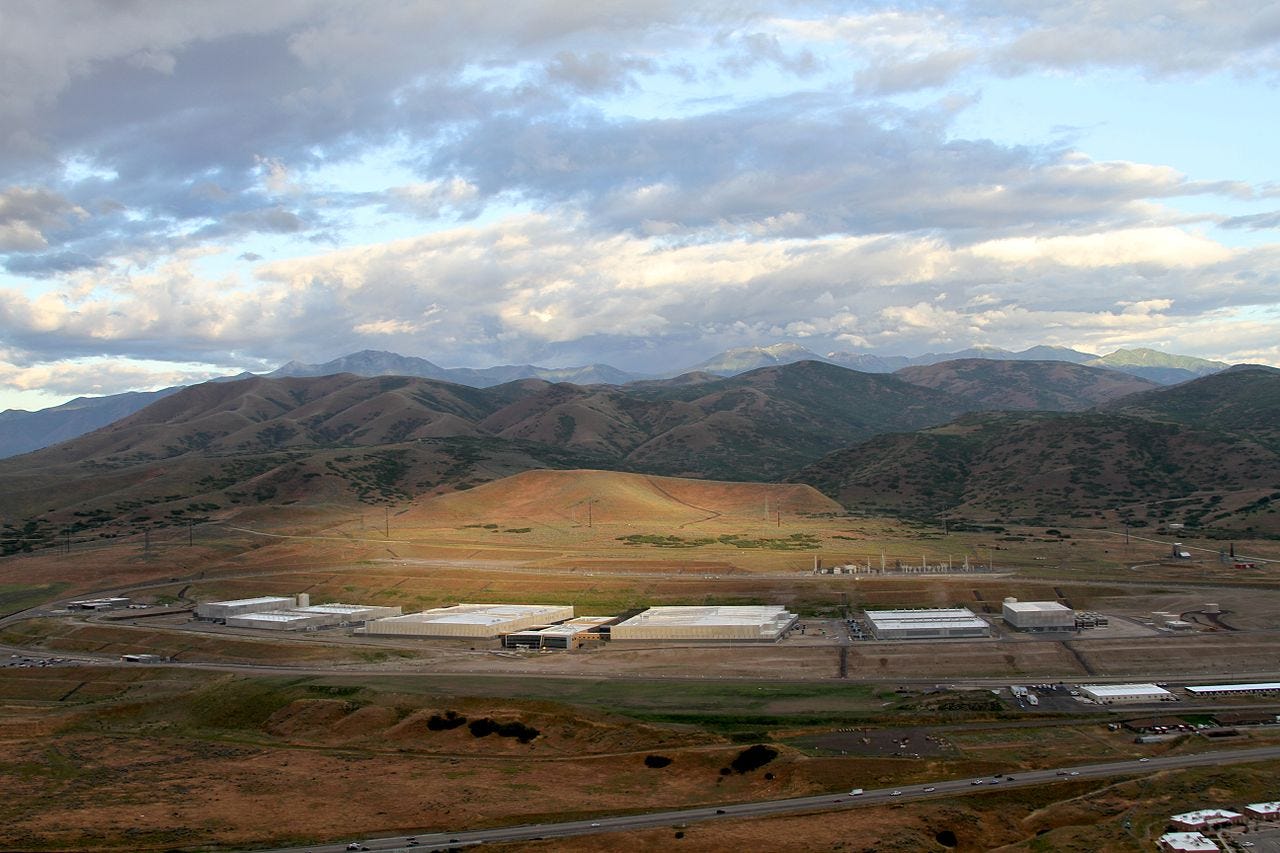
In March 2026 the United States Army announced that The Tooele Valley Project Area would build a massive data center operated by CyrusOne—itself a joint holding company owned by BlackRock and KKR (KKR also owns the company that operates the educational software Canvas)—in order to provide Artificial Intelligence capability for the United States Army.
“AI is a strategic asset for the Army,” Secretary of the Army Dan Driscoll said in a statement. “It is a force multiplier, supports future transformation and requirements, keeps the Army ahead of our adversaries, and generates resiliency across the force. These data centers are a critical resource to support that strategic imperative.”
This paper aims to contextualize and understand the history of the data center and to tie that history back to one of the most influential (if little known) figures produced by the American West, James Jesus Angleton of Boise, Idaho. For more on him, read these Hunt for Tom Clancy dispatches
During the early Cold War Angleton was the head of CIA’s Counterintelligence unit; his index card-based files on Americans suspected of subversion, espionage, or any number of other offenses against the state rivaled those of FBI Director J. Edgar Hoover, another early pioneer in index-card based data management, and those of the United States Army’s Counter-Intelligence Corps (JD Salinger served in the USACIC during World War II).
This ongoing series of dispatches will attempt to explain the rise of the data center as the direct result of a continuum of American intelligence projects begun after World War II managed by the military, the intelligence agencies, and the Atomic Energy Commission that were reliant on the use of labor, land and ideas from the American West, and suggest that it is no new phenomenon to Utah or Idaho. In 2019 FBI added 140,000 square feet as part of new $100 million dollar facility dubbed “Grey Wolf” to its already existing Pocatello facility FBI operates in partnership with Idaho State University.