Cicero, Skepticism, and Stoicism
Follow into
Save into
Follow into
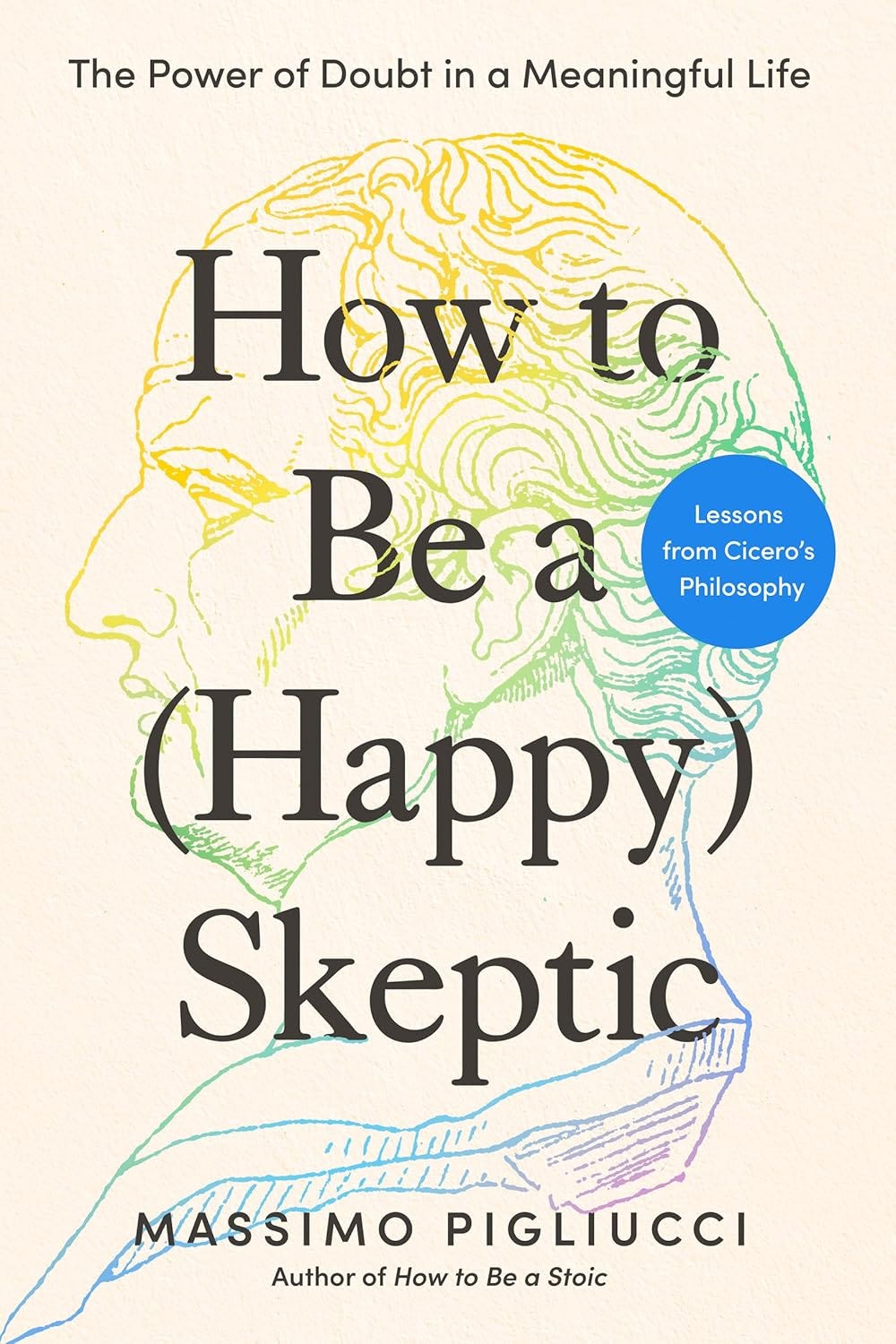
Welcome to Stoicism Today! This week we are pleased to bring you an interview with philosopher Massimo Pigliucci about his latest book, How to Be a (Happy) Skeptic: The Power of Doubt in a Meaningful Life. The book describes the life and work of Marcus Tullius Cicero, the influential Roman statesman and philosopher. While Cicero considered himself a Skeptic, he was highly sympathetic to Stoicism and frequently wrote about Stoic ideas. Below, Pigliucci sheds light on Cicero’s philosophical work, making the case that his writings are still relevant for us today. We hope you enjoy his interview with Stoicism Today editor Brittany Polat.
Brittany Polat: For those who aren’t familiar with Cicero’s work and influence, could you describe why he is such an important figure in the history of philosophy?
Massimo Pigliucci: Marcus Tullius Cicero was one of the first Roman philosophers, was keenly aware of the rich heritage of Greek philosophy, and tried not just to popularize it in Rome but to absorb it, digest it, and produce a novel synthesis of some of the major ideas of the time, especially when it came to Platonism, Aristotelianism, and Stoicism.
He also has had an outsized influence on the history of western thought: Augustine of Hippo read and greatly appreciated Cicero. He was also well known throughout the Middle Ages, and the Renaissance began when the Italian poet Petrarch rediscovered the lost letters that Cicero wrote to his friends. He was a major influence on the thinkers of the Enlightenment, as well as on the founding fathers of the American Revolution. There really hasn’t been a time period – except our TikTok and Instagram-cursed one – where Cicero was not well known and appreciated.
BP: What drew you to study and write about Cicero? Why should we all be interested in his work today?
MP: I was drawn by his thorough humanness. He was a deep thinker, and yet could be petty at times; he was both courageous and yet shied away from physical confrontation; he strove to follow Stoic ideals but fell into pieces when his beloved daughter, Tullia, died in childbirth.
He is, in other words, very relatable and inspiring. Don’t get me wrong, I love Epictetus, for instance, or Socrates. But those figures seem a bit too remote to me, almost legendary. Cicero, by contrast, is one of us. If we read his personal correspondence we can readily recognize our own foibles and defects, and yet we can also see someone who strove mightily to save his country from destruction, succeeding once and failing the second time.
The reason we should be interested in him today is the very same we ought to be interested in ancient thinkers in general – be they from the western tradition like the Stoics and the Epicureans or from the eastern one like Buddhists and Daoists: the fundamentals have not changed. Sure, we have far more sophisticated science, and hence technology, than those people could have possibly imagined. But our brains, our thoughts, our passions and wants, have not changed significantly since the Pleistocene, 200,000 years ago. Which means that what sharp thinkers like Cicero or Epictetus understood about human nature will remain valid so long as there will be a human nature.
BP: When many people think of skepticism, they think of the more extreme Skepticism advocated by Pyrrho of Elis. But Cicero was an Academic Skeptic. How is Academic Skepticism different from Pyrrhonism, and why do you consider it a more reasonable framework for belief?
MP: The two forms of ancient Skepticism were initially very similar, as Arcesilaus, the philosopher who began the skeptical turn at the Academy, was influenced by one of Pyrrho’s students, Timon of Phlius. But they then began to diverge, particularly under the most influential of the Academic Skeptics, Carneades of Cyrene.
Briefly, the Pyrrhonists believed that in most cases we should simply suspend judgment about things, a stance they thought would lead to ataraxia, or tranquility of mind. The reason for this counsel was that, according to them, it is always possible to mount just as good an argument in favor as against a given proposition, so on what grounds would one take sides?
Of course even Pyrrhonists still had to make daily decisions in life, and they thought it reasonable to proceed on the basis of commonsensical criteria: our feelings (like hunger, thirst, etc.); what our senses appear to tell us; the teachings of people who are skilled at what they do (e.g., blacksmiths, carpenters, and so on); and the customs of the society one lives in. Fair enough, though not particularly philosophically exciting, and – more importantly – nudging people toward social conservatism: if we just follow society’s customs, then on what basis are we going to argue that slavery, for instance, ought to be abolished?
The Academics had a more nuanced view of skepticism: they thought it was genuinely about open inquiry, not reducible to just commonsense. So they articulated a sophisticated epistemology that was fallibilist and probabilist. Fallibilism is the notion that – since our two sources of knowledge about the world (the senses and reason) can be wrong, then we ought always to keep in mind that our conclusions are provisional, subject to revision by way of further observation or argument. Probabilism is the idea that assent to impressions (to use the Stoic terminology) is not a matter of yes or no but of degrees.
Specifically, Carneades described four levels of “pithanon” (i.e., “persuasiveness”) when it comes to any given impression. The impression may appear to be apparently true, meaning that we think it is more likely to be true than not, but we wouldn’t bet a lot on it; or it could be convincingly true, a stronger belief that we might back up with a decent bet; or it could be “undiverted” by other impressions, that is, coherent with everything else we know on the subject; or, finally, the impression could be “thoroughly explored,” basically the equivalent of modern scientific knowledge.
Notice that we never reach certainty, but we now have a graded guide to decision making. Every time you are regarding an impression, then, you should not ask yourself – as Epictetus might – is it true or not? You should instead be more nuanced and consider how much money you would be willing to bet on its veridicity. That bet is a direct estimate of your confidence in the truthfulness of the impression.
Incidentally, Cicero – with a stroke of genius – translated Carneades’s “pithanon” with the Latin “probabilis,” from which of course we get the modern term probability. I’m not suggesting that the Academic Skeptics had a fully worked out quantitative theory of probability – for that we had to wait until the work of Blaise Pascal and Pierre de Fermat on gambling (of all things), as late as 1654. But the Skeptics got close enough for many practical purposes!
That’s why I find Academic Skepticism more defensible: it gives you a rigorous method for revising belief in light of evidence, rather than a blanket counsel to suspend judgment.
BP: Though Cicero was officially a Skeptic, he seemed to agree with the Stoics on quite a few points. In what ways does his philosophy dovetail with Stoicism? And what were his strongest disagreements with the Stoics?
MP: Yes, Cicero was definitely “Stoic-adjacent,” which is another major reason I chose him as my guide in the book. Fundamentally, he agreed wholesale with Stoic ethics. Many of his books are clearly inspired by the Stoic approach, and he is often not shy about telling us directly. For instance, he says in De Officiis (On Duties) that the book was inspired by a (now lost) treatise by the middle Stoic Panaetius of Rhodes, who had been the teacher of Posidonius, who in turn had taught young Cicero.
Even in De Finibus Bonorum et Malorum (On the Ends of Good and Evil), where he compares the Epicurean, Stoic, and Platonic systems, he ends up telling us that though his allegiance is with the Academy, he feels more strongly attracted by the arguments of the Stoics.
That said, Cicero doesn’t pull punches when it comes to criticizing the Stoics either. He does so most clearly in De Divinatione (On Divination), which modern philosophers of science such as myself consider the first treatise ever written on the subject that we call pseudoscience. Cicero marshals an impressive number of examples and arguments to demolish the Stoic belief in divination, which is the ability to predict the future on the basis of astrological signs, the flight of birds, or the entrails of animals — the last of these known as haruspicy, a practice the Romans took seriously enough to maintain an official college of priests for it.
The Stoics, incidentally, were not stupid: their acceptance of divination came from their metaphysical position that everything happens by way of cause and effect. If that’s true, then it follows that examining one aspect of the cosmic web of cause-effect ought to allow us to predict a different aspect of that web. It is the same principle of modern scientific inference, but it doesn’t work when there are no causal connections between events, which the Stoics failed to appreciate but Cicero saw clearly.
BP: In the book you devote several chapters to issues of justice: how to be a good citizen, how to build a just society, how to be a good friend, etc. These are based on some of Cicero’s most influential works, such as On Duties and On the Republic. What would you say are his most significant ideas on justice? How much are they based on Stoicism?
MP: The single most crucial idea articulated by Cicero in this context is the notion of natural law, to which I devote a separate chapter in the book. Consider this: we often say that a given law designed by human beings is just, or unjust. But that way of putting it implies that there is a higher standard on the basis of which we can judge the justness of a law. Where does this standard come from?
Nature, answers Cicero. Whether you interpret “nature” in the Stoic sense of a providential cosmos, in the Christian one of a benevolent God, or in the modern secular one of evolution by natural selection, it is nature that tells us that certain behaviors are either conducive or undermine human flourishing. And those are objective, if contingent, facts. It’s like saying that certain substances or foods are good or bad for human beings. This is objectively the case, though it is also a fact contingent on us being a certain kind of social primate. If we were a different sort of animal, both medicine and ethics would work differently for us.
This idea is so central that it was taken up and elaborated by the Medieval Church, by the Renaissance humanists, and by the thinkers of the Enlightenment. Today, it provides the foundation for the United Nations declaration of human rights.
BP: Cicero faced many personal challenges in his life, including the early death of his beloved daughter, Tullia. To what extent did Cicero follow the Stoic approach to dealing with hardship, pain, and grief? What does he say about emotion?
MP: As John Sellars once put it to me, Cicero very much wants to be a Stoic, but he is too human for that. In the Tusculan Disputations he writes about grief along essentially Stoic lines: it is a passion, meaning an unhealthy emotion, because it interferes with reason.
And yet, when Tullia dies, he is completely destroyed by grief. Nothing seems to help, not even reading letters of consolation written by other philosophers for that very purpose. But Cicero is resourceful and he invents a whole new approach: he writes a letter of self-consolation, addressing it to himself in an attempt to get out of the horrible state of mind in which he had descended.
Incredibly, it works! Unfortunately, Consolatio – the book in question – is now lost to the sands of time, only fragments survive. Yet it was so popular that an incredibly good forgery emerged in 1583, during the Renaissance, when the Italian scholar Carlo Sigonio claimed to have found a manuscript of Consolatio. Sigonio was a genuine classical scholar, and he wrote the text with such command of Cicero’s Latin style, vocabulary, and rhetorical rhythm that it passed as authentic for over four centuries. Although scholars always had doubts, we had to wait until a computer analysis in 1999 to finally demonstrate that it was a fake. Still, it is such an effective fake, written in beautiful Ciceronian style, that the classicist Michael Fontaine published a new translation of it, now attributed to Pseudo-Cicero, as recently as 2022.
BP: I appreciated how you interspersed descriptions of Cicero’s tumultuous life and times with the chapters on his philosophy. How should we view his philosophy in relation to his life? Did his theoretical approach inform his historic decisions and actions?
MP: Yes, very much so! That’s a major reason I picked Cicero in the first place. Although he thought that political life was a better way to spend one’s time than contemplating philosophical matters (i.e., the exact opposite of Aristotle), he kept working at different aspects of his philosophy until he was murdered on the order of Mark Antony.
Throughout his life Cicero refined his philosophical ideas on the basis of his lived experience, and vice versa strove mightily to live by the light of his philosophy. His Stoicism told him that virtue is the only thing worth caring about, and that made him uncommonly brave despite a natural disposition to avoid physical confrontations. He knew he was risking his life when he started writing his famous Philippics speeches against Mark Antony, which he delivered on the floor of the Senate in a last-ditch attempt to save the Roman Republic. But he did it anyway, with no hesitation.
At the same time, his Skepticism counseled him never to be too sure of any of his beliefs, which made him a cautious yet effective statesman, one who did manage to save Rome from the Catilinarian conspiracy in 63 BCE.
Most of us won’t have the opportunity to engage in such greater-than-life efforts, and yet all of us can take inspiration by Cicero’s striving to – as his father recommended to him by quoting Homer’s Iliad – “always be the best, my boy, the bravest, and hold your head high above the others.”
BP: At the end of the book you offer 10 lessons for living philosophically, suggesting that Cicero’s philosophy offers “not just a guide to individual virtue, but a road map to civic renewal” (p. 299). What are some of the most important ways we can apply Cicero’s philosophical approach in our own lives today, both as individuals and as a society?
MP: The first lesson, I think, is to always ask ourselves why we think that something is true. Could we be wrong? What are the chances? That would save ourselves and society a lot of trouble.
The second one is – at least from time to time – to ponder what we value and why. Socrates said that the unexamined life is not worth living. That may be a bit of an exaggeration, but Cicero would agree that a good way to avoid misliving our life is to decide what matters and then go after it.
Third, I think Cicero’s emphasis on duties (he wrote a whole book on the topic!) is crucial. We live in a society where everyone wants more and more rights, yet we seldom pause to think that rights come with duties. What do we owe each other? When was the last time we fulfilled our social and ethical obligations? What are we waiting for in order to do better?
Finally, Cicero insists that the best way to tackle problems is to prepare for them, not ignore them. We become old, if we’re lucky, and we all die, no exceptions. Even the luckiest life will be marked by pain, suffering, and loss. Rather than live as if all of the above concerned other people and not us, how about we take seriously the sort of animal we are: fragile, flawed, and mortal? That way we will both reduce the impact of the bad stuff when it comes, and manage to make the most of what nature and fate give us in the meantime. Cicero’s own shattering grief over Tullia is the clearest proof he lived this lesson before he wrote it.
BP: Anything you would like to add?
MP: Yes, thank you. I’d like to make an appeal for the revival of the word “skeptic.” These days, it has a very negative connotation, indicating someone who doesn’t believe in anything and cultivates a grumpy attitude toward life.
But the term comes from the Greek skeptikos, meaning inquirer. A skeptic is someone who never ceases to ask questions, evaluate evidence and arguments, and reach tentative conclusions all while remaining aware of her own fallibility and the need to actively cultivate an attitude of epistemic humility.
I really believe that if we were all a bit more skeptical in this sense, the world would be a significantly nicer and kinder place to live.
About the Author
Massimo Pigliucci is an author, blogger, and podcaster, as well as the K.D. Irani Professor of Philosophy at the City College of New York. His academic work is in evolutionary biology, philosophy of science, the nature of pseudoscience, and practical philosophy. Massimo publishes a regular column in Philosophy Now entitled “The Art of Living.” His books include How to Be a Stoic: Using Ancient Philosophy to Live a Modern Life (Basic Books) and Nonsense on Stilts: How to Tell Science from Bunk (University of Chicago Press). His Substack is Figs in Winter: A Community of Reason.
Thanks for reading Stoicism Today! This post is public so feel free to share it.