

Welcome to Stoicism Today! This week we bring you a reflection on Stoic thankfulness from computer scientist and Stoic practitioner Eric “Siggy” Scott. Basing his ideas on Plutarch’s depiction of Cato and Seneca’s work On Benefits*, Scott suggests that Stoicism has a* “tightly integrated theory of thankfulness-as-morality” that includes radical gratitude, generosity to others, and our relationship to the cosmos.
We should make evident our gratitude by unrestrained expressions of emotion, and we should express these feelings everywhere. —Seneca, On Benefits, II.22.1.
Cato’s Bad Investment
When Cato was a young man he inherited an enormous fortune.
Well, a second enormous fortune. As heir to a prominent farmer-warrior family, by my reckoning Cato had already inherited enough wealth as a teenager to own a respectable-sized latifundium plantation. These iconic, slave-worked estates and their monoculture cash crops would come to dominate the economy of conquered Roman lands, and they embodied the drive for efficiency that Cato’s own grandfather had pioneered in his famous agricultural writings. But while still young, Cato experienced another windfall: his cousin died and left him an estate worth 100 talents of silver. This works out to about $7 million US in today’s silver prices, but closer to $100 million of purchasing power when you consider a day’s wage in ancient Rome. Overnight Cato’s wealth had doubled.
On the surface, it’s just another story of a ridiculously wealthy Senator claiming a life of faux-austerity (a trope that continues to this day). Although orphaned and left in the care of the state with his brother and sister, Cato never experienced genuine poverty. This didn’t stop him from reveling in a public show of frugality (a virtue Romans loved to heap praise on), and in the perennial trope of “philosophical” behavior—for Cato this meant going shoeless, walking when his peers rode horses, and actively avoiding fashionable clothes. In the 21st century we have a lot of reasons to cringe at Cato, or at least to be suspicious.
But something interesting happens next. In his Life of Cato, Plutarch tells us that the young leader-to-be—still unmarried—liquifies the new estate: “he turned it all into ready money, which he kept by him for any of his friends that should happen to want, to whom he would lend it without interest. And for some of them, he suffered his own land and his slaves to be mortgaged to the public treasury.”
What I want to argue in this essay is that these two sentences—like so much of Stoic literature—mean a lot more when we understand some context. I declined to omit the bit about mortgaging slaves, because I do think that it is important to be transparent about what we are doing when we adopt an ancient spiritual tradition as the framework for our moral lives: we are making an implicit statement that the good, the novel, and the special things we learn from the ancient world (which is foreign to us in so many ways) make it worth the wrestling and dodging we have to do to cut out the parts we find wrong or objectionable.
In this case, my claim is that the novel, unique lesson that Cato’s generosity teaches us amounts to nothing less than a rich (ha!) and multi-layered theory of radical gratitude that is unlike anything we can find in the modern world—and which takes a lifetime to master. This is a bold claim, because I cannot identify anyone today (scholar or practitioner) who has proposed such a sweeping understanding of Stoic gratitude.
Here I will continue laying out the case that I began in a Stoicism Today post during last year’s Month of Gratitude (hosted by The Stoic Fellowship). There, I argued that the core meditative practices and value system of the Stoic tradition offer an especially *strong and focused route to cultivating gratitude—*going beyond more generic thankfulness habits we find in modern discourse in a way that makes thankfulness flow easily and consistently. I call this gratitude as a way of being, or radical gratitude.
But what makes the Stoic theory of thankfulness profound to me is that it does not stop there. Radical gratitude is just the first of three increasingly unique, unusual, and surprisingly emotional avenues by which the Stoics approach gratitude, which interlock to form a tightly integrated theory of thankfulness-as-morality. Specifically, Stoic thankfulness is inseparable from generosity to others, and (third) our relationship to the cosmos. Stoic gratitude is a way of being, but also a way of giving, and of praying.
In this essay we will take on the second part of this framework, to see how giving is fundamental to radical gratitude. Along the way—largely thanks to Seneca’s guidance—we’ll see the deeper meaning of Cato’s seemingly financially illiterate funding project. But the entry point requires making a sizable cultural jump—into the traditional (Roman) “gift economy.”
The Gift Economy
So how does Cato taking his wealth out of the market (subjecting it to decay from inflation!) and giving massive, interest-free loans to his friends somehow reveal a radical lifestyle of gratitude? The answer becomes clear if we first address a logical kink that my previous essay left wide open. “Okay, fine,” one might say after hearing us talk about Stoic gratitude as a way of being—”I see how following the Stoics into their radical rescaling of values can reduce barriers to gratitude. But something doesn’t make sense about all this. How can we be grateful for things if we say they have no real value?”
This is where the Stoic typically smiles knowingly, invites you in for a cup of tea (are you an oolong person? I just got a new pu’erh, wanna try it? or perhaps something herbal?), locks the door, and breaks out a white board. Like Socrates blocking your way in an alley until you answer all his questions, we’ve baited you with the paradox, and thereby captured enough of your attention to explain how external things can still be “preferred” and “dispreferred,” so they still have a kind of value. This theory is brilliant at restoring common sense (and morality) to an otherwise radical picture. But it takes a lot of time and will probably leave you with more questions than you started with (It doesn’t help that modern Stoics have at least 3 different ways of interpreting preferred indifferents!).
With gratitude, though, there’s an easier way. For the ancients, gratitude was less about appreciating and liking an object—and more about how willing you are to reciprocate the gift.
This is one of those many touch points where the ancients aren’t immediately easy for moderns in the developed world to approach. “What we have received from them leads us to believe that we resemble them,” wrote Fustel de Coulanges in 1864, one of the first scholars to recognize this problem (The Ancient City, p. 3). “We have some difficulty in considering them as foreign nations.” In her popular history of Rome, Mary Beard speaks of approaching ancient Rome as a “tightrope”—where to one side everything looks familiar, like a shockingly modern conversation we can slip right into, while on the other we are confounded by completely incomprehensible practices like infanticide, slavery, and gruesome gladiator games (SPQR, 2015).
In this case, approaching Stoic gratitude launches us headlong into the Roman gift economy. Simply put, in a world without banks, health insurance, and Social Security, the way you get funds to handle big life events or start a business is to ask your friends and family to chip in—and/or to ask wealthy people in your community to be your sponsor. The result is a world where giving people money when they ask—as distinguished from loaning money or trading in a market—was and still is a widespread social duty across much of Earth. As Miriam Griffin & Brad Inwood put it in their introduction to Seneca’s book on the topic, this was extremely important in part because the
“state apparatus was minimal and there was little in the way of impersonal mechanisms of exchange or welfare. Doing something good for someone else and reciprocating when on the receiving end of such a good deed was widely acknowledged as the sine qua non of social stability.”
This is alien to much of the norms around money—and especially asking for money—in the developed world today. If you don’t have experience with a gift economy (or with family members who have emigrated from one), it’s hard to express how pervasive and all-encompassing this giving and receiving of (often small sums of) money is, and how normal it is for people to ask for your money without offering you something explicit in return. It’s not just an occasional ask in times of dire emergency, but a constant part of the daily economic fabric of the family and community.
Wide swathes of the world operate this way. In Chinua Achebe’s epochal Nigerian novel, Things Fall Apart (1958), for instance, we find a depiction of a wealthy character, Nwakibie, deliberating over whether to give the protagonist seed yams so he can start his own farm. While set over a century ago, the basic dynamics apply easily to much of present-day West Africa (p. 16):
“Many young men have come to me to ask for yams but I have refused because I knew they would just dump them in the earth and leave them to be choked by weeds. When I say no to them, they think I am hardhearted…I have learnt to be stingy with my yams. But I can trust you…I shall give you twice four hundred yams. Go ahead and prepare your farm.”
This problem—deciding how generous to be to someone who wants your help—was something Seneca, as one of the wealthiest men in all of history (ten times wealthier than Cato, by my estimate), was consumed with. The longest book he wrote on a single topic is devoted to reasoning through precisely Nwakibie’s problem from a Stoic perspective (only the Letters to Lucilius is longer). Particularly sticky problems include deciding how to reciprocate benefits when the wealth of participants varies and when the value of what you’re given isn’t clear, and how to keep an accurate memory of who has helped you (even though, in modern gift economies at least, writing down exact numbers as if they are debts is seen as rude). And Seneca is especially concerned with when you should say “no” to someone who repeatedly falls into crises of their own making (sound like anybody you know?).
All this is to say, when Seneca says “only the sage knows how to render thanks” (Letters, 81.10), he’s bringing an awful lot of baggage into the conversation with him! One could almost be forgiven for dismissing all this talk about benefits as a curiosity or a detour—hardly relevant to the core Stoic doctrine of accepting what you can’t control.

Yams in a Nigerian market. Image source: Wikimedia.
But this way of looking at gratitude is actually a brilliant move, in my opinion, and one that draws much of the Stoic system together into a tight, self-consistent bow. By situating the concept of thankfulness in a gift economy, we’ve already made the fundamental shift of perspective that Stoicism calls us to: we’ve moved from locating Happiness in “what I want” to talking instead about “what is expected of me” (as Victor Frankl has it).
Giving Wisely
So what is expected of us in our Stoic journey of gifting and gratitude?
At the most obvious level, gratitude is about recognizing that someone has done something for me—and feeling an ethical desire to do something for them in return, as far as my resources allow. It’s an application of the Golden Rule, so it’s no surprise that Seneca puts it in those terms (On Benefits, II.1.1–2):
“Let us give benefits in the way in which we would want to receive them. Above all, that means doing so willingly, quickly, and with no hesitation.”
Sounds like Cato! But what is remarkable about Seneca’s approach to gratitude is how at every turn he calls us to be proactive, thoughtful, and to err on the side of generosity, for instance by always remembering how much we have been given, but quickly forgetting how much we have given (for example, On Benefits, I.4.5).
He is well aware that the world is full of people who will abuse his generosity—either intentionally or out of irresponsibility. Gift-giving is not a traditional investment, and shouldn’t be seen as one—but we do we give to others partly to encourage them to succeed in life and to give back to us in the future. When someone chronically abuses that trust, it is rational to cut them off. Seneca acknowledges this, but he also wants us to be longsuffering and to hold out hope (Letters, 81.2.):
“It’s worth dealing with some ungrateful types in order to find one who is grateful... Let some of them go astray so that others may hit the mark... Let what has happened make you all the more generous. For where the results of an action are uncertain, one should attempt it often in order to succeed now and then.”
Elsewhere Seneca considers the dicey question of someone who has both benefited you and harmed you. Again, generosity is the norm (81.15):
“The good man will indeed judge what will be the fairest response, but he will incline toward benefits; he will lean in that direction.”
As I’ve spent time with On Benefits—as well as Seneca’s much shorter, but hard-hitting epitome of it in Letter 81—I’ve come to see the Stoic call to generously benefit others as one of the most demanding and aspirational aspects of their entire ethical system. In particular, Seneca sets an incredibly high standard by suggesting that we should be so attentive to other people’s needs that we are there and already offering them what they need before they even ask for our help (On Benefits, II.2.1):
“You must intuit the desire of each potential recipient, and when you understand it you must free him from the burdensome need to make a request. The benefit that comes to the recipient spontaneously is the one that will live on his mind most pleasantly.”
Along with his calls for benefits to be executed quickly (”Kindness always hurries”—II.5.4), aspiring to be this attentive to even just my spouse is a project that will keep me occupied for the rest of my life! Overall, Seneca sums up his description of the Stoic donor with a delightful description that in some ways mirrors the simplicity of Irvine’s optimist (Letters, 81.17):
“In sum, he will be easy to bargain with, generous in acknowledging an obligation, reluctant to make an injury cancel out a benefit. All his inclination, all his wishes, will tend toward gratitude and thanks.”
“Easy to bargain with!” What a packed phrase—something so applicable in all aspects of our social lives.
What I especially appreciate about all of this advice is that nowhere does Seneca say we have to be a doormat, allowing selfish people to walk all over us. The advice is to lean toward generosity, to err toward forgiveness and second chances—to be willing to be grateful for the 30% someone has done for us even if we still end up doing 70% of the job ourselves. He does not say we should not negotiate for ourselves. But in the gift economy, the value of generosity pays dividends that are hard to measure.
Socratic Altruism
A Stoic calculates those dividends differently than other people, because we use the “re-scaled” values that arise from our belief that virtue is the only good. Our values give us a wealth of resources that makes it possible to be generous in cases where we might otherwise not be willing to. We’re not necessarily out to make a profit in the conventional way. “It is a sign of a great and good mind,” Seneca offers, “to pursue not the returns from benefits, but the benefits themselves” (On Benefits, 1.1.12). We’ve placed our emphasis on virtue—and benevolence is part of virtue. Harkening back to the ethical doctrines that the Stoics borrow from Socrates, we follow a pure form of altruism that denies the distinction between helping ourselves and helping another person. Seneca goes out of his way not to be misunderstood on this matter (Letters, 81.19–20):
“Everyone who helps another person helps himself. I do not mean that one who has received aid will want to offer aid, or that one who has been protected will want to protect others. Nor do I mean that a good deed circles back by example to the doer... No, I mean that every virtue is its own reward. For one doesn’t practice the virtues in order to receive a prize: the reward for right action is having acted rightly. I do not show gratitude in order that my example will make someone else more generous in showing gratitude to me, but simply in order to perform a most pleasant and beautiful action.”
With Seneca as a guide through the Roman gift economy, we can now come full circle to answer the question “How can we be grateful for things if we say they have no real value?” Answer: it’s the gratitude itself that has the real value! And while we’re at it, benefiting others and thanking others are so closely related that it’s hard to draw a meaningful distinction between the two: gratitude and altruism are two sides of the same coin.
When we understand gratitude as a desire to acknowledge and reciprocate a free gift we have received—an effort to benefit the person who gave it to us—it’s clear how gratitude flows naturally from a virtuous and benevolent character (rather than from an attachment to the things themselves). As Seneca puts it, “a benefit is unconditionally good while what is done or given is neither good nor bad. It is the intention that exalts what is petty and brings light to what is shabby” (On Benefits, I.6.1).
Seneca leaves us with an artistic nugget to act as a touchstone for the entire art of gratitude. People debate the details and they aren’t that important, he says. But the three Graces of Roman art are emblematic of the process of benevolence and gratitude—one “giving a benefit, one for receiving it, and one for returning it... The Graces have joyful expressions, just as those who give and receive benefits generally do. They are youthful because the remembrance of benefits should not grow old” (On Benefits, I.3.3–5). To me this is one of the finest examples of the Stoics’ famous rationalizing mythology, wherein these daughters of Zeus become a symbolic representation of aspects of human values that we can only aspire to fully live up to.
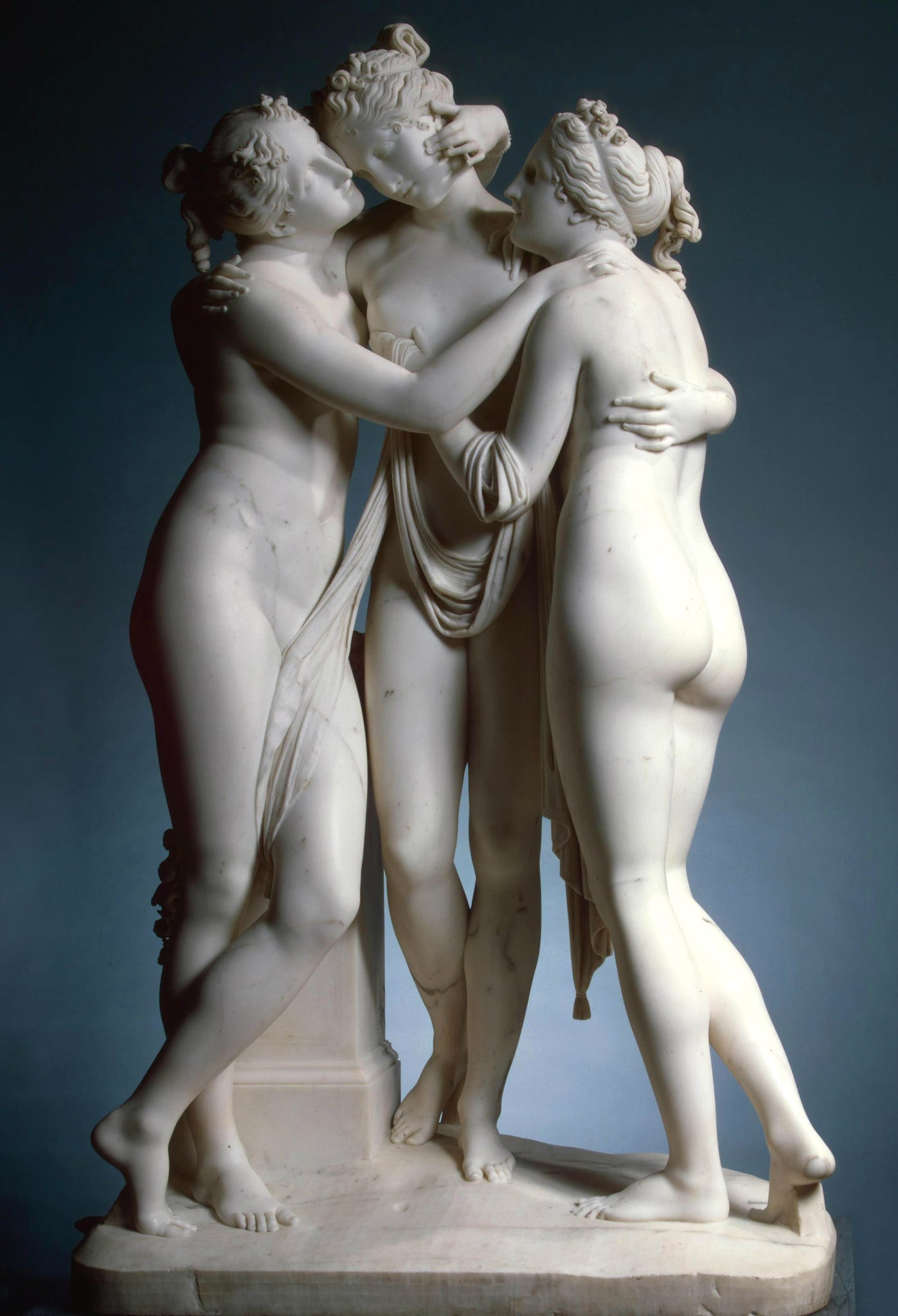
The Three Graces by Antonio Canova, 1814. Image source: Wikimedia.
Conclusion
Cato’s loan program is bad financial advice, that much is clear—and I’m sure any fiduciary financial advisor would have to agree. But I can’t tell you whether Cato was a good man. Or Seneca for that matter. We like to believe that they were highly principled moral exemplars, doing their best in difficult political circumstances. But judging the character of the ancients across a gulf of millennia is like trying to infer how trustworthy a person is based on a profile piece in an (ancient issue of the) New York Times. Even the roughly seventeen quintillion pieces that the Wall Street Journal has been feeding me on Jensen Huang this week and his whole stock-market-decimating “affair with a Chinese spy” episode barely seem to give any reliable indication of the more fiber of the person underneath. Maybe Cato’s frugality was affected for political purposes, or blown out of proportion by his admirers (much like Origen of Alexandria’s supposed philosophical asceticism was exaggerated by later Christians, after the Stoic-influenced theory of monastic discipline had become more prestigious). Or maybe Seneca really was a sycophant to the emperors he served, as some have accused, or did have shady dealings worthy of the Wall Street housing bubble, bankrupting all of Britain on purpose by giving out bad loans!
But what we can say is that the moral ideal that they aspired to in their best moments calls us to see gratitude and generosity as going hand-in-hand. We aspire to be radically grateful to others and the world for all we have received (something made much easier through the sense of abundance that comes with virtue ethics), and we aspire to strive to reciprocate that gift energetically and without hesitation (because we locate the value in reciprocating, rather than the material gift itself). In Cato’s case, that meant earmarking half his fortune to help people in his community—something in line with his culturally expected responsibilities, but also going beyond them in a dramatic way. The question for us today is how—if we really do believe this beautiful framework for thinking about ethics that the Stoics unfolded from Socrates—how we should take that lesson and apply it to our lives today. If we really believe that virtue is the highest good, then shouldn’t we be not just thanking differently, but giving differently?
At this point we’ve seen how Stoic gratitude is a deeply moral theory of generosity. There is one more piece of Stoic gratitude that rounds out their full, speculative system (in the philosophical sense of a system that “sees everything at once from a high vantage”) of gratitude: namely thankfulness to the Cosmos. Cosmic gratitude is the most difficult and demanding aspect of the Stoic theory—but it’s a topic for another day!
About the Author
Eric “Siggy” Scott is coordinator of the Washington, D.C. Stoa. In 2016, he founded Stoics in Action (https://medium.com/stoics-in-action/introducing-stoics-in-action-3d0b5177c4db) to promote “kindness as a way of life.” Siggy has been an invited speaker at Stoicon and has served the past 4 years on the Stoic Fellowship’s Service and Practice Committee. He works as a computer scientist in northern Virginia, where he lives with his wife, 3-year-old daughter, and a new, bright-eyed 4-month-old son.
Thanks for reading Stoicism Today! This post is public so feel free to share it.