Resilience and the Stoic Advice to Try Your Best
Follow into
Save into
Follow into
Welcome to Stoicism Today! This week we bring you a lightly edited transcript of Christiana Olfert’s talk from the Stoic Arts Conference, held at Tufts University on April 25, 2026. Olfert discusses the “Stoic archer” concept and how it applies to artistic endeavors and other real-world challenges. If you’ve ever tried your best at something, you will enjoy this Stoic perspective on effort and results.
Let me start with a confession: I’m a professional philosopher, but a total amateur at art of all kinds. So when I attempt to create an artwork, I try to console myself with the advice that I should just “try my best.” Most of us have heard, and have given, this advice. “Just try your best” seems like the thing to say when a task might be too hard for us; when an outcome is not entirely in our control; or when we’re dealing with uncertainty, unpredictability, or change.
Nowadays, we might say that this advice helps us focus on process rather than product, on effort rather than results. The Ancient Stoics would put this point a bit differently, though. Instead of distinguishing an emphasis on means versus ends or on the journey versus the destination, they distinguish two different kinds of ends or goals we can have (only one of which is strictly speaking a goal). Very roughly, in life and in art, we can have internal or external goals. “Internal” goals (true goals) are about our own psychological states and activities: we might aim to make good choices and avoid false beliefs, for example. “External” goals, targets that are not really goals, go beyond our own psyches: we might aim to create a beautiful artwork, for example, or perform a just action, or live a happy life. For the Stoics, then, there is a significant difference between the goal of creating a beautiful artwork, and the goal of trying our best to create a beautiful artwork. The advice to “try your best,” in this sense, tells us to set a particular kind of internal goal: a goal about directing our motives, judgments, and choices in a certain way, which does not depend on, and can even come apart from, the external goal of succeeding in what we are trying to do.
But is the advice to “try your best” good advice – either in art or in life? Especially for us amateurs, are internal goals like “trying our best” any more in our control, any more insulated from chance and change, than external goals?
Archers, Artists, and Aiming Well
To begin answering these questions, let’s connect our contemporary advice to “try your best” to Ancient Stoic doctrine. What do the Stoics say we should do if we want to live well and happily? Cicero answers this question with his famous analogy between aiming to live well and happily, and an archer aiming to hit a target. We might initially be tempted to compare our goal of living well with the archer’s goal of hitting their target: we will live well and happily – we will succeed at living well – when we get the good things we aim to have, just as the archer will have succeeded if they hit a bullseye on their target. But Cicero explains that this is a mistake. The goal and the standard by which we determine whether someone is a good archer is not hitting the target. It is aiming well at the target:
If a man’s object were to aim a spear or an arrow straight at something, his doing everything in his power to aim it straight would correspond to our doctrine of the final good. On that kind of analogy, this man must do everything to aim straight. And yet his doing everything to attain his object would be his end, so to speak, analogous to what we are calling the final good in life, whereas his striking the target would be something ‘to-be-selected’, as it were, not ‘to-be-desired.’ (Cicero, De Finibus 3.22).
Here is what Cicero seems to be saying. Suppose we were trying to determine whether someone is a good and successful archer. Can we determine this by asking if the archer has hit her target? Well, no. Someone may hit a target accidentally, without being skilled at archery. And even an expert archer might fail to hit her target sometimes, because actually hitting the target depends on many factors beyond anyone’s control, even that of an expert archer. An expert archer can be expected to account for ordinary wind conditions and the usual obstacles, but failure to hit her target because of a once-in-a-millenium earthquake, for example, or for the nefarious plans of a saboteur, doesn’t impugn her skill as an archer. Failing to hit the target in these cases doesn’t make someone a bad or unsuccessful archer, just as accidentally hitting a target doesn’t make someone a good and expert archer. So, since hitting the target does not always correlate with success at archery, we should not think of that as the primary end or goal of archery. Instead, if anything, the ultimate end of archery is aiming well, that is, correctly doing everything in one’s power to hit the target. This is what sets the necessary and sufficient conditions for being a good archer, and is therefore the standard by which we distinguish success or failure at archery. Insofar as the goal of an activity sets the standards for an activity’s going well or successfully, and is grounds for praise for doing the activity well, we should say that the true, primary end of archery is not hitting the target, but aiming well at the target.
What does this mean for our attempts to live well and happily? Well, the Stoics say that in life as in archery, the ultimate end and standard for success in living is correctly doing everything in our power to get what we aim at. Put another way, the ultimate end of life is trying our best to get what is beneficial to us and avoid what is harmful, in accordance with our natures. Like the archer who may or may not actually hit her target, trying our best may or may not lead to our actually getting what is beneficial and avoiding what is harmful. But it’s the aiming or the trying that counts. And more specifically, aiming or trying counts when it is our best effort, that is, when it is done with skill, expertise, or virtue. “Trying our best” in the sense of “aiming well,” Cicero says, is the true, primary end of all our actions and activities, including the activity of living our lives.
Let me now tie this general background to the topics of impermanence and art. First, Cicero’s archery analogy plausibly applies to our activities of artistic creation and appreciation as well as to life as a whole. If we can talk at all about goals or ends of artistic activities, by which we judge if they are going well or badly, successfully or unsuccessfully, it seems clear that the Stoics would not identify artistic ends in terms of the creation of a beautiful work, for example, or the having of a specific aesthetic experience in contemplating a beautiful work. Instead, if artists and art appreciators are like archers, the goal of our artistic activities is something more like aiming well at creating and properly appreciating beautiful works: trying our best to make them and to understand and experience them accordingly.
But why should we think that artists and art appreciators really are like archers, and that we should understand the goals of artistic practices in analogous ways? Well, intuitively, successfully creating beautiful works and having aesthetic experiences are not fully up to us. They depend on external resources and materials; leisure time for creation and appreciation; a certain kind of health status, and physical and perceptual abilities; the material and political infrastructure for art preservation and display; and so on. These external resources and facts about the world come and go, as does our access to them. They are impermanent. And here is the key point: intuitively, we wouldn’t say that someone is a failed artist because the impermanence of external necessary conditions got in the way of her creating something beautiful, or of appreciating a beautiful work. If she develops tendonitis and can’t play her instrument for the time being; if her favorite local art museum is bombed or robbed; if she loses her job and can no longer afford the materials she needs to complete her work; these changes in her circumstances don’t make her a failed artist, nor do they make her artistic activities poorly done. But if impermanent externals don’t have any bearing on whether someone is a good and successful artist, or whether someone’s artistic activities are well or poorly done, then these impermanent things must be separate from the true goals or ends of artistic activity. As in the case of archery – and life in general – to look for the true goals of artistic activity, to find the standards for art done well or badly, we should instead look inward, toward the soul of the artist and her internal discernments, feelings, judgments, and choices.
An Objection
Now, my students would have some questions about what I’ve said so far. One question might be: why are we talking about standards of artistic practice at all? Isn’t art something personal and subjective, rather than something you can succeed or fail at? Isn’t the whole point of the “try your best” advice to avoid thinking in terms of “success” and “failure”?
I think I know how the Stoics I read would respond to these questions. In the context of Ancient Greek and Roman philosophy, to have a goal just is to subject yourself to standards of doing well or badly, success or failure. To the extent that you achieve a goal, or get closer to achieving it, you do well; to the extent that you fail to achieve it, you do less well. Of course, this may be a matter of degree rather than of absolute categories – there might be better or worse, rather than categorical success or failure. But to the extent that “trying your best” is indeed a goal you’ve set for yourself, you can achieve that goal to greater or lesser degrees, and in that respect, there are some evaluative standards to which your activities are subject – even artistic activities.
The Stoics would also remind us that “trying your best” is not a trivial or easy goal to achieve. Giving it your best involves more than putting in some kind of effort when you feel like it. Your best effort might involve trying to cultivate certain skills – even virtues – that advance and perfect your goal-directed activities. You might well need courage, moderation, justice, and wisdom in order to give the best version of your efforts, even in artistic activities. In this respect, the Stoic advice to “try your best” does not merely involve some standards or other for our activities; it might involve very high standards, even the standards of virtue, in order to really count as your “best”.
But here is an aspect of “trying your best” in Stoicism that might reassure my students – and maybe the rest of us – that the Stoic approach to art is not totally unrelatable or overly demanding. If I’m right that the true goal of artistic activities, for the Stoics, is to “try our best” to create or appreciate beautiful art, this is one and the same goal for amateur and expert or professional artists alike. It’s not the case that “trying” is a lower-level goal for us poor amateurs who can’t do any better, while “creating beautiful art” is the loftier, more ambitious goal for accomplished, skilled artists and connoisseurs. Again, if I’m right, all Stoic artists have the same goal of “trying their best,” and amateur art is continuous with professional or expert art in this respect. And we might think that this is a kind of vindication of amateur art: fundamentally, the Stoics say, amateur and skilled artists are doing the same thing, namely, trying their best to create and appreciate beautiful works. Focusing on “internal” goals of effort and discernment might go some way toward making artistic practice more accessible and relatable than you might initially think from a Stoic perspective.
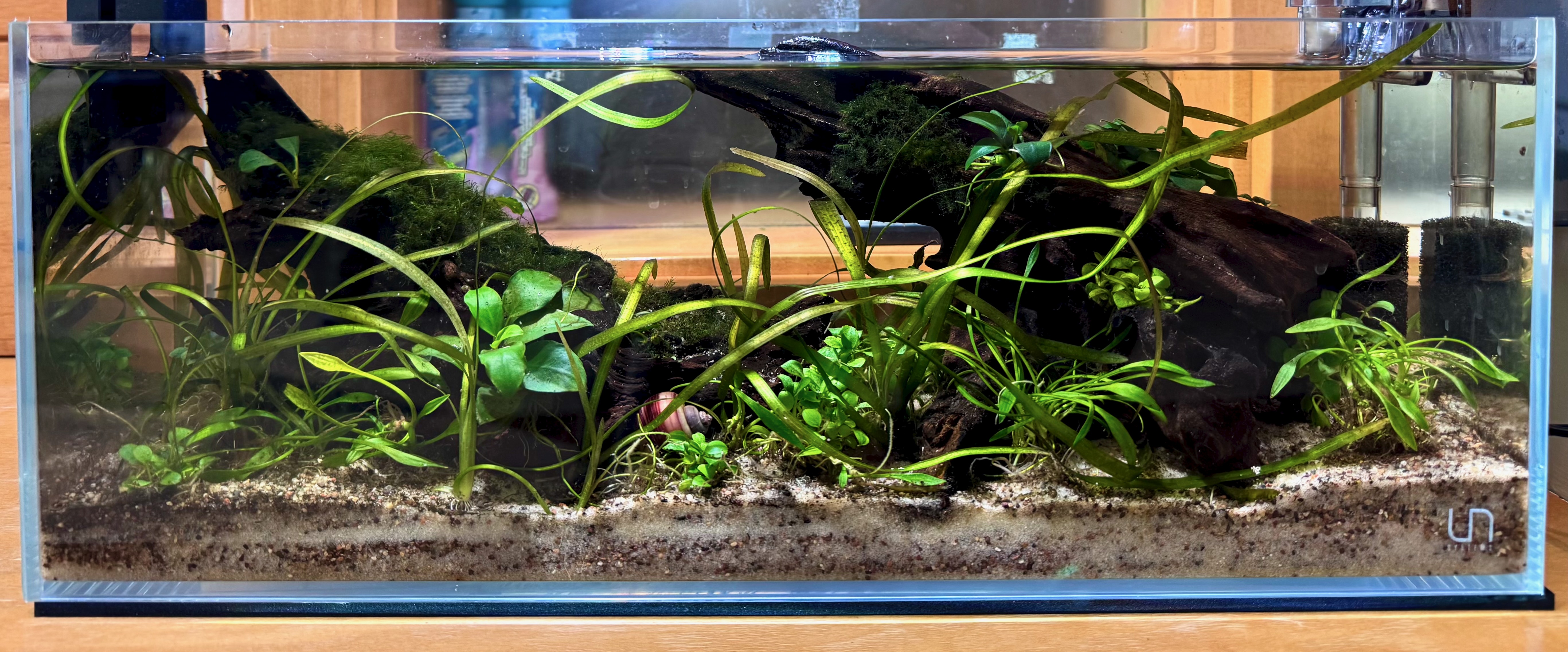
To be honest, this makes me feel a bit better about my own artistic contribution to this conference. As I mentioned, I’m an amateur at all kinds of art, but the medium I chose for this weekend is especially new to me. For the Stoic Arts Conference, I created an aquascape. For those who may not know, people have been keeping fish in ponds and dishes for a long time, and water features prominently in regular landscaping. But aquascaping as its own art form seems to be a mostly 20th century invention, with a great increase in popularity in the 1990s following the work of Japanese photographer and aquascaper Takashi Amano. As you can probably guess, aquascaping is, roughly, the aquatic equivalent of landscaping. It is “water gardening”: the art of arranging various materials, including plants (live or artificial), rocks, driftwood, substrate, and other decorations in aquariums. Usually, aquascapes also feature fish or some other kind of aquatic fauna to add to the impression of a closed, complete ecosystem in the work. Nowadays, there are many accepted, distinctive styles of aquascaping, from Dutch style to Iwagumi to Nature to Jungle Style and more. There are also many aquascaping galleries, awards, and competitions, from the massive International Aquatic Plants Layout Contest (IAPLC), to the Art Aquarium Gallery in Tokyo, to Aquashella competitions at different hobbyist shows around the US, to small display tanks at local fish stores. A year ago, this was a world I was completely unaware of. Then, my son asked for his first fish.
To make a long story short, I wanted to create an aquascape for this conference in part because it was something I’d never done before. There were a ton of challenges involved in creating a scape that would be small, stable, and portable enough to survive the half-hour highway trip from home – where it had been growing in since early January – to my office here at Tufts, and from my office to the conference venue. And then there are my local water parameters, which, I discovered by experience, greatly reduced my plant selection, especially given my budgetary constraints with the kind of lighting I was able to use. I did, however, try my best to create a beautiful aquascape. And in the process, I learned so much about what it takes to put forward your best effort in a project like this. It was truly humbling to discover how much I hadn’t considered, and the myriad choices I had to make that would ideally be informed by the study of biology and chemistry, and ideas about composition and water movement, scale, size, and proportion, light and shadow, color and texture, and a whole lot more. I love a good challenge, and I’m an academic by preference and training, so none of this was discouraging; for me, it was part of the fun. But honestly, the result is a bit disappointing to me. The final aquascape did not, in fact, come out the way I’d hoped or envisioned.
This is where the advice to “try my best” seems most relevant to my own projects – when the result or the outcome threatens to fall short. When I look back and reflect on the work I did, what I learned, and what skills I began to develop, it turns out that I came a long way toward the goal of trying my best to create a beautiful aquascape. I did not fully succeed in this goal, not least because I did not fully develop all the skills of aquascaping, and all the virtues required for aquascaping, on my first try. But if I share this goal – of trying my best – with all aquascapers, even the most skilled and professional, then my project is not that different from the work I most admire. I became part of an artistic community of people all trying to do the same thing within our different circumstances, skill sets, aesthetic preferences, financial limitations, and so on. This practice we share is open to anyone with the same goal – even us amateurs. And from this perspective, a disappointing result doesn’t seem all that significant. After all, if my goal is to try my best to create a beautiful aquascape, I’m not done. I can keep trying.
Practicing for Impermanence
Let me close with one more question and a suggestion for a solution. As I mentioned earlier, the advice to try your best seems especially apt and helpful in changing, impermanent circumstances. Faced with impermanence and instability in the outer world, it seems to make sense to turn inward, toward inner goals more in our control and away from external goals whose achievement is not up to us. The trouble with this strategy is that our inner world might be no less insulated from impermanence and instability than the outer one. From illnesses to sudden accidents and medical events, from trauma to death, there are many, many ways in which our ability to think clearly, judge correctly, and cultivate skills and virtues can be compromised or can disappear altogether. It’s not clear that we should take our dispositions or our ability to assent, choose, or judge for granted any more than our ability to walk, or paint, or vote, or talk with a friend. From this perspective, retreating inward, toward inner goals, as a response to impermanence in the external world might seem like a mistaken strategy – one that preserves a desperate, doomed desire for permanence and stability where none is to be found. From this perspective, then, we might ask the main question of my talk this morning: is the advice to “try your best” good advice? If the benefit of this advice is supposed to be the reorientation of our goals toward ones that are more stable and in our own control, but our inner trying is ultimately no more stable and in our control, how helpful is this advice, really?
Here is one way the Stoics might respond to these questions. Surely, they would say, impermanence, in itself, is not a bad thing. So instead of trying to retreat from impermanence toward something more permanent – whether you locate that in your own mind or somewhere else – why not pursue projects that might reduce your discomfort with impermanence itself? Why not consider that normative standards might apply even to impermanent things beyond our control? To do this, we might try engaging in artistic practices and projects that are emphatically impermanent. Trying your best to achieve something that you know won’t last might be pretty good practice for life. And in this respect, aquascaping might be an especially good example of artistic Stoic practice. As art that often has living things as its key materials, aquascapes are not well designed to “capture” or “pin down” any specific meaning or concept. In fact, expert aquascapers sometimes say that their scapes “peak” between four to six months after planting, and tanks are often torn down and redesigned within a year. Permanence is definitely not the goal. Instead, the growth, change, and movement of the plants, animals, and the water itself are essential to the beauty of the work. Just as Heraclitus could not step in the same river twice [though that’s probably not quite what he actually said], you never see the same aquascape twice. And as Seneca says, in On the Brevity of Life, “time is … constantly on the move, like a rushing river”: aquascapes make great objects of reflection or meditation on impermanence and the passage of time (On the Brevity of Life 10). Marcus Aurelius also likes moving water as a metaphor for the movement of time: in Meditations 4, he comments that
Time is like a river made up of the events which happen, and a violent stream; for as soon as a thing has been seen, it is carried away, and another comes in its place, and this will be carried away too. (Meditations 4)
Given the strong Stoic association between the flow of time and the flow of water, engagement with the aquatic arts might be something worth adding to your Stoic practice – especially as you work to confront and accept the impermanence of everything time touches, not just the external world. Even my own scape, which I’ve titled “A Different River,” is probably going to come down in the next few days to make way for something new.
Note: Elements of this talk were inspired by the paper “The Academics and the Stoics on “Trying Your Best” and the Ultimate End of Action,” in The Routledge Handbook of Hellenistic Philosophy, edited by Kelly Arenson.
About the Author
Christiana Olfert is Associate Professor of Philosophy and Associate Professor of Classics at Tufts University. She grew up on the prairie near Saskatoon, Saskatchewan, Canada. Somewhat of an intellectual tourist, her first degree took her to Mount Allison University in the cozy maritime town of Sackville, New Brunswick, where she graduated with a B.A. (first class honours) in philosophy. From there, she jumped into big city life, receiving her Ph.D. in philosophy from Columbia University in Manhattan. Her primary research interests cover the span of Ancient Philosophy, with a focus on Ancient ethical theories (especially Aristotle's), but she also enjoys thinking about the history of scepticism, the history of ethics, Early Modern philosophy, and contemporary moral psychology. Outside of philosophy, Christiana always has her camera on hand, and will walk whenever and wherever she can.
Thanks for reading Stoicism Today! This post is public so feel free to share it.