
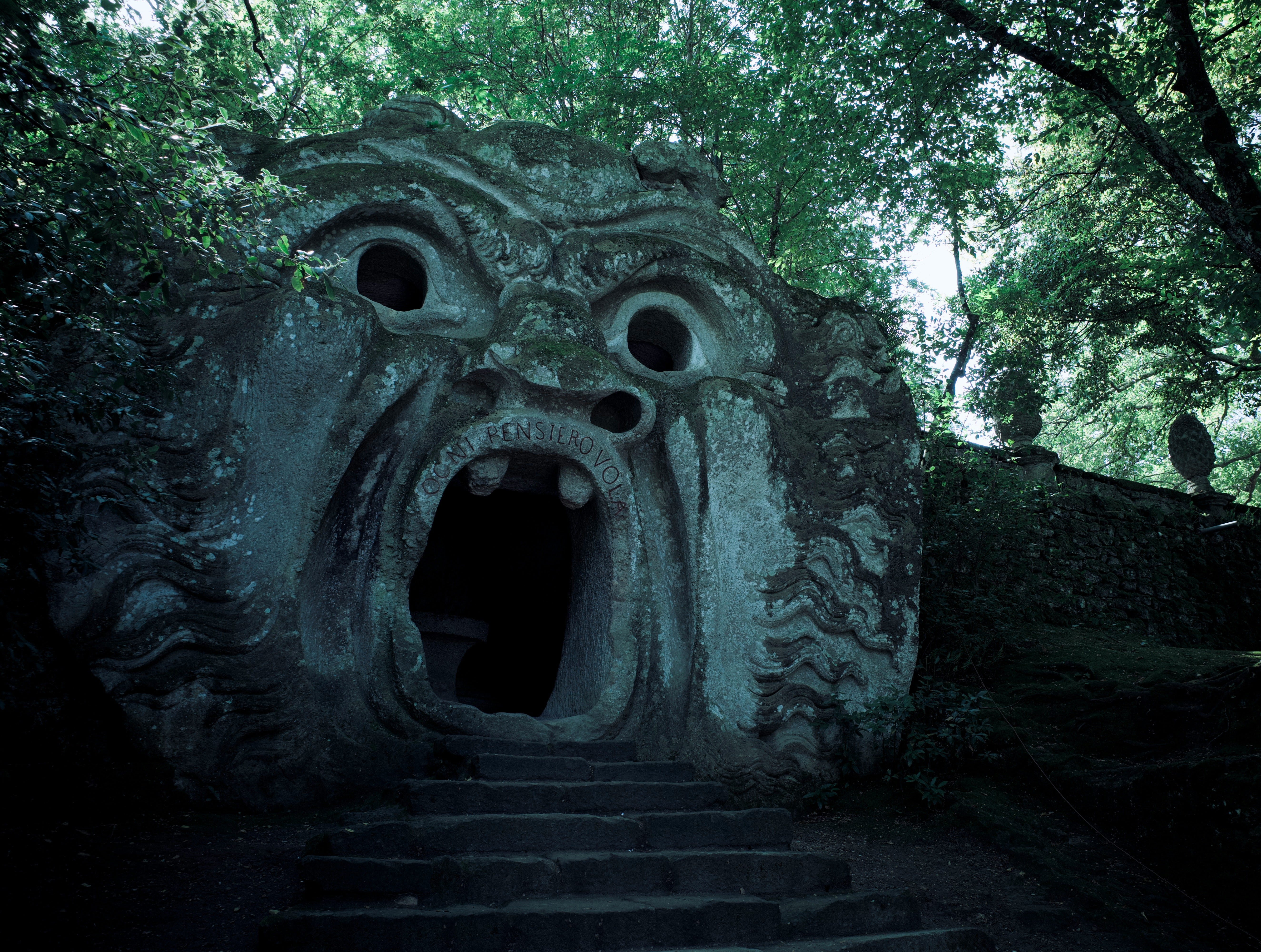
Welcome to Stoicism Today! This week we bring you a reflection on fiction and Stoic emotions by pseudonymous novelist Glenn Dorian, who describes the challenges of writing stories about Stoic heroes and monsters. In this piece Dorian considers the Stoic theory of the passions, the benefits of doing philosophy through fictional work, and the ancient Spartans who populate his novels. Read on to learn more about The Dragons of Alexandria and the Dracontes who prey upon human passions.
In the darkness beneath Alexandria, a monster awaits. It does not attack immediately but listens and watches. It can smell the anxiety-driven sweat. It can hear the rate of breathing change. It can sense tiny human hairs stand on end as footsteps come to a halt in the damp tunnels, silent save for the cool current of air chilling the moisture on the necks of the humans staring into the dark for the creature they can feel staring back at them in the descending corridors beneath the ancient temple. Those trapped in its lair can understand in some primal way that this creature is different. It is not merely that it has claws or teeth, dangerous enough as they are. It is that this beast defeats its prey not merely by overpowering it, but by feeding on panic and rage. It turns its prey’s emotions against it and takes advantage of the passions that threaten to overwhelm reason. The more they give in to their emotions the stronger the beast becomes. The emotions that threaten to spiral into madness become food for the monster even before it attacks.
In my historical fantasy novel, The Dragons of Alexandria, the monsters can turn human weakness against us. Thus, they attack our judgments and our passions before they attack us. The Dracontes, as I call them in the novel, do not create human passions and vice. They do not need to. We humans do this to ourselves. What the Dracontes do is something more dangerous: they exploit it. Fear, greed, rage, anger, glee, makes them stronger while keeping our mistakes and the damage those mistakes cause our responsibility.
What Would Frighten a Stoic?
So, the question becomes, what are monsters for? Throughout human existence, we have put monsters in liminal spaces between the known and civilized world and that which is alien and mysterious. Dragons guard treasures in caves. Trolls and ogres inhabit mountaintops and dense, mysterious forests. Even in our early modern society, when maps were rationalizing the earth, cartographers would still place dragons in the unexplored spaces of the paper, as the phrase HIC SVNT DRACONES on a 16th-century map warns us. As I considered monsters throughout ancient Greek literature, I came to wonder what monsters would truly frighten a Stoic, who accepts that virtue is the only true moral good and that only vice is a true evil, and who understands that those things which non-Stoics fear, such as death, pain, illness, poverty, and ill repute, are only dispreferred and to be usually but not always, avoided.
To answer this question, we can begin by looking at the type of monsters that Stoics, like all Greeks and Romans, would have known from their own myths. They would have grown up hearing about Herakles fighting the Hydra, who grew back two heads for every one that was severed. Theseus descended into a labyrinth to defeat a beast who fed on human flesh. At the corners of the world, Odysseus encountered the lawless Cyclops and the near-irresistible Sirens. Perseus conquered Medusa, a creature so fearsome that a glance could turn men into stone.
All these places are far from the heroes’ ordinary world. Perhaps that is part of what makes monsters so terrifying. It is not just the terror of the creature itself, but that it often attacks us when we are alone, or disoriented, or lost. In our familiar places, we understand how things work and how people and creatures are supposed to behave. In the places where we encounter monsters, we are already at a disadvantage, and risk becoming trapped and devoured before we even get back our bearings.
But the Stoics have a philosophy aimed at precisely these dangers. They had learned from Socrates that these apparent evils are like masks meant to frighten children. They had learned as well from Diogenes the Cynic that pain and hardship are often better for us than wealth and luxury. When we consider the type of being that a Stoic would find frightening, it would have to be something that risks turning the Stoics’ own judgments against them. This is what the Stoics warn us about: giving our wrong assent to the impressions we get, and risk losing ourselves to the destructive, negative emotions that carry us away and overpower us. They understood that we receive impressions, which are appearances from the outside world or from our own thoughts. The way things look or seem is often not up to us. Our judgments, however, are up to us. If we make appropriate judgments about impressions, we remain in control of ourselves, and undefeated. If we make wrong ones, mistaking false impressions for true ones, then we risk giving ourselves into these dangerous emotions and become defeated by our worst enemies, the ones who lurk in the darkest and most unknown places in our minds.
The Stoics understood that we can, with enough training, become the type of hero who remains unconquered, who consistently and unerringly makes appropriate judgments about those received impressions. Such a person develops the type of character, and the virtues of wisdom, courage, justice, and self-control, that no enemy could defeat. They understood that such a person would have apatheia, freedom from the passions. If passions are excessive and uncontrollable emotions that stem from our false beliefs about what is good or bad, or indifferent, then someone who cannot do otherwise than make the right judgment would never have these emotions. That does not mean, however, that the Stoics thought that the perfect sage is emotionless. Epictetus explicitly warns us against becoming “as unfeeling as a statue.” After all, being emotionally vacuous or hard-hearted is not an improvement to being overwhelmed by grief or anger.
There are, though, feelings and affects that we can do relatively little about. When things seem frightful or disturbing, we may still shiver. We may become pale. Our hearts may still race. We might wince or even let out groans before we can catch ourselves. But Seneca tells us that these are not proper passions, but what we might call propatheia, or pre-emotions: merely a quick bodily or even mental reaction to the things we perceive. Passions involve an erroneous reaction, whereas the pre-emotions involve no judgments on our part.
Fighting Without Losing Ourselves
This distinction is important for the characters in my book. The Spartan heroes who take on the monsters come to realize that the true enemy is not the thing that could kill them, but the bad judgments that will make them surrender their self-command. The Dracontes become stronger when people surrender themselves to their fears and lust. They become more powerful when the cultural background is conducive to passions and vice. Therefore, political chaos, tyranny, war, and factionalism are all fertile environments. The enemy becomes stronger as irrationality thrives and when the bonds of sociability break down. With the help of a Stoic philosopher, the characters in the novel realize that they cannot prevent the initial feelings that the monsters produce in them, but instead that they must learn to distinguish what is up to them from what is not. They get impressions that something is terrifying, and that the appropriate response is fear. But the characters can ask themselves, Is this, in fact, terrible? Can this keep me from being brave, from acting justly, or from exhibiting temperance? Their Stoic training keeps them from falling into the insanity that fear produces and allows them to act.
Even when fear has been conquered, there are challenges. It is not only fear that poses a problem, but anger as well. Although my characters receive impressions that they ought to avenge themselves and their comrades, those impressions threaten to turn into hatred and rage. But in the novel, such a passion only feeds the very monster they are attempting to subdue. This reflects the teachings of the Stoic philosopher Seneca, who warns us against anger. If punishment and justice can be conducted rationally and without anger, then anger is an untrustworthy ally, like hired mercenaries who may turn on us at any moment. The heroes then face the paradox of having to fight evil without becoming like the monster they are fighting. They must, as Stoic philosophy exhorts us, act appropriately and sometimes forcefully, without losing ourselves to anger, which obeys no reasonable limits.
Grief gives us another problem. In the story as in our own lives, relationships end, comrades and family members die, and entire cities are destroyed. My characters do not win every battle, nor do they all survive. They receive setback after setback and sometimes lose their only chance at regaining what was taken from them. During it all, they must ask themselves, What remains my own when everything else has been stripped away from me? Here too Stoicism guides them, as it still guides us today. It has never promised that we would conquer in war or in politics. It has never promised that we can keep those whom we love safe, or that our relationships would not eventually end. What Stoicism promises is that we have the tools and the weapons to deal with these things. In truth, it is our defeats and our losses that often teach us more than our apparent victories. From them we learn that we do not control outcomes and external circumstances, but instead we control our ability to accept that loss is inevitable. Our characters and our ability to endure are among those things that are truly ours, the Stoics teach us. It is in there, and in those appropriate actions that arise from our proper judgments, that victory is won.
When Monsters Lurk Inside Institutions
In The Dragons of Alexandria, I envision the kind of monsters that may appear more familiar to us than the typical monsters of literature. The Dracontes of the novel are physically formidable, but they also survive by infiltrating human institutions. They disguise themselves as bureaucrats, priests, advisors. They exploit the political systems that humans themselves often exploit for political power. In this sense, they are more dangerous than other monsters for reasons besides their abilities to exploit human weaknesses such as passions and vices. In this sense, they are more like the Hydra of Greek mythology in their methods if not in their appearances. Factions, political parties, bureaucracies, and institutional norms are more difficult to defeat than a single-headed monster. Herakles had learned to cauterize the wounds so that more heads could not regrow and replace the one that had been severed. With a single monster awaiting in a tunnel, the Spartans in the novel can survive by maintaining their discipline. They can lock shields, level spears, and advance. Once they master their fears, they know precisely what to do. The action required may be difficult, but understandable. The outcome depends on endurance and resilience. But, as the characters in the novel learn, when the enemy hides among rulers, priests, and wealthy aristocrats, no single wound – and no single severed head – is enough to conquer.
A monster like the Hydra is analogous to the monsters we often face in our own lives. They are less obliging than the monsters who await in tunnels and caves. What are we to do when we must battle against corporations that exploit people and places for profit? What can we do when wealthy oligarchs who are unbound by laws and moral constraints do what they will as the rest of us suffer what we must? What do we do against militaries that perpetuate atrocities and coerce the rest of us to participate in the injustices? The difficulty is that responsibility does not lie in just one metaphorical head. It is instead dispersed between shareholders, offices, regulations, traditions, departments, international organizations, corporations, executives, and officials. As the Spartan heroes of my novel come to learn, against these monsters there is no obvious place to thrust the spear.
In these circumstances, the question about how to defeat the enemy must change. Instead of asking how such a monster can be defeated outright, we must ask ourselves, What is the appropriate thing for me to do here? This Stoic conception of appropriate action, or kathekonta, is determined by what we might reasonably expect to happen, what our social roles are, and about whether we can argue, to others but more importantly to ourselves, whether we are being rational in our decisions. Sometimes, depending on the circumstances and on what roles we occupy, the answer may involve using force. But more often it might involve more nuanced methods: speaking up when silence is expected, refusing when acquiescence is commanded, disobedience when others recommend assimilation or appeasement. We cannot be Herakles to sever and cauterize the necks of these monsters, but we can, the Stoics tell us, defeat the enemy by our reasonable actions.
The model here, as always, is Socrates. He had fought as a hoplite in the Peloponnesian War and certainly had chances to thrust his spear and brace his shield against his human enemies. But among his greatest examples of courageous action may have been in something much more discreet. When the Thirty Tyrants, who were ruling Athens attempted to make every citizen in Athens complicit in their murderous schemes, they commanded Socrates and some others to retrieve a prominent citizen, Leon of Salamis, so that he might be executed. Refusal to do so would mean that there would be more than one assassination. It is precisely here that Socrates faced one of his most dangerous monsters. The enemy was institutionalized in the power of the state, not on a distant battlefield where he was protected by the shields and blades of his brothers-in-arms. The others obeyed, but Socrates, we are told, quietly went home. He quite likely would have been killed himself for his disobedience, but the Tyrants themselves were deposed soon afterward.
Like Socrates’s case, sometimes the appropriate action might be as simple, and yet as difficult, as refusing to obey when institutions require cooperation and complicity. Socrates, like the Spartans in my novel, understood that the worst monsters, and often the most difficult ones to resist, are not those we can reach with our spears. They are those faceless institutional and bureaucratic norms that attempt to force us into cruel, unjust, and unreasonable actions. Those are the ones that are hardest to conquer because we often comply, sometimes for the sake of our safety and, worse still, sometimes just for the sake of convenience. For those Stoics who followed Socrates’s example, the philosophical lesson is to understand that we are not required to kill the Hydra. Instead, we learn which head is facing us at the current moment of our lives and what the appropriate action is required when facing it. Socrates quipped that if his death pleased the gods, then so be it. The Stoic can add that the outcome of any battle with monsters, beastly or institutional, is up to Zeus. The choice to act in accordance with what reason requires, however, and how to meet our death if it is required, is up to us.
Cleomenes and the Limits of Victory
For the historical fantasy novel, I chose as the protagonist a historical king of Sparta, Cleomenes III. Cleomenes was tutored in philosophy by the Sphaerus of Borysthenes. The Spartan king seemed to take Stoic cosmopolitanism to its logical as well as its pragmatic conclusions. He reformed the social, political, and military system of the kingdom he inherited. He redistributed the wealth of the ultra-rich oligarchs who held on to their power and status at the cost of the rest of the population and empowered the formerly deprived and impoverished citizens. But Cleomenes went even further: he even expanded the citizen body to include non-citizen foreigners and eventually even freed those of the helot servant caste who could fight in his army. With his radically reformed Sparta, he waged a decade-long war against his regional rivals. Those rivals, who feared Cleomenes’s renascent and revitalized Sparta would threaten their own wealth and their powerful positions in Greece, joined forces with one of the great regional powers, Macedon, to contain him. After being outnumbered, outmaneuvered, and betrayed by one of his officers, Cleomenes was defeated and driven into exile in Alexandria, where he fomented a revolt against the Pharaoh Ptolemy IV of Egypt.
Cleomenes is already a fascinating historical figure even before the monsters I imagine into his story. His life challenges many modern interpretations of Stoicism that suggest the philosophy is meant to help us overcome and conquer external obstacles through mere resilience. In terms of the historical events, Cleomenes was defeated. He could not prevail against the combined powers arrayed against him in Greece. Later, in Egypt, his rebellion would inspire awe and respect, but a frightened and oppressed population did not assist him in overthrowing their tyrannical government.
The monsters I make him and his Spartans face in the catacombs beneath Alexandria stand in for the human weaknesses we all face, but they do not replace human agency. The Dracontes do not make people cruel, lustful, conniving, or craven. One of the dangers of fantasy, historical or otherwise, is when monsters are allowed to absolve the characters of their moral agency. The greatest fiends are those who show us that we are at least partly responsible for our own defeat. For example, what makes vampires so terrifying is that they must be allowed to enter before they can feed on their victims. Likewise, in my novel, the creatures do not simply possess others into their passions and vices. If they did, that would undermine the philosophical premise of the novel. Instead, they simply exploit the weaknesses that humans have already given in to themselves. The characters instead must make use of the Stoic principles they learn. It is not a magic charm against the creatures, like the cross or garlic to the vampires. Rather, Stoicism becomes a way to train their minds to reject those impressions that threaten to deprive them of their reason and to keep them from performing what their duties require.
Why Use Fiction?
One final question that arises is that of method. Why use fiction at all? Presumably, all the arguments in the novel can be more meticulously and deliberately worded in a peer-reviewed philosophical journal. Conclusions can be examined, premises can be verified, and claims can be peer-reviewed. However, there are a few reasons that we might want to discuss the topics in fiction instead. The most obvious one is personal. We might feel that our imagination and creativity provide us with a story that we hope others might find as interesting as we do. In the case of historical fiction, moreover, we can go further than the ancient sources make explicit and ascribe thought and words to the historical figures and to the characters we invent to assist or hinder them in their quests.
The Stoics themselves made use of literature and mythology to make their own philosophical points. They used anecdotes, examples, and stories of gods and heroes of the Homeric epics as metaphors and allegories to discuss everything from their metaphysics to their moral psychology. Seneca himself used letters to discuss his own uncertainties and ruminations. Marcus Aurelius wrote his own thoughts in his philosophical journal. Epictetus was arguably at his best when he harangued his students after a lecture, when the readings were finished and the practical application could be demonstrated. It seems fiction allows us to do something similar. Rather than asking how we could show an argument to be sound, we can ask, What should this character do in this situation?
For my purposes, I wanted to explore Stoicism in historical fantasy so that we can examine what Stoicism requires in particular situations by people who we already know to be inspired by Stoicism. In this way, we can live through the choices they have available to them, the options that they decide on, and the consequences that follow from them. Although I wanted to outline the major themes of Stoicism, I did not want to have my characters stop their lives to give lectures on Chrysippus every five paragraphs. I found it more interesting if they could use their Stoic principles not only to deal with the historical facts that they had to face, but also to fight monsters that tried to take their own reasoning faculties away. The monsters in The Dragons of Alexandria are the monsters—the passions and dangerous inclinations—we all face. They just make those problems literal.
Through the Labyrinth
Sometimes the true test of our philosophical principles comes when we are in the unknown, liminal spaces of our lives. It is in our most difficult and uncertain moments, in the unknown landscapes, that we make our poorest judgements, not when we are prepared. Epictetus warns us to watch out for ourselves as if we were our own enemy waiting for us in an ambush. The fear, grief, cruelty, and anger we experience often comes when we are least prepared for it, in situations we do not expect. Perhaps this is why we humans, and the storytellers among us, have always placed the monsters at the edge of the proverbial map. Although we no longer expect dragons roaming the caves and mountaintops of foreign lands, the monsters we face are real, enormous, and dangerous. Some are personal, while others are institutional or political. Some lie in our own judgments and others are so faceless that we are not sure where the evil really lies.
In fighting our monsters, we do not have the club of Herakles or the sword of King Arthur to help us defeat them, as we do in fiction. We cannot rely on Spartan shields and crested Corinthian helmets to protect us. Even if we did, it would not stop monsters from seeming terrifying to us. That is why, arguably, the Stoics provide us with weapons and armor that is greater than any of these things, not least of which because it exists outside the realm of fantasy. The Stoics followed the legacy of Socrates, who could look behind the mask of a monster to show us that it is in fact a harmless thing meant only to frighten children. As Seneca tells us, we will continue to have involuntary reactions when we receive impressions. Those impressions will threaten to carry us into those hurtful and destructive passions that can keep us from living successful, flourishing lives. However, Stoicism promises us something that can guide us through these dangerous places. Like Theseus, who was guided by Ariadne’s thread through the darkness of the labyrinth so that he could face the Minotaur that lurked within it, we have something to get us through our own darkness and monsters.
Stoicism allows us to make the appropriate judgment according to our common humanity and our social roles. And, like Theseus, we might be able to defeat our personal monsters while unable to do much about the economic, social, or political ones. Theseus could defeat the Minotaur and end Athens’ tribute of innocents to an unjust ruler, but King Minos remained as king. Sometimes Socrates could thrust a spear and sometimes he could only walk home quietly. We do not have to defeat every monster, but we can see what the situation requires of us, and act according to our principles. Like Herakles, who had to choose which weapon to use against the Hydra, Stoicism can show us the principles are worth having.
About the Author
Glenn Dorian writes historical fantasy exploring Stoicism, moral conflict, and the ancient Mediterranean world. His fiction combines historical figures and events with supernatural horror, asking how ancient philosophical ideas might be tested under extraordinary circumstances. The Dragons of Alexandria, part of his Dracomachia series, follows the exiled Spartan king Cleomenes III as he encounters an enemy that preys upon humanity’s most destructive passions.
Photo credit: Alex Pagnotta via Unsplash