What Would a Stoic Say? Civil Discourse in an Age of Outrage

Follow into
Save into
Follow into
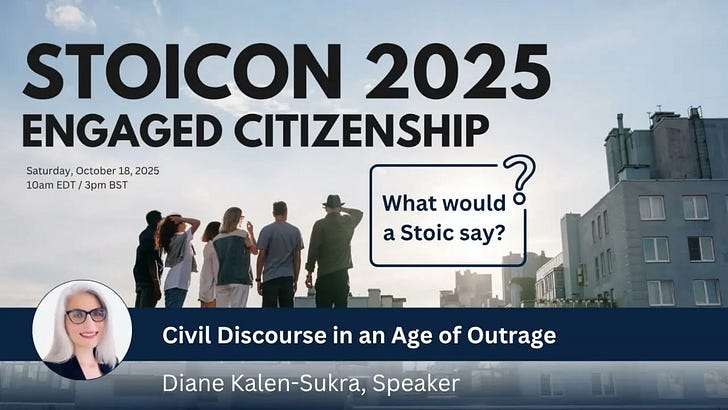
Welcome to Stoicism Today! This week we bring you the transcript from Diane Kalen-Sukra’s talk at Stoicon 2025. Kalen-Sukra shares how classic Socratic and Stoic dialogue is essential for restoring civility to our public discourse today. Her talk distills ancient civic discipline into three commitments for our time: seeing opponents as partners in reason, aiming for the common good, and leading by example.
Hello and thank you for the invitation to be with you today. It’s a privilege to join you at this global annual and historic gathering of Stoics. I’m deeply honored to be among such esteemed thinkers and practitioners and to offer a reflection on what Stoic wisdom can teach us about the most endangered civic art of our time, civil discourse.
This question is more than theoretical for me. I came to it through lived experience, through the practice of civic life, where philosophy meets public service. Eight years ago, I left my role as a city manager to sound the alarm on our increasingly uncivil society and the toxic discourse that accompanies it. I wanted to highlight the threat that it posed to good governance, to democracy, and to well-being, particularly at the level of government closest to the people, our local governments, and our communities. I witnessed how incivility corrodes trust. It drives away good leaders, and it undermines our ability to solve the many complex collective problems our communities face. As many of you know, I wrote a book about it called Save Our City: How Toxic Culture Kills Community and What to Do About It. And that work sparked what has become a civility tour, a journey that has since gone global and continues to this day.
Because incivility and uncivil discourse don’t just end on their own. They only stop when both civic leaders and citizens recognize the danger that they pose and intentionally decide to change course to turn the cultural tide together. And everywhere I go, I see the same challenge taking root. The breakdown of civil discourse is not a superficial communication problem. It’s a civic crisis because there is no good governance without civil discourse. There’s no democracy without it. When public debate turns into performance or when disagreement hardens into contempt, we lose our ability to live and work well together, to flourish together. We see this, for instance, at council tables that are paralyzed by dysfunction, some even facing governance collapse. This, to me, is the true crisis of our age. Not merely polarization or misinformation, but something deeper. It’s a relational and moral failure. The loss of confidence in our ability or even our desire to reason together to meet as citizens rather than combatants.
Since we are living in this age of outrage, we would do well to ask, what would a Stoic say in an age like this? What wisdom could an ancient philosophy born in the slow colonnades of Athens offer to those of us striving to renew civic life and remain constructive in a world shaped by algorithms where attention is currency and outrage is rewarded and the pace of reaction leaves little room for reflection?
To answer that, I want to begin not with a Stoic by name, but with the man that the Stoics themselves called their teacher, Socrates. Socrates lived nearly a century before the first Stoic school. Yet the Stoics looked to him as their moral prototype. Epictetus mentions him more than any other figure, calling him the model of reasoned endurance. Marcus Aurelius revered him as an exemplar of public virtue, one who met ignorance and injury alike without contempt or resentment. Why such reverence? Because Socrates embodied what later became the Stoic ideal, a life governed by reason, by virtue, and the service to the common good. He didn’t retreat from the marketplace of ideas. He walked straight into it barefoot asking inconvenient questions that awakened the moral imagination of a city.
When he asked what would a Stoic say, we can begin by watching what Socrates did. He showed that philosophy is not a private luxury. It’s a public duty through dialogue, through civil discourse. He sought not to defeat others but to engage sincerely with them in the search for truth so that thought might lead to right action. And that spirit, the union of reason and engaged citizenship is what the Stoics later systematized into a way of life.
When we hear the phrase civil discourse, most of us think of polite dialogue, of taking turns, of minding our manners or in formal settings, of following the rules of order, or just simply keeping the peace. But for Socrates, the civil in civil discourse had nothing to do with being nice. It was conduct becoming of a citizen to engage sincerely and boldly in the practice of reasoning together toward a shared understanding of what is right, what is good, and what is true, and what is in the service of the common good.
Each conversation was a form of soul craft, a moral exercise through which both interlocutors could grow in understanding of themselves, of others, and of the world, and in the process be elevated towards becoming better human beings and better citizens. Socrates began with humility and curiosity, famously admitting, “I know that I know nothing.” From that posture, he asked questions. He listened carefully and he probed contradictions not to win or to humiliate but to awaken reflection and growth. He believed that within every person lies a spark of reason waiting to be kindled by conversation. “I am the gadfly sent by the gods to rouse the city from its slumber,” Socrates said. And that’s exactly what he did.
Through relentless and probing civil discourse, he stirred Athens to think, to care about justice, to examine the state of its soul. Even when condemned to death on false charges, Socrates remained calm. “I would rather suffer wrong than to do wrong,” he told his judges. His composure under attack became for later philosophers and teachers the enduring image of moral courage of courageous citizenship. Proof that reasoned speech is possible even under mortal threat.
What cause then do we have today to rely on rage even when confronting the most hostile opposition? Nowhere is this discipline more vivid than in the Republic, where Socrates turns conversation into moral ascent. At first, we meet Cephalus, the elderly merchant who believes justice means paying one’s debt, which is a conventional transactional justice. Socrates honors his experience, yet he gently asks, “What if returning a sword to a madman would cause harm?” Cephalus’s certainty of course waivers. His notion of justice then shifts a bit from transaction to reflection. His oligarchic soul ruled by wealth and convention is nudged towards the democratic animated by honor and conscience.
Next comes Polemarchus, who defines justice as helping friends and harming enemies or essentially just as loyalty. Socrates invites him to see that justice cannot require harm of another for harm corrupts both the giver and the receiver. His democratic soul concerned with loyalty and esteem ascends towards the rational soul guided by universal good through the course of this conversation.
Then in bursts Thrasymachus, bold and cynical, insisting that justice is merely the advantage of the strong: might is right. The real political cynicism. Yet Socrates doesn’t shout him down. He reasons him upward. He says to him, “Just as medicine serves the health of the patients, so surely leadership must serve the well-being of the governed.” Slowly the dialogue reluctantly lifts Thrasymachus even ever so slightly—and with him the audience—towards a recognition that genuine power is service. By the time Glaucon and Adeimantus join, they’re no longer just debating to win, but to understand. The conversation becomes a kind of moral gymnasium in which souls grow stronger through civil discourse.
This, then, is civil discourse as soulcraft in action. Conversation grounded in reason and goodwill draws the better part of us to the surface. Plato dramatized it and the Stoics disciplined it into a daily practice. That, to me, is profoundly hopeful. It means that the antidote to outrage is not silence or censorship but conversation practiced well. Civility, then, is not weakness but strength: the discipline that keeps reason alive in public life.
The ancients wouldn’t have been surprised. They believed that a just city is the well-ordered city. One where public life, like the soul, is best guided by reason. Socrates believed that the health of the city depends on the health of its citizens’ souls. He says, “I do nothing but go about persuading you all not to take thought for your persons or your properties, but first and chiefly to care about the greatest improvement of the soul.” So all that civil discourse is for the improvement of the soul because reasoned conversation actually shapes us. It shapes character as much as it does opinion.
And the Stoics agreed. Justice begins in the reasoning mind and radiates outwards through speech and action. That is why civil discourse matters. It’s not a nicety. It’s how civic culture—and with it, civilization—renews itself. It’s a precondition for human flourishing. And as we move forward, we’ll see how the Stoics transformed that art into a full moral discipline, a guide not only for personal equanimity, but for civic renewal.
When Socrates drank the hemlock, his body perished, but his method did not. His calm courage and devotion to reason echoed across the centuries and took root in a new school of thought that would shape senators and slaves, emperors and citizens alike. The founder of that school, Zeno of Citium, was said to have been reading about Socrates when he first asked, “Where can I find a person like this?” That question became a philosophy, Stoicism. Zeno saw in Socrates a way of being, a life governed by reason rather than impulse, dialogue and relationship rather than domination and coercion. The Stoics took that way of being and made it teachable. They asked, “How can ordinary people, citizens and civic leaders alike, live with the steadiness and integrity and the appetite for civil discourse that Socrates displayed?”
Their answer was both moral and practical. Before we speak, we must prepare the self. Before we enter the forum, the council chamber or the public square, we must first train the inner life to stay aligned with reason and what is good and what is right and what is true so that the outer life can serve justice. And in that way, we can do our part to live together in a just city.
For the Stoics, what we say and the way we engage in discourse is merely the echo of what has already been practiced inwardly. Composure, fairness, attention, and the will to seek the truth rather than simply personal advantage. They called this preparation prosoche, attentiveness. Epictetus taught when someone irritates you, know that it is your own judgment that has disturbed you. The Stoic therefore does not prepare arguments first but the self.
The work of preparation that transforms blind reaction into reasoned response can be remembered through three simple but powerful Stoic disciplines. The first is to pause. It says before entering conversation, take a moment for awareness to still the emotions that rush to speak. Even a single breath can interrupt the chain between stimulus and reaction. Secondly, remember, recall that others may be reactive, misinformed, or fearful. Their tone is not yours to control, but your response is. Recollect, as Marcus Aurelius did each morning, the principle of oikeiosis, recognition of our common humanity. Marcus says, “You will meet people who are meddling, ungrateful, arrogant, dishonest, but they are my kin, sharing in reason and the divine.” And the third is to commit. Resolve to govern your own judgments and tone, not theirs. And this is consistent with the Stoic determination to act justly. Enter dialogue not to dominate, but to contribute to the common good.
These three disciplines cultivate moral steadiness. They are the unseen rehearsal that allows us to stay grounded in wisdom even when engaging in discourse with those we vehemently disagree with. Such preparation is not supposed to be a withdrawal from civic life. It is the preparation. It is the readiness for it. Only those who have mastered their judgments can engage wisely with others. Before we can bring peace to our communities, we must cultivate it within ourselves. Before we can reason together, we must discipline our thoughts.
And of course, for the Stoic, this inner training was grounded in the four cardinal virtues: wisdom, justice, courage, and temperance, each of which prepares the soul for civil discourse. Wisdom asks what is true. Justice asks, “What serves the common good?” Courage asks, “Will I speak what is right even when it’s unpopular?” And temperance asks, “Can I restrain myself long enough to listen and understand?” When these virtues are practiced inwardly, discourse becomes a shared search for truth rather than a contest of egos or a series of power plays that we see too often in public discourse today. So alternatively, if our discourse is rooted in envy, ill will, partisanship, loyalty to the gang rather than the common good, well then it’s toxic. And when this is the dominant modus operandi, our cities and our nations mirror that toxicity and cannot be well-governed or just.
Such inner discipline may seem difficult in a digital age that rewards speed and outrage over reflection and reason thought. Yet that just makes the need for Stoic preparation greater and more necessary than ever. Imagine if every citizen inspired by Stoic thought takes a pause, even a single breath before replying to an angry email or recalls Marcus’ words before a tense meeting, they are my kin. This recollection shifts perception from adversarial to relational. It turns encounters into opportunities.
In my own work with civic leaders, I’ve seen this transformation firsthand. A council that begins its deliberations with a brief moment of quiet, an intentional breath, a shared reminder of purpose, or even a short civility pledge sets an entirely different tone. The space is made and the focus set to what serves the whole. Stoic preparation then is not just an ancient ritual. It is a modern civic skill. It’s a discipline that creates the inner conditions for reason to prevail in public life. As Marcus Aurelius reminds us, waste no more time arguing what a good man should be. Be one.
Discourse without virtue is chaos. Virtue without discourse is impotence. What is the point of cultivating the virtues if it’s not to exercise them relationally and in the public square? The harmony of these two of discourse and virtue is Stoic engaged citizenship.
Next we turn to practice: how these interdisciplines become outward conduct in the Stoic method of engagement. Modern neuroscience is now confirming what Socrates and the Stoics knew all along: that the practice of reasoning together is not only a moral act, it is a biological necessity. Our brains are quite literally wired for dialogue. When two people engage in thoughtful exchange in listening, reflecting, and building on one another’s ideas, neuroscientists observe what they call interbrain synchrony. Activity rises in the prefrontal cortex, the region associated with moral judgment, impulse control, and complex reasoning. While the limbic system, the seat of fear and rage, quiets down. In other words, civil discourse strengthens the very neural circuits that make us capable of self-governance. It cultivates the same calm vigilance that Stoics train through the careful examination of impressions before ascent. Socrates discovered this through observation of the soul and modern science can now trace it through fMRI or functional magnetic resonance imaging.
Researchers studying dialogical learning have found that mutual reasoning or civil discourse activates mirror neuron networks responsible for empathy and shared understanding. When conversation is adversarial, those networks shut down. When it’s cooperative, they light up. And yet in modern life, we are talking less and reacting more. A University of Michigan meta-analysis of over 14,000 college students found that empathy has declined by roughly 40% since the 1980s. Students today are far less likely to agree with statements such as, “I sometimes try to understand my friends better by imagining how things look from their perspective.” Researchers link this decline to rising technology use and the reduced face-to-face interaction, precisely the forms of human exchange that train empathy through real conversation. Broader surveys echo the same trend. Six and 10 Americans now say compassion itself is in decline.
The Stoics would not be surprised. When we cease to converse meaningfully, the moral muscles of empathy atrophy. They would say that the logos within us, the spark of shared reason, struggles to recognize itself in another. By logos they meant not merely logic or speech but the rational principle that orders the cosmos and lives within every person. A shared spark of divine reason that connects us one to the other. To engage in civil discourse is to activate that shared reason to participate consciously in the fabric of our common humanity. When we speak and listen well, we honor that divine kinship. When we withdraw into reaction or noise, we estrange ourselves from it.
Epictetus described this inner resonance long before neuroscience gave us mirror neurons. He said, “Since reason is common to all, the rational faculty in each of us is a fragment of the divine.” To speak and listen well then is not only an intellectual exercise. It is an act of reverence toward that shared rational nature. This is why Socrates insisted that the health of the city depends on the health of its citizen souls.
Civil discourse, then, is the bloodstream of civic life. Without it, both neurons, cities, and nations atrophy. If Socrates gave us the method and the Stoics gave us the discipline, neuroscience now gives us the evidence. Civil discourse is how both the mind and civilization flourish.
So the question becomes, how will we practice it? To close, I offer a simple commitment for our time, a modern Stoic oath for those who would keep reason alive in public life.
- First, see opponents as partners in reason. I pledge to meet disagreement with curiosity rather than contempt, remembering that every person shares in reason and that truth is best sought together.
- Second, aim for the common good over personal victory. I pledge to seek understanding rather than triumph. To measure success not by winning, but by what strengthens the community that we share.
- And third, lead by example, not by force. I pledge to let character, not anger, persuade, embodying the calm courage I hope to awaken in others.
To keep this oath is to bring philosophy to life. It is to make every conversation a small act of public service. Modern science tells us that dialogue reorganizes the brain. Ancient wisdom tells us it reorganizes the soul. Together they reveal the same truth. When we converse well, we become well. Let us then be citizens of the logos. steady in reason, generous in spirit, courageous enough to turn discourse itself into a form of civic healing. Perhaps that is the enduring Stoic task, not to flee the noise or rage of the age, but to stand within the storm, calm and grounded, calling reason back to its rightful place in civic life. Thank you.
About the Author
Diane Kalen-Sukra is a bestselling author, speaker, and founder of Kalen Academy, a civic leadership institute sharing ancient wisdom for modern civic leaders. A former city manager, she has been named a global Top Thinker in Local Government by the U.K.’s leading civic policy institute for “catalysing a movement to renew civility and trust in public life”. Diane is the author of Save Your City, Civic Resilience, and Lead with Civility. This talk, “Civil Discourse in an Age of Outrage,” is referenced in Diane Kalen-Sukra’s new book, Lead with Civility: A Handbook for Uncivil Times.
Stoicism Today is a reader-supported publication. To receive new posts and support our work, consider becoming a free or paid subscriber.