
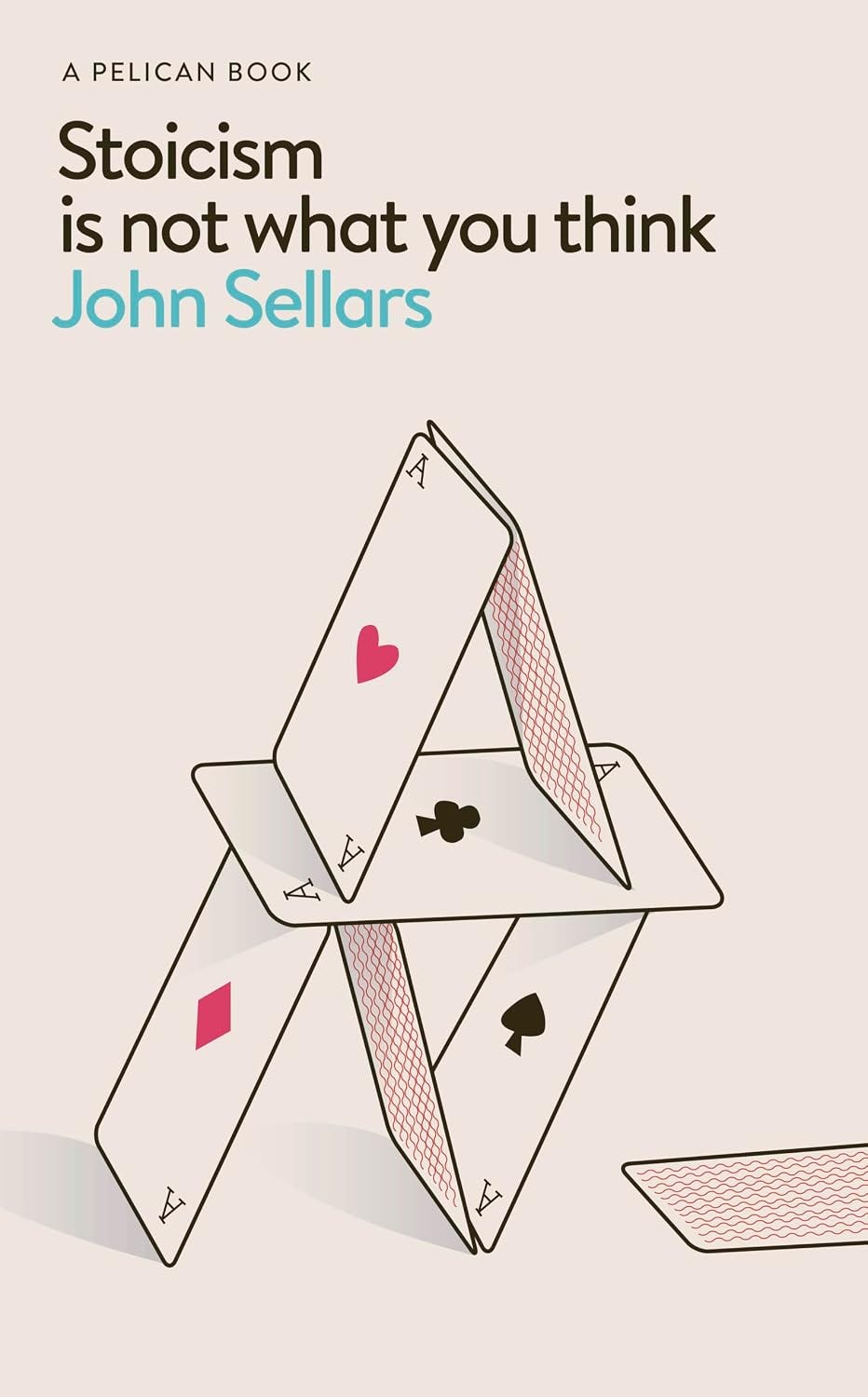
Welcome to Stoicism Today! This week we bring you an interview with philosopher John Sellars, a co-founder of Modern Stoicism and The Aurelius Foundation. His latest book, Stoicism Is Not What You Think, takes aim at some of the biggest misunderstandings about Stoicism: that it advocates emotional repression, that Stoics are selfish, that Stoics passively accept everything. As Sellars clearly shows, all these myths are false. In this interview with Stoicism Today editor Brittany Polat, he explains where these myths came from and what the ancient Stoics really said.
Brittany Polat: In this book you set out to dispel some of the most common misconceptions about Stoicism. What was the impetus for this project, and who do you hope reads the book?
John Sellars: The idea for the book came about at a conference we held in London, which was focused on psychological research into the benefits of Stoicism. Some of the psychologists commented that in their discipline there are plenty of well-educated and otherwise informed people who still assume that Stoicism is something unhealthy and involves the repression of emotions. That was a barrier when it came to presenting Stoicism as a potentially valuable resource for people. Someone commented that it would be really useful if there was a book that challenged some of the common misconceptions about Stoicism to which we could direct people. I was also conscious that these kinds of misconceptions circulate more widely and may put people off exploring Stoicism further. That seemed a shame if those people might in fact benefit from Stoic ideas. So, the ideal readership is someone curious but sceptical about Stoicism, and this is my attempt to show them that there is nothing unhealthy or suspect about Stoic ideas.
BP: Many people first encounter Stoicism through Marcus Aurelius’ Meditations, yet you say that “it is all too easy to misunderstand what Marcus is saying if one does not already have a good sense of the Stoic ideas standing in the background” (p. 16). What is the best way for someone to learn about Marcus Aurelius without picking up any misunderstandings?
JS: There’s a sense in which Marcus Aurelius doesn’t say anything about Stoicism at all. He won’t explain to you the core ethical principles, he doesn’t talk about ‘preferred indifferents’ and how they relate to virtue, he doesn’t set out Stoic thinking about emotions, ‘good passions’, or ‘first movements’. All the things you need to know to understand what Stoicism is all about are absent from the Meditations. Now, I’m not saying that to be critical; I love the Meditations! It is just that it is not that kind of book. It gives you a flavour of what putting Stoic ideas into practice might look like, but it doesn’t give you the ideas. For those you need to go elsewhere. The best places in my opinion are the philosophical works of Cicero, especially On Ends book 3 (for the core ethical ideas), Tusculan Disputations books 3-4 (for the theory of emotions), and On Duties (for the application of virtue). These will give you the ideas that underpin Marcus’s personal reflections and then you’ll be able to see the ways in which he is making use of them without actually stating any of them. Given that these were private notes, he of course had no need to spell them all out; he took them as read.
BP: You mention that one reason many misconceptions about Stoicism have been able to take hold and flourish is because we possess so few of the original Stoic texts (most of them have been lost). Can you tell us more about the process by which scholars reconstruct Stoic ideas from our remaining sources?
JS: Yes, most of the texts by the early Athenian Stoics are lost. So, trying to reconstruct what, say, Zeno thought involves gathering together all the apparent quotations and other references to him from all the ancient sources subsequent to him. The problem with quotations is that they are ripped out of their original context; the trouble with other reports of his views is that there were often written by hostile commentators. In the case of Chrysippus, two of our most important sources are Plutarch and Galen both of whom quote Chrysippus only to argue against him. So, we have to be really careful when weighing up the different types of evidence. I mentioned Cicero earlier and in some respects I think he is an easier source to handle. We know he was fairly sympathetic towards Stoic ethics (even if he had doubts about other parts of Stoic philosophy), he gives us extended accounts that include some of the arguments behind the views, and he’s the earliest source that survives. We also know he had access to all the now-lost texts and he even attended lectures by Posidonius, who had studied with Panaetius in Athens. We still need to tread carefully, but the path is not quite so treacherous.
BP: One of the biggest misconceptions of Stoicism is that Stoics suppress their emotions and try not to feel anything. In actuality, the Stoics advocated eliminating unhealthy emotions but promoted healthy emotions, called eupatheiai. Could you explain the Stoic view on “passions” and how we can cultivate good emotions?
JS: So all ‘passions’ are the product of value judgements we make. If we judge something truly bad is about to happen, we’ll feel fear, for example. But according to the Stoics this would be a mistake, because nothing that can happen to us is truly bad, except the loss of our virtuous character. Lots of unpleasant things can happen, things we don’t like, but we should think of these as dispreferred, not bad. So, a passion like fear is problematic for three reasons: i) it is not nice to experience; ii) it hinders our ability to think clearly, and iii) it is based on a mistake. The ‘good passions’ by contrast are not based on a mistake. Someone who is wise and who can see that makes a value judgement that something genuinely good is present (wisdom); this generates the good passion of joy. This is a positive thing to experience and it isn’t irrational in the same way, because it is based on a correct judgement. The wise person has good reason to feel positive!
BP: While Epictetus is famous for telling people to place no importance on external things, you suggest that this is a psychological technique designed to break our thoughtless habits—and that where we want to end up is in a more moderate position, not a position of valuing nothing at all. Why do you think Epictetus makes this move, and how we can use it to train ourselves today?
JS: Perhaps it is best to take an example. Imagine someone really stressed out about a job interview. Perhaps they think that their entire future career depends on this one meeting. They have placed far too much value on this single event. How do you break someone out of that kind of thinking? Giving a nuanced account of how it is fine to want the job, just not too much, and that one should want things but with a reserve clause, might not do the job. Instead, perhaps you should just say to them, ‘This interview does not matter at all; it is of no consequence.’ They need to remove all sense of importance from the event if they are to overcome their anxiety. Now, of course, they do still want the job, otherwise they wouldn’t even show up, and they shouldn’t do anything in the interview to sabotage it. But as a psychological technique, saying ‘this does not matter at all’ could be very helpful. I think that Epictetus is doing something like this when challenging the assumptions of his students and visitors to his school. Indeed, at one point he comments on this technique: if you have a really bad habit, then the best way to counter it is to go to the opposite extreme habit, with the goal of ending up somewhere in the middle.
BP: When it comes to virtue and happiness, the Stoic position is that “it is only by acting virtuously that we – the social animals that we are – can live an objectively good human life” (p. 55). You also cite a number of studies that support this view. How does living virtuously makes us happy and “give us a genuine sense of satisfaction in our lives”?
JS: Humans are social animals. We live in families, tribes, villages. The extended period of care that children require compared to the young of some other animals makes this essential to the survival of humanity. So, if being social is part of human nature, then anyone who is antisocial is not only in conflict with other people, but they are also in conflict with their own nature. That inner conflict means they can never be truly content or at peace in themselves. Given that the antisocial person still has to live with other people to some extent (unless they hide in the woods, grow all their own food, etc.), they will also live a life often in conflict with others too. Both internally and externally that seems pretty miserable. The Stoic virtues of justice and courage seem especially relevant to thinking about our relationships with others, while wisdom and moderation are concerned with having a sense of control over our own lives, making good decisions and not being overtaken by our appetites. Somone without the Stoic virtues would be a coward, with out-of-control desires, unfair and dishonest, and unable to make good decisions. I can’t image anyone would see that as an attractive or satisfying way to live.
BP: In a chapter called “Is Stoicism only for men?” you introduce readers to female philosophers of the early modern period who admired and wrote about Stoicism. Could you share more about these women and how they interacted with Stoic ideas? Where can we learn more about them?
JS: One slightly frustrating thing is that we don’t really have any evidence for any ancient female Stoics. That just reflects the wider fact that we don’t know about many ancient female philosophers of any school. Happily, though, we know about a whole series of really interesting female thinkers in the seventeenth and eighteenth centuries who became seriously interested in Stoicism and were devoted readers of Seneca, Epictetus, and Marcus Aurelius. These include Margaret Cavendish, Mary Astell, and Mary Chudleigh, among others. For Cavendish being a Stoic meant not being a slave to her passions, challenging the common stereotype of women in her day. Mary Astell liked the idea that real value resides in character, not external things. If as a woman she was all too often judged on her physical beauty or the status and wealth of her husband, Stoicism taught her that true worth comes from within and is in one’s own control. There’s been lots of good work on these female philosophers recently. I’d especially recommend the work of Jacqueline Broad; this piece is open access and a good place to start.
BP: Throughout the book you make the point that the ancient Stoics disagreed with each other on various issues, yet they continued to be recognized as Stoic. Would you say there are certain core beliefs that define a Stoic? Are there some beliefs that are tangential to the key elements of Stoicism that we can safely revise or discard?
JS: This is a really good, but complex, question. In ethics, surely the view that virtue is the highest good is non-negotiable. The idea that some indifferent things can be preferred also seems important, if we are going to distinguish Stoicism from Cynicism. The idea that some passions should be avoided altogether, not merely moderated, separates the Stoics from the Aristotelians, and so seems important. In physics, the claim that nothing exists beyond Nature and that Nature has some kind of internal order and logic to it, both seem key, distinguishing Stoicism from Platonism and Epicureanism respectively. We need enough to ensure that Stoicism is distinct from the views of the other, competing philosophical schools of antiquity. But beyond that we also want to retain enough independence of thought to think through these issues for ourselves, accepting and rejecting ideas as we see fit. If we start listing all the things a Stoic must believe, we risk drifting into something closer to a dogmatic religion than an open-ended philosophy. Epictetus often says that we shouldn’t become merely interpreters of Chrysippus; in a similar spirit, we don’t want to become unthinking disciples of him either.
BP: Are there any other misconceptions about Stoicism that did not make it into the book but which you might want to address?
JS: There are lots of negative views about individual Stoics that I don’t tackle directly in the book – that Seneca was a wealthy hypocrite; that Marcus’s political actions were at odds with his professed beliefs; that both were hopeless eclectics not fully committed to Stoicism. Most of these have been addressed by others in various works, although I don’t think they have been brought together in one place.
BP: Anything else you would like readers to know about Stoicism Is Not What You Think?
JS: One of the other things that the book does is offer a record of some of the work we have done in Modern Stoicism. It includes a brief account of the origins of the whole project and a report – perhaps the first in a book – of the data and results from Stoic Week gathered over more than a decade. It also reports some of the results of more recent psychological research, much of it done by psychologists who were present at the conference that prompted me to write the book. It offers a snapshot of where we are now when it comes to evidence for the benefits of Stoic ideas.
Many thanks to John Sellars for this conversation about his new book, Stoicism Is Not What You Think, published by Pelican Press and available at all bookstores.
About the Author
John Sellars is currently Reader in the History of Philosophy at Royal Holloway, University of London, where he is also Director of the Centre for the Study and Application of Stoicism. In addition, he is Associate Editor and Research Project Manager for the Ancient Commentators on Aristotle project at King’s College London. He has written and edited many books on Stoicism, including Stoicism and Lessons in Stoicism, and is also a founder of Modern Stoicism and The Aurelius Foundation.