

Welcome to Stoicism Today! This week we bring you a piece interpreting and illustrating the dichotomy of control, which is often misunderstood or oversimplified in popular depictions of Stoicism. Stoa App cofounder Michael Tremblay offers an expanded explanation of the concept, suggesting that we think of it in terms of stressors, essentials, preferences, and irrelevants. Read on to find out which of these elements deserve your focus and which ones do not.
If you’ve heard one piece of Stoic advice, it is most likely Epictetus’ distinction between the things that are up to us, and the things that are not.
It is a simple and appealing idea, accessible and immediately actionable for anyone. Different things should be treated differently, depending on their nature. And some things are up to us and others are not. So, if you try to control what you can’t, you’ll be frustrated, and if you do not take responsibility for what is up to you, you’ll be selling yourself short.
For example, don’t be upset by the opinion of others, but do take accountability for how you respond to them.
But, once you start to study Stoicism further, you will notice that there is nothing particularly Stoic about this framing of the idea. It is helpful, but shallow.
It could just as easily be applied by a criminal as a parent or a philosopher. You could, without a hint of irony, imagine a movie villain telling a team of bank robbers before the big heist to focus on executing the plan and do not worry about how the guards might react. But robbing a bank is not a very Stoic thing to do, is it?
If Epictetus is only saying to focus on what is up to you and ignore what is not, then this is philosophically agnostic. It requires no value commitment, no conception of the good life beyond one in which you’d rather not do useless, unhelpful things in pursuit of your goals. So, it risks falling into the same category as other good advice that applies to anyone, like making a to-do list, or sleeping eight hours a night. That’s helpful, but not Stoic.
I’d like to propose a different way of thinking about Epictetus’ fundamental divide, a more Stoic way. Something that explains how to put this idea into practice to change your life for the better.
Epictetus’ Fundamental Dichotomy
In the very first line of the handbook, Epictetus explains his key distinction: “Some things are up to us and others are not.” (Handbook 1).
What is up to us are things internal to us: Our judgements about impressions and the impulses, desires, and emotions that follow from those judgements. More specifically, what is up to us are the choices we make around how we interpret situations, which Epictetus calls how we make use of impressions, and the consequences of those choices.
So, as I have argued before, our anger is ‘up to us’ because it follows from how we make use of impressions. It is the result of us judging an insult as harmful, so it is our responsibility, even though angry people cannot just decide to immediately be calm.
The things up to us are our responsibility. No one can constrain or determine them besides ourselves.
What is not up to us are things external to us: our reputation, our body and health, our job titles. These things are slavish and restricted. Other people can control them, change them, or stop you from acquiring them.
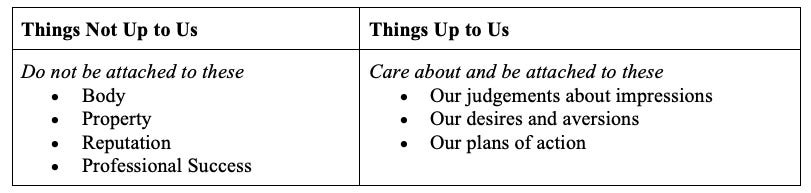
It is tempting to leave Epictetus’ idea just at this. And on its own this is an incredibly helpful idea. There is serious progress to be made in realizing that your reputation has more to do with someone else’s view of the world, than it has to do with you. There is an empowerment that comes from taking accountability for your emotions. Making this distinction is helpful, I do not want to trivialize that.
But it is only, at best, half the idea. Epictetus does not think we should focus on the things up to us because it is useful or calming or productive. We should care about them because they are what really matters.
The Good and the Bad
In Stoicism, a good thing is not just a pleasant or preferable thing. A good thing is something that necessarily makes your life better. It is something we should always choose. It is what makes us happy. Likewise for bad things – these are never to be chosen and always make our lives worse.
Throughout his Discourses, Epictetus really wants his students to understand that good or bad, as value categories, are only something we can say about the things up to us:
Where, then, shall we place the good? To what class of things shall we apply it? To that of things that are in our power. (Discourses, 1.22.11)
...Both good and evil rest essentially in the proper use of impressions, and that things that lie outside the sphere of choice are not by nature either good or evil. (Discourses, 2.1.4)
If you ask me what is the good of man, I can only reply to you that it consists in a certain disposition of our choice. (Discourses, 1.8.16)
The idea that only things up to us can be truly good or bad is critical to Epictetus’ key distinction. However, it almost always gets dropped from the discussion, likely because it requires a philosophical view of the good life that not everyone agrees with.
Epictetus’ distinction is not a pragmatic one. We don’t focus on the things up to us because that is where we have the most influence. We focus on them because they are where good and bad exist.
We focus on them because if they go well, we will be happy, and if they go poorly, we will be miserable.
Let’s return to the example of your reputation. Yes, it is ineffective to worry about the opinion of someone who hates you, because it is not up to you. But, much more importantly for the Stoics, it literally does not matter to your happiness. What matters for your happiness is how you respond to the insults, the rumours, the bullying.
You make your life bad if you incorrectly judge you have been harmed by an insult. The insult itself does nothing to you. Your happiness is up to you. It depends on how you make use of your impressions.
Critically, Epictetus does not think we are calmed just by ignoring the bullying. We are calmed by actually not caring about it; by thinking it is indifferent to our happiness.
I suspect many people critical of Stoicism see it as a form of self-gaslighting, or self-denial. They imagine Epictetus is saying something like: ‘Do not think about the bad things in the world, or the abuse happening to you. Ignore them unless you can change them.’
But he’s actually saying: ‘The thing happening to you cannot possibly be bad unless it is up to you. And it if it is up to you, then you can fix it.’
Epictetus has no interest in self-denial. Likely because it does not even work. Of course, if you value something someone else has control over, you will suffer. As Epictetus says:
If you gape after externals you must necessarily be tossed up and down, according to the inclination of your master. And who is your master? He who has authority over any of the things that you strive to acquire, or want to avoid. (Discourses, 2.2.26)
He is well aware that if you want something that is outside of your control you will be thrown about by the people that have power over it. You cannot avoid that pain just by recognizing the thing you want is not in your control. You have to actually not want it. You have to not desire to be liked by everyone, to have a perfect body, to have the most expensive things.
Recognizing what is and is not up to us is not enough to practice Epictetus’ key distinction. We have to actually change what we value. We have to shift our desire and fear towards the category of things up to us.
Epictetus’ Four Quadrants
Instead of thinking of this as a dichotomy, we can think of it as four quadrants. On one axis we have whether something is up to us, and on the other whether something is important. By ‘important’ I mean something that makes a difference to your happiness. In Stoic terms, it is good or bad.
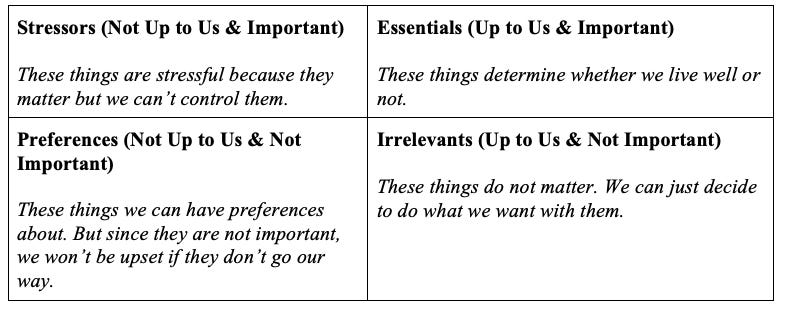
Epictetus does not make this four-part distinction explicitly. It is my own and these are not technical terms, but I think it is a more helpful way of thinking about the categories available to us.
If you took a moment to try to fill in these boxes, your answers would depend on not just what you think is in your control, but also what you value. As Epictetus would say, it would depend on your application of the preconceptions of good and bad. Filling out these categories requires you to take a philosophical position on what the good life is.
I suspect readers of this blog lean Stoic, but for the normal non-Stoic person, it might look something like this:
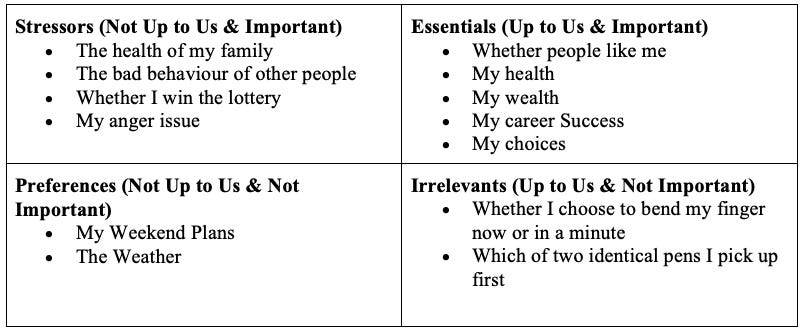
There might be some variation person to person. I might care about my appearance while you don’t. I don’t care about how nice my car is, while to others it is very important. But generally, everyone is going to have a few things in each bucket.
Now, the Stoics do something radical. They entirely empty what I’ve called the stressors bucket. They do this by claiming that everything in that bucket is either not actually important (not good or bad), or actually up to you.
For them, the category of ‘things not up to us and important’ simply does not exist. So, the Stoic sage’s quadrants look something like this:
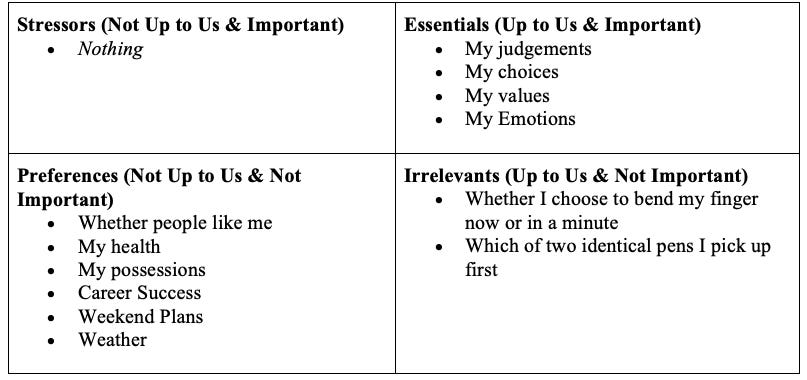
Practicing Stoicism is in large part about transforming your life by realizing that stressor bucket is empty. This is done by clarifying both what is up to you and what is important in life.
For example, the student of Stoicism might realize that their anger issue, something that has affected their entire life, is their responsibility to fix and in their power to fix. It is something that matters, but they can’t treat it like it is not up to them. So, it is not a burden to carry, but a task to improve.
Someone else might need to learn to detach from embarrassment over their height or a birthmark, even though they know it is outside of their control. They are right that it is not up to them, but wrong to think that being traditionally attractive matters for a good life.
So practicing Epictetus’ key distinction actually looks something like this:
Stoic Practice
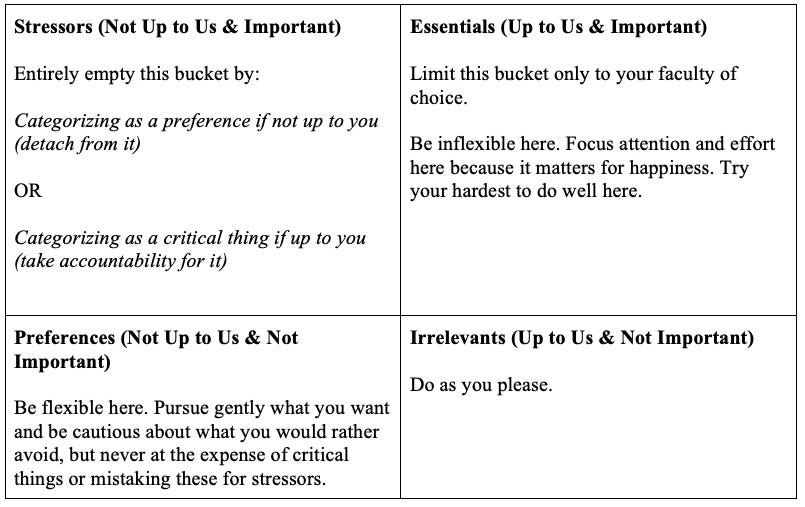
Practicing Epictetus’ distinction is not just about recognizing what is and is not up to you. Put more precisely, it is about clarifying that everything we typically talk about is either a preference or essential to your happiness.
Preferences need to be held lightly, while essentials need our sharp focus and attention.
Now, this is not to say that the Stoics think our character and the choices we make are the only things that matter. They are just the only things that are good or bad, the only things that make us flourish or flounder, the only things essential to a good life.
Not all preferences are made equal. And according to the Stoics we should prefer some things over others. The Stoic technical term here is that there are preferred and dispreferred indifferents. Things like the health of our family, or the respect of our community are natural, healthy and normal to prefer. But on their own they do not make us happy. No amount of health or beauty makes a bad person happy, and no amount of struggle can make a great person wretched.
While it is fine to have preferences, Epictetus’ point is that we must be flexible with them. In Handbook 15, Epictetus uses the example of being at a banquet. It is fine to enjoy what is made available to us, but bad manners to be angry when the food is taken away. We are a good dinner guest when we are flexible. We take the food when it is there and accept when the party has ended. There is nothing in that category which deserves our stress, nothing there that should throw us about.
Maybe We Should Accept a Life with Some Stress
A major benefit of framing is that it helps people who are progressing with Stoicism, and wrestling with Stoic value theory, incorporate Epictetus’ lessons more effectively.
Once they have understood the argument, most people don’t disagree with the Stoic idea of what is or is not up to us. However, almost everyone except the Stoic sage disagrees with the Stoic value theory. They think it is cruel to look at a dying relative and say: ‘this is nothing to me’. I struggle with this part of Stoicism myself even after ten years of practice.
But we can still get so much from Epictetus’ idea if we use these quadrants instead. For example, maybe you agree with the Stoics that being well liked is a preference, but you think they go too far when they say that the health of your child is not important, that it is neither good nor bad.
Then you can use Epictetus’ advice for the opinions of others. Detach from it, hold it lightly. Be glad when you are liked, but accept when you are not.
And then for the health of your children accept that if it is important to you, then it will be stressful. It is necessarily stressful to care about something outside of your control, something not up to you. That is a vulnerable, precarious position. As Epictetus said, if we do that we must necessarily be tossed up and down.
Well so be it, we might say. I am happy to be tossed up and down for my children, or my friends, or my passion. And that is a philosophically consistent position to take, if it is an examined one.
Then, maybe after more years of Stoic practice, that opinion will shift. Or maybe it won’t you, and you will accept that you just can’t be Stoic about some things most important to you.
But don’t be tossed up and down by everything, and especially not by those things that don’t really matter to you. For anything in that stressors bucket, make sure you want it there and have accepted the consequences. We must suffer if we find something that is not up to us to be important, so we must be incredibly critical of what those things are.
However, even if you don’t yet fully live by the radical Stoic idea that our character is the only good or bad thing, you can still clarify what matters to you, take accountability for what is up to you, and try as much as possible to hold your preferences lightly.
In my experience, this is a much more fruitful way of thinking about Epictetus division. And it leads to much more interesting questions about what we think is necessary for a good life than just a dichotomy between what is up to us and what is not.
About the Author
Michael Tremblay, PhD, has been practicing Stoicism as a way of life for over ten years. He writes about how Stoicism and ancient philosophy can improve our lives. He is the co-founder of Stoa, co-author of the Stoa Letter, and the host of the Stoa Conversations Podcast.
Photo credit: Etienne Boulanger on Unsplash