Building an After-School Stoic Philosophy Club

Follow into
Save into
Follow into
Welcome to Stoicism Today! This week we bring you a multi-authored article about an after-school philosophy club at a high school in Arkansas. Russell Holt shares his experience teaching Stoicism to his granddaughter and her classmates, offering suggestions for others who would like to start their own philosophy clubs. Read on for Russell’s perspective, as well as the perspective of 17-year-old students Midori Holt and Vivienne Le.
The Mentor’s Path: From Grandchildren to the Classroom
Many of us in the Stoic community believe that introducing students to Stoicism is important for cultivating the emotional fortitude necessary to navigate the world today. I’ve seen initiatives like Modern Stoicism Stoic Week for Schools provide excellent resources, which are great. And the College of Stoic Philosophers is currently building a program for young people. One thing all these programs will need is committed, knowledgeable mentors. My own path to meeting this need began not in a classroom, but at home with my grandchildren.
I have long shared Stoic principles with them, hoping to provide a compass for young adulthood. My granddaughter Midori took these lessons to heart at her charter school, The School for Advanced Studies. Her teacher, Mrs. Cochran, noticed Midori’s uncommonly rational approach to challenges and asked where she developed such poise. When Midori credited her “Grandpa,” I was invited to guest-lecture for her Speech and Debate class.
The assignment had a specific constraint: I had to bridge the gap between the book they were studying Dale Carnegie’s How to Win Friends and Influence People and classical Stoicism. Though an unlikely pairing, the overlap in emotional intelligence and self-regulation proved to be a powerful “hook” for the students.
As Mrs. Cochran later reflected:
“Mr. Holt brought a thoughtful perspective, emphasizing resilience and focusing on what we can control. His visit was an overwhelming success that deepened our students’ understanding of mindful communication.”
That single hour in the classroom created a ripple effect. A year later, the Assistant Head of School reached out to ask if I would mentor a formal after-school Stoic program. Having witnessed the hunger these students have for practical wisdom, my answer was an immediate yes. It was a reminder that the best way to serve the cause of Stoicism is simply to show up when given the opportunity.
Beginning with a Plan and Rapidly Adapting
Teaching is not my professional background. My job is that of being a compliance officer. And all my Stoic practice was mainly cultivated through adult discussion groups and mentoring adult students at the College of Stoic Philosophers. I wasn’t sure how to begin when it came to working with teenagers. So, I did what I do at work: I created a manual.
The manual had the traditional framework: there was a section on Logic, Physics, and Ethics; the four cardinal virtues: Practical Wisdom, Courage, Justice, and Temperance; the three disciplines: Judgment, Assent, and Action; and sections on Daily Practice and Community. On the first day, I opened the class with an introduction covering a high-level theory of Stoicism. Almost immediately, I could see their attention slipping. The concepts were too abstract, too distant from their day-to-day lives and concerns. Moreover, I had to remind myself that my granddaughter and her friends were here for an after-school program, not a classroom or lecture hall. So, I pivoted.
The Turning Point: From Theory to Practice
Instead of focusing on theory, I jumped straight into teaching the three disciplines—judgment, assent, and action—while linking them directly to each student’s lived experiences. The shift was immediate.
They began sharing real situations: conflicts with friends, stress over exams, and social media pressures. Each student would share one of their own personal life situations, and each situation became an entry point into Stoic practice.
When a student volunteered to tell a story, we would ask:
- What is within your control here?
- What assumptions are you making?
- Should you assent to that impression yet?
- What would a wise, just, or courageous response look like?
From there, we were able to move Stoicism from abstraction to application. It was no longer out-of-touch and foreign to these students; instead, it was a resource to use in everyday life.
What It Looked Like Week to Week
The club itself was small and informal. The School for Advanced Studies gave us access to classrooms that were not being used. Each week, we had three or four students in attendance, occasionally joined by a younger sibling, often motivated by the fact that my wife would make cookies for each session.
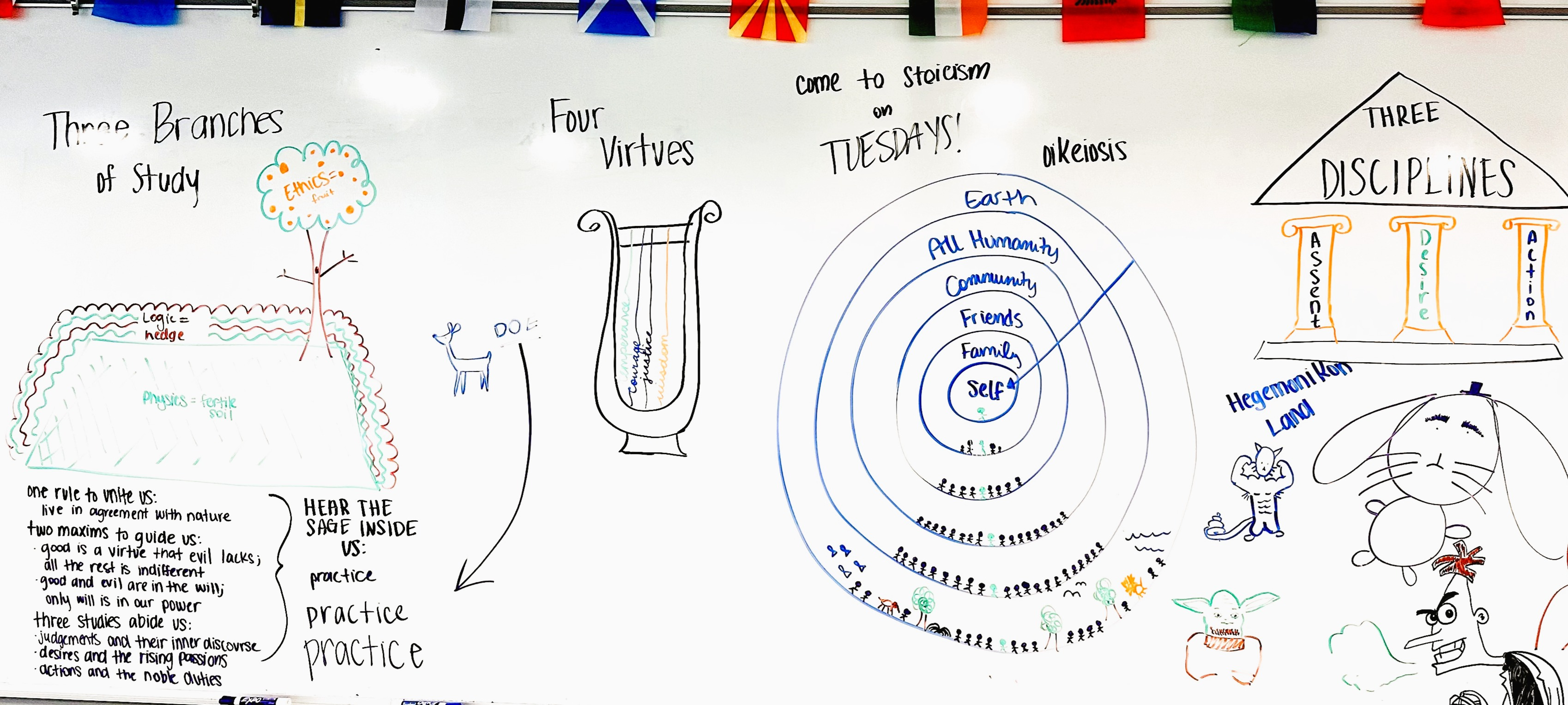
I wanted this to be their club, fun and interesting. In whichever room we were in, the whiteboard became a tool for visualizing the intersection of the theory in their lives. As they shared their experiences, they would map out their situations on the whiteboard over Stoic principles in real time. Social media drama, school pressures, relationship tensions—each became a case study to work through.
I kept discussions intentionally grounded. The goal was not deep personal disclosure, but practical learning.
At the end of each session, the whiteboard became a clear visual that showed a connection between ancient philosophy and modern adolescent life.
Student Perspectives
Midori Holt
My name is Midori Holt, and I am 17 years old. This is my second year at the School for Advanced Studies (SAS), and I am one of the founding students, which comes with lots of responsibilities. However, Stoicism has helped me keep a level head throughout it all.
To begin with, I am not religious. When I was younger, I went to a Methodist church, but I now consider myself agnostic. Thus, Stoicism is the only factor influencing my thoughts and my actions. I must say, it’s been the best teacher in my life.
My exposure to Stoicism started before the other members of the club because my grandpa would tell me about it every Sunday, when we went to his house. I remember my first impressions being that Stoicism sounded like something I would be interested in, but that it would be too hard and high maintenance. I couldn’t see myself having enough self-discipline to keep up with the rules of Stoicism. On my journey, I have debunked many of my original apprehensions. I now understand that Stoicism has no set guidelines for how to act in every situation; it’s based upon many factors. Stoicism only provides guides and a strong support system. Said support system has helped me in my everyday life. I have learned that Stoicism is hard and it does take an ungodly amount of personal accountability, but, in our club, we have taken Stoicism as a whole and broken it into bite sized pieces to learn throughout the year. I know now that I do, in fact, have the mental fortitude to live virtuously, no matter how tempting it may be to let my emotions rule over me. I’ve noticed over time that my mind has started thinking Stoically. It’s almost as if I’ve learned a new language and my mother tongue takes a backseat. In the past, every little thing would upset me and cause me to go basically mute. It was impossible for anyone to get through to me, and even though I hated the way I acted, I felt like there was nothing I could do about it. Now, my mind defaults to thoughts such as, “How would a Stoic sage react to this?” “What is the truth here, and what is illusion?” or “I won’t assent to this.” It feels like I have finally become one with myself and the world; I know how to react in many situations and let things that are not in my control flow like water off a duck’s back. People around me no longer need to walk on eggshells waiting for my next silent bout.
There are many aspects of Stoicism that still confuse me, and many things I feel I have a good grasp over. In fact, most of Stoicism clicked into place in my mind upon learning it. It all makes so much sense. The only aspect that I haven’t been able to fully understand yet is the physics of the traditional Stoic’s worldview. Although I’m sure that as we move along this year and continue to meet for Stoicism club, my grandpa will be able to help us understand.
Vivienne Le
My name is Vivienne Le. I am 17 years old, and this will be my second year at the School for Advanced Studies (SAS). When I started the year, I knew almost nothing about Stoicism. After joining the club, however, it has helped me immensely throughout the year.
I grew up in a Catholic family, but personally, I don’t identify with a specific religion. Even though I no longer consider myself Catholic, growing up in the Church still shapes how I see the world. I was taught to view every action through the lens of its potential impact on my afterlife, the idea that “you reap what you sow.” For most of my life, this left me constantly on guard and struggling with poor emotional regulation.
I was first introduced to Stoicism when my friends joined the club and later encouraged me to come along. I’m so glad I listened. Stoicism has dramatically improved my emotional regulation and completely changed my perspective on religion, the world, and how I navigate daily challenges. It has taught me to stop zooming in on every small setback and to avoid becoming overwhelmed by life’s struggles.
When I first heard about Stoicism, I assumed it was a religion. After attending my first club meeting, I was quickly taught that it is a philosophy, and an interesting one at that. At first, I thought it would be something I was too lazy to practice, but I soon discovered that while it does require real effort, the reward is powerful. It gives you the tools to take control of your emotions and stop clinging onto things that drain your energy for no good reason. This change has transformed my everyday life, especially now that senior year is approaching, and I’m realizing that I’ll be an adult very soon. Stoicism has helped quiet my overthinking, guided the choices I make about my future, and shown me what really matters. It has taught me to pause, step back, and ask myself simple questions like, “Does this really affect me?” or something we say all the time in meetings “Do I ascent to this” or “Stay as cool as a cucumber.” These moments of reflection have become one of the most valuable ways I understand and regulate my emotions.
What I’ve taken away most from Stoicism is the importance of not holding onto things and, above all, not ruminating on them. Of course, I only started learning and practicing Stoicism this year, so some concepts still confuse me a little, but I’m confident that with time, consistent practice, and the support of my friends in the club, everything will become clear.
Lessons for Mentors
For those interested in bringing Stoicism to young people, here are a few lessons that I (Russell) learned from this experience:
1. Start with experience, not doctrine.
Abstract principles matter, but relevance comes first. Meet students where they are.
2. Use real-life situations as teaching tools.
Their daily challenges are the curriculum.
3. Keep it conversational and visual.
Discussion and simple tools, like a whiteboard, can make philosophy tangible.
4. Emphasize practice over perfection.
Stoicism is something to do, not just something to understand.
5. Small groups are enough.
Impact does not require scale.
A Final Reflection
I often think back to my younger self and wonder how I could have benefited by learning Stoicism at their age. Watching these students begin that journey and seeing their growth in emotional fortitude, even in small ways—has been inspiring.
Stoicism does not remove difficulty from life. But it does offer a way to meet it—with clarity, steadiness, and purpose.
Perhaps there is no better time to begin that practice than in youth. If fate permits and an opportunity presents itself, seize the moment.
About the Authors
Russell Holt is a chief compliance officer in the commercial laundry industry. He also serves as a faculty member and mentor in the College of Stoic Philosophers, guiding students in the study and practical application of Stoic philosophy. In addition, Russell writes and publishes articles through his The Stoic Elder Newsletter on Substack, focusing on traditional Stoicism, civic responsibility, and the principles of engaged citizenship.
Midori Holt is a 17-year-old student at the School for Advanced Studies Northwest Arkansas, which opened in 2024. She currently serves as student leader of the school’s Stoicism Club, an organization she helped establish to support students navigating stress and pressure through practical philosophy and resilience. In addition to this role, Midori is co-editor-in-chief of the Hellbender Herald, the school’s newspaper, captain of the cheer team, co-captain of the soccer team, vice president of the National Honor Society, and secretary of Student Council. Passionate about leadership and student well-being, she is committed to creating positive spaces where others can grow, lead, and thrive.
Vivienne Le is a 17-year-old student at the School for Advanced Studies, Northwest Arkansas. She serves as the Vice President of the Student Council and is dedicated to supporting her friends and peers. Driven by a genuine desire to help others, Vivienne joined the Stoicism Club to cultivate personal resilience. By developing the tools to manage her own stress through Stoic practice, she aims to become even better equipped to guide and support her friends and classmates.
Thanks for reading Stoicism Today! This post is public so feel free to share it.