Would you like to join a Stoic research study?
Follow into
Save into
Follow into

Welcome to Stoicism Today! This week we are happy to share an opportunity for readers to participate in a research study on Stoicism and resilience. Clinical psychologist Katrina Merkelt is leading a study at the University of East Anglia, and practicing Stoics from all over the world are invited to join online. Find out more below!
I’m Kat Merkelt, a trainee clinical psychologist and postgraduate researcher at the University of East Anglia, and I’m writing to invite you to take part in my research into Stoicism and psychological resilience.
Stoicism and Resilience
As a trainee clinical psychologist, I’m interested in understanding how individuals and groups make sense of distress and how they approach challenges and setbacks in their lives. What helps people to navigate challenging times, and how might one’s philosophical identity help to shape the way that they approach these situations? Understanding more about this may be key to developing a diverse offering of community-based initiatives that aim to enhance wellbeing and prevent the development of mental health difficulties.
Stoicism is becoming increasingly popular in the modern world, with growing interest in how Stoic principles can be applied to modern-day life. Research has found that those who have taken part in Stoic workshops experienced improvements in their self-confidence, ability to manage their emotions, and ability to cope with challenges or setbacks in their lives.
With all of this in mind, I am eager to hear from modern-day Stoics with the hope of finding out more about the lived experience of the Stoic community and how their practices shape their own sense of resilience. I invite you to take part in my research study: Understanding perspectives on Stoicism and Resilience within the Stoic Community.
What is the study about?
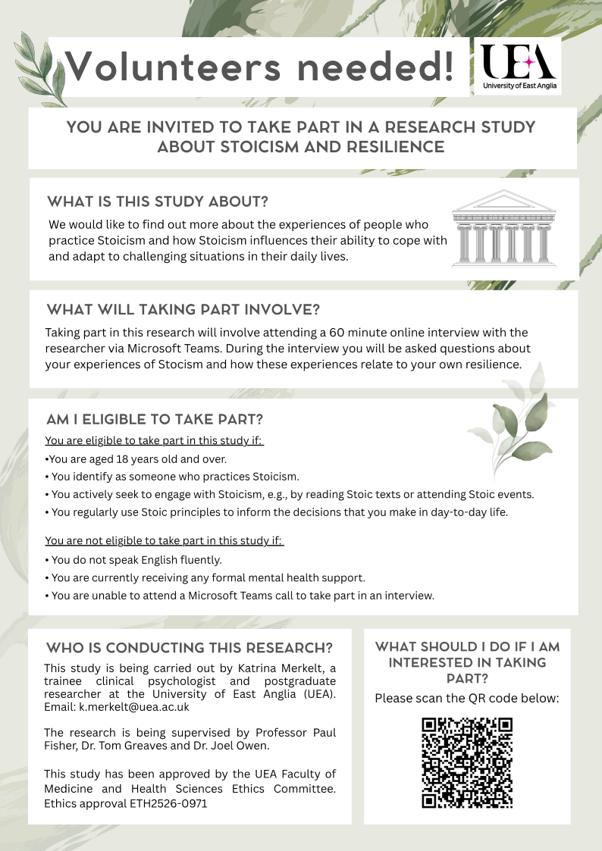
This study is being carried out to find out more about the experiences of people who engage with Stoicism and how Stoicism shapes their ability to cope with and adapt to challenging situations. Your insights will help with understanding more about how Stoic ideas and practices are used in modern-day life to shape resilience.
What does taking part involve?
Taking part in this research will involve attending a 60-minute interview via Microsoft Teams. During the interview, you will be asked a series of questions about your experiences of Stoicism and how these experiences have shaped your own resilience. The results of the research will be written up as part of my doctoral thesis.
Am I eligible to take part?
You are eligible to take part in this study if:
- You are aged 18 years old and over.
- You identify as someone who practices Stoicism.
- You actively seek to engage with Stoicism, e.g., by reading Stoic texts or attending Stoic events.
- You regularly use Stoic principles to inform the decisions that you make in day-to-day life.
You are not eligible to take part in this study if:
- You do not speak English fluently.
- You are currently receiving any formal mental health support.
- You are unable to attend a Microsoft Teams call to take part in an interview.
Who is conducting this research?
This research is being carried out by Kat Merkelt, a trainee clinical psychologist and postgraduate researcher at the University of East Anglia. The supervisory panel for this research includes Professor Paul Fisher, Dr. Tom Greaves and Dr. Joel Owen.
What should I do if I’m interested in taking part?
If you would like to receive more information about this study to help with deciding whether or not to take part, please scan the QR code on the poster below or click here:
About the Author
Kat Merkelt is a trainee clinical psychologist and postgraduate researcher at the University of East Anglia with an interest in psychological resilience and community-based approaches to mental health promotion. She is especially interested in how different communities make sense of their experiences and what helps individuals and groups to navigate challenges and cope with difficult situations.
To support our work, consider becoming a free or paid subscriber.