Are You Still Hands-On?
Follow into
Save into
Follow into
Presented by Fivetran
Your pipeline works great for 3 data sources. But what happens when you hit 30? Or 300?
Building custom connectors is fine until you have to scale. Fivetran takes the headache out of the equation by handling the schema changes, API updates, and retries across hundreds of sources, delivering analytics-ready data in hours.
They handle the ingestion mechanics. You handle the actual data strategy, modeling, and AI.
Try Fivetran free for 14 days.

Are You Still Hands-On?
I get asked a version of this question all the time, usually with a skeptical look: “Are you still hands-on?”
No, not in the traditional sense. My focus has shifted away from the day-to-day engineering tasks that many of us started with, like maintaining pipelines or managing late-night production issues. I value the years I spent in those roles, and they provided the foundation for everything I do now. I still do this work in my own business, but it’s not my main focus. As my career has evolved, I’ve found that my interests have naturally evolved toward different types of challenges.
Nothing wrong with that if you enjoy that sort of work. I meet plenty of people who are happy (or at least tolerate) day-to-day engineering work. But my goals have evolved, and I’m “hands on” in many other ways. Part of me simply doesn’t feel the need to spend the next decade proving I can still do the same work I did over the last twenty years. The bigger part is that life’s too short, new opportunities arise, and careers evolve.
That doesn’t mean I’ve checked out or am out of touch, though. If anything, I feel I’m closer to the ground now than ever in my career, which I’ll get into shortly.
This week alone, I was asked the “are you still hands-on” question a few times, and I reflected on what it’s really asking: some form of “how are you staying relevant?” The question itself actually points to a pretty big blind spot in how we measure technical credibility and credibility.
One Year of Experience, Repeated For 20 Years
There’s this stubborn dogma in tech that the closer you are to raw implementation, the more legitimate you are. When you’re starting, that’s 100% true. You need the scar tissue from building infra, watching it fail, debugging the failing infra, and living through someone else’s (or your own) bad architectural decisions. At some point you might move to management or an advanced individual contributor role. Without those scars, it’s hard to develop muscle memory and pattern recognition to become a competent practitioner.
At a certain point, we start confusing being busy with actually learning and evolving. There’s a massive difference between having twenty years of experience and having one year of experience repeated twenty times. Sadly, I see some form of this everywhere I go. People get comfortable or think they know everything, and stop learning. They start approaching problems from the very narrow lens they’ve built for themselves, focused on the problem space of the particular company or team they’re working within. Often, these are the people asking me the “hands-on” question, as if they’re trying to size me up.
I’ve seen enough architectures collapse to spot failure modes early, but that’s a double-edged sword. It can give you clarity, or it can trick you into thinking every new paradigm is just a recycled version of something you did in 1996, 2006, 2016, or some other point in ancient history. Things move incredibly fast in our industry (especially today). As Janet Jackson once asked, “What have you done for me lately?”
In the end, there’s a point of diminishing returns to doing the same type of work, over and over. How many functionally identical pipelines or warehouses/lakehouses do you need to build? How are you growing if you’re maintaining the same stack year after year? Repetition can lead to mastery, but it can just as easily lead to stagnation. Being buried in implementation doesn’t automatically mean you’re advancing, either technically or careerwise. If you were once a 5x engineer, repeating the same work year after year might only make you a 0.5x engineer today. Especially at the rate things are moving, you’re likely placing yourself at a massive disadvantage relative to where the market is moving.
On a related note, operating inside one company gives you intense depth, but it’s local depth. You’re limited by one stack and one set of corporate incentives. The biggest trap is assuming your local reality represents the global state of the art. It rarely does. Get out of your company and comfort zone and meet other practitioners. There’s a whole world out there of people working on amazing problems and who are happy to share their stories.
I’m not saying that everyone doing implementation work is stuck in a rut and myopic; far from it. Implementation work is certainly “hands-on.” Hopefully, if you’re a practitioner, you’re putting yourself in new opportunities to learn and grow not just your skills and capabilities, but your network. This is how new opportunities arrive, and new opportunities are the lifeblood for a fruitful and exciting career.
Broadening the Scope of Impact
I’d been podcasting, hosting meetups, and blogging regularly for several years, and started building an audience. I did these things to test ideas in public and meet people. At some point, writing a book was in the cards. After Fundamentals of Data Engineering was published in 2022, I didn’t realize how much it would change my own perspective. Seeing how practitioners and enterprises engaged with those ideas made me realize that while a solid implementation helps one system, sharing foundational concepts can support a much wider community. It was a humbling realization that led me to prioritize sharing knowledge more broadly, which I’ve done on Coursera, Substack, advising and investing in companies, in countless talks around the globe, and in my upcoming Mixed Model Arts series.
Becoming a public figure changed how I view my effectiveness and output. Instead of optimizing for 1:1 (one engineer to one system (or company), I now have a platform and leverage to impact in a 1:many fashion.
Local Implementation: 1 Engineer ──> 1 System (1-to-1 Leverage)
Leveraged Architecture: 1 Framework ──> 10,000 Systems (1-to-Many Leverage)
These days, I focus on forming new businesses (where I’m building the infra and systems), writing/content, advising/investing, and experimenting and building what’s next in data. My current focus has been Mixed Model Arts and next-generation data modeling practices and architectures for humans and machines. My “unit of output” has changed. Instead of shipping traditional artifacts like pipelines and star schemas, I’m producing frameworks, books, and companies. I’m peers with the people helping build the future of our industry, and I talk with them daily. And I still advise and chat with leaders and practitioners very regularly, understanding what’s happening in their situation and helping them solve it. This is still very “hands-on,” no matter how you slice it.
Some might see this as a pivot away from technical rigor. Let’s take teaching, where there’s the adage, “those who can’t do, teach.” To the contrary, I’ve found that activities like teaching actually demand a deeper level of “hands-on” discipline. When you move from implementation to explaining first principles to a global audience, you’re forced to confront your own assumptions in some very honest and daunting ways. It’s a challenging and rewarding process that clarifies your thinking in ways implementation alone often cannot. If you’ve ever considered sharing your own expertise, I highly encourage you to try it. It’s a powerful way to grow and contribute to our field together.
And frankly, I’m bored with yesterday’s problems. I’m far less interested in how we wire together yesterday’s tools and more interested in the structural problems we’ll face five to 10 years from now that barely anyone is talking about yet. I’m fixated on building the future, whether that’s from mental frameworks or tools/technology. A big reason I focus on education is that while there’s no shortage of tools, there’s a big gap between the tools and our understanding of how to use these tools effectively, especially first-principles knowledge. That’s a big problem I’m trying to solve.
The Punditry Trap and Avoiding “Uncle Rico” Mode
There is a risk here, for all of us: becoming the tech equivalent of Uncle Rico1 from Napoleon Dynamite, being in your 30s, living in the past, and bragging about how you used to throw a football over the mountains back in high school. Nobody cares how you managed mainframes or built a lofty enterprise data model back in the day. Experience depreciates incredibly fast in tech. What are you doing today?
To stay sharp, you need empirical grounding. Every week I’m checking out the latest tools and projects (as best one can these days). I still build prototypes, dogfood emerging tools, and mess around with agentic workflows. If something works, I incorporate it into my business and personal life; agents run a lot of things for me. The goal isn’t an operational day job where I tinker all day. I’ve got a business to run, which demands a far bigger scope of attention.
Every week, I talk to founders, researchers, and engineering leaders worldwide. I see which cutting-edge tools actually survive contact with reality and where common friction points show up across unrelated industries. Stepping back from day-to-day operations puts you closer to the ground in another way, where the ground becomes the industry itself rather than a single system.
That’s what I do. You might have your own way of staying on top of things and sharpening your skills and knowledge. That’s awesome. You can still be “hands-on” as you evolve. Don’t let the past (or people’s opinions) keep you from pursuing things that interest you. Avoiding stagnation is probably the best investment you can make in your career.
Stagnation scares me, and I do whatever I can to avoid becoming Uncle Rico. Here are some tips I’ve found to avoid becoming Uncle Rico.
Don’t Play Your Greatest Hits
I once asked DJ Hell, a pioneer of European techno, how he stayed relevant for decades. He told me: “You can’t keep playing your greatest hits. Eventually, you have to kill the thing that made you successful and keep moving.”
That’s uncomfortable because our identities get tangled up in titles like “Data Engineer” or “Architect.” But when the paradigm shifts, clinging to that identity forces you to defend a legacy world. Those worlds are rapidly reshaping today. The better questions aren’t about your PR count, but about whether you’re actively changing your mind on architecture or exploring tools that make your current skills obsolete.
AI and the “Post-Literate” Engineer
AI has scrambled everything by collapsing the activation energy needed to build. We used to spend most of our time wrestling with plumbing and mechanical overhead. Now, the distance between a hypothesis and a prototype is minutes. This is turning everyone back into a builder. Leaders and architects are jumping back into code because it’s cheap and fast. In this world, judgment becomes the rarest asset in the room. Knowing how to write syntax matters less than knowing if a system should even exist, or if the underlying data actually makes sense. Your years of judgment are more valuable than ever here.
Build What Comes Next
A big theme of the talks I gave last year is that AI forced everyone back to the starting line. The old world matters, but you have a once-in-a-lifetime opportunity to be on the ground floor of building what’s next. There’s always a place for elite production operators, but operational work isn’t the only way to contribute. At some stage, your highest-value work will be helping shape the tools, frameworks, and mental models the entire field will use tomorrow.
Be bold. Grow and evolve yourself. Build what comes next.
attendee survey for PDM
In this Freestyle Friday episode, I chat about the various craziness and trends of AI right now.
Freestyle Fridays and my other podcasts are available on Spotify, Apple Podcasts, and wherever you get your podcasts. Please support the show with a review. It means a lot.
Where I’m At
My fall calendar is shaping up, and here’s an idea of what I’ll be doing. In most cases, I’m giving a talk. In some cases, I’m just hanging out.
From AI Hype to AI ROI Roundtable (hosted by Revefi)
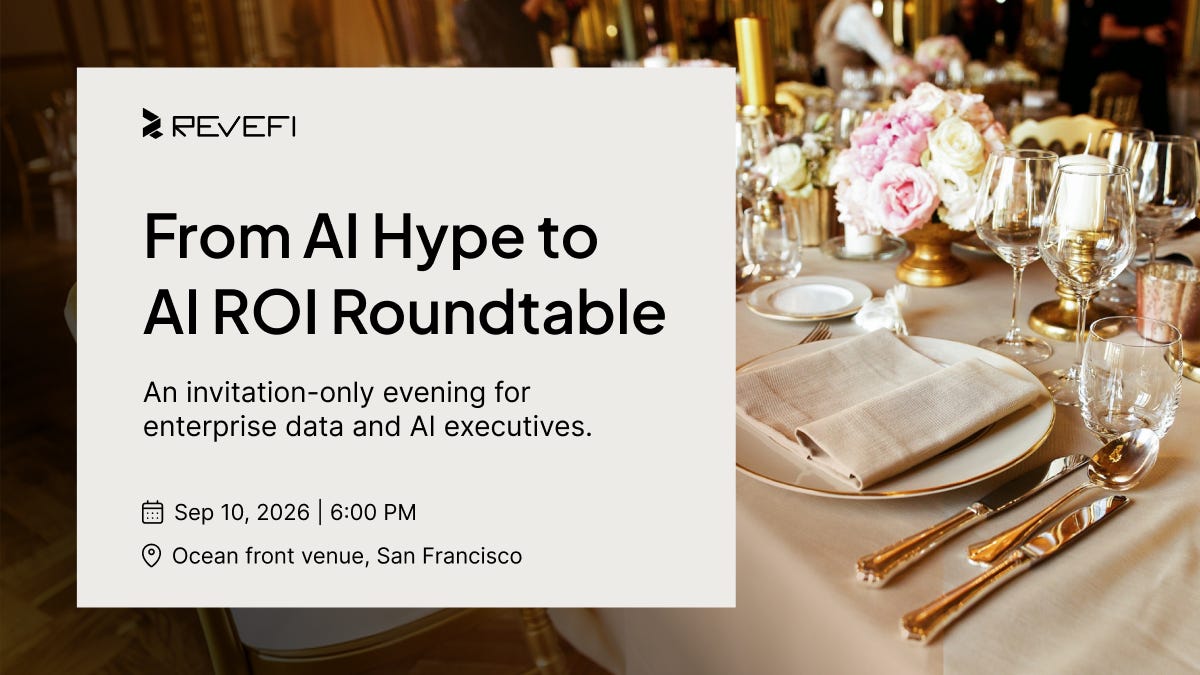
If you’re a data leader in the Bay Area, there’s a very special invitation-only roundtable for enterprise data and AI executives. I’ll be there too. Register here.
Other events:
-
dbt Summit. September 15-18. Vegas. Register here.
-
Big Data London. September 22-24. Register here.
-
Motherduck BDL after party. London. September 23.
-
appliedAI. Munich. October 8.
-
Stanford. This fall, I’m joining Bruno Aziza as a guest speaker in his Stanford class on building products in the era of AI (October 12 – November 9).
The course was just announced and it’s already filling up. Stanford has opened it up online, so you can join from anywhere. Sessions are recorded too, so a time zone isn’t a dealbreaker.
Reserve your spot here soon because the course is almost full.
- Motherduck’s Data Outpost. November 4-5. San Francisco. Register here.
- Connected Data London. November 11-12. Register here.
- Forward Data Conference. November 16. Paris. Register here.
- MLOps World. November 17-18. Austin. Register here.
More to be announced very soon.
Cool Videos and Reads
Building with AI, DuckDB + RDF, and the Semantic Future w/ Dan Bennett (Head of Tech @ S&P Global)
On this episode of The Joe Reis Show, I’m joined by Dan Bennett, Head of Technology for the Enterprise Data Organization at S&P Global.
We get into what it actually looks like to build with modern AI coding tools like Claude Code. Not just as a toy, but for writing production-grade C++.
Dan walks through how he built an open-source RDF extension for DuckDB, why rock-solid test coverage is non-negotiable when working with LLMs, and why engineering leaders need to keep their hands dirty to understand where this tech is headed.
We also react to the breaking news of AWS acquiring DuckDB Labs, talk through the shift from "human-in-the-loop" to autonomous agents running in headless VMs, and dive into why data semantics across organizational boundaries remains one of the hardest - and most important - unsolved problems in our industry.
Here are some things I read this week that you might enjoy
(no articles this week as I’ve been heads down getting my book ready for publication)
Note: These are articles I’ve read and enjoyed. I use AI to summarize my thoughts on the articles. I edit the summaries.
Find My Other Content Here
📺 YouTube - Interviews, tutorials, product reviews, rants, and more.
🎙️ Podcasts - Listen on Spotify or wherever you get your podcasts
📝 Practical Data Modeling - This is where I’m writing my upcoming book, Mixed Model Arts, mostly in public. Free and paid content.
If you’re interested in sponsoring my newsletter and podcast, Q3 and Q4 2026 are opening up. Space is very limited. Please fill out this form if you’re interested.
The Practical Data Community
The Practical Data Community is a place for candid, vendor-free conversations about all things tech, data, and AI. We host regular events such as book clubs, lunch-and-learns, Data Therapy, and more.
Thanks for reading! Subscribe for free to receive new posts and support my work.
I’m obviously a big fan of Uncle Rico. When I Googled his image, my own article link came up as the first result 😅