Why Write Books These Days?
Follow into
Save into
Follow into
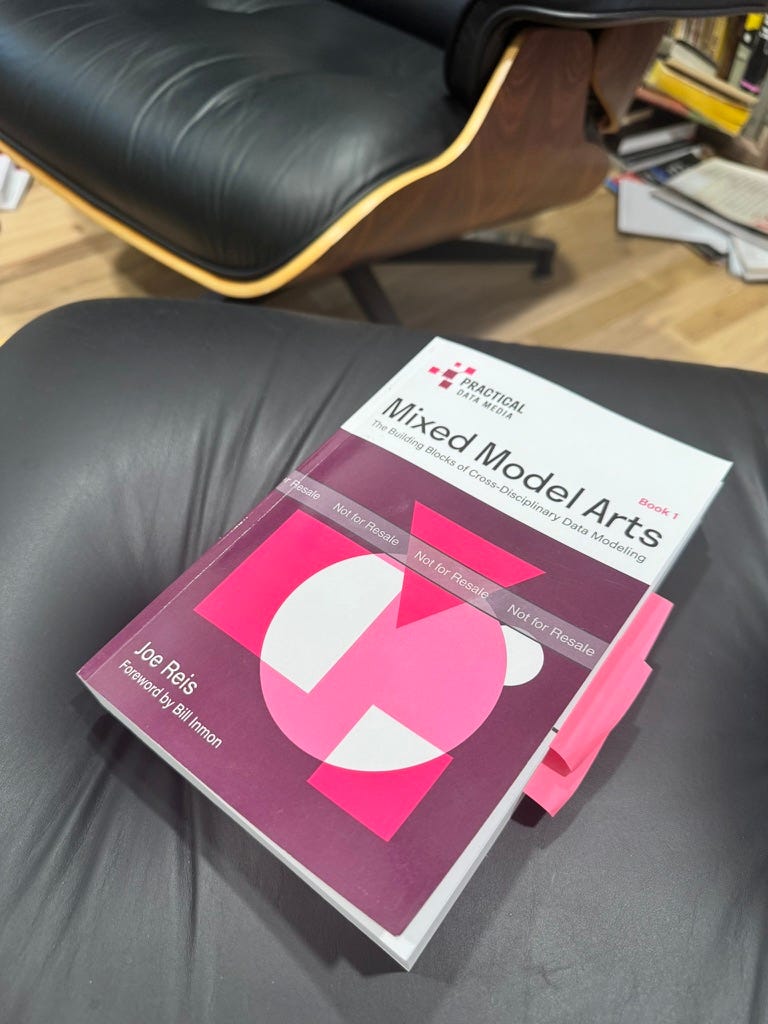
A physical book proof for Mixed Model Arts (book one). Available VERY soon!
The other day at the dbt Summit, dbt’s Tristan Handy asked me “Do people even still read books?” Fair question, and based on the trends, reading is in secular decline. It’s a crying shame, but that’s reality. We live in an era of infinite digital noise trying to capture our fragmented attention spans. LLMs give instant answers on demand. I’ve heard some people say they don’t need to learn anything anymore. There’s even a new book coming out called The New Dark Ages, which looks at the impact of the decline of reading. I call our era the Derp Ages, but whatever.
As I wrap up Mixed Model Arts, it’s a mix of satisfaction and wondering, “Why the hell do I write books?” It’s easily one of the highest friction/effort things you can do. The payoff is questionable for most authors, who won’t recoup all of the time and opportunity cost. If you evaluate writing a book purely on economics, it’s a very stupid and irrational allocation of energy you could possibly make. I’ve also noticed that authors don’t market their book or capitalize on the backend - courses, talks, etc. Then they complain the book doesn’t sell. No shit…
For me, writing is both a forcing function for deep thinking and something I sadistically enjoy doing. Here are some of the reasons I write books.
First, it’s a forcing function for deep thought. Articles, podcasts, videos, conference talks allow you to skate across intuition, topics, and spicy takes. These are shallow waters. A full-length manuscript is totally unforgiving. These are the deep waters that demand a sustained througline across hundreds of pages. You need a linear progression that makes sense to the reader, traversing material in a way that’s impossible to replicate. Writing a book is the only mechanism that forces you to discover what you actually believe and understand, not just superficially wade into random topics. Books will expose your weaknesses in very humbling ways. Try writing a book in public for bonus points and pain.
Second, a book is intellectual proof of work. Whereas social media and video run on ephemeral feeds engineered to decay within a few days, a book (especially a canonical one) does the inverse. A canonical book compounds in value over years. Anyone can ship a thread or a video (especially nowadays when it’s easier than ever to be a slop cannon). Publishing a coherent, rigorous book remains notoriously brutal. That’s why most people don’t bother at all, or quit writing their book. It’s hard work, and this also acts as a credibility filter. A good book can serve as genuine intellectual proof of work, opening up new opportunities - keynotes, executive and practitioner trust, advisory, curriculum, etc. in a way that viral posts never will.
Finally, a book is a bounded contract. Social feeds are optimized for dopamine. A book is an intentionally bounded artifact. When someone reads a book, they’re entering an explicit contract to give an idea their undivided focus across hours, days, and months. Stephen King described it as teleportation, where the reader can enter into a discussion with the author, when that author wrote the words. That depth of connection is something no algorithm can replicate.
Mixed Model Arts will be launched very soon. I’m guessing the ebook is available as soon as next week. It’s already done, but I’m waiting on another physical book proof to double check a very minor formatting issue. Thanks to everyone who’s supported MMA. My goal is to launch before GTA 6, and I think I’ll make it. Stay tuned!
In this Freestyle Friday episode, I chat about the various craziness and trends of data and AI right now.
Freestyle Fridays and my other podcasts are available on Spotify, Apple Podcasts, and wherever you get your podcasts. Please support the show with a review. It means a lot.
Presented by Fivetran
Everyone wants to deploy AI agents, and the hard truth is that agents making operational decisions on stale data or broken pipelines are a liability. Plus you’re wasting your precious time. Do you want to build commodity connectors in 2026? Ok…
You can hand roll or vibe code your own custom connectors across 30+ SaaS tools. But is this the best use of your time (and tokens)? I’ll argue you’re doing undifferentiated heavy lifting and that your time is better spent on work that moves the needle for your stakeholders.
Fivetran handles the ingestion grunt work. You get automated schema drift handling, instant API adjustments, and hundreds of managed connectors ensure your agentic workflows run on fresh, trustworthy enterprise data. Leave the data movement to Fivetran and keep your focus on your agentic overlords, semantic layers, models, and real business impact.
Try Fivetran free for 14 days.
Where I’m At
My fall calendar is shaping up, and here’s an idea of what I’ll be doing. In most cases, I’m giving a talk. In some cases, I’m just hanging out.
- Big Data London. September 22-24. Register here.
- Motherduck BDL after party. London. September 23.
- appliedAI. Munich. October 8.
- Hex Prompt. San Francisco. October 27.
- Stanford. November 2.
- Motherduck’s Data Outpost. November 4-5. San Francisco. Register here.
- Connected Data London. November 11-12. Register here.
- Forward Data Conference. November 16. Paris. Register here.
- MLOps World. November 17-18. Austin. Register here.
More to be announced very soon.
Cool Videos and Reads
Designing AI-Driven Data Foundations
Former Gartner VP Analyst and principal at SanjMo, Sanjeev Mohan, joins me to break down the reality of AI adoption, data foundations, and why enterprises are hitting roadblocks with agents and LLMs.
Here are some things I read this week that you might enjoy
The Last 24 Hours Are the Opening Scene in a Horror Movie
We have seen this playbook before, and doomerism is usually just vendor hype wearing a Halloween costume. If you convince regulators your tech is dangerous enough to end humanity, congratulations: you just justified a trillion-dollar valuation and built a regulatory moat wide enough to drown open-source competitors. Meanwhile, out in the real world, practitioners are still wrestling with broken data pipelines while these models hallucinate basic SQL. Let us tackle real-world engineering failures and sloppy governance before we lose our minds over sci-fi campfire stories (though those are still a possibility). (Ted Gioia)
The new age of the orator
Hear ye, hear ye! The New Dark Ages have begun (The Economist)
Reading and associations with brain health, cognition, well-being, and mental health
On the other hand…reading makes your life better. We work in an industry obsessed with cognitive shortcuts, where people pay good money for nootropics and ask an LLM to boil a three-hundred-page book into five lazy bullet points. Turns out sitting down and reading actual sentences is still the cleanest compound interest your brain can get. It is the mental equivalent of lifting heavy iron in the garage instead of buying vibrating ab belts from an infomercial. If you outsource basic attention to algorithmic feeds, do not act shocked when your deep focus rots. (Psychological Medicine)
College Is Coming Apart
Ian Bogost argues that modern American higher education is a fragile bundle of conflicting functions—vocational credentialing, adolescent coming-of-age, and scientific research—that historical accident temporarily held together. Recent pressures from the pandemic, federal funding threats, and generative AI have accelerated the unraveling of these missions by separating student labor from actual learning and pitting research against teaching. While universities will preserve their outward rituals and credentials due to institutional inertia, the underlying coherence of campus education has effectively collapsed. (The Atlantic)
Note: These are articles I’ve read and enjoyed. I use AI to summarize my thoughts on the articles. I edit the summaries.
Find My Other Content Here
📺 YouTube - Interviews, tutorials, product reviews, rants, and more.
🎙️ Podcasts - Listen on Spotify or wherever you get your podcasts
📝 Practical Data Modeling - This is where I’m writing my upcoming book, Mixed Model Arts, mostly in public. Free and paid content.
If you’re interested in sponsoring my newsletter and podcast, Q3 and Q4 2026 are opening up. Space is very limited. Please fill out this form if you’re interested.
The Practical Data Community
The Practical Data Community is a place for candid, vendor-free conversations about all things tech, data, and AI. We host regular events such as book clubs, lunch-and-learns, Data Therapy, and more.
Thanks for reading! Subscribe for free to receive new posts and support my work.