Booms, Busts, and Builders: Lessons from the High Plains of Wyoming
Follow into
Save into
Follow into
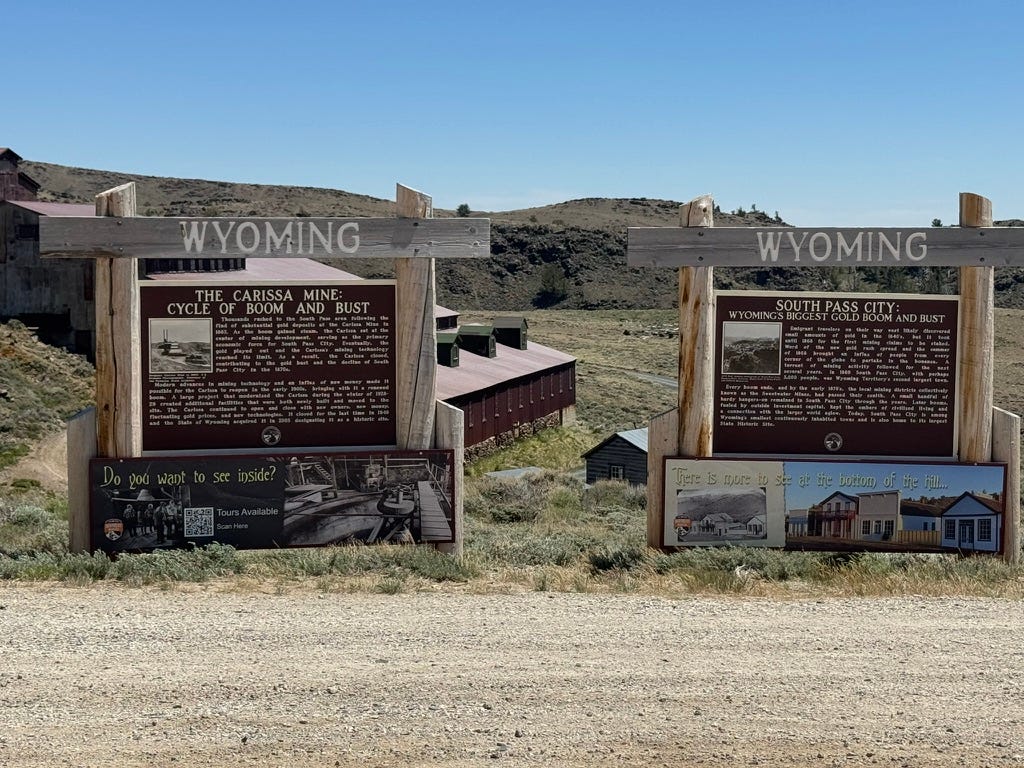
South Pass City, Wyoming
I spent the week in the mountains of Wyoming, a place near and dear to me since I grew up there. Apart from climbing in the mountains, one of my favorite things to do is running and walking around the desolate high plains near South Pass, Wyoming. It’s a surreal, wide-open expanse sitting at around 8,000 feet with far more antelope than people, and lots of wind. Standing here puts you directly at the geographic center of two massive historical booms.
Save serious money on your cloud costs with Revefi’s new autonomous AI DBA, a tool built to handle the gritty reality of cloud data management so you can stop babysitting your infrastructure.
With a five-minute, zero-touch setup, it deploys 18 specialized agents across your data estate to automatically manage FinOps, performance tuning, and data quality. If you want to cut your cloud costs by 30% to 70% and get back to actual data architecture, check out what they are building at revefi.com/ai-dba
Thanks to Revefi for partnering with me on the newsletter and podcast.
First, you have the Great Westward Migration. South Pass is a 20-mile-wide, gently ascending gap in the Rocky Mountains that served as the “Gateway to the Continent” by providing an easy crossing over the Continental Divide. It became the critical route for the Oregon, California, and Mormon trails. Between 1840 and 1869, as many as 500,000 emigrants funneled through this exact spot in search of a better life out West. If you look closely, you can still see the old wagon trails crisscrossing the plains today.
The second boom was a classic gold rush. In 1867, soldiers from Fort Bridger discovered the Carissa lode, igniting a frenzy in the Sweetwater Mining District. South Pass City, located just north of the Oregon Trail, exploded almost overnight. Within a year, the population soared to 2,000 people as thousands of prospectors flooded the area hoping to strike it rich. Walking around, you can still find the remnants of old settlements hidden up in the hills, where desperate miners built rock homes right next to quartz outcroppings, hoping to extract the gold underneath. Butch Cassidy and other famous outlaws frequented South Pass too, bringing along legends of buried treasure and gunfights throughout the area.
When I look at the remnants of these past boom-and-bust cycles, I can’t help but draw parallels to the current AI boom.
Are You a Builder or a Claim Staker?
In any rush, it is entirely rational to want to participate. If you ignore the AI boom, you miss out on today’s big opportunity. But the people who truly win the rush are rarely the ones chasing the claims with the masses.
Historically, the real winners were the ones selling picks and shovels, or building the heavy infrastructure. In South Pass City, early prospectors had to rely on simple hand processing to extract gold (if you’ve ever panned for gold, you know the tedium). It wasn’t until heavy infrastructure, such as stamp mills, was introduced that the region managed to produce around $7 million in gold (a lot of money in those days).
Today, the equivalent of that heavy infrastructure is the massive data centers and the frontier AI models. The people who own the infrastructure are the ones doing the hard work. To a less capital intensive extent, people are focusing on vertical-AI and proprietary harnesses and datasets, among other differentiators. On the other hand, if you are simply building a wrapper around existing foundation models, you are essentially a claim-staker. You are panning for surface gold without a real differentiator, and as I’ve written before, the companies owning the frontier models can easily replicate your product at any point.
And building is only one part of the equation. I’d say it’s relatively easy compared to what comes to the “hard stuff.” Your product and company still need distribution and awareness, which is increasingly the hardest obstacle for many companies to overcome (especially startups). I should know, as my inbox is flooded with founders asking for advice on how to get noticed, or asking for help on “exposure.” I’ll probably do a rant on distribution and visibility at some point. Anyway, back to the gold rush.
The Danger of Exceeding Expectations
By 1872, the easy gold in South Pass dried up, and the bust hit hard. I’ll sometimes visit abandoned mines and old stone homes, which are often right next to each other. Imagine building a home in a desolate place, then mining day and night next to it, trying to strike it rich. The people who spent their savings trying to mine a hillside simply moved on or went broke. Today, South Pass City is maintained primarily as a historic site with only a handful of year-round residents. It’s a great place to visit if you’re in the area (go in the summer, since Wyoming winters are downright brutal).
The paradox of the AI boom is that even if you do the hard work and build the infrastructure - the gold mine itself - you still might not succeed. That’s what happened to the Carissa Mine in South Pass. It was red hot. Then it closed. If massive market expectations aren’t met, the bubble bursts. We are already seeing the economics of infrastructure become tricky to navigate, with some saying that nearly half the data centers in the US are facing delays or cancellations, while others claiming this is nonsense.
When you look at the unprecedented valuations of companies right now, it is tempting to jump in unquestioningly, wondering if you’re an idiot for missing out on the massive wealth generation. But the most dangerous words you can ever say in a mania are, “This time is different”. I spend a lot of time studying manias, panics, and crashes, and human nature hasn’t changed. We are still inherently enamored by the latest shiny thing. It’s a human quirk that’s so far proven impossible to remove.
Hedging Your Downside
If you are going to participate in the AI boom, be honest with yourself about your strategy. Are you building the future, or are you just trying to stake a quick claim? It’s easy to convince yourself you’re doing the former, while actually doing the latter. Everyone wants to think they’re changing the world. Maybe you are, but be honest with your situation and approach. If you’re looking to make a quick buck and you’re honest about your motivations, that’s awesome and good luck.
More importantly, hedge your downside. I’m fundamentally optimistic that the technology and infrastructure we are building now will yield massive benefits for humanity. Still, we need to stay grounded in reality regarding what expectations can actually be met, and when. I saw too many people go broke in various bubbles (dot-com, housing, crypto, meme stonks, the COVID-era VC binge, etc.) because they became overleveraged or overextended, set unrealistic expectations, and mistakenly believed the party would never end. Parties always end, and the hangover can be downright miserable. Keep your head about you while everyone else is losing theirs to the collective madness of the mania. Make sure that if your AI opportunity doesn’t pan out, you aren’t left entirely destitute.
And best of luck to you. I hope you strike it rich!
A few quick updates.
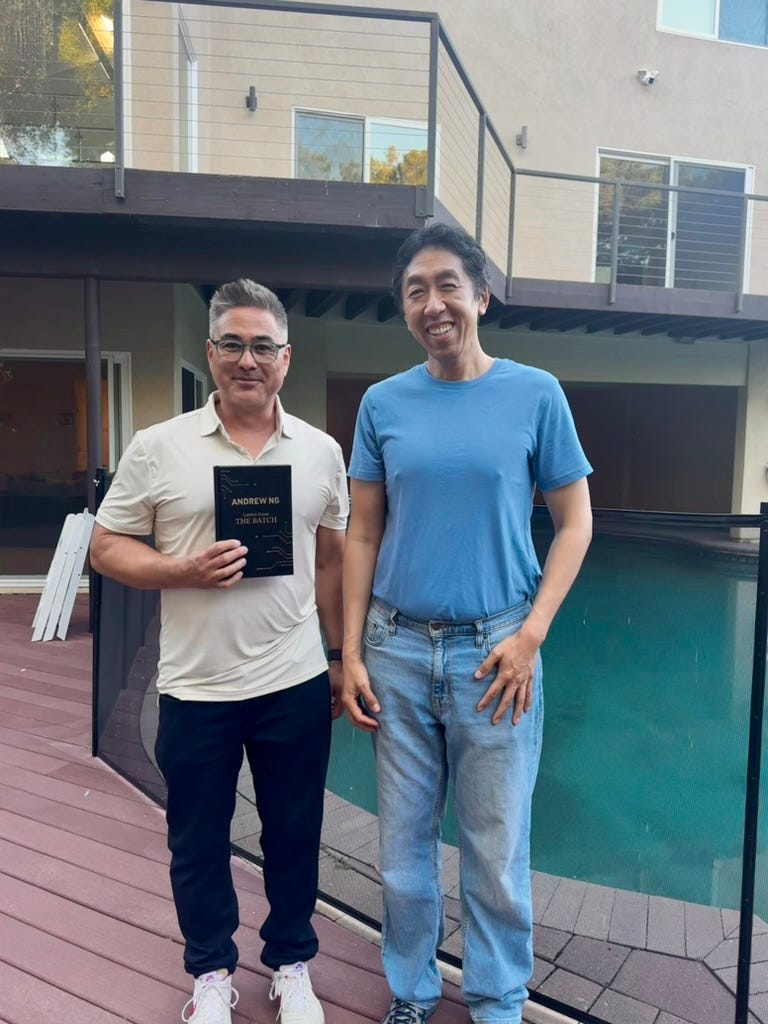
Had to skip last week’s newsletter and podcast because I lost my voice. Was also traveling late last week to spend quality time with some friends, including this guy 👇
- Mixed Model Arts (Book 1) is now targeting late July/early August for publication. The manuscript is edited, so now it’s artwork, formatting and praise quotes left. A companion course is coming around the same time, so expect a lot more video from me.
- I’m going to mix audio-only Freestyle Fridays back in alongside the video ones. Expect more videos too this summer too - tutorials, unboxing, news briefs, etc.
- The Practical Data Community newsletter is live. A couple of articles are up, more in the queue, and you can pitch your own.
- I’m taking the summer off to focus on shipping and building. Back on the road, starting with Big Data London.
- Also, stay tuned for an announcement on a super cool event launching in January 2027.
One last thing. In our surveys this year, "lack of leadership direction" and "poor requirements" combined for nearly twice the share of "legacy systems" as the top bottleneck. Yet this is relatively unexplored territory, and to my knowledge, nobody has actually mapped what that organizational dysfunction for data engineers looks like in practice.
This pulse survey will help the community understand what's happening within the organization.
Anonymous, 8 to 9 questions (1 optional), takes about a minute or two to fill out.
Survey ends June 21 at 11:59pm PT.
Have a great weekend,
Joe
Here’s this week’s Freestyle Friday podcast. Available on Spotify, Apple, and wherever else you get your podcasts.
Please support the show with a review. It means a lot.
Cool Videos and Reads
In this episode, I sit down with Prukalpa Sankar, the founder of Atlan, to discuss the missing piece that makes AI actually useful in the enterprise: context. We dive deep into building the "second brain" of a company, the reality of agent development, and how to transition a traditional business into an AI-native organization.
Juan Sequeda stops by after a massive month on the road to unpack the latest industry shifts, including takeaways from the Snowflake Summit. We dive into the real state of AI agents in the enterprise, separating the hype from the reality of adoption.
Here are some things I read this week that you might enjoy.
The Fairchildren of AIOn mid-career (dis)satisfaction - by Shreyas Doshi
Trust Factory - by Kent Beck - Software Design: Tidy First?
What It Means to Be Non-Invasive - by Robert S. Seiner
Predicting AI job exposure — Benedict Evans
7 More Common Mistakes in Architecture Diagrams | Ilograph Blog
AI demands more engineering discipline. Not less
Data Engineering Acquisitions (2022-2026)
Find My Other Content Here
📺 YouTube - Interviews, tutorials, product reviews, rants, and more.
🎙️ Podcasts - Listen on Spotify or wherever you get your podcasts
📝 Practical Data Modeling - This is where I’m writing my upcoming book, Mixed Model Arts, mostly in public. Free and paid content.
If you’re interested in sponsoring my newsletter and podcast, H2 2026 is opening up. Please message me for details.
The Practical Data Community
The Practical Data Community is a place for candid, vendor-free conversations about all things tech, data, and AI. We host regular events such as book clubs, lunch-and-learns, Data Therapy, and more.
Thanks for reading! Subscribe for free to receive new posts and support my work.