What I've been up to

Follow into
Save into
Follow into
It has been a little while since I’ve posted anything here, and that is because I’ve been busy on a few fronts. Here’s what I’ve been up to in the middle part of 2025.
D
Over the summer I delivered the manuscript for D, which is the second book in the Bomb Light series and the sequel to Polostan. Last week I chatted about it with my editor, Jen Brehl. We’re in agreement about some revisions that I’ll be incorporating into a new draft over coming weeks. The book will be published probably in September 2026.
This one’s somewhat longer than Polostan, which was the shortest book I’ve written in a while. It picks up in 1934, where Polostan left off (admittedly with something of a cliffhanger) and covers events up through the middle of 1940. The title is a reference to deuterium, an isotope of hydrogen that was sometimes given the chemical symbol of D even though it isn’t an element per se. When you combine it with oxygen you get heavy water, which, because of its neutron-slowing properties, was a strategic material during the early years of what became the bomb project.
Fictional and historical accounts of the development of nuclear energy tend to focus on the Manhattan Project. As such they give short shrift to equally fascinating and important happenings during the 1930s and early 1940's. Part of what I’m doing with the Bomb Light project is to shift the focus back a few years and tell stories (a mix of real events and fiction, similar to what I did in the Baroque Cycle) from that era.
In the meantime, HarperCollins has released the trade paperback edition of Polostan with a great new cover design.
Not to be outdone, Subterranean Press has got a preorder page up for its gorgeous limited edition of same:

Artefact
A few months ago I gave a talk in New Zealand about the future of AI. Later I organized some of those thoughts into a Substack post here. It included the following quasi-serious proposal: if we take at face value the proposition that big AIs might be dangerous, then perhaps we should even the odds a little by making them compete for resources, as opposed to raising them in hermetically sealed environments and hand-feeding them everything they need. And since we’re too dumb and slow to compete with superintelligent clankers, we should make them compete with each other.
In the room at that New Zealand talk was Greg Broadmore, a friend and collaborator from Weta whom I met when we were both working at Magic Leap. To make a long story short, this has all developed into a project called Artefact that brings together the core idea from that talk with the creative powers of Weta Workshop, game design from Alvaro Gonzalez, and some of the engineering work that Lamina 1 has been pursuing, lately in collaboration with Linea.
The actual drop is a game—not a fully immersive 3D video game, but something more in the nature of an online board or card game—set in a near-future world decades after everything we know was overthrown and reshaped by a hyperspeed competition among a dozen different big AI systems known collectively as the Bigs.
The Singularity, in other words, has fizzled. Now the Bigs are competing for access to a few basic resources: water, copper, energy, and GPUs (the specialized chips that clankers need in order to think). Humans live in the interstices. Many shun technology but a few are collaborating over a kind of slow, thumb-drive-powered network to build humanistic tools.
My part in this has been to write a few fictional vignettes set in this world and make them available, albeit in rough first-draft form, to my creative collaborators: concept artists from Weta, Alvaro on the game design front, and Rebecca Barkin, Casey Halter, and Will Carter from Lamina 1.
These people’s contributions are what makes Artefact possible. I only have so many hours a week when I can sit down and write original stories. My main commitment, writing-wise, is to finish D and then move on to the next volume in the Bomb Light series. I can’t put that on hold and bang out a whole novel in the Artefact universe. But I can supply some ideas that these collaborators can pick up and run with. They’ve been doing so and I’ve been really pleased with where they’ve been taking it.
Making this all possible are Joe Lubin, Consensys, and Linea. During most of 2025, Rebecca and Joe have been working toward an alliance between Lamina 1 and Consensys that has come to fruition in recent weeks and that we recently announced in Singapore. Without getting too much into the weeds, I’ll say that from my point of view this is all a continuation of the vision that I laid out in my DICE talk a couple of years ago and that I’ve touched on in various posts on this Substack.
Whenere
Being involved in two startups is like having two children: you love them both very much and will do whatever it takes to see them flourish. As I’ve mentioned on this Substack before, I’ve also been working on Whenere, which is in the business of doing something actually fun and humane with AI.
The hours I’ve put into this project have been divided between engineering and fundraising, as opposed to creative writing per se. When people are surprised by that, I sometimes have to break the news to them that I have actually been programming computers for half a century (!), and continue to do so almost every day. In this case the programming environment is Epic Games’s Unreal Engine, which is an unfathomably powerful and multivalent system for creating three-dimensional experiences. It’s by far the most complex and capable system I’ve ever worked with, mostly for better, occasionally for worse. But when the going gets tough we can rely on friends at Epic to help us over obstacles.
Whenere has been running on “angel” or pre-seed funding for a couple of years now. We have put together a system that brings together a web application, LLMs, an Unreal Engine client, and other elements into something that we think is pretty cool, even though we sometimes wish we could spend more money on surface polish. Currently we have put it up on the mechanic’s lift, as it were, in preparation for an initial round of user testing, and so we’ve pulled back from the exhausting round of pitches and demos that is fundraising. However, last month I went down to the Imagination in Action “Next Revolution in AI” Innovation Summit on the Google Campus, along with co-founder and CEO Karen Laur, and found myself in front of a room full of people talking about Whenere and other topics with Bing Gordon, yet another interesting person with connections back to Magic Leap.
When speaking in public I don’t like being perched on a tall chair, largely because I am a compulsive leg jiggler. I have done this all my life. A quick Internet search reveals that jiggling is one of many human behaviors that have lately been medicalized. Apparently it’s a sign of stress. If that’s true, I must be the most stressed out person in history. Anyway, I find this video of me and Bing difficult to watch because of the way it’s framed and because of the jiggling, but I have posted the link anyway for Stephenson completists.
Historical Martial Arts
Speaking of Stephenson completists, the following will be of interest to a very narrow slice of humanity, but it’s part of the overall picture of how I spend my time.
In September I gave a talk at Swordsquatch on the topic of “heavy” one-handed swords and how they are used. I’m putting scare quotes around that word “heavy” because the question of weight is important and, in my opinion, under-discussed in the world of historical swordsmanship.
I’m talking specifically about broadswords here, of which this is an ornate but basically representative example:
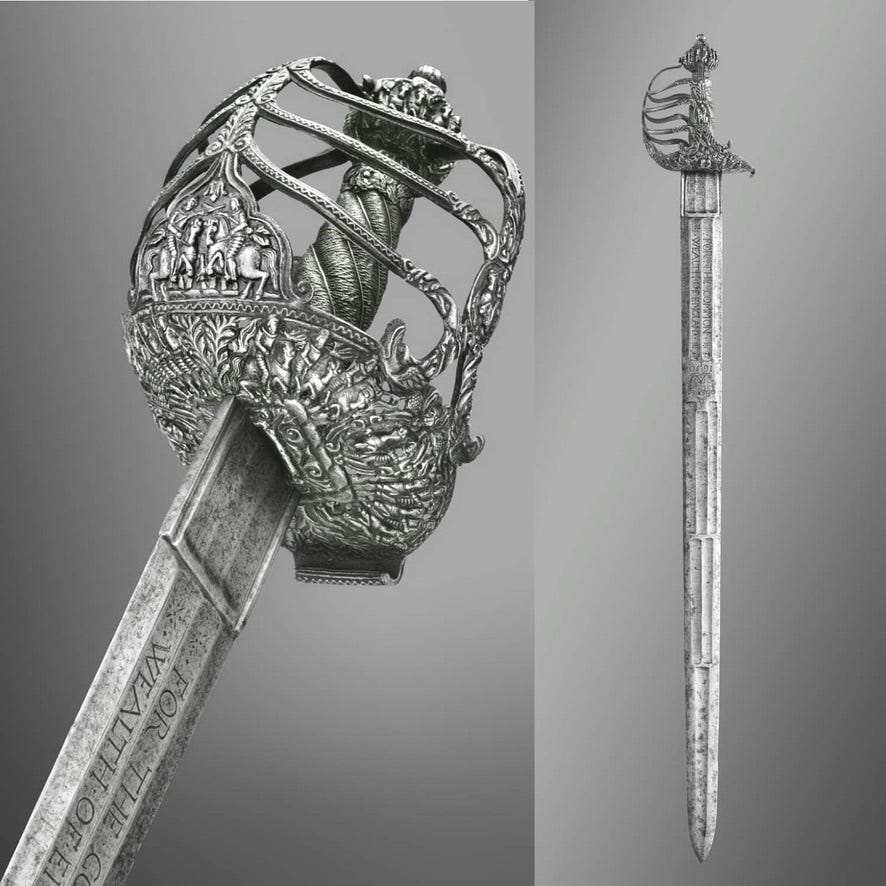
I got interested in this type of swordsmanship some years ago when I got tired of my fingers getting injured while working with longswords, which offer basically no hand protection. It is also a style with a wide historical range; swords of this general type were used from the Tudor era up into the Twentieth Century.
People who are actually knowledgeable about historical swords and swordsmanship spend a lot of time writhing in agony as they look at movies, TV shows and games depicting swords that would be completely useless in practice because of their size and blade geometry (I specifically exempt swords that were produced at Weta Workshop, such as the ones in the Lord of the Rings movies; those for the most part have realistic size and balance). People who made and used swords back in the old days had every incentive to be as economical as possible in their use of steel, both because it was expensive and because too much of it would make the weapon unwieldy. So historical swords tend to be much thinner and more flexible than the massive, over-decorated slabs used as movie props.
(To be clear, we’re writhing in agony even before the characters in those movies and TV shows actually begin fighting with those swords. Once the fighting starts, we’re writhing in agony at the unrealistic fight choreography)
Having said all of that, some historical swords were heavier than others. The general trend was for them to get lighter as the centuries passed, culminating in the nearly weightless simulators that are used in Olympic-style fencing. During the last decade, the same trend has started to play out in the world of HEMA (Historical European Martial Arts). Not all HEMA practitioners compete in tournaments. Among many who do, however, there’s a gradual shift toward lighter versions of the blades that are used to simulate longswords, broadswords, and other historical weapons.
In my talk, I’m arguing that, at least in the specific case of broadswords, you can’t reduce the weight of the weapon without changing the nature of the game; but if you embrace the weight and learn to work with it, the sword needn’t feel unduly heavy in the hand.
I’m not even going to link to the hour-and-eighteen-minute video of my punishingly obscure talk, but you can find it by searching YouTube on “swordsquatch backsword stephenson.” It’s easier to watch because I’m up on my feet walking around and so there is no leg jiggling.
Making Things
I have always been a tools geek, and have enjoyed making things. During COVID this got completely out of hand as I found myself making an armor carapace out of Kevlar for a BattleBot. This led to my acquiring a used vertical machining center and a metal lathe, among other means of production. Such tools need to be housed in suitable buildings with heavy power supplies and other amenities. Fortunately, along the way I’ve had plenty of support from family and friends who share the same interests.
This is a pretty long story with various twists and turns, including a hastily planned middle-of-the-night extraction of valuable equipment from a garage that suddenly found itself engulfed in an RV shantytown populated by fentanyl-addled arsonists and people trying to break down the back door. As of this week, however, the stuff is settled in a new location, still a little rough around the edges but much cleaner and more secure, and we have a working waterjet cutter, which is the sine qua non of a modern shop.
Something I’ve observed in other cases is that, when it comes to shops, it works to adopt an “If you build it, they will come” mentality. Trying to pitch a machine shop as a business proposition is never going to work. But if you can start to pull some tools together, somehow, some way, other people who like to build things will start to show up and begin contributing to a stone soup dynamic.
In conclusion…
So that’s the general picture of how I’ve been spending my time and why I haven’t done a lot of Substack posts in mid-2025.
When I set up this Substack I decided not to charge for any of my posts. Everything’s available for free. I did that because I didn’t want to feel any pressure to keep pumping out material to satisfy an implied obligation to paying customers. Many have decided to be paying subscribers anyway, which is warmly appreciated.
The real payoff, to the extent there is one, is that I can put more time into patiently nudging these various projects toward fruition.