KdK part 3: Kucharski and the Knickstelle
Follow into
Save into
Follow into

W. Kucharski studied the physics of whips by doing exactly what the guy in this video is doing, so it’s worth clicking that link and watching it in order to visualize his experiments. Here’s a still from it, which I have improved with a label:

According to a note at the end of his extremely detailed and comprehensive 23-page paper1, Kucharski did most of this work in Berlin in 1935 and 1936 and submitted the paper at the end of 1940. I have always wondered about this man’s life and fate, since Kucharski is a Polish name, and the work detailed in his paper spanned the moment in history when Nazi Germany invaded and crushed Poland. But apparently he was employed at the Society for Applied Mathematics and Mechanics in Berlin during this time.
As mentioned in the previous post in this series, Kucharski seems to have coined the terminology, and devised the basic mathematical model later used (with due credit) by Grammel and Zoller in their paper about the physics of whip-cracking ten years later. The title of this series, Kinetik der Kontinua, his coinage.
The key to his analysis is to break the system down into three parts: two parallel straight segments of varying length, joined by a 180 degree bend that he calls a Knickstelle (“bend location”). The material of the chain (or whip or whatever) moves through the Knickstelle as the Knickstelle propagates along the medium. He analyzes a number of different scenarios using this basic framework, including this one:
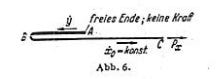
which, as he points out, is an idealized whip.
The mathematical formalism used is a Lagrangian, which is a powerful tool of meta-problem-solving that undergrad physics students often learn after they’ve spent a couple of years solving problems the hard way. It’s exactly the right tool for this job and it enables Kucharski to run easily through a number of different scenarios. In the one shown above, the straight segment on the bottom (C) is held stationary. The Knickstelle (B) propagates leftward drawing the upper straight section (A) along with it; this is the “free end; no force” according to the caption. C therefore gets longer while A gets shorter. The velocity of A (designated by the letter y with the dot above it) becomes theoretically infinite at the end, but as Kucharski points out, eventually A becomes subsumed into the Knickstelle, resulting in “Herumschlagen.” This is one of those terms that works perfectly in German and is hard to translate directly into English. It is mildly comedic and it means to violently thrash about in a careless or chaotic manner. As such it can’t be captured in his simplified mathematical model. However, you can witness the Herumschlagen very clearly at the end of the video linked above, being calmly watched by spectators who clearly have no idea the level of danger being posed to their feet and ankles by a massive chain moving at potentially supersonic velocity.
Kucharski states that he conducted experimental trials using lengths of chain, just to verify that his mathematical models weren’t leading him astray.
His generalization of the problem using the Lagrangian formalism pays dividends in that it enables him to cycle rapidly through a range of different basic scenarios. The bullwhip, shown above, is only one of about half a dozen of these. Some are intricate, bordering on farfetched, and I won’t try to summarize them here. One is shown in this diagram:
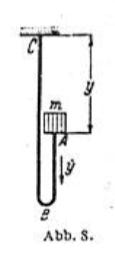
Here the vertical segment C is anchored to an overhead support. It drops straight down to the Knickstelle B which connects at its other end to the vertical segment A which runs up to a weight. The weight is in free fall. Now, normally when something’s in free fall on this planet it will accelerate downwards at about 9.8 meters per second squared. What Kucharski predicts, and what he apparently observed in experimental trials, is that, in the scenario shown above, the mass falls faster than can be accounted for by mere gravity. That’s because it’s being pulled downward with an additional force created by the tension in the chain. The source of this tension is the Knickstelle itself. As Kucharski proves (and as can be verified with a simple centripetal-force calculation), when a chain or other continuous medium is moving through a Knickstelle with velocity v, it experiences a tension force equal to
where the “curly rho” symbol is the linear density of the medium — the mass per unit length of the chain, rope, whip, or whatever. This is always true of any system with a Knickstelle. The two straight ends A and C will always experience that amount of tension. Any end that’s free to move will accelerate accordingly.
An important thing about the above formula is that the tension depends only on the linear density—how much the chain weighs—and the velocity with which the chain is moving through the Knickstelle. The diameter of the bend makes no difference. This, I think, explains the weird stability and persistence of bends in moving chains.
And it is intensely counterintuitive! All of your lived experience with ropes and chains tells you that applying greater tension causes it to straighten out. If you’re holding one end of a rope or chain that has some slack in it, and you pull, applying more tension, it gets straighter. If you reduce the tension, giving it more slack, it hangs lower, curving more. None of this is true of moving bends. Also, the angle of the bend makes no difference. Kucharski happens to be talking exclusively about 180 degree U-bends, but the same thing is true of more or less acute bends.
Kucharski goes on to point out that the same diagram works just as well if you flip it upside down:
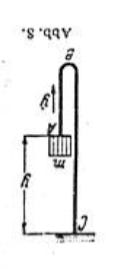
Here we have one end C attached to the ground and leading up to a Knickstelle that connects at its other end to a freely moving mass below it. The Knickstelle acts as a virtual pulley, hauling up on the payload. As Kucharski states (with apologies for my crappy German translation):
It may be mentioned that old tales of the magic tricks of Indian conjurors, in which men or animals climb up ropes that have been thrown up into the air, according to the above-mentioned remarkable properties of moving cords, have a real physical basis.
He goes on to outline an experiment in which the weight m is thrown vertically upwards, creating a Knickstelle above it that would continue to pull it up using the Knickstelle tension. Of course, this would fail unless the “curly rho v squared” tension exceeded the weight of the mass on the end. You could make that happen by making the chain heavier (increasing the value of “curly rho”), and/or making it move faster. The latter approach would be more effective since the velocity v is squared.
If this seems physically impossible, you can get some intuition for the idea by imagining what would happen if you were to crack a bullwhip aimed vertically upwards, instead of horizontally. Once you had snapped your wrist and got the whip moving upward, the bend in the whip would continue to propagate up against gravity, dragging the lighter end of the whip behind it. That’s because the tension in the middle section of the whip, where the bend is propagating, exceeds the weight of the distal section.
Needless to say this made me sit up a little straighter 25 years ago when I was thinking about new ways to hurl objects into the air. Of course, actually setting up such a mechanism and putting it into motion is the difficult part, as Kucharski himself mentions in a thinly disguised plea for additional funding and facilities that will be immediately recognizable to any modern researcher. If Hitler hadn’t become so fascinated by rockets, perhaps he’d have put this man to work (probably against his will) making steel bullwhips for smacking bombers out of the air.
It’s worth mentioning that the same basic configuration would work if the mass were moving down, instead of up. It could be used, in other words, to slow down a falling object. If you could come up with a way to anchor one end of a chain on the ground and suspend its entire length vertically, e.g. by attaching its other end to a balloon, then when a falling object somehow coupled itself to the free end of the chain, it would form a Knickstelle that would exert upward force on the object, slowing its descent. The whole system would simply collapse and fall to the ground, however, unless the curly-rho-v-squared Knickstelle tension were large enough to support its own weight. So the idea would only work if the velocity, the height, and the density of the chain were properly balanced against each other.
I believe that there is a plausible way to build such contraptions, at least on a performance art level, which I’ll get to in a later installment of this series. Think Burning Man, not Cape Canaveral. The real practical obstacle is dealing with the aftermath. Once you’ve used a massive vertical bullwhip to accelerate a payload straight up, and released that payload, you’re now left with a heavy chain extending high up into the air and thrashing around in what Kucharski denoted Herumschlagen. Eventually it’s going to hit the ground. And if you’ve used it to launch anything of appreciable weight, it’s going to be heavy and it’s going to be moving fast!
Zur Kinetik dehnungsloser Seile mit Knickstellen (“Kinetics of inelastic ropes with bends”), Ingenieur-Archiv XII (1941) pp. 109-123. https://doi.org/10.1007/BF02086072