Virtue, Archetypes, and the Narrative Self

Follow into
Save into
Follow into
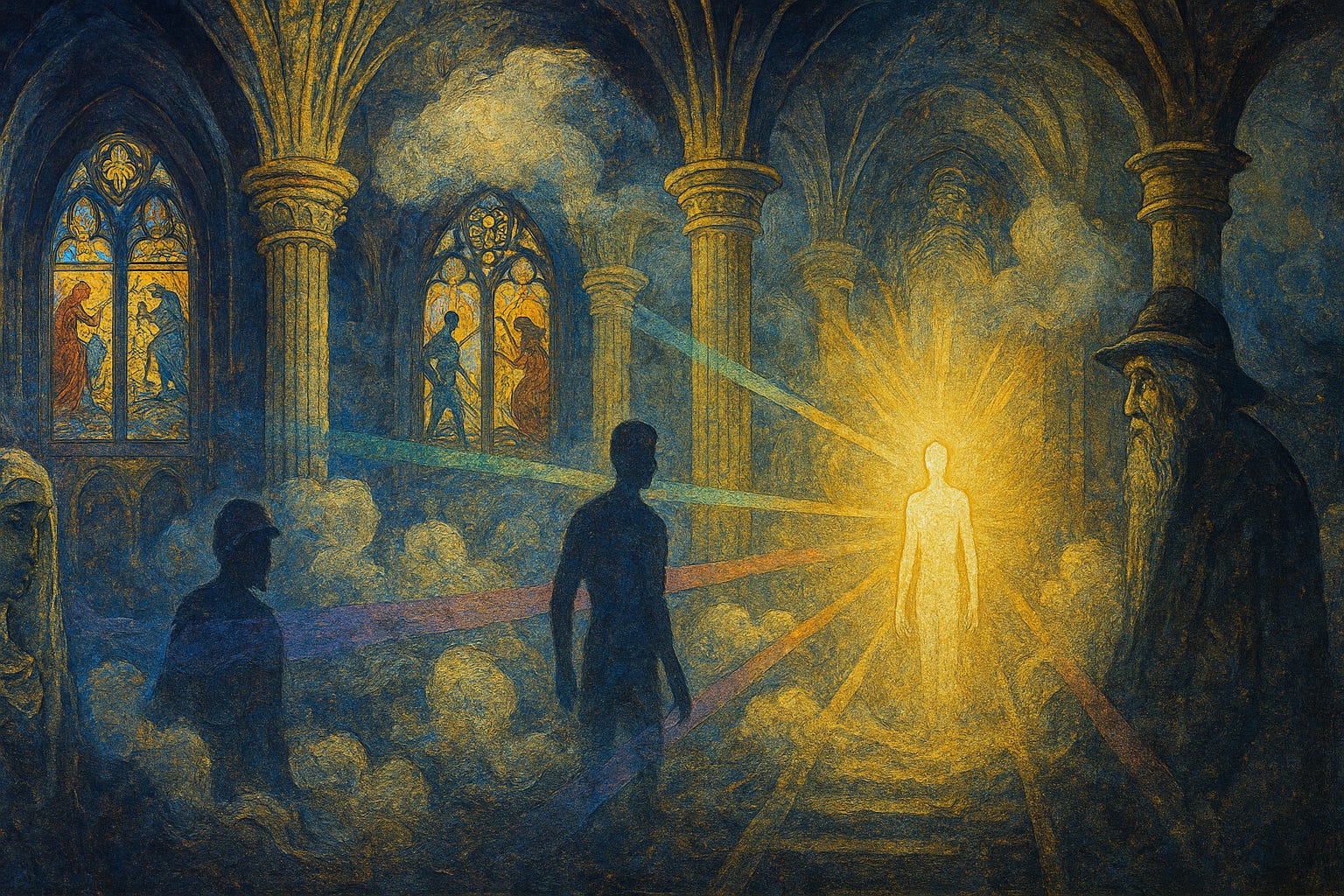
I’m going to weave a thread which ties together virtue, Kantian ethics, the narrative self, and the archetypes.
This will be done with accounts of Kantian and virtue ethics which both depend on roles or identity. On Korsgaard’s1 account of Kantian ethics moral principles can be derived from our identities. On MacIntyre’s account of virtue the virtues can be derived from roles, which itself depend on conceiving of oneself as being the author of one’s own narrative journey, or quest. How we learn about which narrative we’re self-authoring involves a moral education rich in literature and mythology. The connection to Jungian archetypes was immediately obvious.
This Substack is reader-supported. To receive new posts and support my work, consider becoming a free or paid subscriber.
While it takes a bit of work to get to the punch line, I’ve found these connections to be highly action guiding and its theoretical grounding immensely satisfying. We will begin by unifying various competing accounts of virtue ethics which follows an argument from MacIntyre’s After Virtue. Once we have this grand unified theory of virtue ethics in hand, we will move on to connecting this account with Kantian ethics and Jungian archetypes to provide an outline for a convergent, dynamic account of morality.
MacIntyre sets the stage
MacIntyre opens After Virtue with a cautionary tale:
Imagine that the natural sciences were to suffer the effects of a catastrophe. A series of environmental disasters are blamed by the general public on the scientists. Widespread riots occur, laboratories are burnt down, physicists are lynched, books and instruments are destroyed. Finally a Know-Nothing political movement takes power and successfully abolishes science teaching in schools and universities, imprisoning and executing the remaining scientists. Later still there is a reaction against this destructive movement and enlightened people seek to revive science, although they have largely forgotten what it was. But all that they possess are fragments: a knowledge of experiments detached from any knowledge of the theoretical context which gave them significance; parts of theories unrelated either to the other bits and pieces of theory which they possess or to experiment; instruments whose use has been forgotten; half-chapters from books, single pages from articles, not always fully legible because torn and charred. Nonetheless all these fragments are reembodied in a set of practices which go under the revived names of physics, chemistry and biology. Adults argue with each other about the respective merits of relativity theory, evolutionary theory and phlogiston theory, although they possess only a very partial knowledge of each. Children learn by heart the surviving portions of the periodic table and recite as incantations some of the theorems of Euclid. Nobody, or almost nobody, realizes that what they are doing is not natural science in any proper sense at all. For everything that they do and say conforms to certain canons of consistency and coherence and those contexts which would be needed to make sense of what they are doing have been lost, perhaps irretrievably.
In such a culture men would use expressions such as 'neutrino', 'mass', 'specific gravity', 'atomic weight' in systematic and often interrelated ways which would resemble in lesser or greater degrees the ways in which such expressions had been used in earlier times before scientific knowledge had been so largely lost. But many of the beliefs presupposed by the use of these expressions would have been lost and there would appear to be an element of arbitrariness and even of choice in their application which would appear very surprising to us. What would appear to be rival and competing premises for which no further argument could be given would abound. Subjectivist theories of science would appear and would be criticizes by those who held that the notion of truth embodied in what they took to be science was incompatible with subjectivism….
If in this imaginary world analytical philosophy were to flourish, it would never reveal the fact of this disorder. For the techniques of analytical philosophy are essentially descriptive and descriptive of the language of the present at that… Nor again would phenomenology or existentialism be able to discern anything wrong. All the structures of intentionality would be what they are now… In the actual world which we inhabit the language of morality is in the same state of grave disorder as the language of natural science in the imaginary world which I described. What we possess, if this view is true, are the fragments of a conceptual scheme, parts which now lack those contexts from which their significance derived. We possess indeed simulacra of morality, we continue to use many of the key expressions. But we have—very largely, if not entirely—lost our comprehension, both theoretical and practical, of morality.2
How did we get here? MacIntyre steps outside traditional analytic and continental (read: phenomenological and existential) philosophical methodologies to answer this using a historical approach. While a tour de force of this 3rd pillar in the philosophical methodology toolkit, I’m not interested in sketching this part of his view. Instead, I will focus on his positive argument for how we can reconnect with morality as it was once grounded.
Unifying the virtues
There are two types of virtue ethics that MacIntyre identifies and successfully provides a unified account of:
- A virtue is a quality which enables an individual to discharge his or her social role (homer);
- a virtue is a quality which enables an individual to move towards the achievement of the specifically human telos, whether natural or supernatural (Aristotle, the New Testament and Aquinas).3
We can denote these two conceptions of the virtues as:
- Role-based virtue
- Telos-based virtue
In order to unify these two accounts we’ll thread the needle through the beads of:
- Practices
- Narrative orders
- Roles
- Telos
- The narrative self4
Practices
By a ‘practice’ I am going to mean any coherent and complex form of socially established cooperative human activity through which goods internal to that form of activity are realized in the course of trying to achieve those standards of excellence… Practices of course have a history: games, sciences and arts all have histories. Thus the standards are not themselves immune from criticism, but nonetheless we cannot be initiated into a practice without accepting the authority of the best standards realized so far [emphasis added].5
Think chess, architecture, sports, science, etc. These are all joint enterprises where there’s rules to the game and markers of success. You become an exemplar practitioner of a craft depending on how you stack up to the rules and heuristics native to that craft.
Put another way, practices are multiplayer enterprises where the objective of this cooperative behavior dynamically drifts as these individuals see fit. Cheating nullifies the true mark of success, thus there are standards of excellence. If you win a chess tournament by cheating, you have not proved that you’re actually good at chess. If you falsify data for a publication, you are not actually a groundbreaking scientist. To do well within this shared enterprise, one must be honest and have integrity, two virtues this early account yields us.
These standards of success too can drift, but not willy nilly. How and why these goal posts move depends in large part on that practices’ history, as well as the current players in the game. More on that below in Narratives.
What does “realizing internal goods” mean? What are internal goals? MacIntyre distinguishes between two types of goods: internal vs external.
It is characteristic of what I have called external goods that when achieved they are always some individual's property and possession... The more someone has of them, the less there is for other people... External goods are therefore characteristically objects of competition in which there must be losers as well as winners. Internal goods are indeed the outcome of competition to excel, but it is characteristic of them that their achievement is a good for the whole community who participate in the practice.6
An Olympic medal is an external good, only one person gets the gold. Your share of a bonus from the bonus pool on a trading desk is an external good. Power and fame too are not infinite resources, there’s only so much attention we can pay.
Internal goods are also the outcome of competition to excel, but it’s necessarily the case that the achievement of an internal good is good for the whole community who participates.
When Gaudí designed Casa Battló to the right of Casa Amatller, the architect of Casa Amattler might be worse off when it comes to relative fame (external good), but all architects and civilians who pass by are enriched by the existence of both buildings. One doesn’t take away from the other (internal good). The same is true for new discoveries or innovations in physics, art, and even sports, all notoriously competitive yet cooperative fields. And yet, game respects game. So much for internal goals.

It must be emphasized here, that by virtue of practices being about cooperative activities, there must be shared goals. At this stage, the virtues only exist in relation to some joint enterprise. Morality, therefore, cannot be merely about advancing one’s own personal projects such as happiness, wellbeing or flourishing. Valuable in its own right, but a different thing altogether (that’s what some versions of practical rationality7, prudence, or egoism/self-interest8 are about). Morality exists within a community only insofar as we are all pointing at the same north star. This rough distinction between intra-personal and inter-personal normativity is in line with how contemporary moral philosophy carves up this conceptual space.9 10 11 There are exceptions.12
Practices take center stage in MacIntyre’s conception of the virtues because the conventional alternatives (moralities based on desires, emotions, duty or goodness) end up categorizing all actions under a static means-end distinction. But this crucially misses actions where the ends are discovered and changed in the process of acting. These sorts of actions are characteristic of practices.13 The history of art is a case study in this point. Recent advances in cognitive science like Relevance Realization support this less rigid view.
Upon the foundation of practices he gives the version 1 account of the virtues:
A virtue is an acquired human quality the possession and exercise of which tends to enable us to achieve those goods which are internal to practices and the lack of which effectively prevents us from achieving any such goods.14
Put more precisely, virtue is an optimal policy within a dynamic, inter-personally coupled, time-variate control problem.
Narrative (roles, telos, and the narrative self)
The next stage of development for MacIntyre's conception of the virtues comes from defining virtue within a backdrop of what he calls a narrative order. In order to make sense of virtues, we need to make sense of actions. What context is necessary for someone’s action to be intelligible to us?
Actions aren’t made spontaneously out of the vacuum. Deliberate actions are made with reference to some goal, they are done with some intention. It is by reference to one’s intention that an action is made intelligible. It’s by reference to these intentions that we can piece together an explanatory reason for an action.
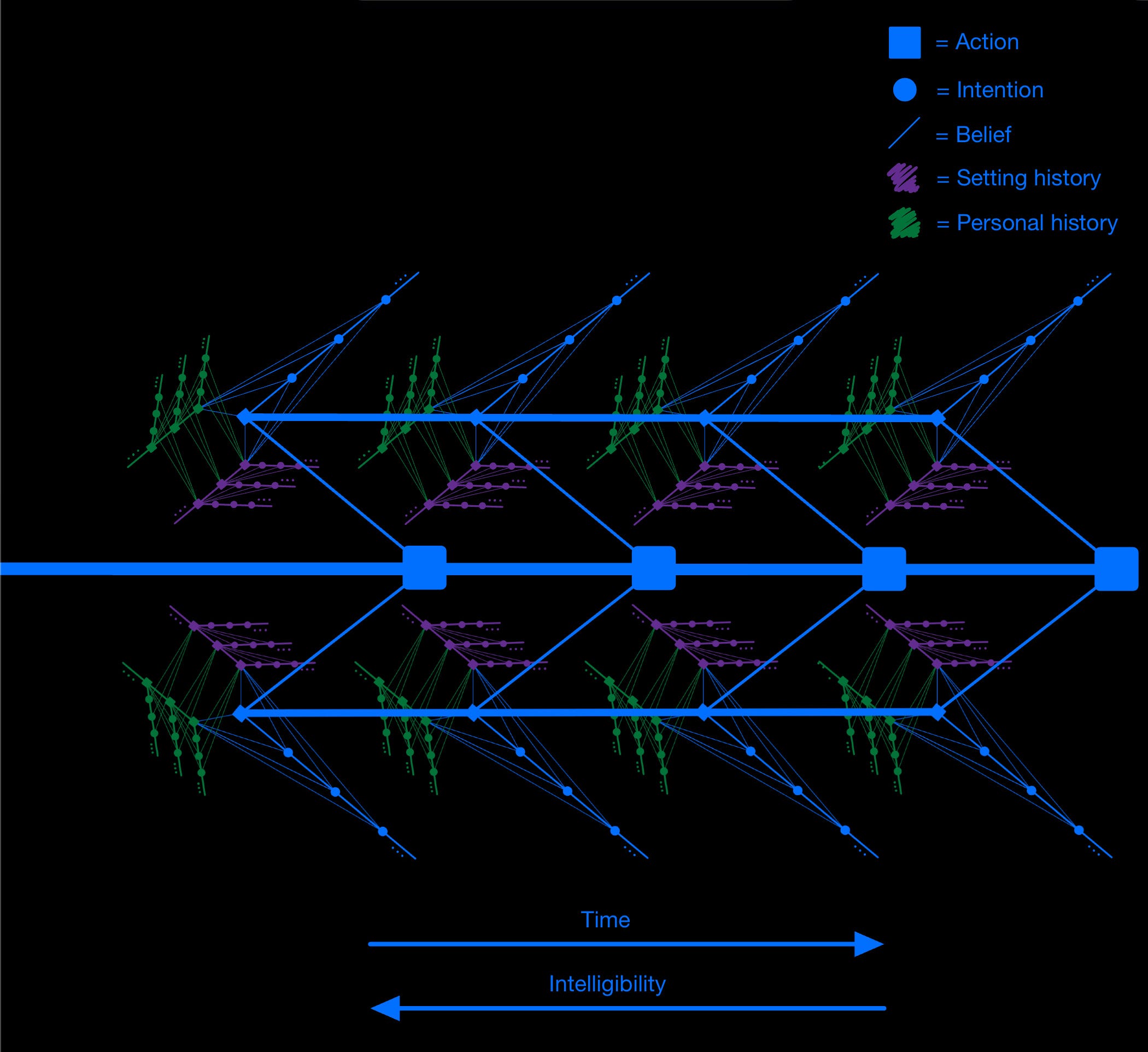
When someone acts, their immediate, short term intention is the proximate cause of an action. In the counter factual where their short term intention were different, so too would be their subsequent action. Of course, intentions are only made intelligible by reference to other, longer term intentions, and so on. I like to visualize this as follows:
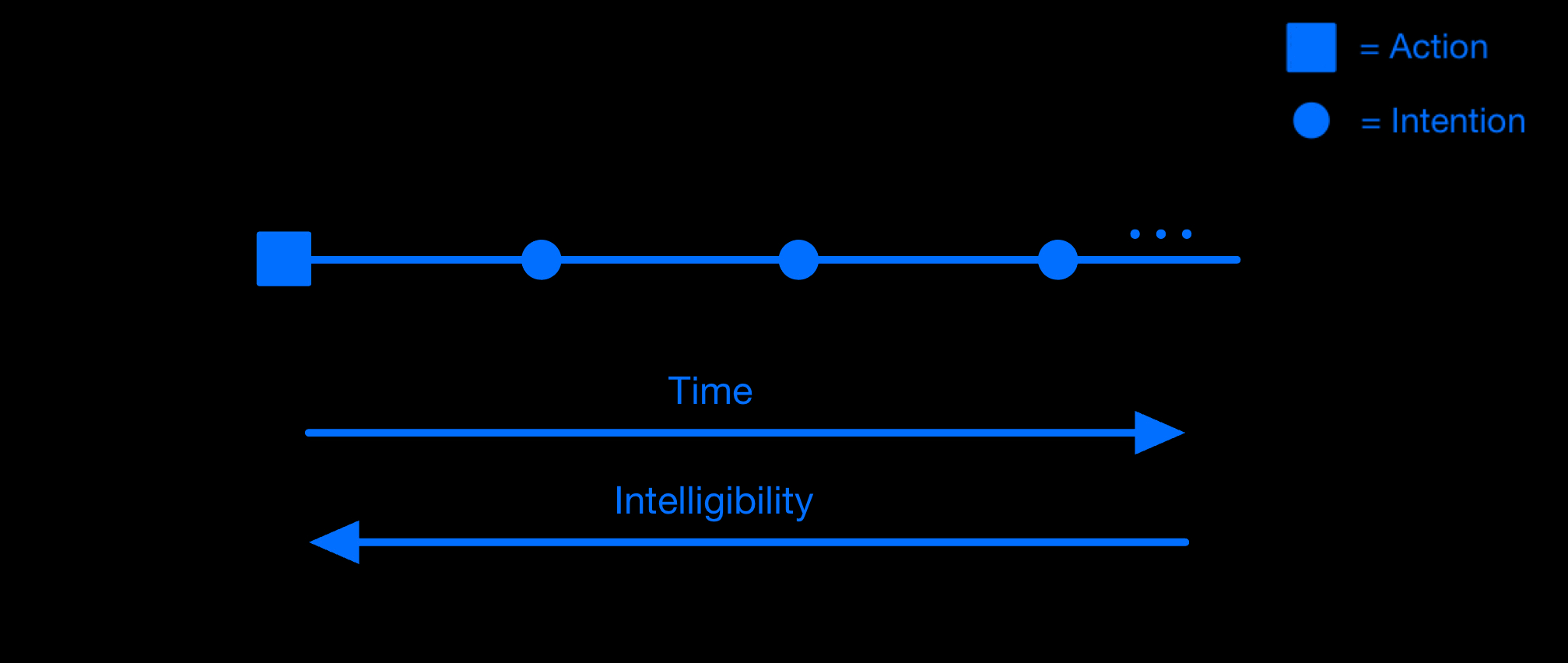
The further out into the anticipated future we estimate, the more comprehensive of a picture we make about why someone did the action that they did, the larger and more densely packed the network of consistent beliefs we have supporting a given interpretation. This also helps us figure out how we should act around others, it allows us to better model out human behavior: we can anticipate other’s actions and, crucially, their expectations and demands of us.
None of this implies that all actions are perfectly planned out in a long chain of intended goals stretching all the way into the far future. Nor does this imply that all or even any of these intentions beyond the first one are within the agent’s consciousness at the time of action. This is merely to show what is required for us to have a better grasp on the explanatory reason(s) behind someone’s action. But actions are not made intelligible solely by reference to one's intentions, but also by references to one's past actions.
The fact that I intend to turn on the stove is more fully explained when one considers my previous actions of grabbing and cracking open eggs onto a frying pan on the stove. But it’s not just our own personal histories that matter. We are not isolated cartesian agents. We behave within a social backdrop that gives our actions further intelligibility.
It's relevant that previous and current individuals have set up and maintained the social institutions relevant for the acceptance and function of currency, otherwise me tapping my phone to a piece of plastic and walking out with food makes no apparent sense. These two histories, our personal history and our setting history, affect our actions and our intentions. These histories affect our intentions by virtue of various beliefs we have of the actions which make up those histories. Each subsequent action we take can be thought of as a free act of self-authoring of our narrative self. We’re literally writing ourselves into existence.
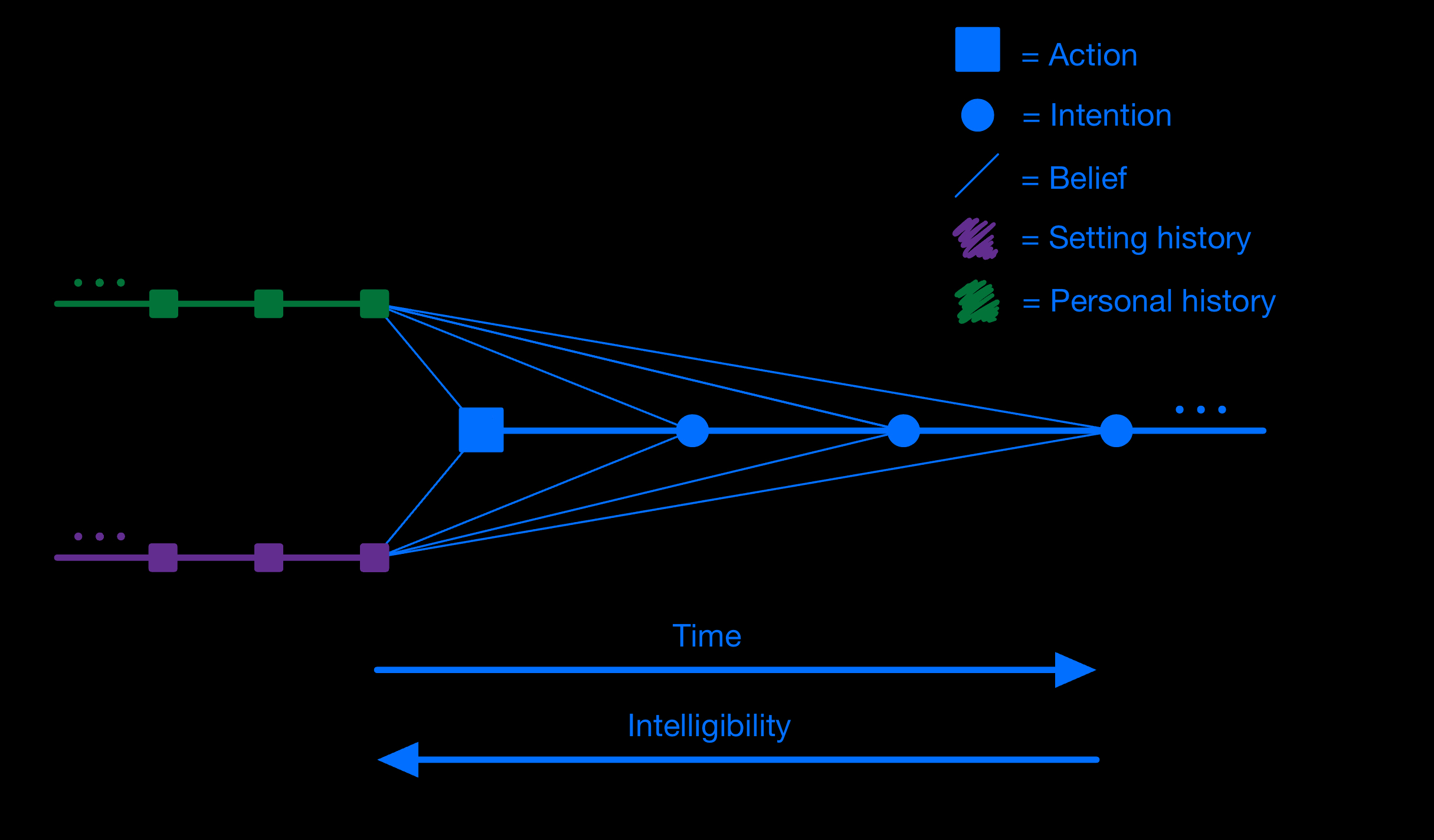
Crucially, MacIntyre equates both these histories with narratives. But how do we get narratives from an ordered list of (agent, action, time) 3-tuples? A timeline does not a story make.
The key is to note that we don’t conceptualize these histories as mere timelines. We allocate a collection of human events to a specific mental box, to genres. We remember things with beginnings, middles, and endings. We recall reversals, and movements towards and away from climaxes. Our brain’s native filetype has the .story extension.
These histories are also recalled through a lens of beliefs about relative salience of different events with respect to one another. Failing a university exam might, for one person, not even register as an important memory while for another may mark the beginning of an inflection point in their life.
Narrative is baked in to how we see the world. "We dream in narrative, day-dream in narrative, remember, anticipate, hope, despair, believe, doubt, plan, revise, criticize, construct, gossip, learn, hate and love by narrative".15 Narrative, is crucial to understanding all human action. Therefore, actions are made intelligible if they are understood as constituting part of a narrative. We can visualize this as the following:
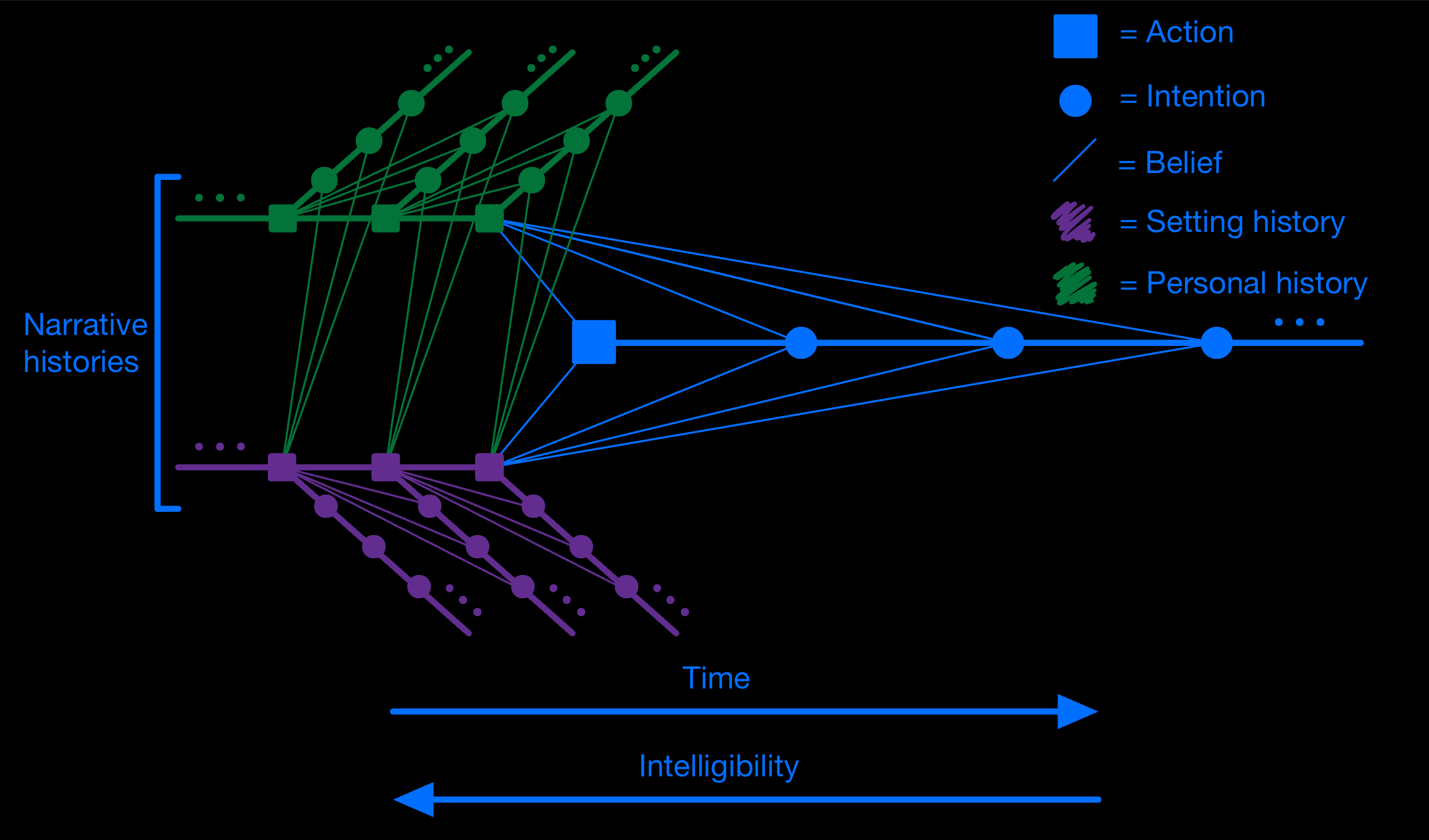
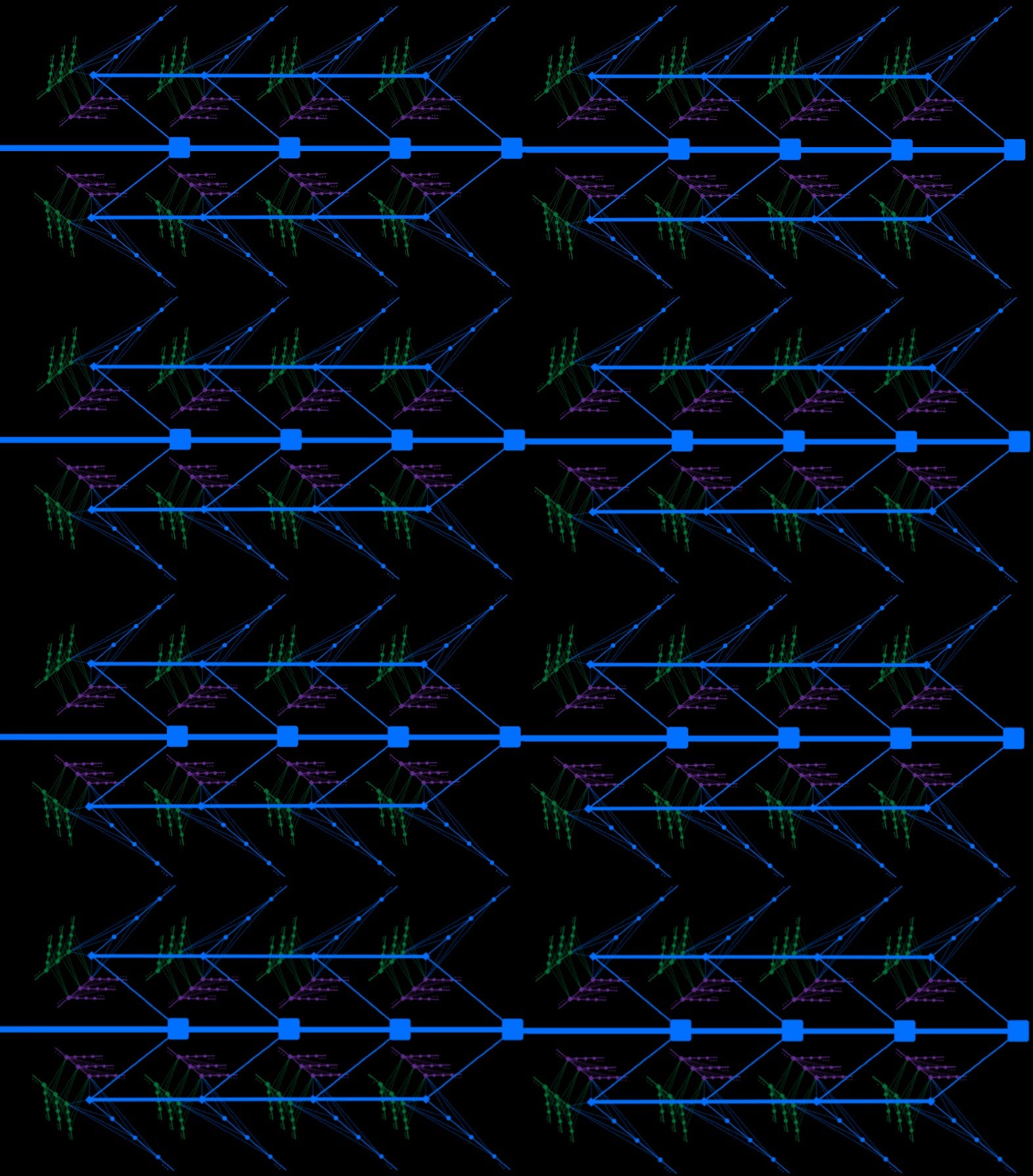
But each person is typically embedded in several narratives, both personal and social, at the same time:
Finally, when we consider multiple agents we can begin to see how these chords of narrative histories of actions, intentions, and beliefs weave together to form the tapestry that we call the social fabric of reality.
Roles
A key “data structure” in the .story files our brain writes memories in is that of the characters portrayed, the roles they play in various narratives. Once we realize that roles are a key lens for reading this social fabric of interlaced narratives, this picture becomes much more than a mere explanation for actions, but also a source of justification for action.
Recalling that you are considered, and consider yourself to be, a close friend to someone informs you as to how you should behave with that person, what is expected of you. You just know what you have to do when you recall the roles you are playing in the world.
There are normative standards implicit in the roles you play. There is a better and worse way to be a friend, and this knowledge is knowledge you have slowly and iteratively built up over time. The skill of knowing what’s reasonably expected of you is part of what the virtue of wisdom is for.
Roles are also where accountability comes from. Failing to live up to the standards you yourself have adopted while playing a role means that you can reasonably be held accountable via praise and blame by external parties.16 Deriving virtues from roles allows us to account for the Homeric conception of Roles-based virtue.
Telos
These narratives, these roles, usually have goals. To dispel the suitors, to destroy the empire, to find the source of eternal life. "We live our lives, both individually and in our relationships with each other, in the light of certain conceptions of a possible shared future." That is, we have a shared goal in mind when we act, implicitly or explicitly. This isn't a goal that has to be held in our mind in any concrete way. The fact that we act as if that were our goal is enough for it to matter.
Human lives, when considered as a single unified narrative, can be a success or a failure relative to the aim of that narrative. These (internal) goals however, are often unclear and have to be discovered as we coauthor our stories. The dynamic nature of these goals are similar to practices. Vervaeke would call this a transjective relationship. The agent-arena relationship is a continual mutual unfolding. The metrics of success shift as how we fit within this social fabric changes as both ourselves and our environments are constantly shifting in a perpetual dance of reciprocity. Your north star in your 20s vs. when you have grandkids will be and ought to be different.
Given the shifting nature of practices, and of our own narratives, a useful framing is to view them as quests. Quests to successfully complete the narratives that we ourselves write, quests to finish the story.
To ask 'what is the good for me?' is to ask how best I might live out that narrative unity and bring it to completion. To ask 'What is the good for man?' is to ask what all answers to the former question must have in common.17
The narrative self
So what is our highest good? Presupposed in this question is the existence not only of a highest good but of a you in the first place. The existence of sharp boundaries around identity (usually clamped with birth and death as the boundaries) has received some sharp criticisms from philosophers in line with Parfit18 and experienced meditators, call them the empiricists.
The empiricists take a bottom-up, or an inside-out approach. They start with raw perception, and with the help of a little inference and perhaps a thought experiment or two, they show that all that there is and all that really matters is psychological connectedness and/or continuity. There is no “self” when you go looking.
MacIntyre approaches this from the opposite angle, a top-down, or outside-in approach. “I am forever whatever I have been at any time for others.” While constantly being written, identity is fixed. Fixed around what? Fixed around our tendencies, our character, your virtues and vices. To borrow from Vervaeke’s model, we are the unity of sub-routines that operate underneath the constantly Becoming entities that we are. The bottom-up approach is the wrong frame in the moral domain:
[The empiricists have] failed to see that a background has been omitted, the lack of which makes the problems insoluble. That background is provided by the concept of a story and of that kind of unity of character which a story requires. Just as a history is not a sequence of actions, but the concept of an action is that of a moment in an actual or possible history abstracted for some purpose from that history, so the characters in a history are not a collection of persons, but the concept of a person is that of a character abstracted from a history.19
Our narrative histories are primary. Things like agents, actions, and identities are not building blocks lacking robust constituent parts as the empiricists have argued. Rather, they are inferences from this mesh network of narratives that we weave with every action we take within these narratives. It is the social fabric that is normatively real, identity and actions are pulled out from that hyperobject, not the other way around.
You can think of MacIntyre as course correcting the analytic philosophers and empiricists’ obsession with zooming in on features as opposed to zooming out and seeing the gestalt. Of course, the real skill is knowing when to zoom-in vs. when to zoom-out20, but expanding our ontology to include the macro is, at the very least, useful objects to talk about is a much needed upgrade.
Working top-down in this way is a requirement for the moral project in the first place. Without this fabric, accountability, blame, and praise aren’t possible, and even if they’re not fundamental building blocks of reality, they’re certainly entities we are better off including into our model of the world. Without a unified narrative self there would be no self-correcting force in society. There would be no virtues or morality.
But we do in fact have selves in an important sense. There is a unity to one’s lifespan and it’s predicated on our ability to explain to others (via this narrative fabric) why we did what we did. We are held together by the glue of accountability. This is what Contractualists pick up on when they ground normativity in what’s reasonable for other parties.21
The quest for the highest good
Now MacIntyre can finally answer the question of what our highest good is:
In what does the unity of an individual life consist? The answer is that its unity is the unity of a narrative embodied in a single life. To ask, ‘What is the good for me?’ is to ask how best I might live out that unity and bring it to completion. To ask ‘What is the good of man?’ is to ask what all answers to the former question must have in common… It is the systematic asking of these two questions and the attempt to answer them in deed as well as in word which provide the moral life with its unity. The unity of a human life is the unity of a narrative quest. Quests sometimes fail, are frustrated, abandon or dissipated into distractions… A quest for what?... It is clear the medieval conception of a quest is not at all that of a search for something already adequately characterized, as miners search for gold… It is in the course of the quest and only through encountering and coping with various particular harms, dangers, temptations and distractions which provide any quest with its episodes and incidents that the goal of the quest is finally to be understood. A quest is always an education both as to the character of that which is sought and in self-knowledge.22
In short, the highest good is seeking the completion of one’s personal narrative. Left as an exercise for the reader. We must embark on our own Hero’s Journey, we must find our Holy Grail. We must be sensitive to the signs that our environment gives us as the social fabric, the universe, God, the Dao subtly nudge us to realize those roles, those quests which we are best suited for, that which the world most needs from us.
From here we get the second iteration of the virtues.
The virtues therefore are to be understood as those dispositions which will not only sustain practices and enable us to achieve the goods internal to practices, but which will also sustain us in the relevant kind of quest for the good, by enabling us to overcome the harms, dangers, temptations and distractions which we encounter, and which will furnish us with increasing self-knowledge and increasing knowledge of the good. The catalogue of the virtues will therefore include the virtues required to sustain the kind of households and the kind of political communities in which men and women can seek for the good together and the virtues necessary for philosophical enquiry about the character of the good... The good life for man is the life spent in seeking for the good life for man, and the virtues necessary for the seeking are those which enable us to understand what more and what else the good life for man is.23
Deriving virtues from the completion of narrative quests allows us to account for Aristotle’s Telos-based virtue thereby unifying the two accounts.
MacIntyre’s roles and Korsgaard’s identities
Coming across a unified account of virtue is exciting in its own right. What’s even more exciting is noticing how further unification can occur between another one of the 4 major moral theories.
For context, analytic philosophy has done an excellent job not only sharpening the questions we’re asking, but also creating a taxonomy of possible answers. For the question of how to determine what I ought to do? the four leading theories are:
- Consequentialism
- Kantian deontology
- Contractualism
- Virtue ethics
Korsgaard provides us with one of the most compelling arguments for Kantianism24. She argues that the only way to answer what she calls the normative question (“why be moral?”) is to lean not on voluntary consent to a higher authority (the State, a deity, etc), not on purported “moral facts” (i.e. moral realism), nor even on our own endorsement of moral principles in times of reflection (Scanlon, Parfit), but on autonomy. And core to her notion of autonomy is that of the preservation of identity.
The type of identity that Korsgaard is after is slightly different than that of Parfit and MacIntyre25 but is close enough in practice for our purposes. What Korsgaard calls practical identity isn’t a matter of what you are scientifically. It’s a matter of what you value26 yourself for. You’re a man or woman, a husband or wife, a member of a certain religious group or profession. These identities are roles and roles are the source of reasons, obligations, and principles. This needs no argument, as you already believe this to be true: “‘A psychiatrist doesn’t violate the confidence of her patients.’ No ‘ought’ is needed here because the normativity is built right into the role.”27
So when one identifies with a role, they are implicitly adopting that role as a source of reason (“I have a strong reason to not violate confidentiality by virtue of my occupation”). These reasons, when overriding28, create an obligation to not violate this confidentiality.
I would extend this beyond reasons and obligations to include principles. If one wants to save compute cycles every time we deliberate on an action we can compress patterns we’ve recognized for when certain reasons and obligations occur into a principle in the form of the implicit ought (“A psychiatrist ought not violate client confidentiality except in certain cases”). Identifying with roles binds us to principles.
But so what if I fail to live up to my practical identity? What if I simply want to do the expedient thing, principles be damned? What does being “bound” even matter?
Consider the often earnestly uttered phrase, “I couldn’t live with myself if I did that.” Clearly there is a self that we must live with and would strongly prefer to not fail. Granted, you can get away with failing to live up to the standards you yourself implicitly adopt when you hold various identities. But you can’t do it for long. If you, as a friend, repeatedly and in significant ways, fail to consider the other’s well being, are you really a friend? Is a writer who never writes still a writer? Eventually you start asking yourself existential questions like “who am I really?” Failing to live up to the principles that your identity requires leads to nothing less than the dissolution of a unified sense of self.
That’s not a fun place to be. MacIntyre might still maintain that you’re still the same person for the sake of attributing obligation and blame, but he would also certainly admit that what’s most important, your narrative self, is now shattered or absent entirely. Plato converges on this same conclusion.29
It’s no coincidence that etymologically, the concept of integrity applies both to oneness (for something to exist as an entity at all), and for living up to one’s standards. This is because living up to these standards, these principles, is what makes someone a coherent and consistent person across time. To act without principles, to let one’s desires push them every which way is to be a wanton, to lack agency altogether. You are not steering the ship if you always do what notoriously fickle impulses dictate.
Principles are cognitive scaffolding, are psycho technologies which help us act in accordance with a consistent identity across time. Failure to do so can result in such a severe state of psychological distress that in many cases one would rather die than live with that cognitive dissonance. So when you do the expedient thing, you’re not just failing to live up to the standards of the roles you identity with, you are breaking the binds of the identity-glue that holds you together across time. And without a unified sense of self, you are not an agent. Acting in accordance with any other principles at the expense of the ones you yourself give not only results in identity dissolution, but in a lack of autonomy.
This leaves us with the meta-principle: preserve identity by abiding by the principles that are constitutive of one’s roles/identities, otherwise suffer the consequences of intense cognitive dissonance from a crisis of identity.
So both MacIntyre and Korsgaard converge on the belief that roles or identity are not only the source of the unity of a human life but are a source of both reasons for acting and the principles we should follow.
It is important to note the degree of subjectivity still present. Korsgaard’s picture thus far gets us only normative principles (hypothetical imperatives) based on identification with roles, but not necessarily moral (other facing) principles, much less absolute principles (categorical imperative). Her arguments for moral principles unfortunately fail.30 But that’s okay, because we are not selfish creatures. We do care about others. The roles we inhabit are not anti-social. Morality, in some form and to some extent can be grounded in practical rationality.
Archetypes
Questions remain: Which roles should we identify with? How do we know which story we find ourselves a part of? How do we know what’s expected of our roles? MacIntyre offers a suggestion:
We enter into human society, that is, with one or more imputed character — roles into which we have been drafted — and we have to learn what they are in order to be able to understand how others respond to us and how our responses to them are apt to be construed. It is through hearing stories about wicked step-mothers, lost children, good but misguided kings, wolves that suckle twin boys, youngest sons who receive no inheritance but must make their own way in the world and eldest sons who waste their inheritance on riotous living and go into exile to live with the swine, that children learn or mis-learn both what a child and what a parent is, what the cast of characters may be in the drama into which they have been born and what the ways of the world are. Deprive children of stories and you leave them unscripted, anxious stutterers in their actions as in their words. Hence there is no way to give us an understanding of any society, including our own, except through the stock of stories which constitute its initial dramatic resources. Mythology, in its original sense, is at the heart of things... [It was right] that moral tradition from heroic society to its medieval heirs according to which the telling of stories has a key part in the educating us into the virtues.31
Myths are crucial for the moral education of the individual. Our personal life journeys have their own unique twists and turns. But we can identify the general structure of the personal history we are coauthoring and use our knowledge of similar archetypal myths, learned through reading great works or religious stories, to help us better understand where we ought to be headed.
I like to think of the archetypes not just as “archaic, primordial, universal images”32 part of the collective unconscious, but as “bundles of virtues and vices.” Seemingly autonomous entities encoded in our myths and psyche with their own tendencies, talents, and quarks who typically unfold over the course of characteristic developmental arcs.
Know thyself then is in part about figuring out your particular tendencies, talents, and quarks, and then learning how to adjust accordingly. Find the archetypes which resonate with your felt sense, not your intellectualization, of who you are and who you’ve learned to become and with that knowledge learn to navigate the characteristic pitfalls that plague those archetypes.
If you find yourself wise, be cautious of pride as Odysseus’ story cautions lest you endanger yourself and those you’ve been entrusted to care for. If you find yourself radiating love, be cautious that you don’t eschew playing the right social games that constitute the material reality of living in a social world, lest it burn you as it did Jesus. If you find yourself doing all the right things and yet you’re faced with seemingly unfair adversity, cast the struggles as forces greater than you testing you as Abraham did.
Identifying resonant archetypes has the additional benefit of being more practical, more action guiding compared to abstract principles and even virtues. Humans are exception at modeling out what other people would do in different situations (theory of mind). You know pretty well how your loved ones would respond to most situations. This person-modeling software was crucial to our species’ survival in social contexts and can be leveraged in the field of moral deliberation.
Reading great works, mythologies, and biographies of people we admire allows us to identify and identify with archetypes and draw parallels to our own stories, to build up models of who to emulate. We can then bust out these models when we encounter forks in the road on our on personal narrative quests.
Your search for resonate archetypes should not be limited to ivory tower (great works, religious studies) and those who have climbed some status hierarchy (biographies). Some of the best inspiration comes from those in our own lives who we have even clearer pictures, more “training data” so to speak: a sibling, a spouse, a friend, these are often the best sources of action guidance. That’s what makes them role models.
You might be thinking “once I’ve identified archetypes which strike a chord, what do I do with that information? How do I use this in my daily life?” The answer is to prompt your intuition.
When faced with a dilemma ask yourself who would be the best person to handle this situation. Then simply ask, “what would they do?” You’ll be surprised to find how often a crystal clear answer arises from your unconscious. This is the wisdom in “what would Jesus do?”
Archetypal roles aren’t just the source of some normative standards, they’re also more practical to use when deliberating compared to abstract moral principles. Rather than asking “does this action maximize expected utility?” or “does this action abide by the principles of practical reason?” we can simply ask, “is this how a good father treats their son? Is this how my father, treated me?”
You have a role to play. You have models of those roles. You’ve spun up subroutines modeling out these archetypes and have access to them at all times. Use them. Does this situation call for courage? Who is the most courageous person you know or have read about? Is grit required? Love? Focus your attention on what comes to mind. Enter the Being mode. Channel them. Channel them and then act. Act and bring your own narrative quest closer to its completion.
Conclusion
My hope is that I was able to show some exciting degree of convergence in what are often considered to be antithetical theories. In particular I hope to have made you sympathetic to the following points:
- Our highest goal, or telos, is dynamic and ever shifting
- We can and should think of ourselves as embarking on narrative quests
- The virtues we ought to practice depend on the practices we are a part of and wish to preserve, the narratives we find ourselves self-authoring, and the traditions we find ourselves embedded in and wanting to preserve
- Normativity (obligation, reasons for acting, and principles) can be derived from the roles we identify with
- Read great literature, mythologies, religious texts, biographies, and look around to those already in your own life to identify archetypes which resonate with you
- In a dilemma, use your intuition by prompting your unconscious to find out which of the archetypes or people you resonate with would be the best fit for the current task, and ask yourself what they would do in this situation
I never comment on Kant because I’m scared some Kant scholar will jump out of a bush somewhere and give me 10 pages on how the particular noun i used is not only wrong, but if I understood the original German, it would be a ridiculous notion to even consider. So do I think Kant or Korsgaard would agree with me? I don’t particularly care. What I’m doing here is carving out parts of each theory I like (Korsgaard’s connection between moral motivation, identity, and principles, and 2/3 of MacIntyre’s theory of virtue) and weaving them together into a larger whole that I think is closer to the truth of the matter.
MacIntyre. After Virtue. 3rd ed. University of Notre Dame Press, 2007, pp. 1-2.
Ibid., p. 185.
Ibid., pp. 186-187.
Ibid., pp. 187, 190.
Ibid., pp. 190-191.
Parfit, Reasons and Persons. Oxford University Press, 1984, 1.1.1.
Sidgwick. The Methods of Ethics. 7th ed. Hacket, 1907, I.1.§4.
Scanlon. What We Owe To Each Other. Harvard University Press. 1998. p. 4.
Parfit, Reasons and Persons, 2.6.49.
Korsgaard. The Sources of Normativity. Cambridge University Press, 1996. 2.2.3. Note: Korsgaard doesn’t explicit make this distinction here, but does highlight that justifying actions relative to egoism is a separate project from justifying relative to moral principles implying the two are separate.
Foot. Natural Goodness. Oxford University Press, 2001. p. 12. Foot here links practical rationality with morality insofar as an agent factuallyconsiders certain pro-social considerations (e.g. justice, fairness) as reasons for acting.
MacIntyre. After Virtue, p. 273.
Ibid., p. 191.
Ibid., p. 211.
Ibid., p. 209.
Ibid., pp. 218-219.
Parfit, Reasons and Persons, 3.
Ibid., p. 217.
https://www.meaningcrisis.co/episode-9-insight/
See Chapter 1 of Scanlon’s What We Owe to Each Other
MacIntyre. After Virtue, pp. 218-219.
Ibid., p. 219.
Korsgaard. The Sources of Normativity.
Slightly different yet in her account of integrity, which she uses to justify her elevation of identity, she connects the oneness of self across time with remaining a single object in the metaphysical sense. So clearly practical identity and personal identity aren’t much different, if they’re even different in any important sense.
Value, or judge, yourself to be. Keeping this equivalence in mind allows us to preemptively plant the seeds of convergence with Scanlon’s view of the source of reasons for acting. These come not from desires, but from the judgement that the intended end is good.
Ibid., 3.3.1.
There are certainly thought experiments one can run where other considerations provide overriding reasons to violate client confidentiality. In fact, this is so intuitive to us it has been codified to have certain exceptions.
Plato. Republic. Translated by C.D.C. Reeve, Hackett Publishing Company, 2004. 573a4-573b4
Her argument involves pointing out that one practical identity we must always have, by virtue of entering into reflective consciousness and considering reasons in the first place, is that of being human (because humans characteristically have this ability to respond to reasons). And if our humanity is valuable as it is the source of all reasons, then it must be the case that all of humanity is valuable (3.4.7). This, paired with some metaphysics about maxims needing to be universalizable to be maxims at all (3.3.5) and she derives a moral principle (categorical imperative). The issue is she defines maxims as necessarily universal, which is circular. Further, it’s a leap to go from my humanity is valuable to all humanity is valuable. She extends Wittgenstein’s “no private language” argument to show that all reasons must be “public” to do this. I remain unconvinced and therefore conclude that she cannot extend her theory to ground absolute moral principles.
MacIntyre. After Virtue, p. 216.
Jung. The Archetypes and the Collective Unconsciousness. Routledge, 1968. p. 5.