We Found Eden

Follow into
Save into
Follow into
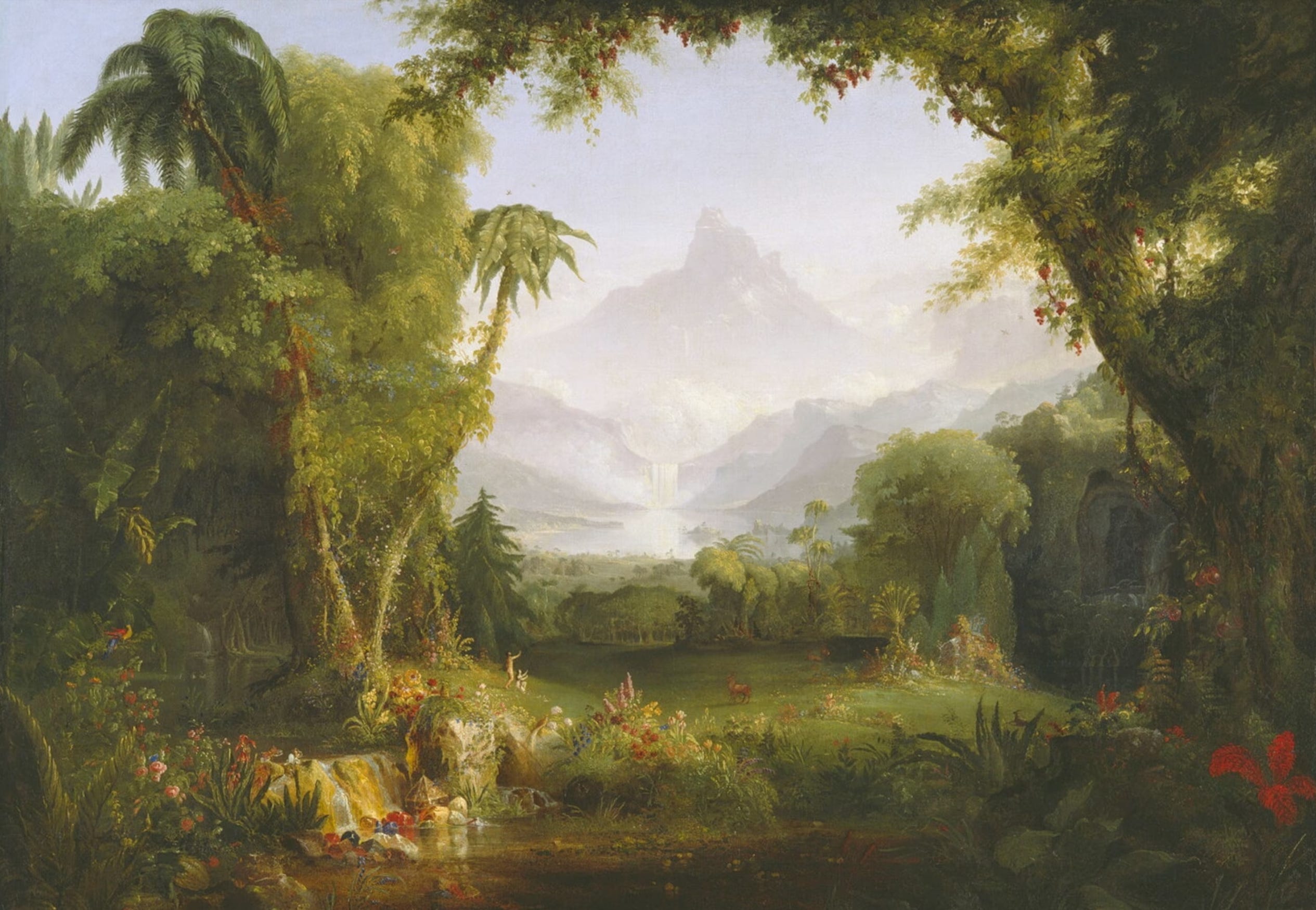
Is myth memory or parable?
There’s a common trajectory that many secular Westerners run through: myth is literally true→myth is fake→myth encodes lessons but isn’t literally true. It is my hope with this essay to move the reader one final step: myth encodes lessons and is often rooted in real events and places.
I will attempt to do so by arguing that the Garden of Eden and The Flood were some such myths, myths which go beyond “mere” parables, myths which are echoes of real challenges our ancestors faced and tried their best to make sense of. I do so by pulling from a large array of myths from Sumer, Babylon, the Bible, and other Near Eastern peoples. I also leverage data and arguments from the literature of archeology, geology, linguistics, genetics as well as from satellite data and original data analysis from yours truly . The picture I will present will be synthesis converging on a unified thesis.
My aim here is not only to disseminate these ideas but to weave together these multiple threads so painstakingly spun by previous scholars into a cohesive and relatively comprehensive tapestry that demystifies some of the fog of mythical pre-history. It was important for me that every step in the inferential chain be as clear and well cited with primary sources as possible.
I hope, above all else, this serves not to disenchant, but to *re-*enchant the world around you. Remember, even Troy was once thought to be “just a myth.”
The Sumerian Analogue
Our first clue comes through comparative mythology. It’s important to understand that the Garden of Eden myth didn’t spontaneously pop into existence out of a vacuum, but emerged within a broader backdrop of much older Mesopotamian mythological motifs. In this article, we’re going to hone in on the most ancient known civilization: Sumer.
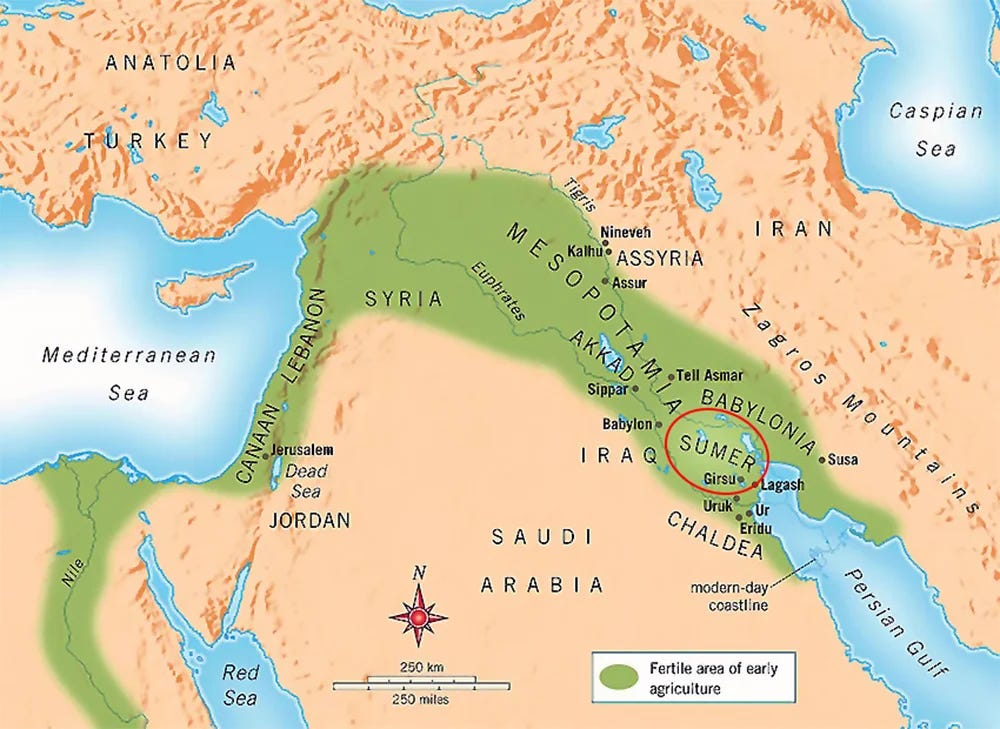
Our first clue comes from the strikingly similar Sumerian myth of Enki and Ninḫursaĝa1. This myth bears a striking resemblance to Genesis. Here are three overlaps.
First, after the consumption of a plant:
“My master, the plant,” he said to him, cut it off for him and Enki ate it…
After the consumption of which, our transgressor was condemned to die:
Ninbursaga cursed the name Enki: “Until his dying day, I will never look upon him with life-giving eye
Second, as first pointed out by Samuel Noah Krammer2, there is a woman whose name almost literally translates to “Lady Who Makes Life” who is born out of a rib. We may call her “Sumerian Eve”:
“My brother, what part of you hurts you?” “My ribs (ti) hurt me.” She gave birth to Ninti out of it.
And, of course, a pristine, initially pre-agricultural land free from suffering and aging, a land known to the Mesopotamians as Dilmun:
Pure is Dilmun land. Pure is Dilmun land. Virginal is Dilmun land. Virginal is Dilmun land. Pristine is Dilmun land…
In Dilmun… the lion did not slay, the wolf was not carrying off lambs, the dog had not been taught to make kids curl up, the pig had not learned that grain was to be eaten…
No eye-diseases said there: “I am the eye disease.” No headache said there: “I am the headache.” No old woman belonging to it said there: “I am an old woman.” No old man belonging to it said there: “I am an old man.” No maiden in her unwashed state ...... in the city. No man dredging a river said there: “It is getting dark.” No herald made the rounds in his border district. No singer sang an elulam there. No wailings were wailed in the city’s outskirts there.
So where exactly was this Eden-like paradise Dilmun?
Locating Dilmun
The precise location of Dilmun was a point of contention3 in the mid-20th century. Famed Sumerian scholar Samuel Kramer identified4 Dilmun with the Indus Valley civilization. But we now have good reason to be confident Dilmun lay much closer to the Mesopotamians who frequently wrote about this region.
Dilmun was not just a mythological region to the Mesopotamians. It was a much more banal, yet nevertheless important, trading hub. For instance, we get an explicit mention of Dilmun in the Inscribed Prisms of Sargon II5, cuneiform artifacts documenting various military and bureaucratic matters of the Assyrian king.
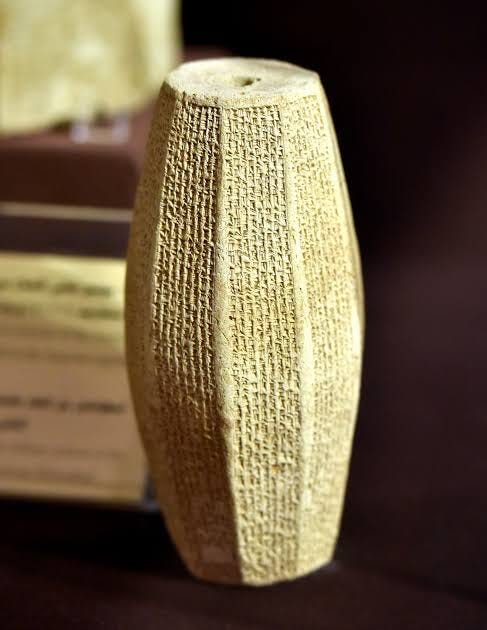
The Prisms of Sargon II.
This clay prism, first unearthed at Nimrud, chronicles tribute from Ahundara, a king of Dilmun. Dilmun, as Gadd restores the text, is located in the middle of the eastern sea (Persian Gulf).
Ahundara, king of [Dilmun, whose lair is situated a journey of 30 bêru] away in the middle of the [eastern] sea, like a fish.
Dilmun then, is located roughly 30 bêru away from Assyria. 1 bêru is approximately 10.8 km6 for a total of at least 300 km out from the head of the Persian Gulf. So the king of Dilmun was located over 300 km out into the sea, on an island, in the middle of the Persian Gulf. This is in line with Sumerian myths, which also associate Dilmun with fish and boats.7
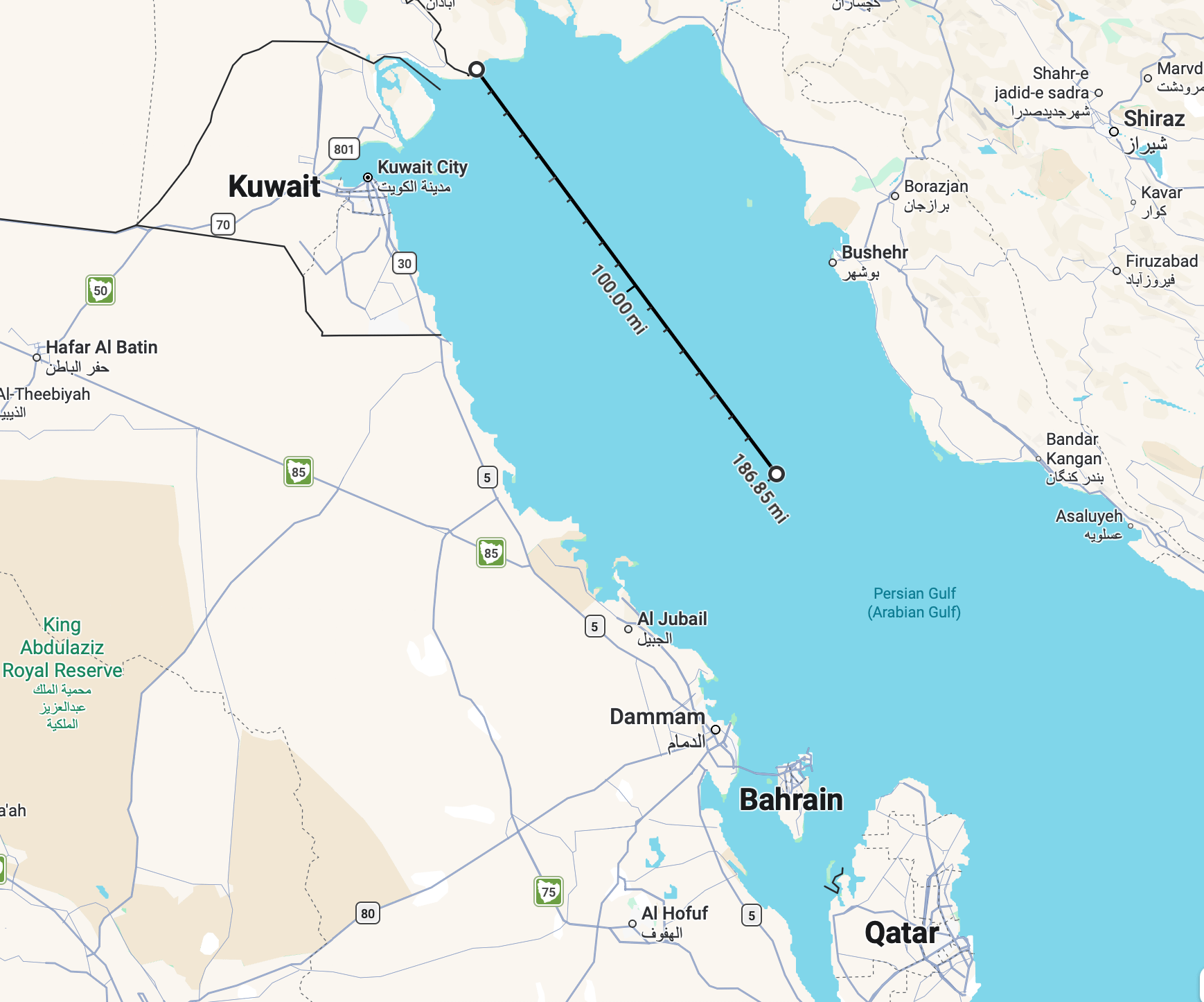
Given how bêru were very rough units of measurement, this is the minimum radius that Dilmun must lie outside. But it must also lie near this radius.
Understanding that bêru was a very rough unit of distance traveled in two hours (high variance given boats and sailing conditions), there is only one island that qualifies as a candidate: modern-day Bahrain.
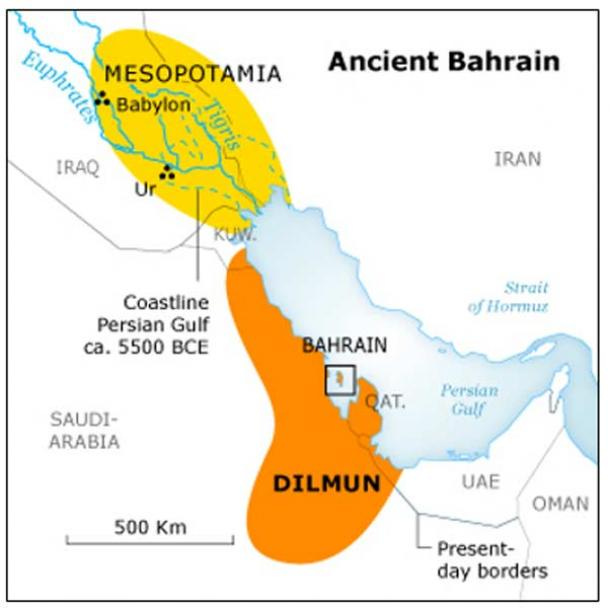
So that’s it? Eden = Bahrain, we can all go home now? Not quite. First, we’d have to show convergence between Biblical references and Dilmun before declaring victory (more on that below). Second, Bahrain is merely one part of Dilmun. Dilmun is now understood as encompassing not only Bahrain, but also much of the eastern Arabian Peninsula89 and perhaps more. Dilmun is conventionally mapped as the following region.
The Four Rivers
We can feel relatively confident that we’ve located what the Sumerian paradise myth was pointing at. But this article is about Eden, not Dilmun. If we could also find overlap between the Biblical account of Eden and this region, ideally in a way that further narrows our search space, that would be good reason to believe we were on to something. The reconstruction that follows was first worked out in the 1980s by the archaeologist Juris Zarins.10
Our biggest clue comes from Genesis 2:10-14:
A river watering the garden flowed from Eden; from there it was separated into four headwaters. The name of the first is the Pishon; it winds through the entire land of Havilah, where there is gold. (The gold of that land is good; aromatic resinlal and onyx are also there.) The name of the second river is the Gihon; it winds through the entire land of Cush. The name of the third river is the Tigris; it runs along the east side of Ashur. And the fourth river is the Euphrates.
So where are these four rivers?