
Originally by Patrick Seebold — read at the source
Welcome or welcome back, dear reader! It has been nearly a year since my last entry in the Principia, and in today’s post, I would like to offer a short explanation for my hiatus along with some reflections from that time.
Over the holidays in late 2025, a close family member was diagnosed with a tumor in a sensitive region of the brain. Their treatment continues and out of respect for their privacy, I will not go into their particular case. However, over the past year I have spent a considerable amount of time in hospitals and clinics. In that time, I have witnessed a tremendous amount of suffering, kindness, and scientific marvel. This has given me a new appreciation for the complexities of medicine and human biology, and I suspect some of my reflections may be of interest to the readers of the Principia.
(Disclaimer: Nothing here is medical advice, this is all for educational purposes).
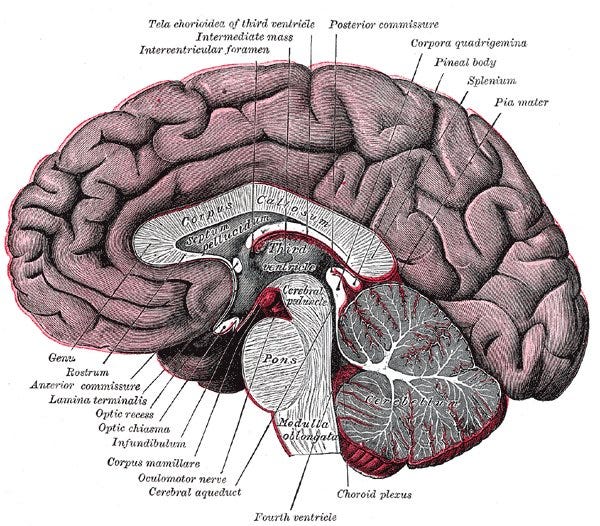
Sagittal section of a human brain from Gray’s Anatomy of the Human Body (20th ed.). This book is over 100 years old and is in the public domain, making it an excellent source for anatomical images.
Discovery in the Lab vs the Clinic
In the lab, we are often spoiled by the relatively low cost of failure and the enormous amount of control we can have over our environment. During my PhD, I regularly set up experiments in which sound and light were controlled to extremes that you will essentially never find in the natural world. In doing so, I could gather compelling data on how modifying one variable (sound) influenced another (visual ability). If something went wrong one day, I’d reset the experiment and try again the next. Over time, this is the sort of meticulous iteration that allows lab science to give us new insights into how the world works, and ultimately lets us find new ways to engineer solutions to meaningful problems.
From what I have seen, discovery in the clinic is a very different beast. When patient health is on the line, the stakes are high and the luxury of systematically altering one variable at a time is not always available. For example, imagine that a hypothetical cancer patient named Bertrand undergoes surgical resection (removal) of a tumor followed by radiation therapy and chemotherapy. Suppose that Bertrand tolerates the treatment extremely well and several months later there is no detectable cancer. Relieved and curious about his treatment, Bertrand asks the doctors, “So which treatment solved the problem? Was it the surgery, the radiation, the chemo? If we had only done chemo or radiation, would the treatment have worked as well?”
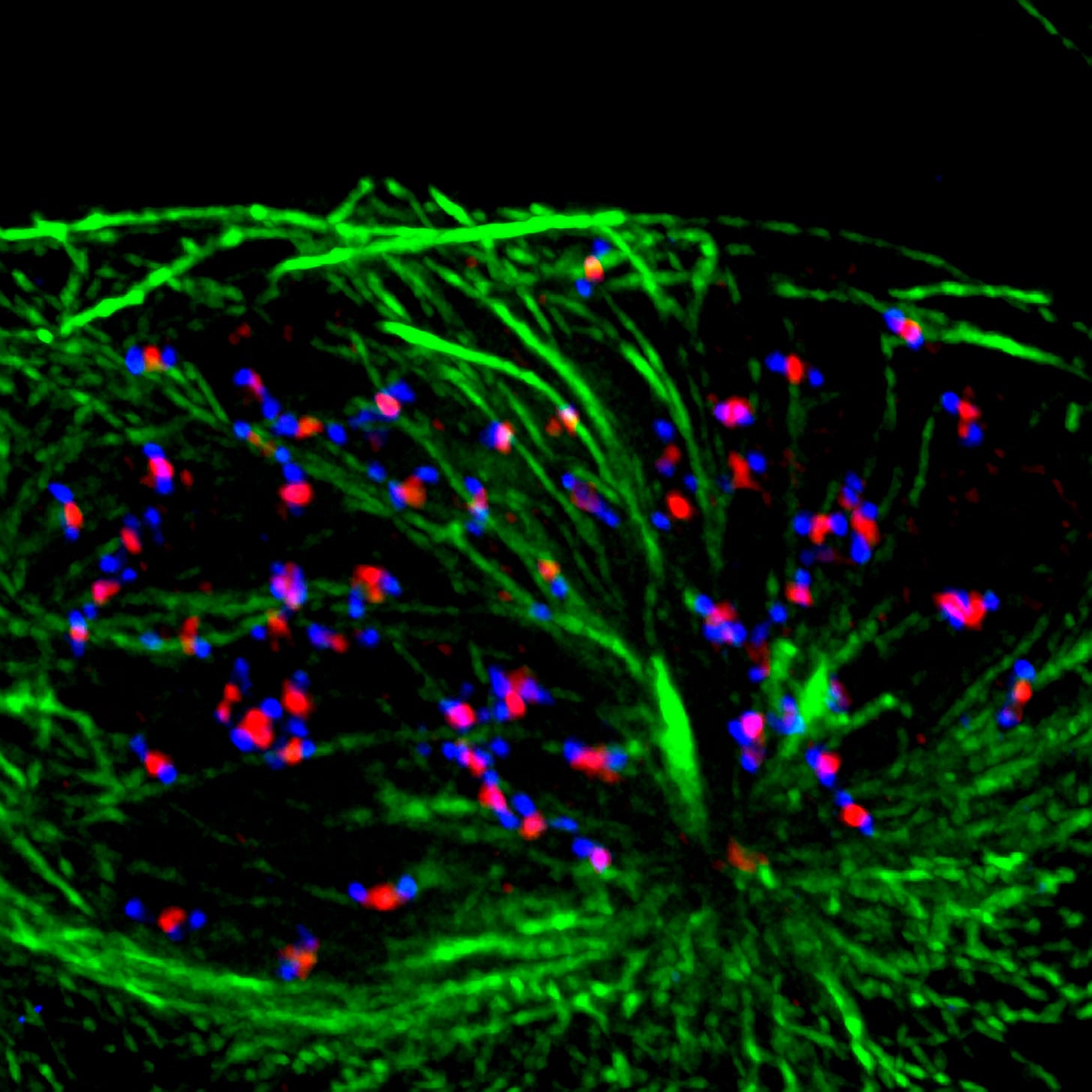
A fluorescence microscope image of a human cancer cell by Dr. Elena Knatko of University of Dundee, collected through the Wellcome Collection. CC BY 4.0.
From the perspective of a lab-trained scientist, I find this question difficult to answer. With Bertrand’s treatment, we can’t just rewind time and compare how his recovery would have gone if he had been on some other treatment plan. Medical science has tools to work around these constraints, such as randomized clinical trials and retrospective analyses, but many of these are at the population level, not the individual level. This reminds me of the difference between a confidence interval and a prediction interval in statistics. If you want to estimate the average outcome across a population (i.e., a confidence interval), you will get a more precise estimate than if you want to predict the outcome for any one member of that population (i.e., a prediction interval), since the differences between people will average out across the population estimate but not for individual predictions.
As I understand it, answering Bertrand’s question today would require us to extrapolate an individual outcome from a model based on the average outcome of all past patients who fell into his “population bucket.” Future research in precision medicine might be able to improve these population-level estimates by subdividing those buckets into multiple smaller ones. For example, imagine a newly discovered genetic marker reveals that patients with that marker respond better to a different treatment, enabling doctors to better match patients to therapies. Although this would not eliminate the challenge of extracting an individual estimate from a population model, it would provide a more precise population-level estimate and enable the development of more targeted treatments. This is a promising direction for improving our collective medical capabilities, but it is not guaranteed to provide us with a mechanistic model through which we could directly answer Bertrand’s question. For that, we’ll almost certainly need a different approach to modeling biology.
An Emerging Thesis - Structure & Function
The interplay of structure and function in brains and biology has fascinated me for most of my life, and this past year has only further fueled this interest. Back when I taught Biological Psychology at university, I would open the course with a quote that is often attributed to Francis Crick of DNA double helix fame. Entertainingly, Crick was not so sure that he actually said this, but it is still a good start for our discussion:
If you want to understand function, study structure.
When I was starting out as a researcher, I believed in this statement wholeheartedly. After all, structure was the easier thing to measure, so why not put our focus there? Now, as a more experienced scientist and engineer, I suspect this view was more indicative of my own inexperience than of any fundamental truth of nature. Function is what structure does, and at the end of the day, function is what we seem to care most about when it comes to human health. I don’t mind what my cells get up to on a daily basis so long as they enable me to walk, talk, eat, think. It’s only when that daily function is at risk that we turn our attention inward and ask what’s going on under the hood.
But when something does go wrong, where exactly do we look? Sure, maybe I can tell that something is off, but where does a problem live when my body can be viewed as a bunch of cells, or tissues, or organs, or organ systems? Each level of analysis has its own demands and its own habits, yet somehow they are all me and enable me to function. Traditionally, we reach for the lowest level we can access, genes, molecules, etc. But what about diseases where these aren’t the primary agents? What knobs do I reach for if I’m suffering from a psychiatric illness, or a cancer, or aging itself? It could be argued that all of these conditions do emerge from genes and molecules, but it’s not clear to me that going to the lowest level is always the optimal choice. To use one of my favorite examples from Michael Levin, when you want to open a website on your computer, you don’t pull out your soldering iron.
Actual footage of me at the workbench, writing this article with a soldering iron.
I believe that one of the greatest open questions in modern science is how to map and predict the relationship between structure and function across scales in biological systems. We are very good at understanding the behavior of an enormous number of tiny things when they are completely random (e.g., statistical mechanics) or completely deterministic (e.g., digital computers). What we are missing is a way to understand and predict how a great many semi-independent entities (e.g., cells) work together in a semi-dependent way to cooperate as a macroscopic entity (e.g., a human body). Spending time around the medical world has convinced me that better understanding this topic could have major ramifications for human health. For example, if it were possible to predict the behavior of a cancer based on the patient’s native biological state, such a model might offer one approach for answering Bertrand’s question.
I do not pretend to have the answers to this riddle of scale, and I concede that it is an incredibly daunting challenge. It could even turn out that biology is chaotic all the way down and can’t be simplified in a way that we can actually use or understand. The truth is we just won’t know until we look. Whatever turns out to be the case, it is my hope, dear reader, that you and I will someday be involved in the many incredible discoveries that surely await us in the years to come.
In Conclusion
It has been an eventful and consequential year, and I have a backlog of ideas that will be materializing in the Principia in the near future. These will include some new neurotech builds as well as theoretical considerations around topics such as those discussed here. As always, I appreciate you taking the time out of your day to engage with my ideas, and I hope they will have stimulated some novel ones of your own.
Also, before closing, I’d like to offer an extra round of thanks to the many nurses, doctors, technicians, and medical staff that I’ve spoken with over the past year. Although you may never read this, your patience with the countless questions of an overly curious family member has been greatly appreciated.
—
Cheers, and best of luck on all that needs luck,
Patrick Seebold, PhD
Source: Principia Fantastica