Cordyceps Culture

Follow into
Save into
Follow into

The Zombie Apocalypse
Many have heard tell of Cordyceps, a genus of fungi known for its parasitism. Sometimes called “zombie-ant fungus,” the species formally known as Ophiocordyceps unilateralis infects carpenter ants. Their behavioral functioning hijacked, the infected ants are compelled to climb to a specific height on vegetation, bite down firmly on a leaf or twig in a “death grip” and remain there until the fungus kills the host. O. unilateralis then sprouts from the ants’ bodies and releases spores to infect others.
Contemporary popular media has made much of Cordyceps as a concept, most readily evidenced in the video game and television series, The Last of Us, in which a mutated form of the fungus infects humans, turning them into zombies that attack and infect others. Infected humans lose their agency and become a vector for an alien purpose. It is a kind of eldritch horror somehow deeply commensurate with the zeitgeist.
While the conceptual Cordyceps is resonant now, it has been an object of curiosity for some time. Aldous Huxley’s Brave New World imagines a society in which (through the pharmaceutical aid of Soma) citizens are rendered harmless to the ongoing functioning of the state by virtue of a docile acceptance of their place in the hierarchy. In Franz Kafka’s The Castle, the protagonist (named simply “K.”) is unable to pierce the cultural veil of the village he received commission to assist because the emanations of its mountain castle have terminally entranced the people of the village into absurd cohesion. Sophocles’ Antigonedescribes a king so possessed by his conception of the culture of Thebes, he feels enjoined to thoroughly dishonor himself, and in so doing, lose all he loves. These are not isolated anxieties. They are recurring intuitions that when systems lose their capacity to generate possibility, they cling to their forms with increasing desperation.
Across eras and civilizations, art has repeatedly returned to the suspicion that in moments of exhaustion, the structures meant to preserve life begin preserving themselves. Yet when we speak of culture, we’re convinced it is mostly good. When we notice its propensity to bind us together, we are compelled to feel its value, or its beauty. There are historical and even sacred reasons we are led here. Yet we cannot accept the compunction in questioning it. There are times in which culture hides or aids a posture of protection, fear, and senescence. Sometimes culture is a parasite.
Leaders are desirable targets for parasites. What leadership countenances easily becomes what is understood as possible. The spores of fungal ideation prove most fecund when their site of dispersal is so supremely visible as the office of leader.
If you subscribe to The Subjunctive, all your dreams will come true, as long as you limit them to getting more email.
There can be little doubt many leaders are intimidated by the opacity of whatever it is we’re calling culture. They feel chastened by what they perceive as their exile from the Dionysian energies animating their organization’s culture: the youth movements, moral currents, and symbolic revolts that seem to outpace their institutional footing. They fear being seen as out of touch, morally behind, or generationally obsolete. In that insecurity, alignment feels safer than authorship.
“But if we believe that our thoughts are our epiphenomenology and that we have had them, we all too easily forget how often our thoughts have us.”
—Carl Jung, The Psychology of Kundalini Yoga (1932)
Modern leaders are negotiating with what they’re afraid they do not understand. How can we haggle with the unknown? What might we already know for which we’re not accounting? What even is culture? What is the provenance of our conception of culture? Why do we have this concept? Does it have a temporal or cyclical nature of expansion and contraction? What are we doing with it? Moreover, what might we be doing with it that we’re unaware we’re doing? How might culture be, to paraphrase Jung, not so much an idea we have, but an idea that has us?
The Semiosis of Culture
Culture resists interrogation for many reasons, chiefly because it is a complex system. Complex systems resist not only easy understanding, but easy modeling. They require us to wonder whether we’ve identified all the variables needed to create an accurate model (we haven’t).
Compounding this is a kind of epistemic confusion. The word ‘culture’ not only means different things to different people, but it also carries an intersubjective hermeneutic. The political space in which we talk about organizational culture tugs in various directions at our understanding of this definition. As culture implies coordination, these political weights are not a trivial concern. Recognition of this confusion is rare and attempting to discern how everyone defines culture is exhausting and cost prohibitive. It is easier to give up and assume everyone’s definitions of culture are commensurable.
We are not asking earnest questions about culture. Academics pontificate, but they rarely offer significant alterations to the assumptions we already possess. We’re not sure what we mean, we uncritically presuppose someone does, and whatever the experts say generally fails to elucidate anything. It is unsurprising contemporary leaders are given to shrug off understanding culture and simply accept its diktats.
Nietzsche observes that concepts—especially moral concepts—are not neutral descriptions of reality. He insists they are the sediment of historical conflicts. This kind of genealogical exploration of the concept of culture is illuminating.
“The cause of the origin of a thing and its eventual utility, its actual employment and place in a system of purposes, lie worlds apart.”
— Friedrich Nietzsche, On the Genealogy of Morality
What is the origin of ‘culture’? What political pressures have borne upon the way we understand the word? How has the struggle to apprehend ‘culture’ shaped its influence in a contemporary and conventional sense? These are the questions that must precede an understanding of what we think this word asks of us when it shows up on LinkedIn, or a TED talk, or common discourse among those for whose titles or aspirations have convinced them they should be intoning about culture in sotto voce.
It is accepted that the word ‘culture’ was given by Rome. The Latin colere means simply “to cultivate.” The Ancient Greeks, however, conceptually presaged this with the word paideia (παιδεία). For the Greeks, paideia was not merely cultivation, but its harvest. In the abstract, this is why we have the idea that what grows in a Petri dish (or in our refrigerator) can be called a culture.
Moreover, what emerges as paideia is served through the deliberate. With this frame, we can imagine culture as not only what we cultivate, but how we cultivate, why we change the way we cultivate over time, and why what we cultivate is not always what we intended. Seen this way, culture is a relationship between what we imagine could be and what will be. It is a means of employing tragedy in the service of proliferation. Culture is how a given locality optimizes for what it imagines to be possible.
But this is not our current frame. Our frame defines a very different kind of culture. What we call ‘corporate culture’ exposes this.
In our frame, we are invited to believe corporate culture is adduced through pithy utterances: “How we do things around here,” or, “The invisible operating system,” or, “The emergent mindset that guides decisions and behavior,” or, “An iceberg,” or, “A psychosocial cognitive hierarchy,” or, “A socially constructed set of intersectional oppressions,” and so on. What each of these heavily imply is that culture is neither intelligible (so it can’t be strictly shaped or designed) nor is it localizable to any given scope (so it has to do with something beyond the purview of not only leaders, but organizations themselves).
Conventional wisdom insists culture entails something “invisible.” It is emergent, by which is apparently meant irreducibly emergent. This gives one to wonder if there is any point even thinking about it at all if what emerges is utterly beyond our influence. Still, somehow, culture has direction because—as orthodoxy maintains—the arc of history bends toward the vindication of culture’s proclamations.
Edgar Schein is a venerable figure whose formulation for culture remains a touchstone in the academy. He describes culture as a pattern of shared basic assumptions learned by a group as it solves problems of external adaptation and internal integration. He further explains that when these assumptions work well enough to be considered ‘valid’ they are therefore taught to new members as the correct way to perceive, think, and feel. Those last two sentences are almost literal recreations of a passage from Schein’s Organizational Culture and Leadership.
“The bottom line for leaders is that if they do not become conscious of the cultures in which they are embedded, those cultures will manage them.”
— Edgar Schein
Here again we encounter a vague teleological compulsion: there is a correct way, and that way is what culture demands. Intellectual patterns survive (or don’t) the trial of reality. These become part of what Schein is describing as culture. This is, of course, true.
Until it is not.
Schein proclaims leaders should, “become conscious of the cultures in which they’re embedded …” His elision is an explanation of why this should happen first. Why is there a culture before a leader has had a chance to shape it? Where does the authority lie? Schein treats culture as a cognitive-psychological substrate that must be aligned. Who or what authored this substrate? What does that attribution mean for leadership?
For the Greeks and Romans, culture is an output of cultivation and formation. Authority acts, discipline shapes, excellence emerges, and culture is the residue; always at a cost, through exclusion, and never without loss. Culture then is downstream of deliberate action. Emergence is a component of this but requires the witting premeditation of the leader. Hence, culture was not seen as self-originating, ambient, or sacred. It was understood as the product of repeated, directional acts.
We have inverted this. Modern conceptions of culture treat it as antecedent to formation and constraining the exercise of authority. We now conceive of culture as prior to decision, morally elevated, diffuse, impersonal, and beyond any ownership. At bottom, our conception of culture either authorizes or forbids leadership. Whereas leaders were once the progenitors of culture, we now demand they steward, protect, or “align with” it. Culture is now upstream of deliberate action.
Under the original structure of culture, authority was visible. We could attribute decisions to leaders. We could be intentional about formation. Consequently, we made culture accountable to outcomes.
With the structure inverted, we have obscured authority. We now consistently attribute decisions to culture and frame formation as emergent. When culture is treated as anterior and morally elevated, leadership becomes reactive. When authority cannot generate form, it negotiates legitimacy. When decisions are no longer judged by outcomes across time, they will be subsumed by the prevailing symbolic paradigm.

Culture In Cursus
We will ask who benefits from the inversion. Ironically, we should ask not whom but what benefits. The beneficiary is a larger paradigm: an impersonal order that preserves itself by progressively shedding responsibility it can no longer bear.
Every paradigm behaves as a living system. It begins in rupture. Energy is abundant. Over time form consolidates. If the order endures long enough, preservation begins to matter more than generation. This pattern is visible at every scale.
At the outset, authority moves first and culture trails behind. As the order consolidates, culture stabilizes what has been built. Over time, the residue ossifies. It ceases to follow and becomes a retrenched certitude. The very forms that emerged from authorship become its constraints.
This transition rarely announces itself as decline. It arrives as moral refinement, procedural maturity, or sincere democracy. Yet something has changed. Preservation of form begins to outrank expansion of possibility.
Responsibility is relocated. It migrates downward into institutions, into organizations, into the very concept of culture. Leaders are disinvited from the generation of form. They are asked only to align.
It is tempting to imagine the lifecycle of a paradigm as chronology. It is not. A lifecycle is functional. Each phase alters the relationship between authority and culture. We would be naïve to imagine our present order exempt. No order is exempt.
Meanwhile, leaders find themselves immersed in a miasma of instability. Those most comfortable with uncritical alignment enjoy a spurious power. The generation of form is subordinated to its administration. Leaders that risk disruption are supplanted by those that reproduce orthodoxy. As generative capacity wanes, the paradigm elevates those most fluent in its preservation. Power detaches from possibility and attaches to compliance. The rise of this kind of leader is not incidental. Yet the advantage is contingent. The order that confers this authority will inevitably revoke it.

Culture As Laundry Service
The business maxim “culture eats strategy for breakfast” has achieved the status of bromide. It is a quotation consistently attributed to the once doyen of management, Peter Drucker. Drucker is a thinker of considerable repute, writing extensively on management, decentralization, responsibility, and the role of the executive. He argued that the purpose of business is to create customers. He insisted that the executive’s job is to make decisions under uncertainty. He treated results as the test of leadership. He saw management as discipline. He wrote 39 books on these subjects.
There is, however, no evidence Drucker ever wrote or said, “culture eats strategy for breakfast.” A web search will confirm this. The discourse surrounding organizational culture has mutated and evolved in the interregnum. Perhaps while on a subway in 1982, an enterprising junior associate at McKinsey decided this sounded like Drucker, but an honest reading of his work makes one suspicious. In any case, the phrase appears to have emerged later, acquiring Drucker’s name because it carries authority.
“Culture eats strategy for breakfast.”
— Not Peter Drucker
Drucker was not mystically inclined. He was a sober diagnostician of institutions. He understood that strategy cannot survive where incentives and norms undermine it. Moreover, he believed executives must be responsible for results. For Drucker, culture was not a veto over leadership. Rather, he accepted it as sediment from discipline, structure, and repeated decisions. Ascribing the idea of culture-as-sovereign to him converts his realism into a kind of fatalism.
This story gives measure to how far the concept of culture has drifted. Culture, once understood as the outcome of formation, is now invoked as its antecedent. We now imagine norms generating authority rather than authority generating norms. What was once cultivated is now treated as sovereign.
Consider what is entailed. If culture eats strategy, responsibility is dissolved. Misjudgment becomes misalignment. Misalignment becomes atmosphere. Atmosphere has no author. When we fasten genesis to culture, we are drawn away from admitting any structural flaws. When we cease to believe our senses and loudly admire the exquisite raiment of the naked emperor, the parasite animating culture carries the laurels. Initiatives may fail, strategy may falter, but the culture remains immaculate.
When culture is sovereign, it becomes moral interdiction. This does three things. First, it immunizes norms. Norms become self-validating. Our interpretations may be misaligned, but what culture tells us should be is always the end for our endeavors. Second, it renders authority irretrievably diffuse. Only when a manager violates the most obvious taboo does accountability crystallize. For everything else, authority dissolves into committee, process, and mood. Finally, it protects theory from indictment. Leaders are provisioned theory that never fails because theory is never allowed to fail. When outcomes disappoint, the theory is preserved by blaming cultural misalignment.
Contemporary leadership theory urges us to lead without power. This is impossible. Power is merely moved under another shell. Contemporary theory of organizational culture provides a shell under which to hide it. In evacuating power from leadership, we imagine we have eliminated it when all we have done is to launder it through culture and thus render it unaccountable.
What Dreams May Come
When a living system is young it does not require elaborate self-protection. Youth is the story of growth, expansion, and the metabolization of risk. The authorship of this course is visible because growth requires decision. Error is costly in youth, but it is conspicuously intelligible. When leadership acts at this stage, it owns the consequences.
Only in senescence does preservation begin to run beyond generativity.
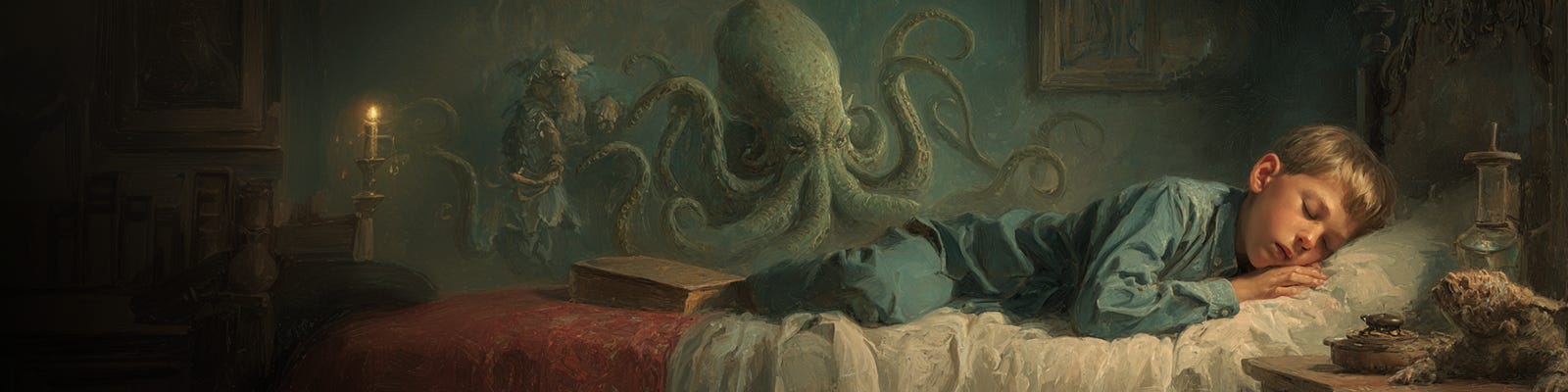
When preservation is preeminent, the vulnerability to parasitism grows. The parasites were always present, but the resistance of the host declines with its vitality. Instead of conquering the ant by force, Cordyceps colonizes a system already structured for survival and redirects its instincts. The ant continues to move and function. It does this perhaps more fervently. But its agency has been appropriated. It becomes the parasite.
So too it is with culture.
When a paradigm exhausts its possibility space—when it can no longer generate more than it eliminates—authority becomes seen as dangerous. Decision becomes risk. Structural failure becomes too expensive to name. This is when culture ascends to sovereignty. When this happens, it is not because culture has become wise, but because leadership has grown tired.
The language of culture offers relief for these depredations. It does this by dissolving blame and diffusing power. Culture inoculates norms and fortifies theory. It promises harmony without the trouble of responsibility. Under its aegis, organizations can continue to move, speak, and posture. What is lost is the ability for the organization to decide the way it once did. Strategy melts into performance, and power becomes an atmospheric mist.
This is senescence.
Culture in decay—where it had been the accretions of vision and formation—becomes the mechanism by which future formation is foreclosed. The organization clings to form while its vitality quietly recedes. It becomes fit only for the parasite that feeds on preservation rather than vitality.
The Cordyceps metaphor is not an accusation. It is not polemical. It is a diagnosis. Infected ants do not know they are infected. They obey what feels like instinct. In the same way, leadership emptied of purpose will accede to the parasite and feel it as perfectly normal.
We will not resist this condition by discarding culture as a concept. We may wish to avoid tyranny, but we must confront the uncanny purpose of responsibility. Authority must be visible to realize authorship. If norms are not posterior to vision, there will be no vision but stultifying sameness or collapse. Theory must again be allowed to fail. We must rediscover the location of power.
Only with new eyes will leaders make harvests of vision, inspiration, and disciplined action. We will not forever accept a desultory simulation of leadership in place of leadership itself.
Filling in one-field subscription form is a thing that happens. People do it. We believe this.