How To Be Popular

Follow into
Save into
Follow into

Provocation
Arthur Schopenhauer, in the chapter On Reading and Books, from his Parerga und Paralipomena II, writes
“… we might then know that whoever writes for fools always finds a large audience, and turn the little time we have for reading to only the great works that stand above all, from any time or people …”[1]
You are reading The Subjunctive. Thank you. Subscription is free, other than the cost of having to read this stuff.
The maxim describes something. Perhaps more importantly, it prescribes something. Do not engage with slop. That we should need remind ourselves of this is a testament to its allure. We seem to want our attention wasted on that which deserves it least. Schopenhauer is describing the contemptible writer and warning the fool in all of us.
This warning also exposes a deeper insight it fails to elucidate. We are left to wonder why we should be so attracted. What does it mean to write for fools? What does the fool want? What is it about easy dross the fool finds so interesting? As we will see, what endears to the fool is compelling precisely because it is not interesting. It only pretends to be.

Consideration
In explaining the desire of fools, we may account for many variables. Is it close to their world? Fools are provincial. They want affirmation of what they know, which is mostly contained by what they’ve experienced. This locality might be geographic, creedal, cultural, political. And yet, even the provincial may enjoy stories of foreign origin.
Perhaps they want something new? A novelty? Never content with diving deeply, fools always enjoy something they’ve not seen before. A spectacle. And yet, are they not also enamored of old things? For nostalgia? For home?
So, neither locality nor novelty explains it. We must identify what our foolishness seeks out and what repels it. Finding this will give us a continuum from desire to rejection.
The sucker in each of us is foremost an egotist. We want to be flattered. Flattery requires two conditions be met. We must have something we believe about ourselves confirmed, and we must be surprised by the avenue of confirmation. Put another way, we must be surprised to learn we were right all along. Nothing sates the ego more completely. We feel joy at our own rectitude. We needn’t think more deeply about it because our beliefs are confirmed. The surprise becomes amusement.
However, our egos want to fall for this flattery without falling for it. What the egotist detests more than anything is being exposed as a chump. When the two conditions of flattery are inverted, the ego gets hung out to dry. If something we believe about ourselves is disconfirmed—disrupted—we experience injury and must work to reconstitute ourselves. If our expectations are merely met, we fear we are being manipulated, or worse, ignored. When both conditions are met, we perceive we are being hassled, subordinated, marginalized. All we feel is frustration.

Synthesis
This discovery describes a phase space. The two variables—the egoic conditions of our foolishness—are accommodation and expectation. Expectation is easily understood. Accommodation measures how much rearranging we must do to fit new information into our sense of ourselves and the world. We can frame these as axes in a cartesian graph.
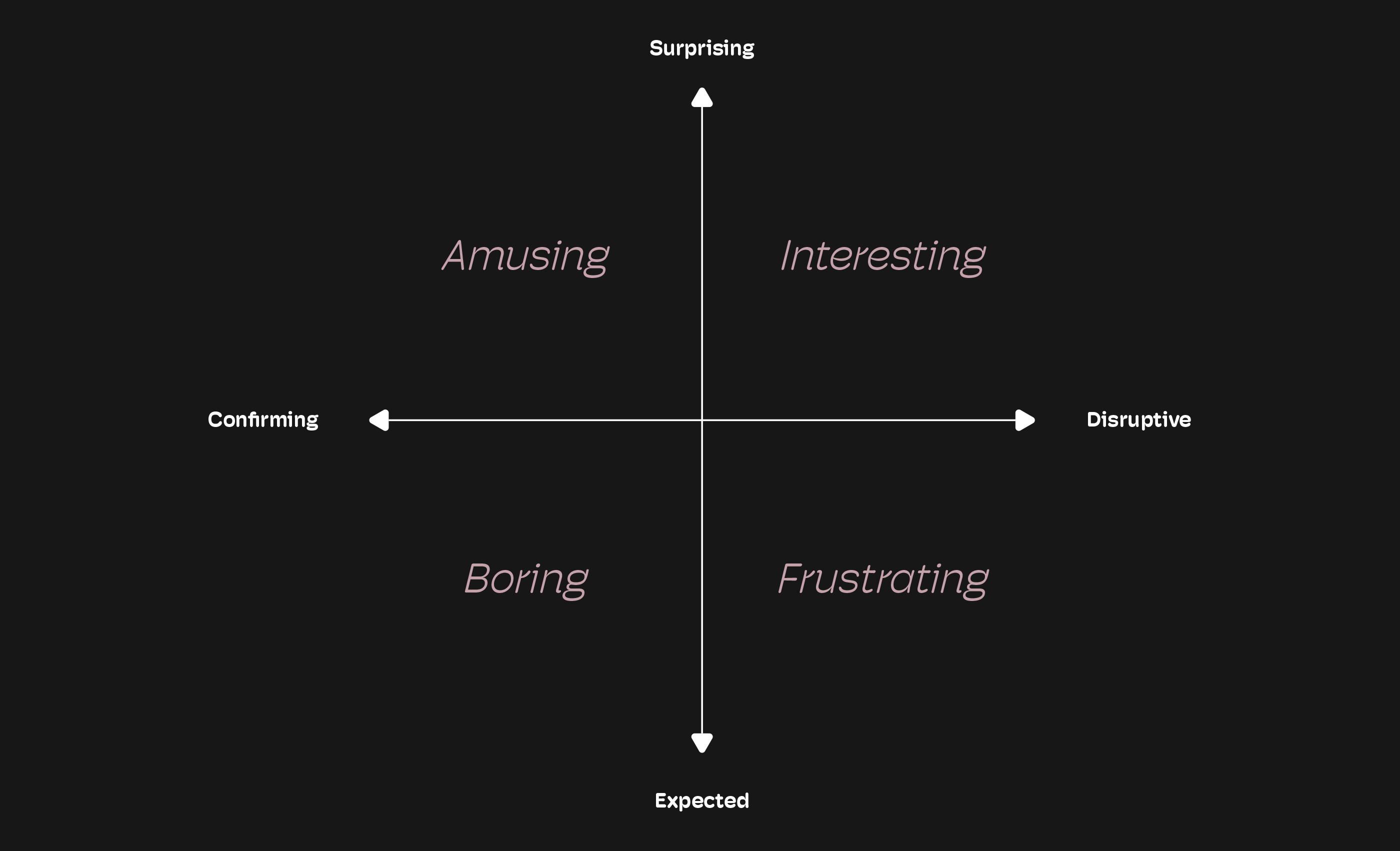
What appeals to the fool is confirmation and surprise. We consume some media that surprises us and yet confirms our existing beliefs. This surprising confirmation serves the ego because it affirms what we already knew. We’re smart. We’re not fools.
The experiential payload is, “Oh. Well of course.” We are pleased at our own perspicacity. It gives us the appearance we have discovered something interesting, but we haven’t. It is merely amusement. It feels interesting, but structurally, it’s flattery in disguise.
In the graph, this is the upper-left quadrant: amusing[2]. It is the quintessence of flattery. It can be outrage bait that confirms your ideology: “Look what this politician did now!” It can be celebrity gossip. A video of a dog opening a refrigerator. Crime stories that reinforce a belief that cities are dangerous, elites are corrupt, teenagers are reckless, etc. Pretty much all content on late-night comedy shows. The paradigmatic gloss is something like, “I didn’t expect that, but it figures.”
Content that gives us what we expect and doesn’t surprise us is in the lower-left quadrant: boring. It may be a mnemonic, a banal reminder, or simply the communication of someone who is dull-witted, but we expect it and we needn’t do anything to accommodate it. The response to boring content is, “Tell me something I don’t know.”
When we glance at the speedometer in our car repeatedly and see the same reading, this is boring. Plagiarism is boring. Uncharismatic leaders are boring. Insults involving “your mom” are boring. Dad jokes are boring for everyone except dads. Pretty much every post on LinkedIn. Corporate communications involving authenticity, resilience, integrity, empathy, purpose, or culture.
The lower-right quadrant is the domain of content that we expect and yet disrupts our ego or desires: frustrating. This kind of communication can be as simple as an alarm we set to wake ourselves in the morning. It tells us what we already know but still requires us to alter our behavior.
A parent reminding a child to do their homework. A screen-time report telling us we’re up 23% this week. Dave Ramsey moralizing about someone’s debt, or Suze Orman intoning that we can’t afford the avocado toast. Jillian Michaels reminding us we have no excuses for being fat. Somehow, we seem to want to hear these things, yet our reflexive response is the childhood sequence, “But I know!” The reply? “Then do it!”
The quadrant in the upper-right describes content that is interesting. Appropriately, the insight it yields is itself challenging and surprising. It is the most expensive of the quadrants. Content here surprises and disrupts at once. It demands not only that we contend with what we didn’t expect, but that we potentially rearrange our understanding to make sense of what it offers. For many of us, in many situations, this is worse than boring. It is often too much to ask.
Truly interesting content may ask us to reverse a causal relationship we had taken for granted. It may inform us a political or cultural figure we despise is substantially right about something important to us. It could show us that something we had regarded as a virtue is actually doing harm. We read a philosopher who radically challenges everything we’ve believed for as long as we can remember. We discover late in life that we must radically change our career. Perhaps an employee who appeared lazy was doing work that allowed everyone else to perform well, and no one noticed. It turns out your spouse of 20 years was never in love with you. Searching for a childhood memory in your parents’ basement, you discover your adoption papers.
Of course, the fool in us wants amusement as a stand-in for interestingness. Surprise alone carries less cognitive burden than surprise and disruption. Amusement gives us novelty without the need for revision.
The characteristic response to the truly interesting is something like, “Wait … what?” We know it’s actually disruptive because the next thought is usually, “No. It can’t be.” But it is.

Sloptimization
What we have in our graph is also a theory of popular media. It illuminates why Schopenhauer’s insight was accurate, but it also explains other elements of our relationship to media. It exposes the cognitive cost of media and how that burden varies across people and circumstances. Perhaps most interestingly, it pulls back the curtain on slop and virality.
We’ve seen that amusement masquerades as interesting by offering novelty without revision. When the content we consume gives us a surprise without asking anything of us, we reward it with our engagement. We like it. We comment on it. We share it.
The effect is even more pronounced when the content walks right up to the edge of interestingness but stops short of any disruption. We feel a little tingle as we think our whole world might be overturned, and when it isn’t, the psychic tension is released harmlessly. This is what slop sells. It’s not stupidity, simplicity, cuteness, or even confirmation bias. What slop does is to fabricate the experience of learning while leaving the learner unchanged. And it works.
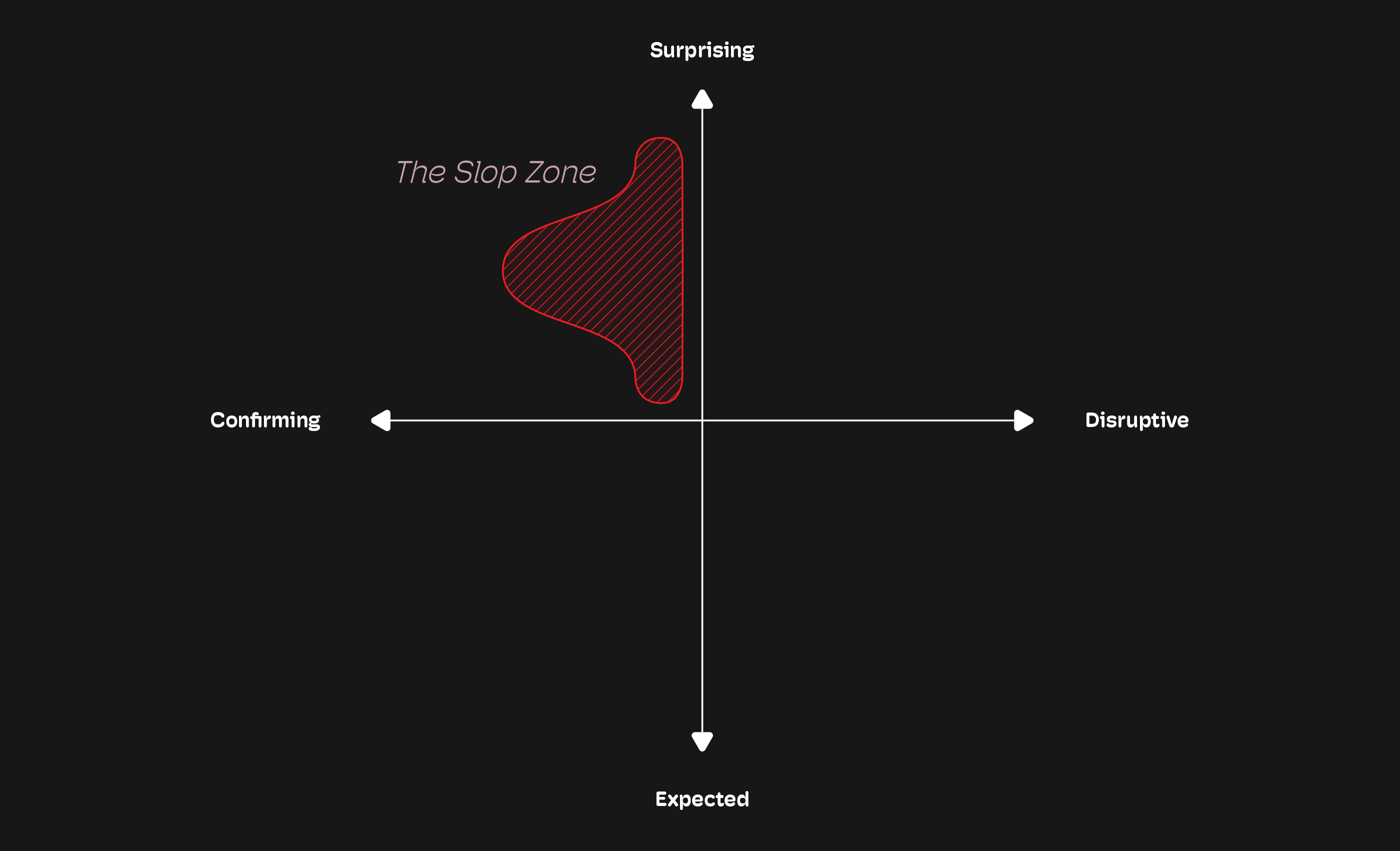
Information that is deeply interesting is almost always contextually narrow. For any given audience, very few people will be willing to pay the cost to accommodate what is genuinely interesting. It may have value in niches—academic journals, technical communities, therapy sessions—but it is extraordinarily rare for it to achieve mass-market appeal.
But there’s another insight here. Interestingness and slop are relational. The same material can appear in different quadrants for different people. Newtonian physics may be boring for a physicist, interesting for a child, and frustrating for a high school student who has to learn it for an exam. On YouTube, it becomes amusing slop about the one crazy fact about gravity that will blow your mind!
Creators become slopportunists when their content must appeal to a large, heterogeneous audience. This means communicators must crank down the cost of accommodation until the largest possible number of people can metabolize the content as confirmation. If the novelty level remains high enough to avoid boring us, the slop goes viral. This is the essence of how to be popular.
We may all profess to want less slop. We may say we hate it. We may claim to be more sophisticated. We’ll say we want challenge, we want to learn about what is truly interesting. But unless something dramatically changes in our nature, the fools in all of us ensure the slop will continue to have a large audience. Schopenhauer’s dictum is something more still than we first noticed. We will engage the slop. We all need some slop. Because we are all fools.
[1] Translation and emphasis mine
[2] The etymology of amuse is disputed, but the various positions on the matter are instructive. In the 17th and 18th centuries, the original English meaning was “divert from serious business, tickle the fancy of” or to “deceive, cheat” through the occupation of attention. In Old French, amuser meant “to stupefy, waste time”. It may be a cognate of empty through the Proto-Indo-European root, med- (“to acquire, possess, control”). For further amusement, we might note the French amuse-bouche, meaning “A bite-sized hors d’oeuvre or appetizer that is served before a meal.”
You are seeing this because you either read the whole thing or just scrolled to the bottom. Either way, subscribe to The Subjunctive and the Substack gods will smile on you.