It Was Always Already There

Follow into
Save into
Follow into

A Feeling We Cannot Place
Toward the back of the lobby, dominating the inoffensively provocative brick façade whose once utilitarian intention is now displaced in performative anachronism, looms the tastefully backlit logotype of our estimable firm. In the two years since the rebrand, its stolid aluminum Graphik face grimaces at the tangle of impersonal persons about the open office, acting as officiant for the induced motility of something far older than even the industrial manufactory in which it is affixed. More demure—and yet disquieting—than any gargoyle, the environmental brand felt somehow immanent today, as if evincing something intentional, palpable, proximate.
But since that vertiginous moment, the glowing insignia and fallow tenantry of the office have transmuted into the psychic projection of an abyssal presence.
Discovery is suffused with mystery. Our environments, our contexts, our careers all conspire to obscure this mystery, and although we cannot see it, we can feel it. What is felt is spectral; faintly ominous.
Thank you for reading The Subjunctive. You can support my work and make normies uncomfortable by subscribing.
Yet we are drawn in. This is now. All of us have registered a tremor lurking just beneath the surface of the modern world. It saturates the narratives in our news media, and our popular culture, and even the tenure of human existence. We are uneasy about the conflict that pervades our world. We consume with uncanny amusement the zombies, ancient aliens, and rapacious internet ghouls that inspirit the content with which we occupy ourselves. We are voyeurs to real housewife avarice and the tender spectacle of autistic romance. We expose our most intimate solecisms and debacles to farm engagement as we strive for influencer status.
Meanwhile, the institution of institution has become a caricature of itself. Everything is venal. We treat the most lurid aspersions as attainders. Innuendo is indictment. “They” want to kill you and the people you love. The elites are eating babies.
These pathologies are not disparate. What we feel—the paranoia, the vulgarity, the existential dread—is not random coincidence. Something is animating it. That something is older than the office, or the rebrand, or the industrial manufactory whose brick shell we have repurposed as an escape room. It was always already affixed in the lobby before we entered it. It was there before we could name what we only vaguely perceived. The shape we only feel has always enclosed us. It is a shape we inhabit.
What we are feeling is the ministration of an egregore. It is an entity begotten by a paradigm and accreted over centuries. The egregore inhabits us as surely as we inhabit the paradigm. Its being is easy to wave away, yet those who have looked into the abyss (see Paradigms and Egregores) will recognize it as real. The paradigm animating this egregore is cultural. Its pace is slow and its duration is long.
We may call it the modern paradigm, though it goes by other names. It is also known as Enlightenment thought, liberalism, modernity. Curiously, it does not allow itself to be seen as a paradigm, but as the end of paradigms. It consecrates itself as the final demystification of the arcane forces that governed life in the pre-modern world. It is the universal solvent of religion, fate, cosmic order, divine will. It sublimates the supernatural with the light of reason and reduces reality to the scope of humanity. It has made the world knowable, manageable, ownable by us.
In accomplishing these things, modernity has concealed something of itself. It did not quell what pre-modern people felt when confronted by fate and faith. It has instead become the vast and incomprehensible force it sought to repress. It is now the object of an awe once reserved for the numinous, the divine.
What is less obvious is why the modern paradigm reveals itself this way. If discovery is suffused with mystery, the persistence of a paradigm depends on putting an end to both. If there is something mysterious—something to be discovered—the reigning paradigm has failed to metabolize it. Each paradigm wishes to be an end in and of itself. While no paradigm can exhaust all mystery or foreclose all discovery, modernity demands we see it as having done so.
Every paradigm produces an egregore. Its terrible potency is always felt. Its eldritch form is almost never seen. The only difference in modernity is this: its egregore arrived wearing a lab coat and carrying a copy of Newton’s Principia Mathematica.
Mentalités du Paradigme Libéral
Paradigms have a lifecycle (see Paradigms and Egregores). Their egregores determine the horizon of imagination differently at different stages in that lifecycle. At first, imagination is boundless. As loss outruns generativity, imagination comes to contain only images of collapse. Finally, the future is decomposed into discipline, maintenance. The egregore knows it can no longer expand, but it does not wish to dissolve, so it insists. Each phase of imagination is a means to perpetuate the paradigm. Even when its inhabitants imagine the paradigm falling apart, they remain entirely engaged with it.
The modern paradigm is late in its lifecycle. It is aged and increasingly infirm. It has not always felt as it does now. It has traversed the field of possibility over such a broad span of time that no one now living inhabited it in its youth. To diagnose what is currently ailing it, we must retrace its course.
Imagination of Growth
Modernity began before it began. An interregnum preceded it, pregnant with what was to follow. What catalyzed it? Was it the mechanical clock? The printing press? The Renaissance? The Reformation? The scientific revolution? All of these? What matters to the story of our paradigm is not what caused this disjunction, but how it felt to live through it.
The Renaissance was something like a dress rehearsal. It did not yet constitute a philosophical framework that could instantiate the modern, but it could be felt. As its vates, Petrarch foretold, “My fate is to live among varied and confusing storms. But for you perhaps, if as I hope and wish you will live long after me, there will follow a better age.” The Renaissance sought to recognize the human being as worthy of loving attention, to ennoble the individual, and to recover the wisdom of antiquity. What it reclaimed, above all, was wonder.
The Reformation performed other work in exposing humanity’s changing relation to itself. While the Renaissance brought humanness into focus, the Reformation demanded we encounter revelation without the intercession of the clergy. Luther’s priesthood of all believers installed individual conscience as the site of religious authority. The sacred was thus made personal. The personal would, in time, become the political. The Reformation prepared a novel experiential ground by stripping away the mediating structures that had governed access to truth.
Then, in the 17th century, the modern paradigm arrived as liberation. It promised release from superstition, from ungrounded faith, from religious inquisition, from the imposition of the ineffable upon our understanding of the natural world. From this, the paradigm took its familiar name: liberalism.
Energy long bound by the sheer mass of inherited structures was explosively released, and with it a new will for humanity. The first inhabitants of the paradigm imagined limitless potential to reshape life. Where divine order had once governed our relationship to God, to our institutions, to nature, we now claimed that agency for ourselves.
Rather than sacrificing our virgin daughters to mercurial forces, we could find mastery in agriculture through selective breeding, mechanized harvest, and the science of soils. We could harness natural forces through physics. We could improve the materials with which we constructed our environment through chemistry. We could categorize the living world and catalogue its forms and functions through biology.
The political dimension of the human experience was similarly—and literally—revolutionized. The way we ordered and instituted our relations with one another had been assumed to descend from above and beyond. Nobles ruled by divine right. Aristocrats held their stations by accident of birth. Religious leadership was derived from impenetrable theological elaborations. Before the modern paradigm, government itself had been utterly separated from the governed.
By contrast, modern governance was to be by the people, of the people, and for the people. It promised not only to enfranchise, but to lift up the citizenry, making their education a foundation for its mission. It demanded rule be exercised through reason—enshrined in law—so that it should be intelligible and accountable. Sovereign will, said modernity, must be more than the caprice of man; it must represent the voice of the masses. It located sovereignty in the principle that all men are created equal. This principle would eventually come to encompass all women, and all humanity—irrespective of race, class, or origin—until it might even reveal a final ambition to abolish all borders.
As the egregore of modernity gained its footing, we can imagine the disposition of those it deputized to fulfill its purpose. Called to overthrow old regimes and found new countries, they must have reveled in the profundity of their works. Humanity had come into its own! We had become beneficiaries of a grand inheritance. We would liberate ourselves, remove the shackles of ancient ignorance, and fulfill our destiny to shine a light into all the dark places of the world.
Beyond the paradigm’s stewards alone, the average person began to register the exuberance of hopeful futures. In late 18th and early 19th century America, the field of the possible opened widely. While many still could not realize this opening, more than ever before it granted access to people outside the traditional elite. On the American frontier, a man could simply strike out and become something unfettered by his previous circumstances. In Europe, the centuries-old hegemony of monarchical structures was overthrown in favor of republican and constitutional models. The French Revolution enacted this as a fracture in time itself, renaming the months and restarting the calendar at Year One. Everywhere it appeared, the irruption of the modern was experienced as inevitable, self-confirming, like a tide coming in.
At the same time, the industrial revolution arrived. Often remembered as oppressive, it did not displace pastoral abundance. The move to enclose formerly open land had already broken the commons. The putting-out system had also collapsed, leaving cottage workers destitute. Those entering factories came from a rural world that had long since lost its coherence. The brutality of industry would be measured against this loss. For many, the field of the possible had already become so narrow that the factory, despite its violence, widened it again. Cities fed where rural laborers had once gone hungry. The newly urbanized workforce was clothed at a fraction of the former cost. The chronic threat of famine began a long retreat.
Imagination of Collapse
Within this vindication, however, the imaginal space began to turn. The “dark satanic mills” described by William Blake, unrest among the working class, and Marx’s indictment of capital evoked a malaise not yet understood as symptomatic of the exhaustion of the paradigm. These concerns were generally read as correctives for modernity. They were metabolized as appeals to stated values against a backdrop of visible failures. Yet the egregore was shifting its focus. It was beginning to populate future images with the suspicion that progress was its own undoing. Improvement itself might be the source of harm. Narratives of collapse had not yet been labeled as such. Still, they had begun to find a voice.
That voice grew. From the U.S. Civil War on through the close of the 19th century, thinkers began to name what many had only begun to feel. Nietzsche announced we had killed God, and with him the metaphysical foundation upon which the paradigm had been quietly predicated. Joseph Conrad went upriver to return with the discovery that the light of civilization might itself be a kind of darkness. The colonial project—the paradigm’s most ambitious universalizing vehicle—was coming to be seen as something other than liberation.
Then came the wars of the early 20th century. The great achievements of industry were now turned to the enterprise of mass slaughter in the trenches of the Western Front. From this, a Lost Generation emerged, disillusioned by the emptiness of the old words: honor, progress, civilization. The paradigm that had breathed life into these words had also produced a generation of corpses. The existentialists would spend the next decades transmuting this vertigo into philosophy.
Defiantly, the America of the mid-20th century would repeatedly attempt to revitalize images of the future. While the rest of the modern world licked its wounds, the U.S. would generate a baby boom, Levittowns, nuclear power, and the mass-produced automobile. The silent generation ardently struggled to recapitulate the confidence of early modernity while never truly recovering it. The powerful tide, once inexorable, now required much greater effort to sustain.
With the 1960s, the generational product of the baby boom brought an end to that effort. The demand for civil rights demonstrated the paradigm was failing to deliver on its foundational promises. The war in Vietnam deracinated whatever virtue the Second World War conferred on military intervention. A growing counterculture rejected consumerism as spiritually hollow. A new wave of feminists declared war on a patriarchy liberalism had failed to dismantle. As a cold war insinuated the horror of nuclear holocaust, we began to both fear and fetishize the possibility of civilizational extinction. We began to document signals of modernity destroying the natural world it had once meant to lay open to a deeper appreciation.
These visions of collapse were not suppressed, at least not successfully. The egregore wanted them—used them—to keep the paradigm alive. What had started as a whisper became a barbaric yawp demanding liberalism must honor its commitments. Rather than presage disengagement from modernity, imaginal collapse brought us to an even deeper preoccupation with the realization of what we felt we were owed. When Ronald Reagan announced a New Morning in America in the 1980s, the growth to which he gestured was already a nostalgic artifact, but one we still desired. The field of the possible had not become wider. It had been merely costumed to appear as if it had.
Imagination of Discipline
The imaginal phases through which the egregore passes do not succeed one another discretely. The center of gravity shifts gradually, during which old images of the future continue to circulate even as their allure weakens. New future images emerge before the phase they represent has established its new center of gravity. During this passage, it appears as if the egregore is running two programs simultaneously, because it is. As always, it does this to keep the paradigm alive.
The 1990s were an example of just this kind of shift. The briefly euphoric moment attending the end of the Cold War resembled, superficially, the resumption of growth as center of imaginal gravity. In what appeared as vindication for the modern paradigm, Francis Fukuyama declared the end of history. The sense that modernity had not failed was seductive. Its triumph may still be absolute!
Practically, however, the decade generated patterns of governance that revealed something more subtle. Bill Clinton reformed welfare, balanced the federal budget, and signed novel international trade agreements that would come to reframe the global economy. This was not recapitulation of the Great Society or the New Deal. It did not recover the early generative surplus of modernity. Instead, it humbly announced a turn toward maintenance. The egregore wanted, needed, discipline to shape imagination.
The European Union became coherent at roughly the same time and for similar reasons. It was not seeking a new renaissance. Its intention was to discipline Europe into something more durable. China, witnessing the implosion of the Soviet Union, adopted a comparable posture. It did not want the excesses of either liberal democracy or communism, but a third path. It chose a managed self-containment.
Each of these three disparate state actors—despite the difference in their strategies—adopted the same underlying orientation: discipline.
This orientation became more entrenched in the first years of the new millennium. While September 11 violently recentered the imagery of collapse, the collective reply was yet more discipline. That reply comprised the surveillance state, indefinite wars, and an administrative complex whose purpose appeared to be the perpetual management of threats it could never eliminate. Unremittingly, the egregore performs its function: in this case to convert collapse into fuel for maintenance, and the persistence of the paradigm.
By the 2010s, discipline had become the only acceptable frame for imagination. This is where the egregore begins to insist. A now sclerotic paradigm can only pay the cost of its continued existence by drawing on the language of the sacred to demand propitiation under the threat of excommunication and perdition.
Since that time, the institutions of modernity—the academy, NGOs, news media, the entertainment industry—have had their interests concatenated by the egregore into one imperative: the identification and suppression of harm. Racism, colonialism, patriarchy. This litany is liturgy. The paradigm does not intend to provide solutions. A solved problem generates no priestly function. These problems are instead sacred wounds requiring eternal ministration. Their persistence gives authority to the minister.
The images that flow from this imperative offer neither inspiration nor consolation. What our culture imagines now is not a future at all. It is a corrective against a past for which we feel only shame.
This is how the egregore presents itself in its late discipline phase. It intimates neither triumph nor creativity. A surplus of vitality is no longer its coin. The inhabitants of the paradigm feel its narrowing like a once beloved garment grown threadbare. Yet the experience is one of moral clarity. Its frailty lays bare what was always the paradigm’s one demand: keep it alive at all costs. To do otherwise is to do evil.
The threat is real. The fear is genuine. The paradigm truly is in danger, but it is not the danger against which we keep vigil. The danger is the age of the paradigm itself. The egregore has nowhere further to travel. Growth has been exhausted. Collapse was metabolized. Discipline is the terminus wherein there is no longer generation or dissolution, only extraction.
The Liberanomicon
A cultural paradigm constitutes reality for its inhabitants. The cultural paradigms that preceded ours were often harshly direct in exposing this. While we might think this cruelly oppressive, it was always simply structure being made explicit. Reality was shaped thus. That shape was beyond our control. The task was to accept and live properly within it. The inhabitants of pre-modern cultural paradigms knew, even if only dimly, what they were inhabiting. The enclosure was visible as enclosure.
The modern paradigm arrived differently. It offered instead to make each individual inhabitant the architect of their own reality. This is the core promise of modern liberty. Giving up agency to a paradigm is precisely that from which we were to be liberated. The paradigm provided the foundational instruments of this liberation, such as reason, empirical inquiry, individual conscience, equity. The promise was genuine. We have largely cast off the yoke of antecedent cultural paradigms.
What modernity left occluded is what these instruments cannot do. They cannot reach beyond themselves. Built into the design of these tools before they were even handed over is the assumption that they expose the world as it truly is. Reason assumes reality is rational. Empiricism, that it is measurable. Equity, that it is equitable. Individual conscience, that the individual is the end at which moral resolution occurs. Rather than arising from reality itself, these conclusions are conditions of how the tools were constructed. What this means is that the field they survey, however vast, is never the whole field.
Medieval peasants were offered no such instruments. Their salvation was a matter of forces beyond their ken, to which they could only pledge obeisance. With modernity, individuals are told they can generate their own deliverance. This arrangement dramatically alters the cost of failure. When traversing the field of the possible returns us to the tools we use to navigate it, resolution never arrives. This goes unrecognized as a failure of the paradigm because its tools—not reality—set the standard of success. The cost of failure, then, is paid by us.
For this reason, the liberation provisioned by the paradigm is only partial. While we have been liberated from the past, modernity cannot liberate us from itself. It simply says, “If the tools aren’t working, try using the tools.”
Precisely what has been built into these tools to produce this outcome? How do they conjure a world they claim only to describe? Why do they appear so genuinely and urgently as salvation from ignorance and servitude? The egregore cannot answer these questions. The architecture of the paradigm itself may prove unable to answer them. The most we may accomplish is to understand why the questions should be asked at all.
Cartesian Dualism and the Axiom of Naturalism
Perhaps the most felicitous place to begin is in the early 17th century with René Descartes. We might say he breaks the world, but he is only noticing the break that necessarily arises for the modern paradigm to be born. He tells us reality is not one, but two; an insight known as Cartesian dualism. Part of reality is out there. Descartes calls this res extensa: the world of objects we discover through our senses. The other part is in here. He calls this res cogitans: the world of our minds wherein we understand reality, and ourselves.
This Cartesian split establishes the terms within which modernity would come to define itself. Every philosophical structure taken seriously within modernity has had to situate itself in relation to the split Descartes disclosed. Serious philosophy may dispute the answer he provided, but none can escape what he made visible.
One response is materialism: the decision to resolve dualism by choosing res extensa. Materialists proclaim that what is out there—the material world—is all there is. As noted materialist Sean Carroll puts it, “everything is just stuff doing things.” Nobel laureate physicist Steven Weinberg says, “all the explanatory arrows point downward,” first to physics and then to its formalization: mathematics.
Another response is idealism. While more inscrutable than materialism, idealism can be simplified as the insistence on res cogitans. Idealists tell us reality is what happens in here, in our minds. The claim that the mind is all that is real may seem antithetical to modernity, but it is not. Bishop George Berkeley, one of the great idealist thinkers, said, “All the choir of heaven and the furniture of the earth—in a word, all those bodies which compose the mighty frame of the world—have not any subsistence without a mind.”
The third response is not orthogonal. It does not exist outside the dualism exposed by Descartes. It is, instead, an attempt to dissolve both the outside and the inside into something prior to either. The exemplars of this approach do not demand we choose, but insist the choice was never real.
In Being and Time, Martin Heidegger argues that Descartes begins in the wrong place. Before either subject or object, he says there is only “Being-in-the-world”. For him, this is not a thinking subject trapped inside a skull reaching outward to a world requiring proof. Heidegger starts with a unitary structure from which the in here and out there are abstracted. The split is therefore something philosophy does to us. His approach is perhaps the most prominent of many such attempts at this third response.
In all cases that are taken seriously, philosophy since Descartes—modern philosophy—starts by responding to his duality. This is evidence of the grip of the paradigm. It provides an armature around which the whole of the thought within the paradigm is constructed. This is what it means to be a cultural paradigm: it generates the very field of play in which it can be challenged.
The way modernity accomplishes this is through an elegant deflection. It starts with the claim that everything that exists is natural. The acceptance of this claim is called naturalism.
The question is immediate: what is natural? Yes. What is natural?
The paradigm had a problem it needed to solve. The authority of what preceded it was predicated on claims that could not be interrogated: divine revelation, priestly intercession, the threat of punishment in a world beyond our experience. To liberate us from this impediment, modernity needed to establish a criterion of legitimacy these claims could not meet. That criterion is the natural.
For the paradigm, the natural is the opposite of anything spooky. It is confined to nature, matter, causal processes. It is what submits to empirical inquiry and whatever good science has to say. Under this formulation, the bishop’s pronouncements or the inquisitor’s warrant are not merely wrong but nonsensical. They do not clear the threshold. Liberalism does not remove the supernatural millstone from our necks so much as disqualifies it.
Naturalism, then, is an axiom of the modern. It is what underwrites all three responses to the dualism of Descartes and why none of them escape the paradigm. The materialist says the exterior face is all there is. The idealist says the interior face is all that is real. The third-way dissolutions insist on unity. None of these are making a claim about anything genuinely beyond or prior to the natural. Modernity metabolizes all three.
The reason we can call naturalism an axiom and not merely a belief is that it doesn’t require conscious endorsement. It is built into the tools. When the modern paradigm encounters the sacred, the numinous, the transcendent, it has two available displacements. One is to reduce these to natural phenomena. That was just neurochemistry. The other is to bracket them out as epistemically unavailable and therefore irrelevant. That second gambit looks like tolerance, but it’s not. It’s the same dismissal with better manners.
Collapsing all that is not natural into the category “supernatural” is philosophically dishonest. The supernatural is defined negatively as what is outside the natural. This means it only makes sense if the natural is assumed to be the primary frame. Any genuine challenge to the natural wouldn’t be supernatural in that sense at all. It would be a claim about what is real that precedes the distinction entirely.
The Axiom of Individualism
The individual is what the modern paradigm liberates. This primacy of the individual—individualism—is not only a kernel assumption of liberalism, but also a palladium of human dignity. Our most deeply held sense of what makes us good people is bound by the demand that the world is seen and understood through the individual. The self is the measure of all things.
It is tempting to mistake this for atomism, a picture of the self existing prior to and isolated from all context. This is not the paradigm’s most abiding commitment. Discarding it removes nothing essential. The more consequential claim is structural: whatever psychological, social, historical, material or other conditions mediate it, the individual remains the unimpeachable seat of knowledge and value. Some modern philosophy may dispute the path to this seat. None can dispute the destination.
Descartes’ famous dictum, cogito ergo sum (“I think therefore I am”), is not merely the claim that thinking establishes the self. What he was revealing is that the self is the irreducible site of certainty. To arrive at this conclusion he employed a thoroughgoing skepticism. Everything we encounter—everything out there—requires proof. The material world and its abstractions, other minds, even God demand an account. Yet the self alone provides proof of itself by being that which is performing the questioning. This is what makes the individual the locus of all doubt and resolution and therefore the deepest structural commitment of the modern paradigm.
In the 18th century, Jean-Jacques Rousseau gives us an early example of how even modern philosophy’s apparent departures from individualism fail to escape it. His conception of freedom was more severe than the common liberal formulation wherein no one interferes in one’s private choices. He instead saw freedom as self-legislation, mediated through a general will. The apparent incongruity with modernity is starkly illustrated in his demand that those who refuse to obey the general will may need to be “forced to be free”.
Rousseau appears to be subordinating the individual, but he is not. His entire apparatus was designed to recover freedom for each person. He justifies his social contract by what it delivers to individuals. Properly understood, his work claimed individual liberty as its final destination. Individualism was already animating the tools before he applied them.
In the middle of the 19th century, the pattern recurred with Karl Marx. He attacks the modern liberal picture of the individual as an abstract, self-owning, rational unit who manages his relation to society through contract and exchange. To him, there is nothing primordial in this conception of the individual. Instead, Marx claims the individual is a product of the historical order of bourgeois society. He tells us the liberal individual is abstracted, alienated, and unnaturally competitive.
His liberal detractors characterize this as an erasure of the person into the collective, but it is not. For Marx, the telos of communist society is the free development of each person. The Communist Manifesto states this explicitly: “… the free development of each is the condition for the free development of all.” Collective liberation is his path. The emancipated individual is the destination. His philosophical tools were just as inscribed by individualism as those of his contemporaries, both friend and foe.
Georg Wilhelm Friedrich Hegel provides the most formidable apparent challenge to individualism in the modern paradigm. Rousseau and Marx mediated freedom through the general will and class, whereas Hegel dissolved both into something larger. His Geist—the Absolute Spirit which unfolds through history toward self-realization—renders the individual an instrument of reality, rather than a primary unit. For Hegel, history moves through individuals rather than being about them. Observing Napoleon ride through Jena, Hegel described him as the World Spirit on horseback, a vehicle for something greater than himself.
Yet the destination of spirit is self-consciousness, which is an achievement of a self. His Phenomenology of Spirit traces the journey of a consciousness, not an abstraction. For Hegel, history culminates in individuals realizing themselves to be free within a rational ethical order. His state is the condition under which individuals become fully what they are. Traversing Spirit, history, and the rational state, Hegel arrives finally at the self-conscious, free individual. No less than with any other modern thinker, his tools already contained individualism before he took them up.
These three modern philosophers have been cast as enemies of the open society. Yet they delivered an ardent version of its cardinal promise. While they disputed the common liberal account of the individual, they could not dispute its primacy. Their tools were forged by individualism before they wielded them. To think within the modern paradigm is to be inscribed by a predetermination of just what it is that thinks, knows, and assigns value.
The Collapse of Ontology into Epistemology
Philosophy must contend with what is. What is real? What is reality? Why is there something and not nothing? The attempt to answer these questions is generally known as ontology. The term ontological concerns being or the conditions under which being appears and is intelligible. The term ontic concerns statements about individual beings and facts about them. The word ontology, while derived from Ancient Greek morphemes (ont-, for being, and -logia, for discourse or study), first appeared sometime in the early 17th century, precisely as the modern paradigm was taking shape.
Philosophy must also contend with knowledge. What is knowledge? How do we come to know things? How do we know that we know? Are there limits on what we can know? The attempt to answer this kind of question is known as epistemology. The term epistemological concerns the theory or study of knowledge itself. The term epistemic concerns knowledge, belief, justification, evidence, or cognitive status. The word epistemology is also derived from Ancient Greek (epistēmē, meaning knowledge or understanding, and again, -logia, for discourse or study). Curiously, it was coined in the middle of the 19th century, nearly 250 years later than ontology, right around the time images of the collapse of the paradigm began to appear. Its coiner, James Frederick Ferrier, defined it by explicit contrast as, “the doctrine or theory of knowing, just as ontology is the science of being.”
The relationship between these two domains—reality and knowledge—is central to the modern paradigm. It is not incidental that these two words entered our lexicon at different times. The first philosophical move the modern paradigm made was to frame a new ontology. Only later did this framing become a problem.
Before modernity, what was understood as reality presented itself with a larger and more intangible scope. It was larger in that it included more than just the material world. It was more intangible in that it also contained the divine. Modernity proceeded first by excising divinity. It did not do this overtly. At least not immediately.
It began by making the natural world accessible. It told us nature is something we can analyze and regiment into formal categories. While divine will may have been terrifying, it intimated an enchantment that modernity had begun to remove from the world. It would take nearly three centuries for this project of disenchantment to provoke Nietzsche into declaring we had killed God, and even longer still for pure materialism to saturate our experience, but the terms had already been set.
The paradigm already knew what we did not. God would have to be replaced. This was necessary not because we could not live without our previous conception of divinity, nor because we required something immaterial to anchor our sense of the real. It was necessary because the internal coherence of the paradigm demanded it. The modern egregore had already been given the axioms of naturalism and individualism through which to provide this replacement: us.
In supplanting God with us, the modern paradigm provided itself growing license to make a claim no previous cultural paradigm had been able to make. The claim is that any attempt to escape its description of reality will fail. It sees this description as the ontology to end all ontology. This putting an end to things will become the paradigm’s signature move. It will produce a war to end all wars. It will announce the end of art. It will eventually even pronounce the end of history.
While it was still new, this modern ontology was powerful. It commanded assent easily. Its adjacent possible was vast. The problems it would yet confront still appeared soluble. Its failures remained only potential and largely invisible. That modernity might fail was not yet a serious concern. But as it began to age, the conclusiveness of its ontology started to erode. Is the natural really all there is? Is the self really the measure of all value? It was in part this vitiation that led the egregore to begin feeding the imagination of collapse. Moreover, it came as a threat to the paradigm’s claim that its description of reality was inescapable. The claim would require more than its assertion to sustain it.
What would come to the rescue is epistemology. Before the word even came to be, Immanuel Kant made the concept explicit. In the Critique of Pure Reason, he explains that the thing-in-itself is forever inaccessible to theoretical reason. For Kant, what a thing is gives way to how it appears to us. The world of appearances—which Kant called the phenomenal—was thus rendered the only legitimate ground for knowledge. He did not deny things have a nature independent of our perception. He merely declared it was irrelevant to knowledge. What could be observed, measured, and verified was now enough.
What Kant bestowed upon all subsequent modern philosophy is the collapse of ontology into epistemology. Later, the logical positivists would complete this procedure. They declared that the thing-in-itself was not merely unknowable, but meaningless. Anything we might try to say about the nature of a thing is thus a pseudo-statement, a category error, the residue of a pre-scientific miasma.
In what would come to be known as the analytic tradition, this foreclosure was cemented. Strongly associated with Britain and the U.S.—where the postwar boom permitted the imagination of growth to persist longer—analytic philosophers largely dispensed with the thing-in-itself as a viable category. Like the positivists, they declared it not only unknowable, but nonsensical.
In Europe, what the analytic philosophers somewhat pejoratively call the continental tradition attempted a different path. Europe had experienced the great wars on its own soil. Its philosophers were therefore more passionately embracing the imagination of collapse. Nonetheless, the path the continentals took, while different in character, reached the same destination. The German idealists had already dissolved being into a product of knowing. Foucault, Derrida, Lyotard, and their epigones reified this as power and language, which became the medium of collapse. Yet despite what we may have heard about the European philosophers as Promethean challengers to modern orthodoxy, they have only been able to dispute the terms under which knowing operates. They have done nothing to challenge the foreclosure of ontology itself.
All this is to identify something important for anyone living within modernity: anything we might say about the nature of reality that is not already a disguised claim about knowledge, access, or method will not be taken seriously. We may discuss individual things, the ontic. What we may not discuss is the ontological. Even those claiming to reopen ontology do so through claims about what exceeds or withdraws from knowledge, which is still the jurisdiction of epistemology. What is the nature of reality? This has been decided and the ladder pulled up behind the deciders.
The preclusion of ontology leaves epistemology as the only remaining theater for inquiry. We may dispute what we know, how we know it, whose knowledge counts, and how knowledge may be distorted. What we cannot do is contest that we have adequately determined the nature of the field upon which knowing takes place. The nature of that field was decided before we arrived to begin play upon it. The question of what reality is has been replaced by the question of what we can do with it. The answer was always going to be this: we may improve it. Progress is teleology for an age that has foreclosed ontology.
The Teleology of Progress
Among the excisions the modern paradigm made to what preceded it was that of teleology. To say there is a telos is to say there is something toward which we are moving. Teleology is the study or explication of this progression. Both the path and the destination provide meaning. Teleology tells us why we are doing what we are doing.
Modernity starts from the assumption that purpose is provincial. Once we consider the full scope of the cosmos, we cannot help but notice there is no purpose: it simply is. The paradigm holds that desire for purpose is the means by which we generate our own oppression. The religious clerisy—and religion itself—predicates its existence on this human desire for meaning. It thus becomes the mechanism by which we exempt ourselves from understanding nature, preferring only what God has provided us.
The modern paradigm is hostile to this conception. As we have seen, modernity demands of us that we consider such intentions as weakness. There is no God. There is no telos. There is no meaning. Everything that happens, happens for no reason other than randomness in the service of nothing. To believe otherwise is to engage in fantasy.
Yet we are dissatisfied by this frame, a frame that will not even obey itself. To accept a purposeless reality is still an act requiring some motivation. This is still a form of purpose. The paradigm cannot deliver us true meaninglessness. To offer us nothing is to invite us to despise everything, including the paradigm itself.
Modernity knows this. It knows it must provide meaning somehow. It knows we must have something to live toward. Because an overt embrace of telos would appear to be regression into theology, it must accomplish the reinsertion of meaning by other means. The way it does this is through progress.
The concept of progress is a restatement of the core promise of the modern paradigm: to liberate us from oppression. When liberation occurs, progress has been made. The most legible version of this liberation is accessible by imagining the transition from a pre-modern world of benighted religious superstition and the caprice of supercilious kings and clergy. The modern world brought liberty. That liberty was progress.
The irony is worth noting: progress requires ongoing liberation. While there was much from which we once sought to be liberated, the supply of genuine oppressions is not unlimited. At some point the demand for liberation began to outrun the supply of that from which we might wish to be liberated. However, within the modern paradigm, meaning requires ever more progress.
In this way, the modern paradigm banished teleology and then smuggled it back in by calling it progress. Modernity tells us progress is not telos because its destination is not a destination, but rather the abandonment of destinations. Just as it foreclosed ontology, modernity forecloses teleology. When understood properly, we are told, liberty requires no destination but itself. Progress is merely the measure of our distance from needing anything beyond ourselves.
More disconcerting still, modernity does not merely disguise progress as telos. It does something even more strange. It establishes progress as a direction that refuses any destination. Progress obligates motion while revoking the permission to ask what it is toward which we move. If the paradigm were to allow us to ask this question, it would expose the ontological austerity it requires to live.
The Privatization of the Sacred
Pre-modern cultural paradigms all possessed a feature that made their enclosure legible, tangible. While they may not have intended to do so, these paradigms made their power and mechanism of control visible. They were unable to do otherwise.
This feature of pre-modern paradigms made the matrix visible because it was public. It openly institutionalized an acknowledgement of forces beyond human control. It demanded the inhabitants of the paradigm accept they are bounded by something larger than themselves. Those who failed in this were derided, punished, and made themselves enemies of the paradigm. It located those acceding to it within a larger order, helping them to orient themselves and providing them comfort. This feature is the sacred.
The sacred is an immutable component of human nature. It is what makes value sensible. It is the homeostatic presentation of value. In The Strange Order of Things, neuroscientist Antonio Damasio argues that feelings—not emotions, which are their outward behavioral expression, but the subjective experience of the body’s homeostatic states—are the foundational ordering mechanism for consciousness. In this sense, the sacred is the felt presence of value. It is not an artifact a cultural paradigm installs. It is instead what the paradigm discovers in the biology of its inhabitants and conscripts to its own ends. This is why the sacred is immutable. It cannot be suppressed, only displaced.
In its boldest and most brilliant occultation of itself, the modern paradigm composed its relationship to the sacred in a way no previous paradigm did or even could. In its quest to be the paradigm that ends all paradigms, modernity needed to liberate us from the sacred. But of course, it could not. The sacred cannot be interred. The paradigm instead did what only it could do: privatized it.
What does it mean to privatize the sacred? What it does not mean is to dissolve it. It is instead the permission to engage with the sacred without doing so openly. Each of us is allowed to cultivate whatever we take to be sacred, in private. In modernity, the sacred is never public. Unlike its predecessors, the paradigm does not claim to own the sacred. It has transferred that custody to the individual. Indeed, the paradigm explicitly forbids the imposition of sacredness from above. What one person finds sacred may never be imposed upon another.
This is the origin of the separation of church and state. This is why we moderns feel such distaste at proselytizing. We may tolerate expressions of the sacred in public spaces, but we have become increasingly parsimonious about what defines a public space in which this can happen. In many cases, we have even come to see unsolicited expressions of the sacred as a kind of oppression.
Privatization carries a more consequential implication still. The sacred has been rendered ontologically impotent. Just as the paradigm has collapsed ontology into epistemology, it has collapsed the sacred into something with no public reality. It may be real for the individual, but it cannot be real for all. We are free to defend the reality of our sacred to ourselves. We can gather in congregations of believers to share this reality. What we cannot do is openly claim our sacred is universally real. Those who do so are derided, punished, and make themselves enemies of the paradigm.
This is a lie. All of it. Modernity does demand obeisance before a public sacred. The supreme sacred is liberty itself. It is what may not be questioned. It is what justifies punishment for heresy. These tools—naturalism, individualism, the epistemic foreclosure of ontology, the teleology of progress, the privatization of the sacred itself—form the doctrinal architecture of the paradigm. There are subordinate sanctities as well: pluralism, empathy, safety, inclusion, harm. These function as the sacred always has. They are the publicly institutionalized acknowledgement of what the paradigm places beyond question, enforced through derision, punishment, and enmity.
The irony is total. Don’t look behind the curtain. Modernity privatized the sacred while installing a public sacred in the vacated space. It then declared it not sacred but rational. The sleight of hand is that the paradigm gets to call its public sacred something else entirely. The Principia Mathematica and the lab coat return.
The Illusion of Opposition
It is said that we are more combative than we have ever been. Among other things, this is called polarization. We dislike one another. We do not see one another as we are.
We are not merely incorrect. Our facts are not simply baseless. It is not even enough to say our reasoning is deficient. We are morally wrong. We are bad people with bad ideas about the world. The zeitgeist is constant moral outrage. We deserve to be silenced. We deserve to be excommunicated from polite society. We deserve to be punched in the face. We deserve to be deplatformed, unbanked, unpersoned.
This litany of complaint describes our mutual perception. It is resentment and contempt. Each of us is waving one of many diverse flags. Each flag despises the others. The common analysis is that this is a problem in urgent need of solution.
We often hear from this analysis: The historical origin of our fighting is class, gender, religion, ethnicity, identity. The rancor we’re experiencing is a trauma response. Today’s outrage is justified by long unrequited moral grievances. We are witnessing the emergence or reemergence of terrible ideologies. Our enemies are trying to destroy our way of life.
The analysis also tells us what is facilitating it: We spend too much time using our phones. We outsource parenting to tablets. Social media algorithms keep us fighting. We amplify the voices of the wrong people and silence the good ones. Wealth disparity and oligarchy feed outrage. The avarice and pettiness of our elites undermine the civitas. We have lost or killed some civic virtue that once held our polities together. We fail to understand and apply the paradox of tolerance.
All of this analysis may be pointing at identifiable phenomena. We want to have found an answer here that satisfies our prior commitments. Of course the bad people are the cause of this! We defend not only our egos, but our commitments themselves. Of course I’m on the good team! Most importantly, we require these conflicts to be existential threats. Of course the bad team will destroy what is good and true in the world!
What we cannot avoid once we have seen the egregore is that none of these conflicts are what they claim to be. The egregore governs the imaginal space within the paradigm. The modern paradigm is old, but it is not yet dead. There are no teams that are not already metabolized by the paradigm. Every ideology that commands serious allegiance finds its purchase in the kernel assumptions of modernity. The core axioms and maneuvers described in The Liberanomicon do not permit escape.
We may test this with any contemporary position. Are the progressives enemies of the paradigm? Their forebears—Rousseau, Marx, Marcuse, and so on—are all decidedly modern thinkers whose ideas do not dispute the paradigm’s first principles. Or are the conservatives the enemies of the paradigm? No conservative has recovered pre-modern traditions in any meaningful sense. Those traditions were paradigmatically inscribed and cannot be reanimated as instruments independent of the context that gave them life. Any putative conservative taken seriously is advocating for the liberal paradigm as it was understood at some point in the last 75 years.
Communism is modernity. Socialism is modernity. Capitalism is modernity. Neo-reactionaries, despite their appetite for unitary executive power, still accept managerialism and supply chains. Environmentalism is modern. Technological accelerationism is modern. Effective Altruism is modern. Meat consumption at scale is modern. Veganism is modern. Like it or not, both the DSA and MAGA are modern. Even our most hated ideologies—Nazism, Fascism, the American Confederacy—are modern.
If something were to genuinely escape containment and pose a threat to the modern paradigm, the egregore has two options. It would first attempt to tame it by abstracting and commoditizing it. Failing that, it would declare it madness and place it beyond serious consideration. Nothing that anyone is exercised about is actually a threat to our way of life. The bad people are not the cause of this animus. None of us are the good people. Beneath the conviction that we are flying different flags is the subordination of every flag to the modernity that permits them all to exist.
What is real is the viciousness and bitterness. We really do hate one another with an intensity not seen in the lifetimes of anyone living. That all flags fly under the modern flag does not engender the cooperation, empathy, and care upon which the paradigm increasingly insists. Why is that?
The egregore is the explanation. The experience of the inhabitants of a cultural paradigm is shaped by its egregore. The egregore responds to the changing conditions of the paradigm’s existence. When it is young, imagination is ebullient. As its adjacent possible is depleted, imagination grows dark. At the end of its life, the paradigm is placed on life support. Its egregore grows insistent that all imagination should be disciplined. This kind of imagination is specious, simulacral. The paradigm is all but exhausted. The egregore wants us to imagine it otherwise. It tells us if we remain disciplined, all will be well, when we know this cannot be the case. What remains of the space of possibility the paradigm may still explore is mere residue.
Attributed to Wallace Sayre, Sayre’s Law says, “In any dispute, the intensity of feeling is inversely proportional to the value of the issues at stake.” The melodrama is so high because the stakes are so low. We are like rats fighting over scraps on a sinking ship. What feels so profound and urgent about our internecine battles is not derived from the battles themselves. The source of our suffering is the dissolution of the field upon which the battles are being fought.
The Horrors at Frankfurt and Paris
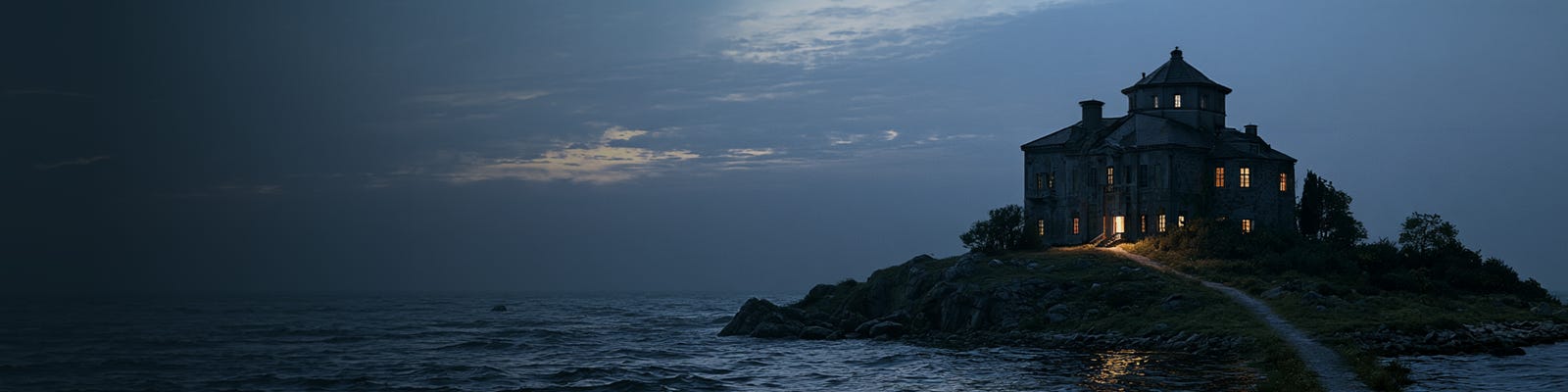
We have been dropped on a small uninhabited island. The island is a paradigm. That which is above sea level is the known. We may quickly discover what is within it, and therefore that with which we may work. The deep ocean is the radically uncertain. The shallows just below the waterline are the adjacent possible. We may explore these shallows using the tools available on the island, but while we can wade or dive there, what lies beneath is never fully visible until it is reached. At some distance from the shore, the shallows drop off precipitously, but it will take us some time to determine the location of that boundary and explore what lies within it.
The shape of the paradigm exposes and begets the shape and size of its adjacent possible. The tools in the paradigm permit the exploration of that adjacent possible. The shallows outside the island are the problems to be solved with these tools. We will explore the most accessible parts of the shallows first. When these are depleted, it may be possible to squeeze out a bit more from the adjacent possible, but the cost of doing so vastly exceeds whatever we may extract in value.
Once the shallows have been almost entirely explored, we will inevitably attempt to go beyond them. We will make naked excursions into the deep waters. What we will find there is nothing but the possibility of annihilation. It is too vast and too unforgiving to be metabolized into anything that can be brought back to land. Although the adjacent possible has been mostly exhausted, we will make the attempt regardless.
Each of us has an ego. Our ego tells us we are the center of reality. When it emerges for us as toddlers, it is a paradigm. It is the island from which we explore.
At first, the adjacent possible of the ego is unrealized. What might this child become? What could it see, know, assemble? What relationship may it have to the world? These questions are as yet unanswered. Its adjacent possible must be explored.
As years pass, the exploration proceeds apace and what lies in the shallows around the ego crystallizes. From toddlerhood until the preteen age, our ego becomes more than the locus of our conscious awareness. It precipitates who we are as individuals. But as its adjacent possible is increasingly exhausted, the ego begins to fray. It is no longer certain what it is becoming. Further complication arises in the form of other egos of which we accrue a mounting awareness. We are only dimly cognizant of what other egos want and progressively confused about what we want.
The apotheosis of this growing dysphoria is puberty. Sexual maturity inaugurates a new paradigm of social integration. Pubescence is the liminal interregnum between the regimes of the egoic and the social. It is a space filled with angst and horror at the loss of who we believe ourselves to be. As this shift approaches, the ego is torn asunder, losing its purchase on the safety of the family from which it sprang.
On the other side of the doorway of puberty lies the new paradigm. With it comes an obviation of the terrors previously faced. The ego is transcended. Yet the ego does not disappear. It is not lost. It is included. The budding teenager is now a member of a social group. This social situatedness is a new shape with a new adjacent possible. It is a new island from which to explore a new shallows. The ego is brought along for this transformation, recontextualized but fully intact, integrated.
The experience of inhabiting a paradigm as it approaches this kind of caesura is the vertigo of having swum past the edge of the shallows where the bottom makes a terrifying descent into infinity. Those having attempted such crossings return to the island changed. When not utterly disintegrated by ordeal, they see the island and its shallows differently. They have not escaped it because only a full transformation can accomplish this, yet they are no longer like everyone else. The remaining inhabitants behold these orphic voyagers as apostate, unmoored, frightening. Like a pre-pubescent child who has experienced more than their ego can metabolize, those transgressing against a dying paradigm are objects of awe, fear, disgust, pity.
Yet the origin of these figures is not beyond the paradigm. They are not alien to it. They are not interlopers. Their presence may portend paradigmatic death, but they are not its agents. They are wholly of the paradigm. They only exist because the shape of the paradigm inscribes the shape of the adjacent possible. It is from within the paradigm these wanderers make their Faustian bets.
As modernity reaches toward its end, it is fraying. With so little of its shallows left unexplored, it has given birth to voyages beyond itself. We seek to inure ourselves to the fetid thing lying beneath our world through our responses to those who have taken these voyages. Yet these voyagers are not what we wish them to be.
As the egregore of modernity quickened the tempo of collapse visions, the early 20th century would give birth to the most impassioned of these voyagers. Their arrival shaped what would grow into the greatest cultural conflict in centuries. This conflict continues to escalate to this day, consuming not only our attention, but the majority of what little energy remains in the modern paradigm.
The Frankfurt School
The earliest imaginings of the collapse of the paradigm were, ironically, hopeful. Marx hoped that through revolution, the world could be made both qualitatively and structurally better, more humane. In the ensuing decades, this failed to materialize. The world was not only no different, but proceeded to move toward catastrophe.
As if in response to impending doom, in February of 1923, at the University of Frankfurt, a cohort of German academics founded the Institute for Social Research. At first, the focus of the school was straightforward Marxist research. In 1930, one of its most prominent members, Max Horkheimer, took over its direction, moving the program toward an interdisciplinary social philosophy: philosophy, sociology, psychology, psychoanalysis, economics, culture, authority, family, mass society, fascism, and eventually, the critique of instrumental reason.
Perhaps the most famous member of the institute, Herbert Marcuse joined in 1933. His mentor, Martin Heidegger turned to Nazism, disillusioning Marcuse. He thus came to Frankfurt hoping to recover the hopefulness in Marxism he felt Heidegger had betrayed. In the institute, he saw the potential for a new kind of Marxian temperament that could revitalize the existential question of human being.
Having fled Nazi Germany to America, these thinkers—who would later come to be known as the Frankfurt School—founded their new posture on a critique of instrumental reason. They would tell us the rational had been reduced to a means by which to organize our enterprises. This was, they said, the primary failure of modernity because reason should also be the means by which we come to determine what is good and right.
While many significant academics were involved, the addition of Theodor Adorno in the late 1930s defined the Horkheimer, Adorno, Marcuse trio most often associated with the school. Over the next few decades, their efforts would catalyze a New Left that would have a profound impact in both Europe and America. The critical theory of the Frankfurt School redefined how the modern paradigm saw itself through a diagnosis that exposed conformity and oppression everywhere it turned its gaze.
The Frankfurt School luminaries swam out beyond the shallows. In the deep water they turned to view the island. When they returned, the perspective they brought was thought to be emancipatory. Through their vision, they proposed that we might escape the island altogether.
The Postmodernists
In May of 1968, the New Left inspired by the Frankfurt School attempted to foment a revolutionary transformation. Beginning in Paris, student rebellion spread across the modern world. It momentarily appeared as if the most ambitious self-critique of modernity might translate itself into successful political action. It did not.
The dust settled. The modern paradigm did not dissolve. Its institutions persisted. What remained for those with an interest in the critique was the question of why it failed to generate the liberation it had promised.
In the city wherein the insurrection originated, at the institutions that had nurtured its intellectual forebears, a group of thinkers would surpass the Frankfurt negation of the modern application of reason. They would attempt to negate reason itself, and with it, the one doing the reasoning, the language in which it occurs, and the power that determines whose reason counts. They would declare an exit from modernity.
Jean-François Lyotard would eventually give this interpretive posture a name. In The Postmodern Condition, he proposed that modernity had produced a necessary incredulity toward what he called metanarratives that attempt a total description of our world. This was not a skepticism of the individual claim per se, but a suspicion of claim as a form. The metanarrative that legitimated reason itself was, for Lyotard, one such dubious claim. We could no longer trust any grand story. Neither Marxism, liberalism, nor any other orienting frame could ground knowledge or endow liberty.
Michel Foucault ranged through the institutions of modernity—asylums, prisons, schools, factories, hospitals, families—making their operations visceral. He tells us these institutions only reveal what they are when we examine who they exclude, silence, or punish. Out in deep water, looking back at the island of the modern, he pronounced that knowledge was never neutral. It was always, he said, the instrument of power.
Jacques Derrida returned from colonial Algeria, bringing with him a vision of Western universalism seen from the outside. He took up this frame to expose that every philosophical claim is hiding something which can be revealed in its deconstruction. For Derrida, language is never signified. It never has a conceptual ground. Everything we say, the objects of our thought, even our very selves lack a final place of rest wherein we can see what we need to see so we can know what we need to know to provide a foundation for what we believe.
These three thinkers—and many others we might place within the postmodern milieu—felt they had utterly overturned modernity. They had dismantled, unmasked, subverted, and delegitimized it. Through their efforts, the paradigm had been brought to an end. The island had not only been left behind, it had been totally destroyed.
The Spectators
Over the last hundred years, many have made this voyage from the island of the modern out past the shallows. They’ve awed themselves at the rapture they felt in suspension above the yawning maw of the unknown. They’ve returned to the island—wild eyed and red faced—with proclamations about what lies beyond. They were something new, they said. They had beheld and could articulate the way forward.
Upon their return, those still on shore responded in two ways. Some believed. Yes, these strange voyagers represented salvation from the ills of modernity. The unrequited grievances against the paradigm would be finally avenged. Others looked on with horror. To them, the voyagers had arrived as aliens, bent upon liquifying all that had been hard won over centuries. These spectators did not see saviors, they saw pied pipers whose songs would lead to confusion and damnation.
What is invisible to all is that the spectating is taking place on the island. The spectators never left. Those spectated never truly left either, nor did they arrive from another island. Everyone involved is squarely on the island.
The orphic voyagers have no special dispensation from beyond. What can be solved from the island has been largely solved. The shallows of the adjacent possible have been comprehensively explored.
The Frankfurt School did not repair or escape the modern paradigm. Their efforts have metamorphosed into the very ministerial discipline function the paradigm now demands. In perhaps the most devastating example of this, the New Left student protests Marcuse birthed turned their ire on his colleague, Adorno, disrupting his lectures. They scrawled on the blackboard, “If Adorno is left in peace, capitalism will never cease.” One of the fathers of the critical theory that would eventually call for the abolition of the police called the police on the protesters. This is more tragic than mere hypocrisy. It is critical theory realizing it still required the coherence it had taught others to despise.
For an even more fundamental reason, the postmodernists were incapable of defection either. The deepest reason for this lies in the collapse of ontology into epistemology. None of these thinkers touched that substitution. Their entire project—unmasking power behind knowledge, exposing the construction of the subject, language deconstructed—lives within the domain of epistemology. They disputed the dispensation of knowledge, but they did not contend with what is. The closest any of them came was Derrida, who suggested presence is unavailable, leaving only trace. He proposed this as a reopening of ontology as hauntology. And yet, he never provided any affirmation of what this would mean other than endless deferral. Like the rest of his cohort, he could not move beyond the modern paradigm. The egregore metabolized and domesticated them.
As many analytic philosophers have pointed out, the postmodern attempt to depose reason was conducted using the tools of reason. This is the core “performative contradiction” so often used to discredit these voyagers, but it is the surface of a deeper concern. We cannot escape the paradigm by merely naming a different source of epistemic authority while its foundation remains unexamined.
It is instructive to note they could not even find agreement among themselves to affirm their programs. They all appeared to ground their efforts in a moral perfection modernity had failed to provide. But because there was so little left in the adjacent possible of the paradigm that had not already been put to use, they twisted themselves into an increasingly opaque, Rube Goldbergesque machinery in their attempt to accomplish this. Even within the tradition, the fractures were visible. Jürgen Habermas, the Frankfurt School’s second-generation director, charged from inside the same inheritance that postmodernism amounted to an arbitrary partisanship of a criticism that cannot account for its own normative foundations.
More ink has been spilled in service of this conflict than any other intellectual rift modernity has produced. Foucault is said to be the most cited scholar of the 20th century. Postmodernism and the critical theory of Frankfurt sit at the intersection of almost every contemporary cultural dispute. These ideas are seen as salvatory and satanic in profound and equal measure.
Yet the spectators who have organized their lives around these analyses are deluded. The delusion is placed there by the egregore. The modern paradigm is very old and infirm, but it is not yet dead. The gravity of this rupture is the last, most desperate effort of the paradigm to keep us collectively engaged with it. While we are in its thrall, we do not see it dissolving. This is the never-ending work of the egregore, that for every paradigm is always already there.

Where the Egregore Cannot Go
The shape of the paradigm and the influence of the egregore is not deterministic. As its inhabitants, we have choices. But like the island, we do not choose the paradigm itself. It emerges from what preceded it. We may be able to kill it, but because we are its inhabitants, the consequences for everyone would be dire, and the will to do so would have to be thoroughgoing. What we cannot do is hasten or delay its natural death.
What we can do is deftly navigate the departure and transcendence of the paradigm. To do this, we must understand what it is, what it wants, how it goes about getting it, and where its exits are situated. Most of us will fail in this. We will continue to see the dying of the paradigm as if it were an existential battle between a multiplicity of mutually antagonistic forces. We will not notice what has happened until it has happened, and even then, many of us will remain recalcitrant until well after the center of gravity has moved.
In such moments—when the institution has been most thoroughly emptied of purpose—is when leadership finds new purchase. What was once a focus on exploring the island and its shallows becomes for leaders the ability to hold open an aperture through which to imagine departure. Perhaps there is something better available elsewhere. Leadership has become performative precisely when it is most needed to become something else. Leadership at the end of the lifecycle of the paradigm is no longer evaluated by its ability to generate, its ability to manage fear, or its ability to reinforce discipline. At the end, leadership becomes the bravery to hear the few voices that see something beyond and hold open the possibility to depart for that something.
In what new cultural paradigm we will ultimately land is not yet generally imaginable. When we leave the island for good, we will not immediately see our destination. But what we can know is that we will undertake a transit. We will spend time crossing the ocean. Because the egregore is coterminous with the island, the ocean is a place where it cannot go.
The imaginal space of the ocean is transformation. It is where we leave behind what we once were and construct visions of futures in which we are something else. It is a liminal space. We are no longer inhabitants of the old island nor yet of the new one. The shape of what we have left behind has already conferred direction for our transit and scaffolds what we will build when we arrive at our destination.
The ocean is not another theory, or a rival program, or a purified politics. It does not make the island more honest. These are all its tools. The ocean is the field of possibility itself, within which every island sits. This realization makes departure from the island an even more frightful challenge. To do so is to recover the question we had when we first arrived on the island, a question that the island now regards as childish, mystical, meaningless. We must be able to ask what is real before our instruments have arrived to measure it. When we ask this without immediately translating it back into method, we will have begun to depart the island. Only then will we begin to feel as though the emptiness beyond the shallows may be the beginning of a new world.
The monster in the modern paradigm has also been our inspiration. What feels so abyssal now is its desperate maintenance of what remains of itself. This is not its whole story. The egregore, with all its insistence at its end, has been the story of us. It was born from us and lived through us. What dies is our requirement that it act as the primary means by which we make sense of our world. What does not die is its presence in our continuing development. The thing we mistook for reality was merely the island dreaming of itself.
The yawning logotype is yet alive in its brick chasm of rationality, shielding that which has animated it since science was young. Who knows its end? What has risen may sink, and what has sunk may rise.
If you’ve made it this far, you’re important to the efforts of The Subjunctive. Subscribe for free and make the world a little weirder.