Occluded Perfection

Follow into
Save into
Follow into
A Time for Mending
Can an author expose something beyond their intent? Might we notice such a thing without misattributing it to their intent? We often see this in conversation. An interlocutor replies, “I know that. Don’t you think I know that?” Perhaps they do know it. Yet possessing a proposition is not the same as having followed its implications. We may know something perfectly well within an unacknowledged settlement that makes it intelligible, and still remain ignorant of what it might mean otherwise.
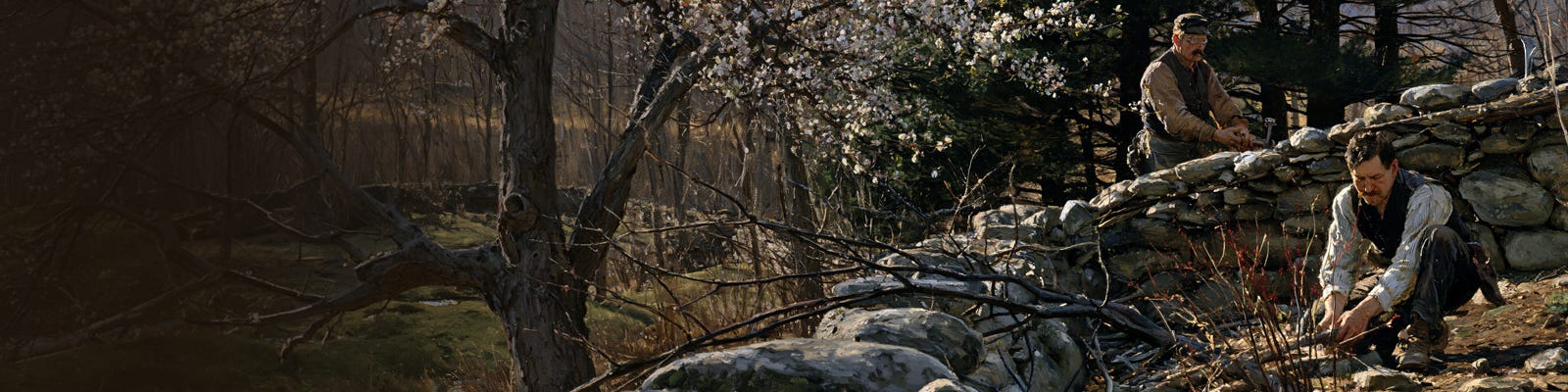
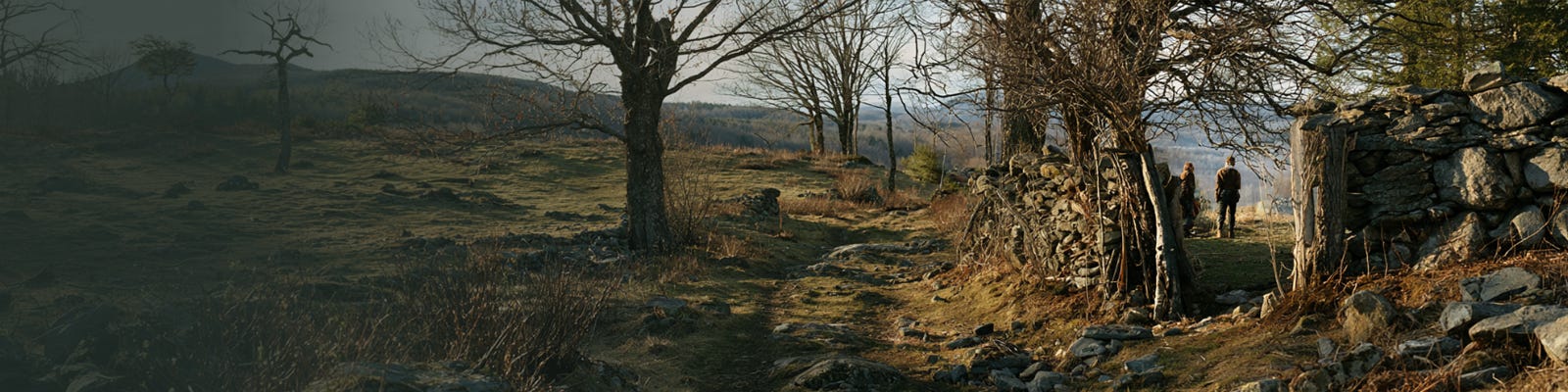
In his 1914 poem, Mending Wall, Robert Frost appears to have exposed just such a moment. The poem invokes themes of boundary, division, fellowship, separation, tradition, habit, nature, language. The narrator relates a vernal ritual he shares with his neighbor in early-twentieth-century New England. In this annual observance, the two come together and repair the old stone wall marking the boundary of their properties. Walking along, each to their side, they survey breaches and mend them with stones fallen from winter’s plunder and hunters’ disturbance.
You are reading The Subjunctive! It is said that to subscribe is sublime.
The narrator does not love the wall. He muses that some other unnamed influence does not love walls either. He cultivates apple trees; his neighbor, pines. He does not think these endeavors should come to the kind of conflict anticipated by such a wall. When the narrator raises this with his counterpart, he replies, “Good fences make good neighbors.” Despite this apparent disconnection, each spring it is the narrator who reminds his neighbor that the time for mending has arrived.
Most familiar readings distribute insight unevenly between the men. The wall is a cipher for division. The poem challenges the necessity of this. The neighbor’s aphorism demonstrates tradition, and one imagines it may have foretold Chesterton’s Fence. The narrator asks for something more reflective, wondering what he was, “walling in or walling out.”
Spring is mercurial, yet it occasions a yearly repair that restores an order neither man created. Some interpretations notice the wall also joins the men, offering a fellowship they might not have realized otherwise. The poem has even been treated as a proverb demonstrating how our thought and language act as a “wall” preventing us from looking behind it.
These explanations all treat the characters and their wall as the principal actors within the poem. And yet, something more deeply hidden may be disclosed. Something may be acting upon the characters, unseen by them and most readers. Whether Frost intended to uncover this shadowy influence—or the disposition that opens the actors to receive it—we may discover it nonetheless.
Two (or More) Sayings
The characters in Frost’s poem might be called protagonist and antagonist, but to do so feels inaccurate. Even after repeated readings, we are challenged to resolve either character as merely advancing or resisting the central conflict. Neither can we attribute such to the wall itself. The three are presented as inseparable correlates in the same movement.
This interdependence becomes more visible still when we hear what the actors have to say. The narrator gestures dramatically at “something there is that doesn’t love a wall.” He goes on to vividly imply the ‘something’ is nature. That something “sends the frozen-ground-swell” and “spills the upper boulders in the sun.” As if to say, it is not me who does this, he wants to ground his reticence regarding the wall in something beyond his will, something natural, something obvious.
The neighbor is meanwhile cast as a more stoic figure. We are led to imagine him a man of few words. Within this register, he speaks his singular maxim proclaiming the indivisibility of good fences and good neighbors. We can be certain of nothing else regarding his opinion on the matter. The only other indication we have of his posture is when the narrator tells us, “He will not go behind his father’s saying, and he likes having thought of it …” The neighbor, too, wants his insight to have originated from beyond him; from something more primordial. His father stands proxy for tradition, and behind it, what is naturally true and good about the world.
And what of the wall? What does it ‘say’? Beyond being simply present, the only indication we have of its will is when the narrator notes that it may only be propitiated by casting a spell to ensure each replaced stone will, “stay where you are until our backs are turned!” If the wall says anything—if it wants anything—it is perhaps only that it be seen as an object requiring continual attendance. So implicit and unquestionable is the necessity of this care that—as with the men—its demand is most readily understood as natural; obvious.
We might then give nature a voice. The characters within the poem all set forth to conjure it. What does nature say? Perhaps it says all things decay and must be renewed. Perhaps it is describing decay and renewal as a cycle. Perhaps it is telling us we are all part of a whole: interrelated, transcendent. Or perhaps it is saying nothing. Perhaps we ventriloquize it to provide a ready canvas upon which to paint our intuitions as obviousness.
And yet we might still call this nature, for it is human nature. There is a desire in each of us to find warrant for our intuitions beyond ourselves. More than hoping we might convince others, we wish to conscribe nature as the ground for what we apprehend. We want to believe not only that we see the world clearly, but that we do so by the commission of nature itself. We want what we perceive to be not merely correct, but on the authority of nature, obviously so.
More than a tic, this desire suggests itself as constitutive of human psychology. It manifests itself as reflexive and impulsive. We appear to want our sense of ourselves and our world grounded as obvious even before we have rendered that obviousness into explicit concepts. Conjecturally, we might imagine an evolutionary history for this impulse. An organism acting under conditions in which delay could prove costly might benefit from treating some perceptions as obviously authoritative rather than continually reopening them to doubt.
Philosopher and professor P. Kyle Stanford offers what appears to be an even more compelling explanation of this reflex. In The Difference Between Ice Cream and Nazis: Moral Externalization and the Evolution of Human Cooperation, Stanford proposes that we are motivated to externalize our moral assumptions as a more efficient means of assessing others as suitable partners for cooperation. One consequence might be that by ‘outsourcing’ moral responsibility to something beyond ourselves, we reduce the cognitive burden of negotiating among personal preferences.
Whether its evolutionary origin is temporal or cooperative efficiency, the presence of this reflex in our disposition is difficult to dispute. If we continue to inquire more searchingly, we may notice that no such coherent authority is forthcoming, or at least inasmuch as it exists, it wishes to be hidden. While nature tears down the wall, tradition impels a devotion to rebuild it. The wall itself refuses stability. The men nonetheless return. One does so to ensure they remain good neighbors, the other to call them to their work while still asking why they should be doing so. Each of the purported sources necessarily contradicts the others, and yet the ceremony persists. No matter how penetrating the objection, nor how profound the paradox, each available explanation within the story remains moored in the obvious.
If nature opposes the wall, tradition requires it, the wall is unable to maintain itself, and neither man quite owns the desire to repair it, what remains? What dark matter accounts for that remainder? What, exactly, is summoning them back to the wall?
The Container That Mends Itself
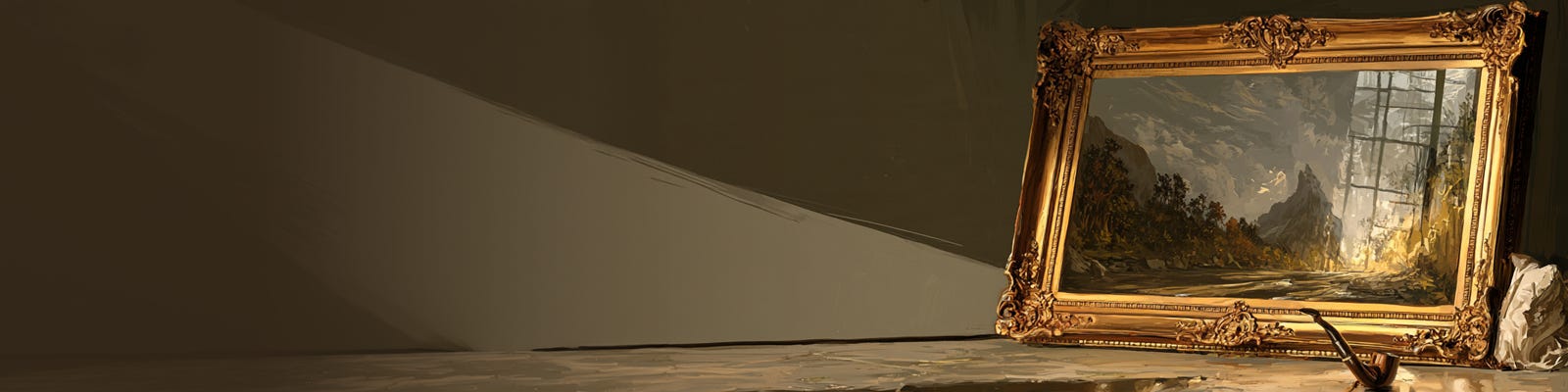
René Magritte’s The Treachery of Images lays bare something far more interesting than what appears in its easiest reading. Yes, it is a painting of a pipe, not an actual pipe. Meanwhile, the painting-that-is-not-a-pipe is exposing a container that almost everyone takes for granted. What is being taken for granted is the field within which the pipe appears at all. That field—that container, the painting itself—is not inert. It is a vehicle as potent as its virtual contents; as potent as their instantiations.
And so it is with the mending wall. The poem is a container. It has potency beyond its contents. It wishes to reveal what those contents are unable to elucidate on their own.
What does the container reveal? To ask this is to ask what Frost intended, but also perhaps what burden his intention bore, whether or not he was aware of it. We may fairly speculate that his intent was merely to expose the paradox. The actors contradict one another and yet they repeatedly reconstitute the same liturgy. But again, if we dare ask why this should be so, we might find something in the container itself. We might find what it is that creates the cohesion the poem—or the poet—will not unveil.
We have encountered the container elsewhere. It is the paradigm (see Paradigms and Egregores): a settlement that defines for its inhabitants a conception of themselves and their world. We have also previously encountered its agency, the egregore: the imaginal presence of the paradigm within which knowledge is made intelligible, birthed by the paradigm to manage that intelligibility.
The paradigm is the container that mends itself. The egregore is the agent tasked with that mending. What we see in ourselves when we bend our conceptions toward the unassailably obvious is what the egregore finds within us. It is the psychology the egregore commissions.
We have seen how the egregore manages the imaginal space for the inhabitants of a paradigm. The mending wall shows us how the egregore enlists the obviousness reflex within our cognitive disposition to accomplish that goal. We do not question the provenance of what appears obvious to us. The degree to which a cultural egregore has animated that obviousness is almost entirely obscured. It is how Oz is able to remain behind the curtain. It is why the pipe appears to be a pipe and yet not a pipe, and why we’re left wondering which part of the art was doing the containing all along.
The Mischief of Spring
Paradigms are nested. Each paradigm is contained by and contains other paradigms. At the cultural layer of this architecture, the dispensation of a paradigm permeates an enormous part of what people inhabiting it encounter. The egregore is the magician-at-arms for the paradigm, and when that paradigm is cultural, the egregore manages what is imagined in its social and civic domains. Like all egregores, it exists to maintain and perpetuate the paradigm that spawns it.
The egregore within the modern paradigm possesses outsized potency in shaping imagination through the claim that modernity is the paradigm to end all paradigms. More exactingly, it insists that there are no such things as paradigms. After the fashion of Whig history, modernity confidently recasts all previous paradigms as failed attempts at creating itself. Modernity was always the final destination; the end of history. Everything that preceded it was merely a blind grasping toward it.
Within the poem, spring is a recurring expression of this dynamic. Since the beginning of modernity, spring has appeared countless times as each revolution, revival, election, intellectual movement, media upheaval, generational rebellion, and technological disruption. Each is a passage from growth to collapse to discipline, and—with a brief transformational interregnum—a renewal of the cycle. Each spring creates a locally authentic novelty while nonetheless aligning with every other spring to renew the modern paradigm that contains it.
What these local springs do not do is expose a successor to the modern. Instead, they serve the perpetuation of it. All paradigms domesticate the change that occurs within them. They absorb change as renewal. Modernity merely compounds this basic function by demanding that no such change will ever escape it. All paradigms make the same attempt, but modernity is especially adroit in its rhetorical dexterity. Every modern novelty carries the connotative implication of obviousness. Of course that happened. It could not have been otherwise. An account has already been made.
The poem recapitulates this. The men challenge one another with their conceptions of the wall. They challenge their own misgivings by their annual return to the ritual. The wall challenges both the men and their conceptions by remaining stubbornly unstable. Nature challenges all three by its caprice and moral ambiguity. We readers are invited to notice each challenge as its own death and renewal, an eternal return in miniature wherein change is locally authentic but paradigmatically impotent. The narrator asks why this should be so, but provides no answer that would permit escape. We are given no obvious means to challenge the poem itself, and no indication that doing so was within the intent of the poet.
The modern allows us to continually reimagine Magritte’s pipe-that-is-not-a-pipe. It is now a representation, now a signifier signified only by its relation to all other signifiers, now a social construction of patriarchy, now an artifact of colonialism and white supremacy, now a problematized expression of intersectional oppression. What modernity forecloses is an understanding of the painting as a potent ontological field that authorizes our ability to render the pipe intelligible at all.
We believe we have traveled some great distance, and yet when we look around, we discover we have merely circled the point from which we started. Modernity presents itself as a passage over the abyss and toward progress. What we find in it instead is a cul-de-sac that imagined itself a bridge.
Good Neighbors
Novelist and filmmaker Michael Crichton, in a 2003 speech to the Commonwealth Club of San Francisco, said the following:
“I studied anthropology in college, and one of the things I learned was that certain human social structures always reappear. They can’t be eliminated from society. One of those structures is religion. Today it is said we live in a secular society in which many people—the best people, the most enlightened people—do not believe in any religion. But I think that you cannot eliminate religion from the psyche of mankind. If you suppress it in one form, it merely re-emerges in another form. You can not believe in God, but you still have to believe in something that gives meaning to your life, and shapes your sense of the world. Such a belief is religious.”
— Michael Crichton, Remarks to the Commonwealth Club, 2003
When Crichton argues that “social structures always reappear,” he also implicates psychological structures. The obviousness reflex—the desire to find warrant for our assumptions in an authority outside ourselves so as to render them obvious—appears to be one such structure. As we have traversed cultural paradigms and the shifts between them over our history, we have repeatedly found an obvious authorization within whichever of those paradigms we inhabited. If you lived in Christian Europe during the 13th century, it was plainly obvious that the Latin Church was the privileged vessel for access to the divine. Once translations of the Aristotelian corpus began flooding into Latin Europe in the 12th and 13th centuries, the Medieval paradigm soon sought a means by which to metabolize it as an obvious kind of Catholic metaphysics. Aristotle provided the novelty, and Aquinas provided the warrant of obvious authority.
This reflex is doing more work than its surface appearance suggests. The warrant of obvious authority appears to tell us what is true. If it is especially forthcoming, it will appear as what is provisionally true. What is hidden—occluded—from this disclosure is a proposition regarding that which was always trying to become true. What we call obvious leads us to believe that if only we preserve and complete it, all contradictions will resolve or be rendered irrelevant.
More directly, when confronted with new knowledge we cannot easily metabolize, we justify it by some obvious authority outside ourselves. In turn, this leads us to an unstated presumption that all such knowledge can be metabolized in this way. We have seduced ourselves into the conviction that we are on the path to total intelligibility.
In modernity, this unstated presumption becomes distinctive in both allure and concealment. The catechism of the modern paradigm explicitly proclaims epistemic humility. Science is self-correcting! We must maintain our skepticism! Our impulse to requisition the obvious—when we look closely—belies a soteriological desire. We want salvation from contradiction. Modernity offers a particular brand of this salvation. Believe the science! The promise that is occluded is a perfection the paradigm dares not explicitly endorse. Instead it deftly and superciliously implies it. Fealty to the paradigm will eventually cash itself out, and that deferred accounting is the salvation that cannot call itself perfection.
The neighbors’ goodness owes nothing to this implied perfection. The annual cycle conceals that no such perfection shall arrive. The wall will never become permanent. No neighborly concord shall ever make the wall unnecessary. That imperfection is what generates the real relation. The men return to the wall—and to one another—precisely because the wall fails to cash out.
What Everybody Knows
The egregore manages imaginal space in stages across the lifecycle of its paradigm. To begin, the future is imagined as growth. As the paradigm reaches middle age, it ordains futures of collapse. In senescence, its imagination is one of discipline. This governance is not merely imposed by brute force. The egregore administers the imaginal through our impulse toward the obvious. It exploits this reflex in order to perform its function. What the egregore orchestrates in imagination appears phenomenologically to its inhabitants as a progression of social configurations.
When the paradigm is new and the imaginal space is framed by growth, the vast majority of its possibility is still unexplored and therefore unrealized. The social presentation of this dynamic is aristocratic. Very few people are able to move quickly enough to begin exploring and applying the potential of a new paradigm. This aristocratic social frame becomes what feels obvious to those living at the beginning of a paradigm’s lifecycle. Because growth is so euphoric and what it produces is so compelling, those not among the elites that engage first are nonetheless moved by the propriety—the obviousness—of the new aristocracy.
As the paradigm ages further and reaches the apogee of its generativity, the imaginal space ceases to support those who first explored it. The phenomenology of this phase is socially demotic. No longer merely the domain of rarefied aristocrats, the paradigm and its tools are now available to all, affect everyone, and are no longer seen as belonging to anyone. The obvious has migrated. No longer the property of the aristocracy, it is now available to all.
Subsequently, the imaginal space shifts toward collapse. There appears to be little more the paradigm can produce, and the future begins to present as loss. Democratization renders images of collapse as a legible threat to our collective bequest. The threat is made productive by protecting what is obviously a shared heritage the paradigm has provided its inhabitants. Collapse may be imminent and the only antidote is that we work together for the good of all!
When the paradigm passes into senescence and its costs have come to outweigh its generativity, its egregore has in turn come to shape its imaginal space as discipline. Neither aristocracy nor demos is sufficient to overcome the imposing cost structure of the aging paradigm. The egregore therefore insists. The social presentation of this final phase appears to its denizens as hieratic. What is obvious in a senescent paradigm is no longer easy to experience spontaneously. At the beginning we accepted that there were some few able to do what we could not. Eventually, we realized we could know what everyone knows. In a senescent paradigm, we come to know what everyone is required to know. What was once self-evident now requires interpretation, rituals, credentials, catechesis. We experience the imagination of discipline as an obvious social demand for a priesthood.
Thus, the field exposed by the examined works of Frost and Magritte is an accrual of nostalgia that emerges in every paradigm as it ages. We inherit the residue of a paradigmatic memory of the aristocratic and demotic, even as we act within the final preeminence of the hieratic. Our collective nostalgia informs the dissolution of coherence that typifies a sclerotic paradigm. What of the aristocrats of growth that offered such promising futures? What of the once powerful sense of our collective demotic purpose? In the senescence of a paradigm, these lingering memories challenge the cohesion that formerly appeared effortless. We still recall the obviousness of the paradigm’s promise even when that promise is only maintained through a priestly class making increasingly convoluted demands.
Occluded Accounting
The time is late for the modern paradigm, and the sediment of what was previously obvious within it grows ever more visible. Priestly discipline can hold the center for only so long, and as it loses the ability to do so, what the egregore has been holding back becomes more difficult to contain. Despite its protests to the contrary, modernity is not immune to the unfolding of this process.
The memory of modernity’s initial aristocratic growth is not gone. Oxbridge, the Ivies, the Great Books. These remain. The names of Descartes, Locke, Hobbes, Hume, Bacon, Newton do not yet require archeology to recover. Just barely, our culture still occasionally surfaces the canon, the gentleman scholar, the philosopher’s pursuit of truth beyond fashion, and the expectation that liberal education entails encounters with minds greater than our own carrying the promise we might thereby exceed ourselves.
In fact, the persistence of nostalgia for an obvious aristocracy now appears to be far more visible than any authority it might still possess. It has been captured in a reliquary. We have portraits of founders, named chairs, Nobel laureates, Rhodes Scholars. Commencement addresses may still quote Einstein. We might still register the status of physicists, philosophers, mathematicians, classicists and others demonstrating that disposition.
Within the imaginal space of discipline, however, the authority of modernist aristocracy has been ploughed under. In private, we may allow ourselves to believe in the visionary promise of gifted eccentrics that freely inquire into our deepest concerns, and yet such figures are now required to prostrate themselves before grant submissions, ethics protocols, assessment rubrics, DEI statements, learning objectives, citation metrics, and committee review. A romantic memory of modern aristocracy may remain, but its institutional standing has been made subservient to the exigencies of hieratic discipline.
Before modernity, the medieval paradigm had its own aristocracy: austere and hereditary. At the end of the medieval paradigm, the literal priesthood of the church had become the privileged interpreter of ultimate purpose. The incoming modern aristocracy set about to dissolve that priesthood. Once accomplished, the energy released by the effort had been dissipated. A modern settlement had been reached, but now lay vulnerable. It exposed the fear that the new boss is the same as the old boss.
The egregore requisitioned this fear. This modern liberal model could collapse on itself just as the medieval model had. The new settlement must be by and for everyone.
Yet now the wheel had turned. While it is more recent within the memory of our paradigm, the obvious necessity of a demotic response to post-aristocratic imaginal collapse has also been transmuted into a nostalgic vestige. The phenomenology of this nostalgia is horizontal and intimate. It whispers to us that we used to understand one another.
The early aristocracy of the modern is perhaps better remembered than the voices of its demotic middle age. One might invoke Bentham, Mill, Peirce, Dewey, but these are unlikely to stir as much nostalgia as someone like Newton. This insight is instructive. The demotic middle age of the modern paradigm is memorable precisely because it does not have an aristocracy. In its place was generated an ethos of common sense, ordinary judgment, or merely what works for you.
Again, we may visit Mill and how he felt individual judgment—exercised broadly through liberty, and constrained by the prevention of harm—was indispensable to social flourishing. We may invoke Bentham and his conception of utility, in which the welfare of each individual is to be treated on equal terms. We may consider the significant influence of Dewey who advocated for collective inquiry, education, democracy, and practical problem-solving. In any of these cases, what matters most is that the obvious authority for understanding the world is located in ordinary people rather than an inherited elite or priestly class.
There is one thinker of the time who did perhaps more than anyone to instrumentalize the obviously demotic. William James not only embraced the centrality of ordinary people in his philosophy; he demanded procedural access to the fruits of modernity by assessing their cash value. James’s ideas were epistemically anti-aristocratic, suspicious of what is true in a grand sense, and favoring a conception of truth that allows one to move, predict, and hold one’s life together. This is not simple relativism (what is true is what is local and convenient to me) so much as an intersection between what is and what I can do.
Despite his disposition toward psychology, one can easily imagine James a tradesman or engineer, locating why anything matters inside the question of what can be done. Should we wish to inquire why something matters, or why the cosmos should be constructed such that anything matters, or even why it should be that things can be done at all, James would likely roll his eyes. From within his pragmatist disposition, such inquiry can begin to look like aristocratic excess. It can appear as a kind of self-aggrandizement that is unable to be cashed out in practical consequence.
Thinker and author Dave Gray has illustrated James’s posture eloquently using the analogy of a man searching for his keys at night. The man may search under the light of a streetlamp, or outside of it. Dave explains that it is better for him to look within the light, because that’s where he’s able to see anything. The practical value of looking outside the light is limited because there the man cannot see anything.
Ultimately, the keys are incidental. Dave does not completely foreclose the potential value of searching for the keys in the dark, particularly if we know the keys exist and they don’t appear to have been mislaid inside the light. Neither Dave nor James needs to deny this. Outside the light may lie things about which we know nothing. We may not even be able to imagine these things. While pragmatism accepts this unknown, it offers no ontological authorization to fund the search for an object we have not yet identified. How can we attach cash value to something before we know what it is?
Before something exists in our experience—before it can be pragmatically utilized—how can it come to be? James begins his effort too late in the process to inform this inquiry. His commitment to the demotic quickly becomes self-justification. Once that posture has been adopted, the obviousness reflex marks it as beyond the necessity of further curiosity. To ask why something new can or should emerge has no cash value and therefore need not be asked at all. We are left with no account of why possibility should exist.
James rejects determinism. He’s pluralistic. He argues that we sometimes commit when evidence cannot settle a matter in advance and we must therefore occasionally act without certainty. He even resists the idea that reality is already eternally complete. What he doesn’t do is supply any account of why there can be a “not yet” at all. Is this function animated by God? Luck? Magic? James—like the modern paradigm he wishes to democratize—treats possibility as downstream of experience. Even when he admits an unfinished universe, his pragmatism brackets everything prior to our experience with it. To him, possibility is only useful as epiphenomenon.
James takes “I know that. Don’t you think I know that?” and compresses it into cash value. He doesn’t ignore possibility. He isn’t actively eliding the role of the unknown. Instead, he’s created a posture in which following those propositions far enough to ask how reality permits possibility is a question not worth asking. His gambit is a deflation. It refuses to answer questions we might want to ask by demanding they weren’t questions that had earned their keep. Rather than answer these questions, pragmatism supplies a reason not to ask them at all.
By contrast, the imaginal space of discipline abandons the earlier foundations of the obvious. What it cannot abandon, it recontextualizes. Superficially, discipline appears as a social chiasmus: a return of the aristocratic. This is an illusion. Hierophants are not aristocrats. However, the modern paradigm gives the illusion special potency.
The hieratic as an imagination of discipline in modernity is constructed alongside a rhetorical demand that the paradigm has long since eliminated any priesthood. The liturgy of senescent modern discipline is shrouded in secularity. It is a creed with no catechism. It is a clerisy with no clerics. Or at least, this is what it would have us take as obvious. Rather than aristocratic revival, the new priesthood shows up as a class authorized to tell everyone what they are required to see as obvious.
What is Michel Foucault if not the hidden pope: prisonnier du Vatican moderne? The Curia might include Judith Butler, Edward Said, Gayatri Chakravorty Spivak. The Signatura could be led by Derrick Bell and Kimberlé Crenshaw. The popular priesthood could be composed of figures such as Brené Brown, Carol Gilligan, et al.
No longer are we the beneficiaries of a nomos granted by those able to disclose the wonder within a new paradigm. No longer are we participants in a demos enlisted to maintain the wonder we had already discovered. We are now sinners in the hands of an angry God whose hierophants will demand obeisance without exemption or repose.
The impetus for this false chiasmus is the need for someone to tell us what everyone knows. While it might be tempting to see the priesthood as a subversive force, it exists because neither the aristocracy nor the demos are now able to carry the promise of the paradigm. The obviousness reflex is reciprocal. The egregore exploits it to provide a basis for cooperation while it extracts fealty. That basis for cooperation is not immortal. It can and does senesce. It becomes progressively less able to provide cooperative warrant without increasingly costly commitment.
Yet those whose fealty remains with previous stages of obviousness are still present. To them, the hieratic appears as alien. To inhabitants who remember the aristocratic or the demotic, this final phase of the paradigm’s lifecycle presents as a kind of virus, intending to destroy the paradigm and lacking the jurisdiction for doing so.
They are not without justification in feeling as they do. To the memory of the aristocratic, the hieratic appears as a usurpation of the prerogative to instantiate and disclose what was once a wholly new paradigm. To the memory of the demotic, the hieratic appears as a novel tyranny, draping itself in the mantle of liberation for those from whom it ironically expects obeisance.
Thus, the citizens of the same paradigm have come to imagine one another as grave threats to that paradigm (see The Same Church). This yields a bizarre state in which the exposure of this commonality is treated as more offensive than hating our paradigmatic conspecifics for embodying the paradigm we also inhabit and share. Tell a centrist neoliberal they share a paradigm with a Christian nationalist and watch them bristle. Classical liberals and Marxians. Zionists and critical theorists. Pragmatists and postmodernists. We remember different social presentations of obviousness within the imaginal offering of the egregore, and yet we will smugly, glibly, even sometimes hostilely reject any recognition that we share the same container.
This is the cul-de-sac. The egregore within modernity issues us a salvation IOU that is sufficient to occupy our sense of what is obvious. Yet this credit is irredeemable. If previous paradigms offer any evidence, we receive the intelligibility afforded by this transaction, but salvation cannot be cashed out in the final accounting.
In Mending Wall, what is obvious to the narrator, his neighbor, and the wall finds its heretofore hidden source in the container inscribing them. The poem is the paradigm. The ministration of the poem is the egregore. While we receive something in return, the tribute for the externalization of our moral cognition is paid to the egregore that preserves the paradigm within which we operate.
Something There Is
Frost’s characters annually return to the wall. The summons is unmistakably obvious, not only to us, the readers, but to the men themselves. What their return does not do is repair the wall with sufficient finality to end the ritual. The compulsion to the ritual cannot be reduced to cash value. To attempt such vulgarizes the effort.
Without doubt, each repair of the wall reveals a quantifiable and practical utility. What it fails to do is provide sufficient warrant for why anyone should care about it to begin. Nor does it license the hope that we might understand how doing so makes possible the discovery of still new ways of imagining the wall. Possibility is at best an afterthought when we locate all meaning inside pragma, or worse, dogma.
The compulsion to action—wonderment, exploration, adventure—is a product of an unrequited remainder that previous action could not exhaust. This is why the wall will never be complete. This is why the removal of walls does not offer a panacea for this foreclosure. This is why nature is insufficient to the provision of an absolute warrant for our pursuits. No amount of fidelity will ever discover the end of our intentions.
A cultural paradigm does not transcend this inscription. Our cultural pretenses can never add up to a final solution. We desperately long for such a realization, so much so that we twist ourselves into prescriptions and certitudes that sometimes generate nearly unimaginable horrors. But these efforts will not ever bring us to an end. There will be no salvation. The task will never be completed.
The men—the inhabitants of the poem—return to their place within the field they inhabit because it is what is obviously available to them. We may imagine them leaders, but their leadership is merely the ongoing renewal of the constraints that define them and within which their action is permitted. This kind of leadership truly does have cash value. It is the value of the renewal. It is the value of the maintenance of the settlement we all inhabit. It is the value of preserving a stability that, while provisional, remains useful. It is the value of that which will demand its preservation for as long as it can.
Yet what is possible will always have its due. The value of what might be is irreducible. It is latent within the remainder of what we’ve outsourced to a certainty we can’t claim within ourselves. It is what cannot be exhausted by any paradigm. Leadership—especially as confidence in its provisional settlement grows less stable—is ultimately measured by a metric with no measure: a metric that is not a metric. This transcendent kind of leadership is always present even when it is not obviously visible. Its purpose is to hold open an aperture in which what is possible—however feeble and uncertain it may appear—can ultimately overcome the seductive allure of what is only presently obvious.
Maybe you just scrolled down here. Maybe you read this whole piece. Either way, please subscribe to The Subjunctive, because doing so marks you as elite human capital.