The Same Church

Follow into
Save into
Follow into
Introit
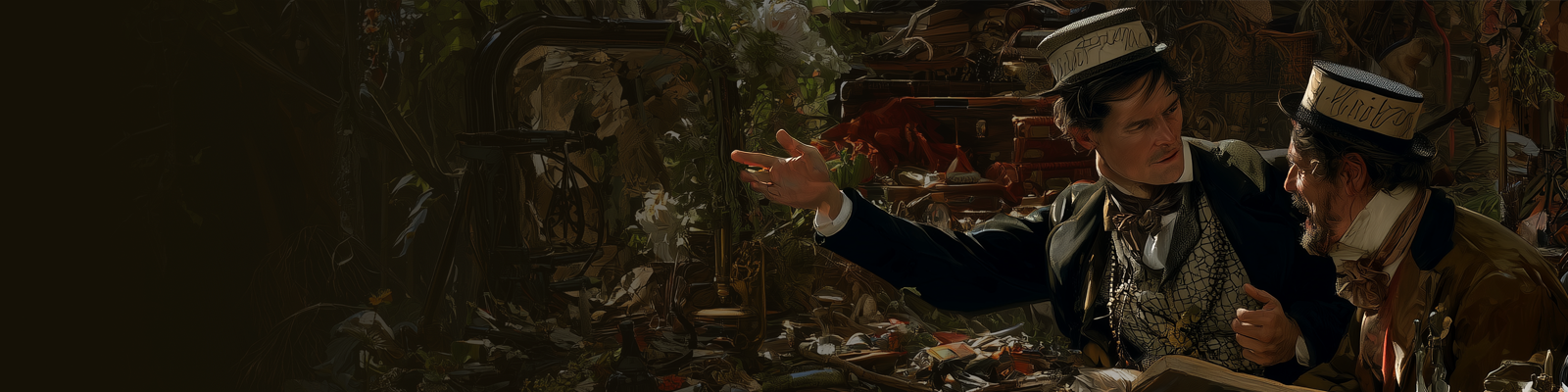
In his novel, Bouvard et Pécuchet, Gustave Flaubert describes the intellectual that modernity is most likely to produce and least likely to truly ennoble. Early in the work, one of its two main characters, François Denys Bartholomée Bouvard receives a bequest from his father permitting a passive income of—as Bouvard dazedly repeats to himself—’fifteen thousand livres!’ This would amount to hundreds of thousands per year in today’s dollars. He has recently befriended Juste Romain Cyrille Pécuchet, with whom he found common cause by virtue of the two having each written their names inside their hats. Finding their vocations as copyists intolerable, together they resolve to retire to the countryside and become intellectual flaneurs.
Having purchased a property containing a farm, they begin to undertake agriculture. Failing this, they find themselves enamored of horticulture and arboriculture. Upon alienating their neighbors and after a fire on their estate presumed to be arson, they move on to chemistry, followed by anatomy and then medicine. After being reproached by a credentialed physician they make attempts at antiquarianism, history, literature, politics, love affairs, occultism, philosophy, and pedagogy. Each endeavor ends in ignominy, the reduction of their wealth, and an increase in ressentiment. Religion is perhaps their most revealing episode, wherein they vacillate between devotion and doubt, never suspecting these are the same posture.
Thanks for reading The Subjunctive! By subscribing, you help me to feel I’m not shouting into the abyss. It’s a delusion, yes, but don’t we all need a bit of delusion?
In the end, they are forced to return to their mundane roles as copy clerks. From nothing to nothing. A tragic farce.
While Flaubert imagined this his greatest work, it has been found wanting by many critics. It deserves greater regard, yet we might see why it is not granted this honor. As a parody of the bourgeois of middle-19th-century France, the story landed, perhaps, too close to home.
Even now the work is not afforded consideration as the product of one of the greatest novelists to have ever lived. And for the same reason. The self-styled intelligentsia of today—whether readers of The Atlantic or Jacobin or Quillette or First Things—will find themselves unnerved by having been foreseen almost 200 years prior. Those who believe themselves charged with the task of explaining the world to the rest of us generate the same foibles as Bouvard and Pécuchet and remain just as blind to their own condition.
These two bungling protagonists reflect the bricoleur certainty and superficiality of the just above-average intellects of the last few centuries at least. Always ready to pronounce from the rostrum of their fashionable but incomplete knowledge, these dilettantes are constitutive of the vast majority of the elites that do not govern. They are the objects of both awe and derision for their hauteur. Epistemic dandies, they dress themselves in ideas whose provenance they cannot name.
We will not find it difficult to see why such a novel would be ill-received by those most likely to read it. Their living heirs will be no less likely to take offense here. This is their requiem.

Kyrie
Anaximander was a 6th century BC Greek philosopher listed among those preceding Socrates. He succeeded his teacher, Thales—with whom philosophy is said to have begun—as the leading thinker in what is known as the Milesian school. According to Bertrand Russell, he was much more interesting than his master.
The unique obsession of the Milesians was the search for an impersonal first principle—an archē (ἀρχή)—from which the creation of the cosmos would be explained as philosophy without recourse to mythic narrative. They wanted to define what it is that constitutes reality such that we should encounter it as we do. They wanted to accomplish this without merely collapsing the challenge into an intention of the gods.
While he did not invoke the term archē, Thales is known for having claimed that everything is composed of water. Through a modern frame, we might easily dismiss such conjecture as infantile. How could everything be composed of water?
So much the worse for our modern chauvinism because it renders invisible the brilliance of Thales. Our experience of reality gestures at the unbounded. For early Greek thinkers, water expressed this concept. Water conforms to the shape of that which contains it. It makes no insistence that it has any edges. It was the only substance they had witnessed as taking on all three phases of matter. Oceans appeared—at least in experience—to be boundless.
Witnessing his master declare the primacy of water, Anaximander sought to distill the declaration’s intent. All particular things, he said, spring from a single primal substance known as the apeiron (ἄπειρον). This word, apeiron, literally means boundless. It combines the prefix a- (not) with the root peirar/peras meaning “limit, boundary, end.” Not only does our presentism permit us to scoff at Thales, it also obscures the profundity in how his student had transformed his insight.
In the only surviving fragment of his writing expressed as a complete sentence, Anaximander said of the apeiron,
“Into that from which things take their rise they pass away once more, as is ordained, for they make reparation and satisfaction to one another for their injustice according to the ordering of time.”
Rather than—as the doxographers would have us believe—correcting Thales, Anaximander literalized that which his master had only symbolically identified in water. He saw the boundlessness Thales was signaling and reified it, and in doing so, he moralized it.
Anaximander is providing us an indictment of life. He is accusing the particular of having stolen something from the apeiron in order to be. After all, the apeiron is that without boundary. Being is limited, bounded, less than. He is telling us life is criminal, guilty. The penalty it pays for its guilt is death.
Christianity would eventually radicalize this still further. More than guilty, it would demand that life is complicit and responsible. It would tell us life must be negated to be redeemed.
In spite of its commitment to having emancipated us from this guilt, the modern paradigm is also deeply invested in the same narrative. As we shall see, it does not want its investment to be known. It merely wants the apeiron to persist in our imagination and to maintain the sense that life is criminal. After all, little else generates a more profound stake in the reigning cultural paradigm than a moral certitude.

Dies Iræ
In positing the apeiron, Anaximander gave life to a pattern whose recurrence would become a powerful cascade reverberating through history, appropriating almost everything it would encounter. While its costume varies, the apeiron is visible everywhere and everywhen across the development of Western thought (and beyond). It answers to the deep human needs for both ineffable perfection and someone—even existence itself—to blame for our suffering.
The example of Christianity is apparent. For it, the apeiron is reimagined as God himself. The injury imparted by being is done to God. Set against the more colloquial understanding as an act committed—forbidden fruit, nakedness, sexual congress—the crime of existence is a more exacting definition of Original Sin.
While it possesses no doctrine of Original Sin, Judaism also tells us being is not its own. For Judaism, life is received, commanded, indebted, judged, and answerable. It tells us creation is both command and covenant. The apeiron is represented by God, and as such, the finitude of being incurs an obligation. While Judaism avers that the source of creation is good, it explains that evil enters through disobedience, violence, idolatry. Being habitually fails at maintaining the covenant. Life is not born without the need for law, priestly interpretation, divine judgment, and the moralization of suffering. While it does not judge life guilty by mere existence, Judaism still demands it pay reparation to the apeiron through covenantal obedience.
But what of modernity? We are given to assume modern thought has emancipated us from such metaphysical nonsense. We are secular creatures. Surely, we owe nothing to anyone or anything but ourselves, our communities, our humanity.
Yet despite liberatory claims to the contrary, the apeiron has not been vanquished by the secular. It remains a coherent force within the modern paradigm. Debt and return may have been given new vestments, but their demands are still felt.
Perhaps nowhere is the persistence of the apeiron more readily visible than in the thought of Karl Marx and its progeny. While the common and superficial conception of Marx is to see him as something like, “the father of communism,” a more complete understanding of him reveals a diagnosis of the modern paradigm. The inhabitants of the paradigm, to him, suffer alienation from their purpose and the product of that purpose. Marx tells us everyone in modernity—not just the proletariat—is estranged from their own humanity.
For all Marxian thought, therefore—from Marx himself right down through Thomas Piketty—the apeiron is represented as that from which we have been alienated. Only by returning to it, we are told, will we redeem our humanity; will we redeem life itself. This evaluation is moral. It speaks clearly and unflinchingly to justice.
This is the modern secular left. It is one of the most lucid expressions of the liberation promised by the modern paradigm. Whether by Marxism, syndicalism, socialism, anarchism, critical theory, or any other of its legion of variants, the modern left seeks freedom from oppression, tyranny, alienation. What it has not done is to liberate us from the apeiron.
However, modern secularity does not live only on the left. Classical liberalism, libertarianism, neoliberalism: these are among the names given to the host of variants comprising the modern secular right. It, too, expresses an emancipatory intent. Unfettered by the arbitrary fiat of primogeniture or ossified regulatory regimes, the secular right promises we might realize our greatest potentials.
Through figures such as Ludwig von Mises, Ayn Rand, and Robert Nozick, we are promised the felicity of a radically individualized liberty. They tell us our liberty is secured through an understanding of concepts such as natural rights, the non-aggression principle, or the Lockean state of nature. Principled and austere, this incarnation of secular modernity pursues the same liberatory promise as the left, but differing in its contention that the tyranny it opposes lies in the state rather than capital.
And yet, the apeiron remains. For the secular right, it appears as the idealized structure in which the radically liberated individual perdures untrammeled. We stand collectively blamed for having relinquished this ideal in favor of communal kumbaya, easy wealth, tribal imperium, hermeneutic dereliction. To atone for our guilt, we must return to whatever configuration was supposed to have proved most apposite to our freedom. While we might liberate the individual from the state, we will not liberate it from the apeiron.
The intellectual camps that compose modern thought all maintain the moral grammar of the apeiron. None escape its influence. We hold ourselves to its strictures. We demand it be propitiated. That they should converge thus demands some account.

Recordare
No diagnosis of the modern paradigm is more perspicacious than that of Friedrich Nietzsche. In his On the Genealogy of Morals, he explicates the history of our moral commitments. He famously offers a kind of parable of two rival groups—priests and warriors—and their competition for social dominion. The warriors have the better of it and the priests are left to determine their next move from a position of weakness. They experience ressentiment, and choose to transvaluate the values of the warrior group that has ascended to power.
What does this mean? Nietzsche uses the word ressentiment, uncommon to 19th century German but quite at home in classical French, especially of the 17th century. Generally, ressentiment is understood as something like the memory of an injury and a renewed sensation of the pain entailed in that injury. In choosing this uniquely French word, Nietzsche is doing something beyond poetic filigree. More than merely remembrance of injury, Nietzsche is signifying something more acute: ressentiment is what happens when the injured party cannot discharge their frustration outwardly as action. He intends to indicate a sense of impotence. In a passage from First Essay, §10, he says,
“The revolt of the slaves in morals begins in the very principle of [ressentiment] becoming creative and giving birth to values—a [ressentiment] experienced by creatures who, deprived as they are of the proper outlet of action, are forced to find their compensation in an imaginary revenge.”
But what of the transvaluation of values? Nietzsche tells us this is an inversion. The priests, experiencing ressentiment, ultimately chose to recast the values of the warriors such that what they find good is, in fact, evil. To ease their suffering, the weaker party locates their imaginary revenge in overturning what is held dear by those they believe to have delivered their injury.
If we imagine this revenge as literal, there is a prudential contradiction we must face. To begin, the strong have no reason to adopt the inversion. They are free to merely disregard it. Moreover, by inverting the moral conceptions of the strong, should they succeed, the weak expose themselves to the same moral claims. Direct revenge against the strong through transvaluation is therefore precluded.
We may alternatively propose the weak are defining a competing ethos within which they might consider themselves superior. On this account, we are led to believe the strong should find themselves wanting in their rectitude by comparison. However, as before, the strong would be free to dismiss such concerns. Even more troubling, the weak would be compelled to believe their own ethical pronouncements. This would entail a proscription against the impulse to vengeance and thus they would incur guilt at having pursued it. Why this guilt would be an acceptable replacement for the frustration felt over the initial injury is left unclear.
More accurately, ressentiment and transvaluation serve to ameliorate the impotence of the weak. Their agency—their will to bend the world to their vision—has been thwarted. This is the locus of the injury. It is also why the revenge sought can be only imaginary. When the weak transvalue the values of the strong, they manufacture the sensation of having acted when they have not.
Yet, what if suffering is not delivered by the hand of the strong? What if it is delivered by life itself? What if our world—our institutions, our polities, our collective citizenry—is what we believe is failing us? These questions have become the foreground in our senescent cultural paradigm. We see everything as compromised, corrupt, guilty. The party responsible for our injury is the undifferentiated, boundless whole of our experience.
This is our appeal to the apeiron. We do not come upon our suffering by merit of some corporeal antagonist, even as we wish for such a scapegoat. The offending party is life, existence, ourselves. The apeiron is the tribunal. Life stands accused. Ressentiment turns the distance between them into a prosecution.
Life itself—and all that it begets in modernity—has given us provocation. We seem only to believe in our collective weakness in reply to being. The inversion we effectuate against it is the negation of life itself. We measure our agency insufficient to realize the visions we have for ourselves and our world and we find this intolerable. By subverting our essence, we imagine our revenge against it. We have indicted reality for the crime of our existence.
More than an indictment, we have offered ourselves a plea agreement. In return for sustained engagement with our guilt, we grant ourselves the promise that one day—a day endlessly deferred—we will have completely discharged our debt. Whether this atonement comes in some hazily specified future, death, or afterlife is unclear. We are not even certain of what redemption would consist. We are permitted only to know our Sisyphean commitment to pay service to the apeiron, each installment in turn.
Confutatis
Christianity, like secularism, is expressed across a left to right continuum. In the U.S., the Christian right is largely composed of evangelical churches most commonly denominated as Southern Baptist, Pentecostal, confessional Lutheran and Presbyterian churches, some Catholics, and others. Something like theological orthodoxy may be said to unite the Christian right. While each denomination has its own catechism, their conservative leaders and members undertake to maintain its historically consistent character.
There is also a Christian left in the U.S., generally falling under the banner of mainline churches. They are commonly denominated as the United Methodist, Episcopal, mainline Lutheran and Presbyterian churches, American Baptists, some Catholics, and others. Something like theological progressivism may be said to unite the Christian left. When the catechism of a mainline denomination is found to be in conflict with the latest incarnations of modernity, its progressive leaders and members amend it as needed.
A more telling exposition of Christianity in the U.S. is contained in the Pew Research Religious Landscape Study from 2023-24. On the question of whether homosexuality should be accepted, among all Christians, 57% say yes. Only a third believe government assistance to those in need should be reduced. 54% say stricter environmental laws and regulations are worth the cost. What this data demonstrates is that it cannot be said that Christianity in the U.S. is simply a conservative or right-leaning institution.
What can be said is that since the 1970s, Christianity has more ostentatiously sorted itself into leftward and rightward assignations. A common claim on the left—Christian or secular—is that the Christian right is the responsible party. Beginning in that decade, emergence of the Moral Majority, evangelical media networks, anti-abortion politics, school issues, opposition to feminism and gay rights, and Republican coalition-building is often characterized as having inaugurated an era in which politics has been moralized by religion. The Association of Religion Data Archives—a thoroughly modernist institution—avers that the 1970s were the decade in which a “new Christian right” arose.
This claim is dubious in part because the application of Christian morality to politics is an institution that long predates even the founding of the United States. Moreover, the Christian left has engaged in a great deal of their own moralizing of politics. Among Catholics, liberation theology dates to the 1960s, along with the Catholic Worker Movement of the 1930s. The same pattern emerges among the Protestant Left in the U.S. Examples include the Social Gospel at the turn of the 20th century, the National Council of Churches, Black Theology, The Sojourners of the 1970s, historic pacifist churches such as the Mennonites and Quakers, and others. Left Christianity has consistently advocated politics be viewed through their theological lens. They have organized politically, castigated the Christian right as heretical, and generally demonstrated the same kind of moral certainty they simultaneously claim to be the exclusive domain of the right.
This is visible across the political messaging of the present. We are told the ideas for which the Christian right are advocating are “not Christian.” A common social media trope is the Christian left assertion that Jesus would be horrified to witness present-day evangelical churches and their apostate bigotry. The positions of the Christian left are just as political, righteous, and morally superior as anything we might witness on the right.
If the symmetry of this moral battle is lost on the average Christian, it is no less invisible to their secular compatriots. The secular right is deeply engaged with morality. We hear from them regularly about how postmodern or critical theory has stolen semiotic agency from the individual. More than a dispute over semiotics, this frame carries a moral urgency. It asks us, for example, to revisit the intentions that animated the authors of the U.S. Constitution and wonder if our ethics are dubious for not having done so. It frets over how much of our received wisdom has been bowdlerized by “woke” reinterpretation. These concerns are fair, but we must still wonder about why this frame—if its moral rectitude is so compelling—has been so thoroughly deracinated.
The answer we hear is that the electorate has failed its duty. We are told of the mid-century French devils of postmodernism whose diabolism is so potent as to thoroughly gull the civitas. When not instructed to disdain the otherworldly power of these insidious serpents, we are led to hate ourselves for allowing them to manipulate us. Were we to only return to good-faith interpretation, we could rediscover whatever lost homeostasis we were supposed to have possessed at some point in our past.
This kind of reclamation is expressed across domains. Our formative—usually Austrian—ideas about economic exchange have been lost. Our once pristine notions of Lockean harmony have been ploughed under. Let us return to The Founding! The forgotten ideal is common law! Restore the gold standard! A virtuous night-watchman state is our only hope! The lost Edens of the secular right are numerous.
Contrariwise, the specter of communitarianism, Rousseauvianism, Marxian infiltration—arrived as it has seemingly from Mars—appears as a movement so odious that it may only be characterized as thoroughly sinful. This diabolism began with Kant! No, it was Hegel! No, Marx! Or Marcuse! Or Derrida! Wherever it may have begun, it has thoroughly defiled the pure light of the original liberal ideal.
The conceptual lens of the secular right is filled with a dudgeon whose purveyors level the identical charge at the secular left. Which, to be fair, is a well-deserved complaint. The secular left as a whole is presently responsible for more fevered moral indignation than perhaps all other groups combined.
And yet this fever is a purely faithful Marxian and Rousseauvian posture. What both these thinkers conceal, however, is a thoroughgoing atavism. Despite the liberatory intentions of the modern paradigm—arriving from what would become the literal left of the French Parliament—Rousseau and Marx both ironically wish to return to something before or outside our modern civil order. Both blame civilization for the alienation and suffering they notice in our experience. Civilization and our ill-conceived desire for it are responsible for where we find ourselves. The secular left demands that we see our cultural dispensation as the cardinal sin against ourselves and our world.
With its hierarchies, power dynamics, complex systems, consumerism, exploitation of energy gradients, efficiencies, wealth generation, and so on, the modern paradigm is at least subconsciously understood by the secular left as a profound moral catastrophe. Their prescription is redemption by negation. The progressive vision is a return to something before or beyond our rational aspirations at all.
They tell us of this constantly. Their pronouncements come from on high, and echo throughout the communication culture. The media, the academy, the agencies that administer the state, the NGOs that pervade every facet of culture: all of these speak with the voice of holy moral absolutism. Dripping with smug disdain for itself, the modern paradigm has, in its senescence, become overburdened by moral abnegation. The secular left—even among the most demotic—is enlisted as the paradigm’s inquisitors, issuing opprobrium for everything and everyone.
We are destroying our planet. Collectively, we are tools of oppression, patriarchy, bigotry. We are a mockery of liberty, democracy, nature. We aid the most vile of humanity in their accession to power. We are all accessories to exploitation, war, genocide. We are the hierophants of idiocracy. Shame! Repent!
Perhaps we might wish to avoid every moralizing pretense altogether. To imagine we might accomplish this elision is not unknown to the paradigm of modernity. The domain in which this posture resides is that of the centrist. What centrism lacks in an overt catechism, it makes up for in the certitude it deploys.
Often articulated as a kind of apolitical desire for comity or compromise, the centrist creed asks what Rodney King asked: Can we all get along? Political and religious commitments are a painful reminder to the centrist that, no, apparently we can’t all get along. This is no small tribulation for what is properly understood as centrist piety. To them, all other expressions of the public sacred are a kind of egoism. For centrists, believers are overburdened by their self-important dogmatism about who is right or wrong.
Given the opportunity, they will complain excitedly about how partisans are killing what is best about democracy. If we would simply stop fighting, they tell us, everything would be so much better. Just be a good person. Be kind to people. Did you see the game last night? Curiously, in spite of their professed claim to decorous mediation within—or altogether outside of—the nasty conflict they see as the character of our society, they generally reserve their most vehement polemic for the Christian right. The center experiences the morality of the reigning paradigm as simply common decency. It does not recognize itself as yet another political ideology. It is only when centrist morality is resisted that it is registered as political.
The more deeply mysterious occlusion here is the devout morality of the centrist. No less than any other category we’ve examined, the centrist is a moralist. We have lost something. Diagnosing what is lost is generally accomplished by the centrist in the most superficial manner. We’re not very nice anymore, now are we? We don’t reach across the aisle anymore, do we? The political incitement on social media is just so unseemly, isn’t it?
The paradigm is effective at metabolizing the desire to rise above or sit outside. No example is more pedestrian than the centrist. Wrapping moral certitude in the mantle of the polite and the genial allows the credulous, hapless center to believe they’ve transcended politics when they are, well, right at the center of it.
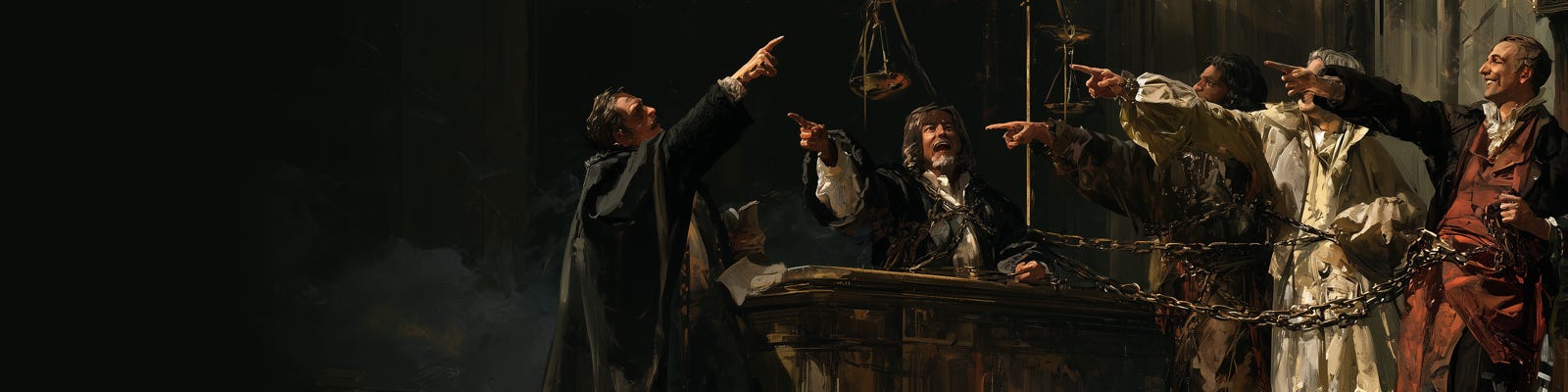
What passes unnoticed for all who inhabit the field of this positively Victorian moral complex is the very thing that provides the foundation for all of it. Within internet meme culture, there exists a collection of memes sourced from the 1967 animated television series, Spider-Man. The most famous of these memes depicts two Spider-Men pointing at each other from the episode “Double Identity” in which a criminal impersonates Spider-Man and the two confront one another, producing the mutual-pointing frame. This led to the creation of a version in which multiple Spider-Men are depicted all pointing at one another. The absurdity of this meme is an accurate representation of where we find ourselves.
The stakeholders of modernity—Christian or secular, left, right, or center—all point to one another. Each is certain the others are the imposters. What none ask is whether an imposter is required at all.

Lacrimosa
Just as we have indicted ourselves—our reality—we have also generated a shared verdict. Guilty. This verdict is not merely a product of elite circulation. We have no need of a Sanhedrin to pronounce it. The juridical star chamber issuing the ruling is composed of everyone. We recapitulate this judgment just as readily in a casual dinner conversation as we do in the egotistically tumescent think-piece published in The New Yorker and ELI5ed for us on Reddit.
However we come by our participation in the shared finding against life, the consequences are everywhere the same. We are leery of our world. Our anathema has grown so vulgar that we spend tens of billions of dollars a year on self-improvement, various kinds of personal coaching, and motivational speakers to generate some small modicum of meaning. No content is more rewarded by the LinkedIn algorithm than that constructed to make the reader feel good about themselves. Have gratitude! Care for others! Go out there and pursue your vision! You’ve got this!
Positive reinforcement of this kind should have obviated itself by its own success, and yet it hasn’t. Why are we not all as confident and grateful and purposive as Tony Robbins by now? Looking more closely, we may notice our pursuit of ersatz affirmation is simply a shallow soporific to the very real grief we experience at having negated life itself.
This is a precise recapitulation of the affliction of Bouvard and Pécuchet. We abandon vocation for vocation. We trade doctrine for doctrine. The promise of each was never tested and found wanting because there was no promise. Our unflinching credulity regarding who is to blame is sacrament, only now holding a smartphone. We miss no opportunity to misapprehend pretense for progress.
The reality of our grief is quite clear in this unrelenting search for the deus ex machina to remediate our loss. We are called to punish ourselves—and, let’s be honest, the existence of Tony Robbins is itself a cruel and unusual punishment—and yet still we pursue an unquenchable desire to punish others. This impulse is insufferable, yes, but it is also overt evidence of the loss of innocence. The modern mind can register this phrase only as obvious, hard-earned wisdom. Of course innocence is lost. One must grow up! More than an intractable paradox of existence, this self-immolation is the summary judgment of our moral order.
In our heart of hearts, we know it is not someone else, nor some other group to blame. Our desires are inexhaustible. Within those desires we mimic those we claim to despise. When we fix blame, we fail to see our will to do so is not our own. We fail to see the ministration of the paradigm itself. We fail to see how what we have put in motion to feed ourselves and our generativity eventually comes to feed upon us.
The original compulsion to live and be and create eventually loses its innocence. The infirmity of a paradigm in which we had once rejoiced is what brings this loss. Under every cultural paradigm since the dawn of civilization we have undertaken this gambit. What we have lost is something far older than we realize.

Domine Jesu / Hostias
Anaximander may have been the first recorded expositor of the apeiron, but he has not provided the most recognizable influence on the contemporary negation of life. Christianity, with its doctrine of Original Sin, is more recent and still retains some hold on our conception of the world. Yet our present commitments grow evermore secular in their bearing. Christianity has been experiencing a decades-long decline that—despite recent stabilization—constitutes a trend exposing its growing desuetude. The defining character of modernity is its secularity.
If we wish to find greater purchase on the apeiron as it is seen in how we currently undertake the negation of life, an important inflection is visible in the work of Arthur Schopenhauer. Born in 1788, Schopenhauer spent the first half of the 19th century producing work that did more than perhaps any other to furnish modern self-denial. We find in him an idea that would see recurrence in modern thought ever since, now so ordinary as to pass for common sense: that life is suffering.
To exclaim that life is suffering—or that life is pain—is utterly pedestrian. No one will bat an eye in response, least of all Christians, who demand it be so. This life is defined by its separation from God, resolved through renunciation. Through the intercession of divine grace, we may only have redemption in the afterlife. As we have seen, secular thought fails to emancipate us from this. Schopenhauer, whom Nietzsche called the first true atheist in German philosophy, articulated this persuasively.
Drawing more from Eastern thought than any philosopher from the Western canon before him, Schopenhauer was resolute that life must be redeemed through its negation. His atheism would become a model for how the antipathy to living encoded in Original Sin could outlive Christian theology itself, surviving in secular form as the sin of being alive. In his synthesis of Vedic and Buddhist thought, our apparent separation from the unifying whole becomes the source of error and illusion. Samsara became the self-deception of particularity from which we must detach to find nirvana. Our desires are sin because were we to recognize the boundlessness of which we are constituted, we would have no need of them.
“Asceticism is the denial of the will to live.”
— Arthur Schopenhauer, Studies in Pessimism
To transvaluate the values of life against life is to become the ascetic. In the imagination of Schopenhauer, it is to become The Buddha, to renounce desire, to live without life. That most people are not called to asceticism is an insight elegantly ignored by this moral recrimination. To see suffering in everything and blame ourselves for it has become modern secular liturgy. That we should all imagine ourselves as detached from desire is an article of faith so powerful that it even permits the acquisition of wealth. To be wealthy, to want for nothing, to float above material needs while being fully immersed within them is the sine qua non of the church of modernity.
Anaximander and Schopenhauer share a tight discipline in their analysis. Existence is convicted. The verdict is coterminous with the indictment. Our guilt simply is. Christianity and its secular inheritors are unable to leave the matter so closed. Conviction is insufficient. Throughout our lives—and the lives of our progeny—our guilt persists in justifying interminable self-flagellation. Given the severity of this enjoinder, the mere bleakness of simple guilt feels like grace.
Nonetheless, Schopenhauer enables our ongoing debt to the apeiron. Bordering on nihilism, our malaise has become normalized, sacralized, commoditized. In an existence lacking any other locus for meaning and purpose, our guilt stands as the last redoubt in which we are permitted to find purchase.

Sanctus
Among the pre-Socratic philosophers, no one offers a more effective antidote to Anaximander than Heraclitus of Ephesus. Flourishing sometime around 500 BC, he left work that—like the work of Anaximander—exists only in fragments. His archē was fire where Thales had named water and Anaximander the apeiron. This assertion was in harmony with his belief that all the world was always in flux. He contended that being was subordinate to becoming. Through his frame, things that are could only be because they could first have become what they are.
Heraclitus is often credited with a flux so thoroughgoing that for him, everything dissolves into chaos. In one fragment he says, “You cannot step twice into the same river, for other waters and yet others go ever flowing on.” His opinion of his fellow man was filled with contempt, and he made no special effort to reduce his insights so as to render them easily digested. For this, he was known as “the obscure.”
The opening of the only surviving work of Heraclitus is available as his first fragment. It provides some indication of his oracular nature. While translation from the original Ancient Greek invites endless disquisition, Professor Emeritus William Harris of Middlebury College provides us a workable English equivalent in The Complete Fragments, Translation and Commentary, and the Greek Text.
“Although this Logos is eternally valid, yet men are unable to understand it — not only before hearing it, but even after they have heard it for the first time. That is to say, although all things come to pass in accordance with this Logos, men seem to be quite without any experience of it — at least if they are judged in the light of such words and deeds as I am here setting forth according to its nature, and to specify how it behaves. Other men, on the contrary, are as unaware of what they do when awake as they are when asleep.”
— Heraclitus, DK B1
Thus, he immediately confounds and condemns the incomprehension of his fellow man. Yet his inscrutability conceals a far deeper affection for life than almost everyone preceding or following him. We may begin to discover this by noticing how he figures the world as play and casts time itself as a child’s game.
“Time is a child moving counters in a game; the royal power is a child’s.”
— Heraclitus, DK B52
This is a very different perspective than what we receive from Anaximander. It departs even more sharply from how Christianity—and then Schopenhauer—would come to describe our existence. Heraclitus would have seen the portrayal of life as suffering through the lens of his misanthropy. This formulation would be for him an example of why men and their seriousness are worthy of contempt. Rather, he would demand a higher regard for reality and he says as much.
“To God all things are beautiful, good, and right. Men, on the other hand, deem some things right and others wrong.”
— Heraclitus, DK B102
Heraclitus performed upon Anaximander a move that Nietzsche would later perform upon Schopenhauer. Unwilling to merely accede that life is suffering, Nietzsche accepted that suffering exists, and demanded it be affirmed rather than redeemed. The mantra for which Nietzsche is known is Amor Fati: the love of one’s fate. In place of the criminality of life provided to us by Anaximander and his progeny, we are permitted a more felicitous scaffold. What this gifts us is the ability to see something almost nothing else in our philosophical heritage has provided. We may imagine a remedy through Heraclitus and Nietzsche far more fitting to our present anomie.
We may allow ourselves to believe—to know—that life is innocent.
Agnus Dei
Every faction in modernity finds fault and offers redemption. Through every ideological throat is voiced the promise that we shall overcome. The vocabularies may differ—this one therapeutic or political, that one economic or eschatological—but their intentions find confluence in the servicing of a debt we are supposed to owe by simply existing. We may now wonder how we can be in arrears to ourselves.
Every flag flown has become a moral ledger. The compulsion to render these obligations as the answers to our fears and doubts has become our last refuge and our ineluctable responsibility. Each of us wants to be on the right side of these ledgers. When we invoke the right side of history, we mean our chosen one among the ledgers.
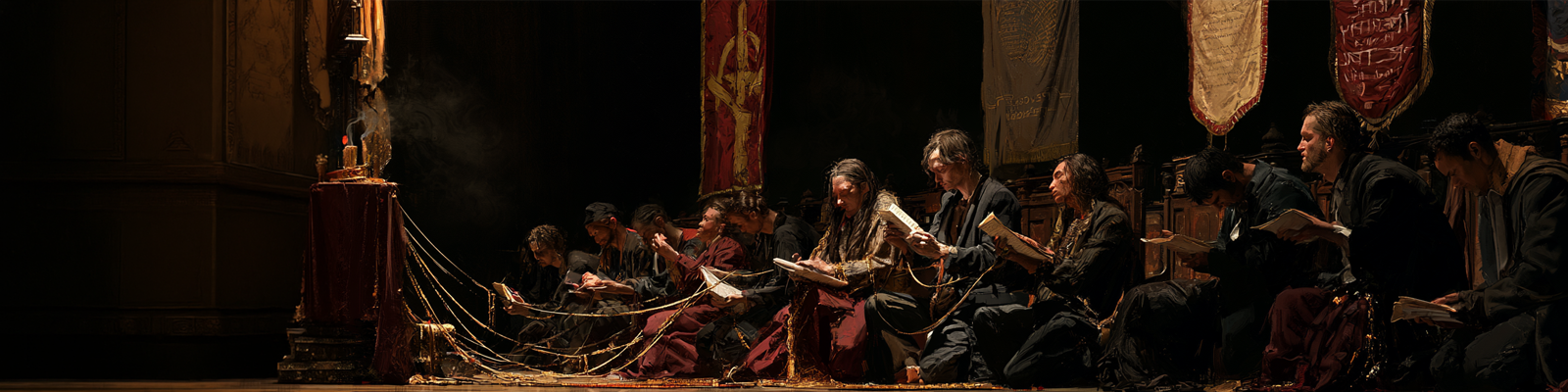
We are deaf to what cries out to us about where we find ourselves: we are all of us attending the same church. While we possess different dialects, we speak with one grammar. The antagonists for our moral calculus are sitting in the next pew.
When we see through the miasma of mutual blame, we still overlook the soteriological payload. Scapegoats are insufficient. We seek salvation. The suffering that attends our experience is the reason we first set upon this path. We want to know not only whom to blame, but in placing that blame, we will be granted release.
And yet we have no reason to believe any such release is forthcoming. Should it appear, we lack the means to identify it. And it will not appear. To cancel our debt would assume the existence of a creditor beyond ourselves or our existence and we can find no such party. No one will certify the discharge of our mortgage. The ledger will not close. Every remittance we make simply reopens it, which the modern paradigm insists is the central point of living at all. Because we are the very tribunal that sits in judgment of our own moral accusations, it is we who are required to render that judgment.
Many have tried to escape through Eastern thought. Since at least Schopenhauer, we have looked eastward to Vedanta, Buddhism, gurus, yoga, tantra. Yet the apeiron lies there too. It asks us to abrogate our individual attachments and sublimate our wills to something, we are told, bigger than ourselves. This world is illusion, samsara. Our particularity is a phantasm we maintain as a debt whose service is paid through suffering.
As our paradigm has declined and our imaginal frame has become filled with images of collapse and discipline, the exoticism of Eastern ideas has become more chic. From Kerouac and the Beats, to the Beatles in India, the hippies, Ram Dass, and the now ubiquitous and callow yoga mat industrial complex, the intellectual product of the East has come to be metabolized as the haute dissimulation of transcendence. Contortions in a hot room and imbibing kombucha may offer a glib and trendy simulacrum of escape, but it fails to escape the apeiron.
A still, small voice goes unheard in all of this. It pleads that something fundamental must be overcome. That something is our guilt, our criminality, the sin of our existence. The conscience to which we were told to listen by our parents when we were small children is this same formant.
We know its song. We hearken to it when we consider ourselves and our world. When we suffer, our first questions are: What have I done? Why me? We are being asked to overcome ourselves, our lives … life itself.
The denouement is not justice. It cannot be. We cannot give life standing to cast judgment on itself and then declare guilt. The latter disqualifies the former. The pursuit of our conscience is in fact a hollow restitution. It is, as T.S. Eliot wrote, “a distraction from distraction by distraction.” It is salvation by theatre. And this exposes our vainglorious intellectuals as Oz, operating the machinery of the masquerade while enjoining that none look behind the curtain.

Lux Aeterna / In Paradisum
Unrelentingly, we are asked to expose and extirpate the sin in our nature. Our intellectual betters are myopically univocal in their certitude that we ourselves are the source of that sin. Scapegoats may be named—those flying other flags, and therefore marked as enemies—but what cannot be elided is that each of us is already guilty and may fall further from grace. We are sinners by merit of our existence. We are little Eichmanns. We cannot claim we were merely doing our jobs. Each of us is a racist, a bigot, a misogynist or misandrist, a fascist-in-waiting.
Thus, our overweening elites permit themselves to float above us, tapping each on the head in turn and saying, “let’s you and he fight.” These Bouvards and Pécuchets no longer even know why they issue the provocation. Inflated by hubris, increasingly meaningless titles, honorifics, and other such badges of pedigree, they dance lightly from this theory to that, knowing only of each what they could glean from skimming their back issues of The New Republic.
In our credulity and self-recrimination, we confidently answer the incitement. Moreover, we feel it an honorable impressment to participate in glorious moral battle. We shall overcome the forces of evil. Our ressentiment animates this belief. We seek imaginary revenge against our existence. What we imagine is that we have acted when we have not.
And yet even this account affords the tribunal more dignity than it deserves. While the vacuous synod survives in the hollows left within the decaying cultural paradigm, a still more penetrating question remains concealed and unanswered. Our grand inquisition dare not make any inquiry there. Were there any true illuminati in our midst, they would demand we ask: was there ever any crime to prosecute?
Our perceived impotence compels an apeiron. We have long sought a theodicy for our suffering. We may not need it. If there is an apeiron, our relationship to it need not be criminal. Our sclerotic culture may weaken us but it does not create the fear upon which the prosecution depends. We fear our pain, suffering, mortality, impotence. We fear ourselves, and not without cause. We have it in our power to injure, destroy, condemn. But we possess another power. We are free to declare for life; for its innocence. Yet repeatedly, we refuse.
And so we continue to discover in leadership the recurring story of Bouvard and Pécuchet. Finding satisfaction in faddish theories and moralized passion plays now confers the cachet of leadership. The ever-present conflict in our organizations—always moralized, never resolved—is now visible as a feature of the criminal court we’ve created for ourselves. Leadership is merely the means by which the court maintains its jurisdiction.
When we wonder about how leaders might recover agency—how they might hold open an aperture—we must search within our relationship to the apeiron. The aperture may begin in another posture altogether. Perhaps the greatest courage in leadership is to have no certain villain, and act anyway.
Thanks for reading The Subjunctive! Subscribing will create the illusion of meaning.