All Theories Are the Same

Follow into
Save into
Follow into
That’s How They Get You
Samuel Beckett remains among the most inscrutable figures of twentieth-century letters. Waiting for Godot stands as his most mysterious work. It is a text whose peculiar cultural magnetism derives precisely from its resistance to closure. The occluded and the sublime constitute not mere stylistic ornaments but the very substance of Godot’s enduring grip upon the collective imagination.
Waiting for Godot concerns itself primarily with Estragon and Vladimir, two figures locked in perpetual attendance upon the arrival of someone called Godot; an arrival that never materializes. They are ardently engaged in the ritualized performance of waiting. Their condition is rendered not as postponement but as circumstance. They may wait forever.
Please subscribe to The Subjunctive because in your heart you know it is something you desire.
Despite occasional intercession by the curious pair of Lucky and Pozzo, our two supplicants are us. We too wait for someone or something. Contemporary leaders feel this dysphoria with particular acuity.
Vladimir and Estragon undertake their vigil in the service of ameliorating their impatience. They speak to one another interminably and without obvious purpose, even when their locutions masquerade as elegance and depth. The two speak of philosophy and theology. Lucky and Pozzo provide momentary absurdity, yet the waiting continues unabated.
Yearning never resolves. The abeyance of Godot’s arrival is never rewarded. The play closes with nothing happening. It whispers to us that nothing ever happens.

The Leader As Placeholder
Leadership orthodoxy traces a sine wave. The wave flows from hope to despair, only to repeat itself unceasingly. Our leaders operate within a gravitational field that compels endless repetition wherein some theory rises to supremacy, then suffers deflation, only for the cycle to be supplanted by a new theoretical guise. When the theory feels vital—when some consultant or other influencer has painted it as ascendant—the leader is filled with hope. When the theory fails—as all do—the leader must both recognize the failure and retroactively protect their choices against it.
Modern leadership drowns in this indeterminacy because the theory that informs it is unable to bear the freight it’s being asked to carry. There is something unnervingly familiar in each new theory. There is something repetitively desultory in the executions that follow. Leaders feel—even if they cannot articulate—why everything presents as unending recapitulation. Each new way we are led to lead exposes a brittle, impersonal sameness: difficult to specify, impossible to ignore.
Leaders are not waiting for the theory they’ve been given to work; they are waiting within theory as a construction. Something in contemporary leadership theory is compelling leaders to anticipate an end wherein wanting and needing is resolved, and yet this resolution is always just beyond the horizon. Theory then becomes the condition of waiting, not its solution.
This is the phenomenology of modern leaders. It is what leaders experience; what they feel. Those who notice this arrive at an unsettling conclusion: they are not leading at all, but serving as placeholders for theory.
For those compelled into leadership, acting as intermediary between theory and execution is often intolerably tedious. The demands of the moment and the ordeal of strategic craft are lost. The subtle intrinsic rewards of leading are denied when leadership is reduced to prefabricated theory.
More ominously, these injunctions expose opportunities favoring fearful, etiolated personalities. Those whose impulse is to pursue power through the flimsiest pretexts prove optimal for this dissolution. They excel at transforming compulsion to leadership into craven service to theory. They do this because theory is but a means to power, and modern leadership theory abets them in this enterprise. The evidence for this type of leader is ubiquitous. Everyone knows the entitled leader whose power consists in a preternatural ability to hide behind the rules of the regnant theory.
The die is cast for contemporary leadership. Its theory has grown into a massive sink of time and resources. Leaders, first seduced by the cycle, have grown uncannily anesthetized to this deterritorialization of their purpose. The perverse opportunities in the remainder are filled by pathic personas. The essence of the waiting is its presumption in the face of a dilating cataract of fear that nothing works.
To resist and strike a new course is the fleeting fantasy of any conscious contemporary leader. This notion is immediately and unsurprisingly dismissed. Modern leadership theories share a common cause: the subordination of leadership to theory itself. Leaders have become placeholders in promulgating the current intellectual dispensation.
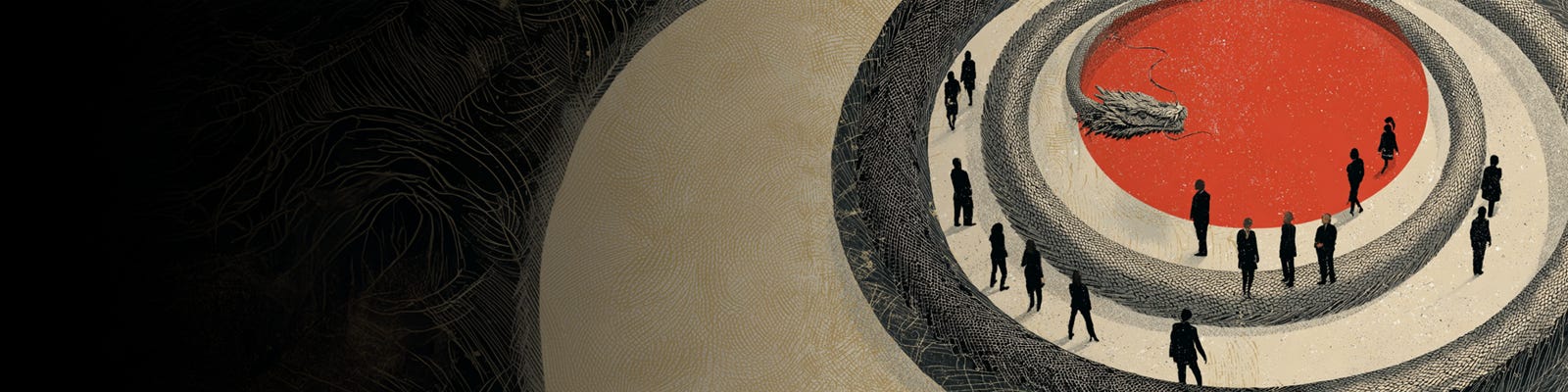
The Leadership Ouroboros
We are not where we are by accident of fate.
The idea that everything is systems became coherent and alluring near the beginning of the twentieth century (see Prolegomenon). While its provenance lies further back, reality as stuff doing things began remorselessly pursuing our collective imagination in the early part of the last century. It was not only a source of explanatory power, but a source of hope for a better future.
Nowhere was this fervor absorbed more fully than among the leaders of the day. What became known as ‘trait theory’ posited leadership is a bundle of cognitive traits. English polymath Francis Galton, in Hereditary Genius, tells us: “… [those] who achieve eminence, and those who are naturally capable, are, to a large extent, identical.” Yet no causal relationship between traits and leadership could be established.
When traits became seen as dubious, we reimagined leadership according to behavior. In the 1930s, social psychologist Kurt Lewin advanced a frame categorizing leadership behaviors as autocratic, democratic, or laissez-faire. Further refinements defined behavioral classes oriented by relationships and considerations, or by tasks and structures. However, while behavioral categories proved repeatable, they were not reliable.
“Behavior is a function of the person and the environment.”
— Kurt Lewin, Field Theory in Social Science (1951)
By the 1950s, leadership theory grudgingly admitted behavioral theory’s defects through the consecration of situational or contingency theory. Kurt Lewin again led the thinking, but Fred Fiedler provided clarity in the 1960s, claiming situations that don’t fit the leader require changing the situation, not the leader. Paul Hersey and Ken Blanchard developed this further, suggesting leaders can adapt, but the key variable is follower readiness and maturity. This demanded leaders shift among direction, coaching, support, and delegation.
Contingency theory challenged the universality of previous theories, yet it remained assured that uncertainty is a problem to be solved. While it says, “it depends,” it still believes the dependence can be modeled. What it couldn’t do was explain why some leaders succeed across wildly different contexts, or why followers sometimes change themselves under certain leaders, or why commitment, sacrifice, and moral authority often mattered more than situational matching. The theory’s assumptions—that situations could be reliably identified, variables could be named, and fit could be optimized—all collapsed under the ambiguity typifying human experience.
Contingency theory didn’t perish; it fractured. In the 70s and 80s, transformational leadership theory took up one thread, claiming that while fit matters, what drives it is meaning-making, motivation, and identity. Simultaneously, leader-member exchange theory (LMX) declared situations are mediated by dyadic trust. In the 80s and 90s, cognitive and sensemaking leadership theory posited that leaders face primarily epistemic challenges of interpretation. In the 90s and 2000s, adaptive and complexity leadership theory stipulated that organizations are complex adaptive systems wherein leaders are not responsible for matching variables but enabling emergence. From this grew distributed theory to advance the notion that leadership is not a role but an emergent property of a system, distributed across people, artifacts, routines, and contexts.
Contingency theory is where leadership theory first realizes it is waiting within theory. Subsequently derived theories weren’t replacements but rescue attempts through symbolism, relationship, interpretation, and emergence. Each tried escaping the waiting without admitting escape is impossible.
On a slightly different path, starting in the 70s, servant leadership arose. Championed by Robert Greenleaf, its central claim was that leadership legitimacy derives from service to followers. It tells us leaders exist to meet needs, remove obstacles, and help others grow. Deeply egalitarian, Christian, and pastoral in its genesis, it presumes a moral asymmetry in which the leader is ethically elevated by renouncing power (a posture that remained even after the theory became secularized). Unlike the analytical theories above, servant leadership integrates the assumption that care precedes authority.
In the 90s and 2000s, ethical leadership employed Rawlsian deontological assumptions as a basis for transcending servant leadership. Under this theory, leadership is intended as a model for moral behavior, fairness, integrity, and norm adherence. Through it, leadership is seen as a moral signaling function. It presumes ethics can be codified, exemplified, and transmitted, and thus treats organizations as moral classrooms.
Most recently, this path yielded inclusive leadership theory. It insists that leadership exists to ensure voice, belonging, psychological safety, and representation across difference. Drawing from Rogersian empathy, Carol Gilligan’s care ethics, and critical theory, inclusive leadership moves the locus of inquiry from ontology to epistemology. It asks not what is, but how does what we think we know result in oppression. It enshrines harmony as the principal moral good. What this theory is structurally prohibited from acknowledging is that the empathic capacities it valorizes may serve predation as readily as care.
Each of these theories invites criticism. The analytical path maintains that reality is legible through the measurable; that organizations are systems whose behavior can be optimized; that leadership is a function improvable through better models; and that failure is a knowledge problem entailed by insufficient data, poor models, or bad incentives. The moralistic path argues that the core problem of leadership is moral; that organizational failure stems from insufficient care; that leadership arises from virtue rather than authority; and that conflict and hierarchy are pathologies to be softened or overcome. What this path cannot acknowledge is that making virtue the basis of authority invites virtuosic performance of virtue and selects for those most skilled at simulation. By subordinating authority to care, it drives pursuit of power underground, where it operates through proclamations of selflessness. The leader who hides behind rules becomes the leader who hides behind righteousness.
What is most salient to the experience of leaders—regardless the path through which their ideals arrive—is that none of these theories produces the denouement promised. There is no culmination. Leaders are never granted resolution. Each theory fails in its own way, and the only resolution consistently on offer reduces to vague gestures toward yet another new body of theory.
The antecedents for this are obvious once we stop pretending they are not. Theorists need to feed themselves and their families. Consultants, the same. Add the xenogenetic mandates of institution, organization, Imperium legis, whose needs are alien, disembodied, and impersonal. From contemporary leaders, we have now demanded the manumission of leadership in favor of a would-be sacred formalism in which the leader—like everyone else—is, as Max Weber put it, “… little [people] clinging to little jobs and striving towards bigger ones …” Each theory, in its way, relegates leadership to a hand moving a chess piece, eliding the possibility that leadership is forged in a mind that perceives a possible move.
Leaders generally don’t notice the shell game immediately. Even after many rounds of “it’s not under the cup you thought it was,” the game behind the game may remain elusive. Nevertheless, there is occasional subterranean awareness that something is amiss. The curiosity is compelling and disquieting.
The essential kinship within modern leadership theory is this prodigious elision by its shared promise of salvation. We are working toward a better tomorrow which will eventually solve any problem vexing individual leaders right now. The theory is not merely an assumed pathway for success, but a moral imperative. It radiates downward from superhuman structures into leadership, and leaves leaders to carry the burden of the remainder. Many will opt for—and the process encourages leaders willing to take—paths of least resistance. It is a gravity well from which escape is functionally invisible.
Impossible Termination
The temptation now is to imagine a remedy. Where have we not looked? What have we not considered? What new rule or contrivance may yet mitigate what has been corrupted and deliver us our better tomorrow?
The easy response to these questions is to point out they’re recapitulating the challenge already defined. The waiting is incommensurable with its own resolution. However, this is neither satisfying nor resolute. To answer these questions honestly, we must look deeper into the problem. That they can’t be answered in the way we would prefer does not preclude a potent reply.
To begin, reciprocation demands tribute upon both opening and closure of the problem. Do we know the problem well enough to adequately describe it? If the problem is complex enough, do we know what would constitute real knowledge of it? Against what are we measuring or evaluating the problem? Is the problem existential or perspectival? What would constitute closure of the problem? What remains after closure? Will what remains permit further inquiry?
At least the opening of problems through leadership theory is deeply problematic when considered this way. We don’t even know how to adequately describe these problems. No one demonstrates this more effectively than physician and theoretical biologist Stuart Kauffman. In a 2016 lecture at the Konrad Lorenz Institute in Klosterneuberg, Austria, he explained how in sufficiently complex systems, we cannot know in advance what the relevant variables are, nor can we know when we have identified all of them.
“Will you accept the following? And once you do, you’re doomed. The number of uses of a screwdriver is not infinite; it is indefinite.”
— Stuart Kauffman, KLI Lecture 2016
Kauffman explains that functional closure—when all tasks necessary for a complex system to exist are accomplished—cannot be fully understood because the space of possibilities is “unpretestable.” To effectively model any complex system, we need to know all the variables involved in its functioning, yet we have no means to identify them all, nor to determine whether we have. Worse still, we can’t know whether new variables will emerge. This is not a trivial problem. This means no model can ever be complete, no theory can ever terminate, and no “better framework” can close the loop.
Any attempt to ‘solve’ leadership theory assumes a configuration that works completely enough to cover all bases. Kauffman doesn’t tell us this is a difficult problem to solve. He tells us something more tragic: there is no “somewhere” at which we can arrive. Leadership theory as we know it is not merely failing; it is attempting the impossible. The waiting of leadership is not accidental; it is structurally mandated.
If opening the challenge of leadership is so deeply indeterminate, closing it is fantastical. Leaders know this viscerally. They know leadership is not meant to be a placeholder. They know leadership will never be a “problem solved.” They know leadership is a burden accompanied by no salvation. Yet leadership theory continually implies otherwise.
Nothing to Be Done
Leadership, as we now understand it, is condemned to waiting for Godot. Leadership theory has not merely demanded it of us; it has constructed our conception of leadership within the expectation that it will close all that has been opened. Tomorrow, we are told, it will do this. Or it will do it with the next iteration of theory. The unbearable weight of leadership has been ploughed under by the treacly listlessness of a salvation that never arrives but is always imminent.
There is much that is valuable in leadership theory. But leadership once meant separating wheat from chaff under the pressure of decisions that could not be undone. Modern leadership theory has severed this calling from its purpose.
Something of what we once understood as leadership can still be reclaimed, though it will not end the waiting. There is no closure, because the primary problem of leadership is not solvable. What can be reanimated is not hope of resolution, but appetite for the unresolvable: the courage to choose, to judge, and to bear the cost without appeal.
Subscribe to The Subjunctive now and everything you’ve ever wanted will come to pass. Or something.