A boring MRI

Follow into
Save into
Follow into
Last week I walked a property that was undergoing demo for a gut rehab. I stepped on a rusty nail jutting up from a piece of wood on the ground. Ouch. Why was I wearing my barefoot shoes here? Idk. I take off my shoe, which is more of a slipper, and blood is spilling out of my big toe where the puncture hit as I was leaning forward to launch my next step.
Anyways, blood-soaked sock, but nothing terrible. Beyond the initial puncture and removal the pain wasn’t too bad. I put my shoe back on, cleaned it and bandaged it 30 minutes later, and was back to business.
Two hours later my foot was starting to feel real stiff and some fairly significant pain was ramping up. Ugh. I’ve got stuff to do. I don’t want to go wait at urgent care or the ER for antibiotics if this is getting infected. I haven’t had a tetanus shot since they made me get one in high school.
I take to an LLM. ChatGPT, because it is the least neurotic, but that turns out to be a bias of its own. The only question I actually wanted answered was: is this getting better or is this getting worse?
Ugh again. What about...
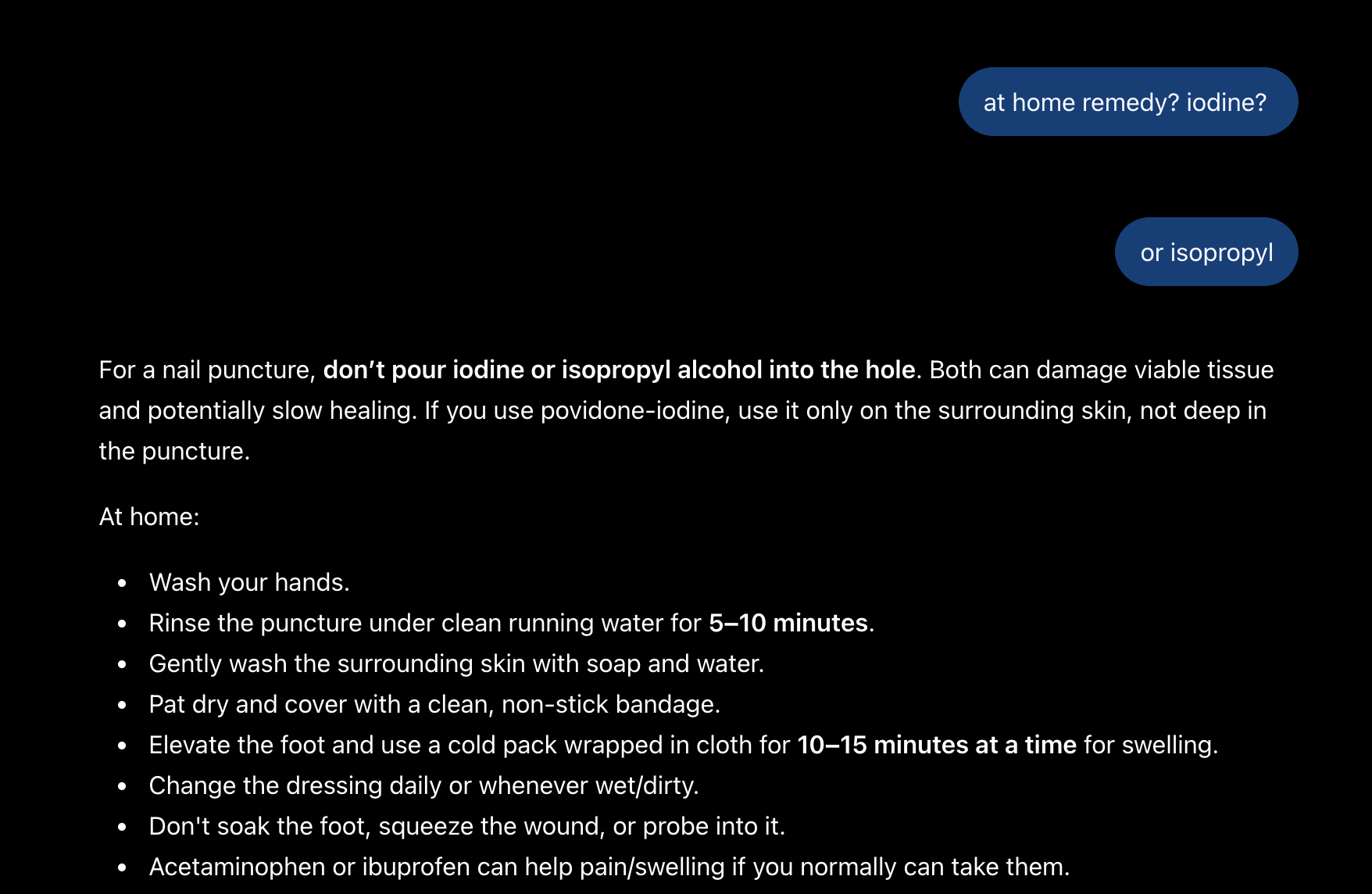
Ok, I do that. It gets progressively worse for the rest of that day. Some follow-up suggests nerve damage in the soft tissue of the foot. I decide to sleep on it. Next day, much better, but the tissue is still stiff, swollen and it’s hard for me to curl my toes.
Now I know what you’re thinking. Why didn’t you just go to the hospital? Why didn’t you just go get an opinion on this? Why wouldn’t you want to go just for the peace of mind before it gets worse?
Because I don’t have time!!! Because the experience sucks! Have you ever been to urgent care? Have you ever been to the ER?
I go in with a sore toe and I’ll be there for 2–3 hours twiddling my thumbs and reading a book, maybe drafting this blog about how annoying the experience is, while folks being rushed in with critical injuries are advanced for immediate attention.
Now what’s the alternative? I’m not rich yet, so a private doctor isn’t in the cards.
So the problem, put succinctly, is:
young men are too poor and impatient to go to the doctor
The user experience for medicine is bad.
No no no, I agree, doctors are heroes and super smart and worthy of our trust. But have you talked to a doctor about this? They’re frustrated too! They’re frustrated because they get that patients get frustrated. They’re frustrated because they get that it’s a huge expense burden. They appreciate that the patient expense burden helps them drive an Audi, but still, they get it.
I’ve been visiting private MRI clinics a bunch recently. Roughly 10 just in the St. Louis region over the last 2–3 months. I’m doing this because we’re building a new MRI machine that takes this technology out of the hospital and aims to (eventually) put it in everyone’s home, to let them see what’s going on in their body anytime. Here’s a non-exhaustive list of all the different things you can know about the body with magnetic resonance imaging (some of these only in a research lab today, but the physics is the same):
- What your organs look like
- Whether something is growing where it shouldn’t
- Whether tissue is damaged
- How much water is in tissue
- Whether tissue is inflamed
- Whether tissue is becoming scarred or fibrotic
- How much fat is in an organ or tissue
- How much iron has built up in tissue
- How tightly packed cells are
- How water moves through tissue
- How blood is flowing through an organ
- How much blood is reaching different parts of a tissue
- What your blood vessels look like (including narrowing, blockages, aneurysms, and abnormal vessels)
- How your heart moves and pumps
- How much blood your heart pumps with each beat
- Whether heart muscle has been injured or scarred
- What your brain looks like
- Which parts of your brain are active during different tasks
- How the major wiring pathways in your brain are organized
- Whether part of the brain has had a stroke or lost blood supply
- What your spinal cord and nerves look like
- The condition of your joints, cartilage, tendons, ligaments, and muscles
- Whether a bone is injured even when an X-ray looks normal
- The health and hydration of the discs in your spine
- How stiff or soft a tissue is
- Some of the chemicals and metabolites inside tissue
- How acidic tissue is
- How oxygenated tissue is
- How tissue uses energy
- How quickly different molecules move and exchange inside tissue
- The microscopic environment around water molecules (gives us clues about proteins, cell membranes, and tissue organization)
- The temperature of tissue
Sorry, I guess that was somewhat exhaustive, but chat just rip’d it, so there you have it. Here’s the one we’re most excited about if access to MRI can become more democratized:
- How all these variables change over time and in response to different perturbations
This last question is also one that we know we can answer. Just do more scans, right? Well, the reason it hasn’t been robustly answered yet is because it is kind of inconvenient to go get an MRI scan. Have you ever gotten one? If you have, I would love to hear about your experience.
But anyways, something I learned talking to these private clinics that charge a flat rate for one of these scans is that there are really just two customer profiles:
1. The upper-middle-class peace-of-mind seeker
The reason I say upper-middle class is because these scans aren’t cheap. The reason I say peace-of-mind seeker is because this person has just been flagged by a routine check-up that they might have cancer. Right after they were told that, they were also told it would take them 6–8 weeks (the clinics’ number, not mine) to get on the schedule for an MRI scan to give them more details about this flag. Has the cancer spread? How big is the growth? What are the above-mentioned properties of the tissue that tell us whether this is a next-month problem or a next-decade problem?
The peace-of-mind seeker hears this timeline and decrees it unacceptable. These private clinics don't have the hospital system's backlog, and he finds his way to one either because 1) the primary physician who flagged him points him there, or 2) he goes looking on his own in the days that follow.
2. The rich-and-curious
This person is also probably upper-middle class or higher, given the costs associated. You can’t just call insurance and tell them you’d like an MRI scan that costs thousands of dollars in the absence of a known flag and have them say “yeah sure, we’ll dole out your entire year’s premium to give you more agency over the health trajectory of your body.” So it becomes an out-of-pocket expense. Most people in this profile are doing this once every year or so, but the clinics tell me a small super-user base will do it as often as once a month. Bryan Johnson is the extreme case, claiming 25 hours a year in an MRI for four years straight as of a January 2025 post.
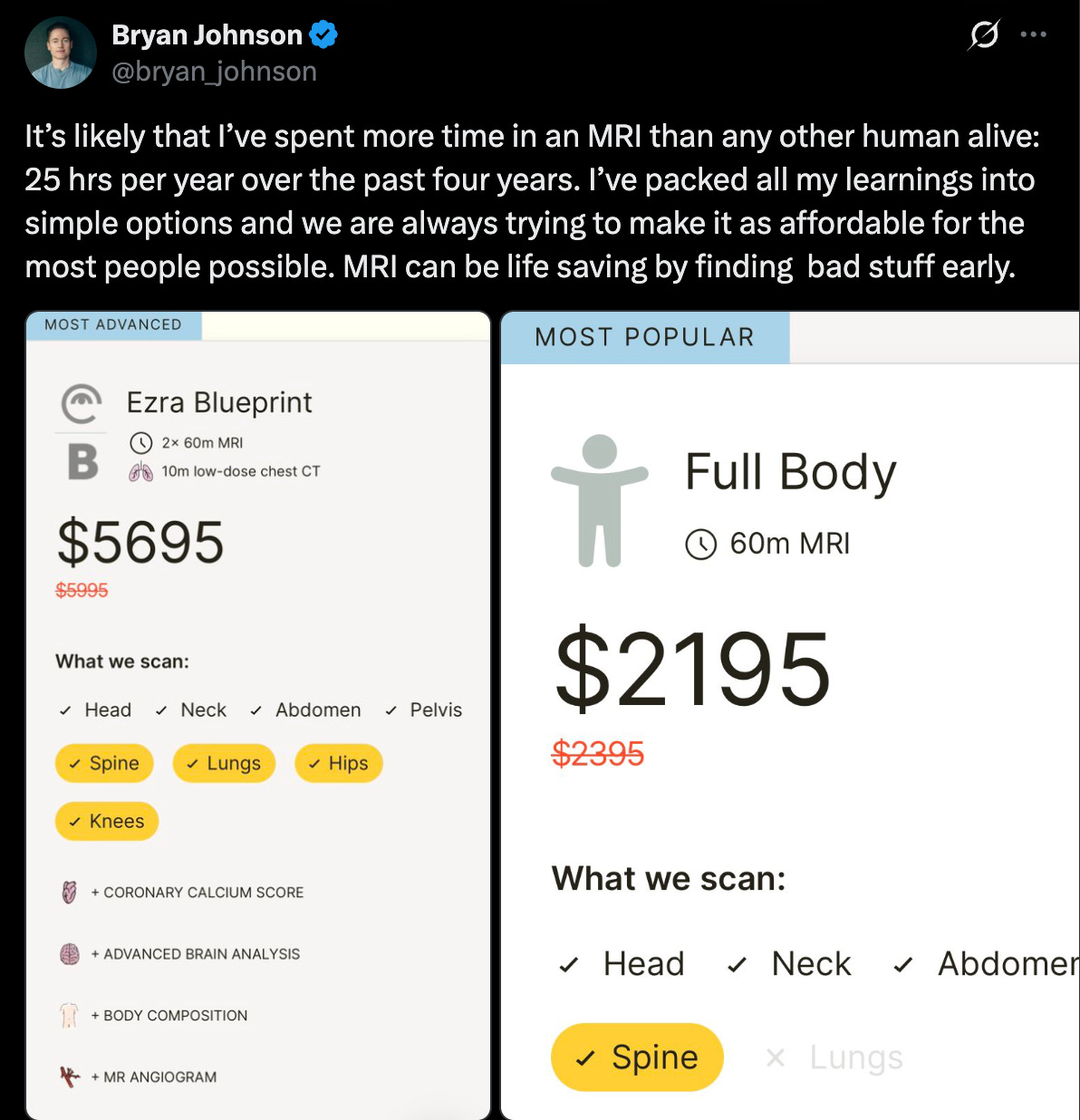
When Function acquired Ezra in May 2025 the headline was a $499 full-body scan; a year later it’s back up to $999, with the bigger protocols running $1,699 and up. Still out of market for most people.
Both of these customer profiles are buying snapshots, with the latter super-user falling just a little bit closer to answering the question I forked this point off of: building a personal map of change over time.
Let me bring this back to my toe.
The only question I really wanted answered was: Is this getting better or is this getting worse?
If it’s getting worse, then I’d take the next step and go jump through the hoops to get an antibiotic prescribed. If it’s getting better, well then, I’ll just let it keep doing that.
There are two kinds of MRI, and most people only know about one of them.
The one you know is the photo. It contains contrast, shapes, and a radiologist squinting at gray blobs to make sense of them. Jensen Huang keeps saying AI made radiologists more in demand. The radiologists I've been talking to think the picture-reading part of the job is still on the clock. The brightness in those images is in arbitrary units. Brighter on one machine is not brighter on another. It is great for “is there a thing where there shouldn’t be a thing,” but it’s not a measurement of a state variable.
The less-known version is quantitative MRI. Instead of “is this pixel bright,” it asks something like “what is the actual relaxation time of the water protons in this tissue, in milliseconds.” On the same scanner with the same protocol, 870 milliseconds today is 870 milliseconds tomorrow.
Consider toe.
Day minus-n through day 0 is the baseline. Day 1 is the puncture; I’d see some variance from inflammation, etc. Day 2, the number moves more. By day 3 I ought to know: is the number continuing to drift from where I expect it to be, or is it starting to turn around, indicating some healing?
Back to the exhaustive list. Every one of those bullets is a thing MRI can measure like this. The reason we don’t measure them every day is because that currently entails driving to a building, lying in a tube that sounds like a dial-up modem inside a jackhammer, and paying hundreds to thousands of dollars for it.
The peace-of-mind seeker does this once because he’s scared. The aficionado does it once a year because he’s rich and curious. Bryan Johnson does it 25 hours a year because he is Bryan Johnson. Still, none of them are generating defensible state trajectories yet. They’re generating a very expensive stack of photographs with months between them.
So the bottleneck for improving the form factor of medicine isn’t really the quality of the tech. It’s making the tech boring, so that it disappears, which is still a really interesting technical problem.
Can we build an MRI that doesn’t need liquid helium? That doesn’t sound like a turbine? That doesn’t rip a metal necklace off your head so fast it’d decapitate you? The answer is already unambiguously yes, and this is being done, but the target use case is still not as distributed as it ought to be for the experience of medicine to improve.
Existing low-field and single-sided MRI companies still sell to the status quo.
Hyperfine’s Swoop is a 64 millitesla brain scanner that runs off a wall outlet and can be wheeled up to a bed in the ICU or ER; it’s the first FDA-cleared portable MRI for the brain, and it leans hard on AI reconstruction to get usable images out of a magnet that weak. Promaxo is a single-sided permanent-magnet system built for urologists to image and biopsy the prostate in their own office, the way ultrasound-guided biopsy already works. Synaptive does a head-only scanner. Esaote does joints. The list goes on.
The reason each exists is still “a clinician needs to look at something right now and the real machine is booked.” The customer is still a hospital or a specialist practice. The output is still a picture.
Which are probably great businesses. It does not help my toe.
Nobody in that list is trying to make an MRI boring. I think the idea of a boring MRI is super exciting! Imagine that instead of debating with ChatGPT about whether the stiffness in my foot was normal inflammation, an infection, or some soft-tissue injury, I could put my foot against a scanner for five minutes and get a conclusive answer to the question: is this getting better or is this getting worse?
The scanner already knows what my tissue normally looks like, because I’ve done this a hundred times.
Maybe it’s something I’ve been sleeping on every night for the last year.
Maybe someday, it'll see what’s wrong and do something about it before I ever wake up. That’s the goal at least. We’ll keep you posted.
-Benjamin Anderson