Flying Blind
Follow into
Save into
Follow into
Hello, I hope that your fall is going great.
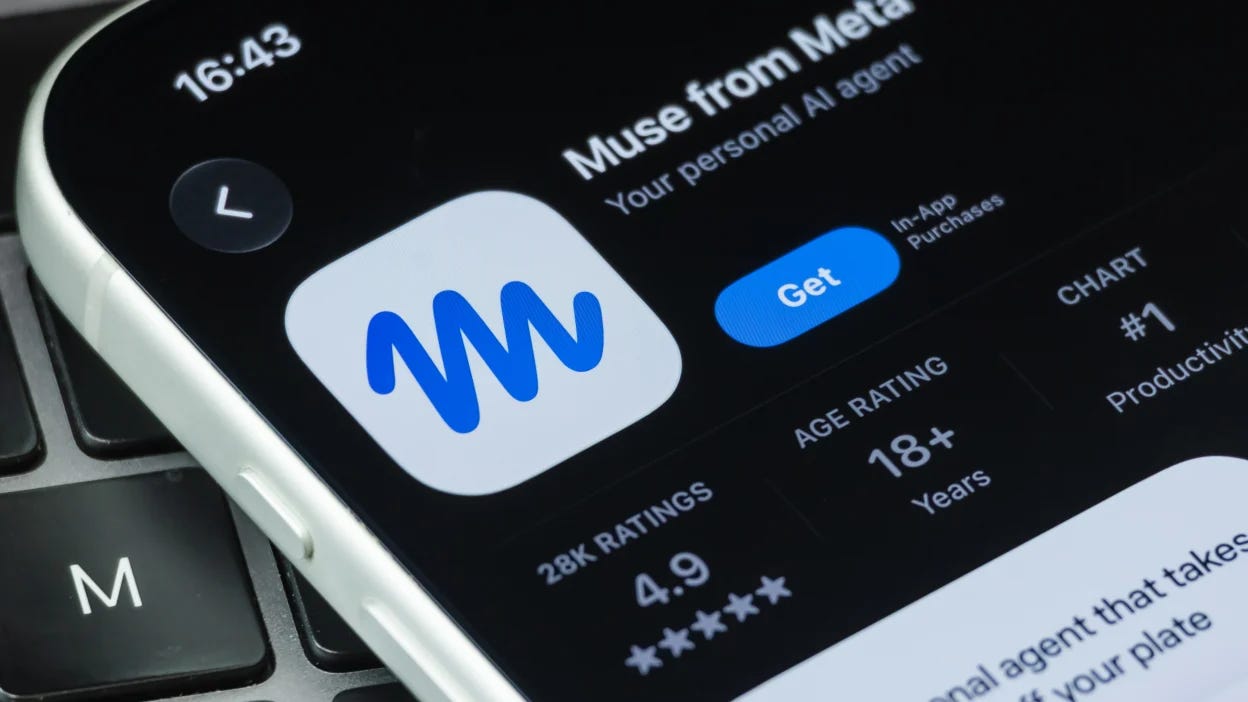
Muse, the new AI personal assistant from Meta, has taken the world by storm. It became #1 in App Store downloads and increased Meta’s market cap by $400 billion or so.
People in my life have reacted anywhere from “No way I’d let Zuck get deep into my personal life” to “I need to try that immediately!” But it’s going to become a fact of life for millions right now.
It also caused consternation in the business world. Press stories came out suggesting that if Muse were to move Americans’ savings en masse from their current non-interest-bearing accounts - the average interest rate on savings that Americans actually receive is apparently only 0.1% - to high-yield savings accounts, all of the banks would go out of business. Another story said that 50% of subscriptions are being paid because we don’t remember to cancel them; Muse would change that, thus gutting subscription-based companies.
I definitely have some subscriptions lingering around that I would cancel if I remembered them. AI will soon remember for us. A colleague used Muse to quit the gym for him, without having to talk to anyone or pay a visit.
AI will stamp out inefficiencies wherever it can find them. The tough part is that a LOT of people’s jobs rely upon inefficiencies.
For example, hundreds of thousands of Americans work as medical billing staff; if you were to have a better, more streamlined system, you wouldn’t need as many people working on verifying billing codes. Customer service employs 2.8 million people (including some people at Noble Mobile) – bots will make those workers less vital very quickly. The insurance industry, which consists largely of passing information back and forth, employs 2.9 million people, including almost 400,000 claims adjusters. AI could figure out the veracity and magnitude of claims in many routine circumstances.
I met with a banking executive this week who said, “There are two changes going on. One is that AI is getting smarter every minute and the models are getting dramatically more powerful every week or so. Two is that companies like mine are figuring out how to productize and operationalize these models in our organizations. The first process is going a lot faster than the second right now, which is one reason that corporate productivity and layoffs haven’t spiked yet. But pretty soon AI will be able to help us apply it too, at which point all bets are off.” This executive expects his company’s staff to shrink very considerably in the coming one to two years.
Meanwhile, Anthropic’s IPO is becoming real. Its S-1 leaked to reporters last week, showing 2025 revenue of $4.59 billion and commitments of $518 billion to Google, Amazon and Microsoft for compute infrastructure. It is targeting a $2 trillion IPO, which would be the biggest IPO in history, surpassing SpaceX.
Can it get there? Anthropic reported annualized revenue of $65.6 billion in July of this year, a stupendous growth rate of 14.3x from last year.
Still, from my vantage point, there is no way it can justify a valuation that high; let’s say it’s doing $80 billion in revenue annualized by October. $2 trillion would be 25 times revenue, while the S&P 500 trades at 3.6 times revenue and its historical multiple is 1.65x. There’s growth and then there’s froth, and we’re clearly into the latter category.
I say this despite the fact that Claude is the preferred model for those around me in corporate contexts. I spoke to investors who warned that they saw some signs of companies pulling back from their per-employee spending on Claude due to unclear returns on investment. It’s going to be tough for Anthropic to keep compounding its growth long enough to achieve a multi-trillion-dollar valuation – at some point you run out of corporate budget. And this is coming from the guy who thinks AI is going to eat a ton of jobs in these companies.
By the way, investors are also seeing lower growth rates in the demand for ChatGPT in the corporate setting. That’s not what you want when the whole story is hypergrowth.
The rubber is going to hit the road when OpenAI tries to go public next year. I think that will be a dicey proposition at best, which will present a huge challenge for this AI-fueled boom. When the updraft ends, gravity remains. It may not feel like it, but we’re in the air right now.
This week on the podcast we hear from Senate candidates Todd Achilles, Seth Bodnar, Brian Bengs and more. To check out Forward Party candidates including Todd, Seth, and Brian, click here. New polls have Todd Achilles and Brian Bengs tied with the incumbents in Idaho and South Dakota! For 3 months off your mobile bill with Noble Mobile, click here or email matt@noblemobile.com and use my name to switch or explore. It will save you money and time. Make the most of what you’ve got while you’ve got it. Look up.