
I remember the last time we saw a major market crash – it was 2008. The subprime housing lending bubble burst. Bear Stearns and Lehman Brothers went bust. The federal government had to step in with a $700 billion bailout. The S&P 500 went down 37.5% that year – if you took it from its peak in 2007 to its trough in 2009 the S&P 500, which represents the biggest blue-chip companies in the world, went down 57%. The Great Recession kicked off and lasted 18 months as unemployment shot up to double-digits.
At the time, I was 33 years old (wow!). I was like, “Okay, how does this market collapse affect me and my little education company?” Major banks were closing and layoffs were widespread. I called my company’s bank – Signature Bank, which would fail 15 years later - and was reassured that our account was fine. I didn’t have enough personally in savings or investment at that point to be meaningfully impacted by the crash; my little nest egg went down but it wasn’t that big a deal. It was one of the bright sides of being cash poor; most of my net worth was tied up in my little company. Meanwhile, unemployed 23-year-olds were washing ashore at our company’s classrooms, which specialized in preparing people to head to business school. We had to rent extra classrooms and schedule more classes because so many young workers were losing their jobs on Wall Street and were seeking shelter.
“Huh,” I thought. “It’s weird that while the world is falling apart, my little company is doing better than ever.” We had banner years in 2008 and 2009 – it turned out that our services were somewhat more in demand in tough times than in good times. Our revenue shot up to the point where we got acquired in 2009.
The 2008 crash was the result of excessive financial chicanery – banks sliced and diced subprime loans to the point where people thought they were high-quality because the ratings agencies were asleep at the switch. Also playing a huge role - low lending standards for housing buyers who should not have been given a zero-cash down mortgage. The acronym at the time was NINJA – No Income, No Job, No Assets mortgages. Yes, that was a thing. They gave mortgages to anyone with a pulse, many of whom couldn’t afford them when they reset.
That crash shook me up. You mean we had this stock market bubble because our financial institutions were morons? The growth and prosperity were illusory? And then the Feds had to bail out the banks and the bankers with taxpayer – our - money? The anger formed the Tea Party faction of the Republican Party in 2009 and then Occupy Wall Street in 2011. In my view, the anger never really ran its course, and fueled both Bernie Sanders’ should-have-been-successful insurgent campaign of 2016 and Trump’s “drain the swamp” rise that year.
There have been market setbacks since then with COVID and interest rates, but in my mind there hasn’t been a real market crash since 2008. I feel fortunate that I lived through that one. I also lived through the crash of 2000, when the Nasdaq went from 5000 to 2000 as the Internet bubble burst. My tiny dot-com company at that time was winked out of existence, and I turned to tutoring and throwing parties to make some money in the aftermath as a 26-year old with six figures in school debt.
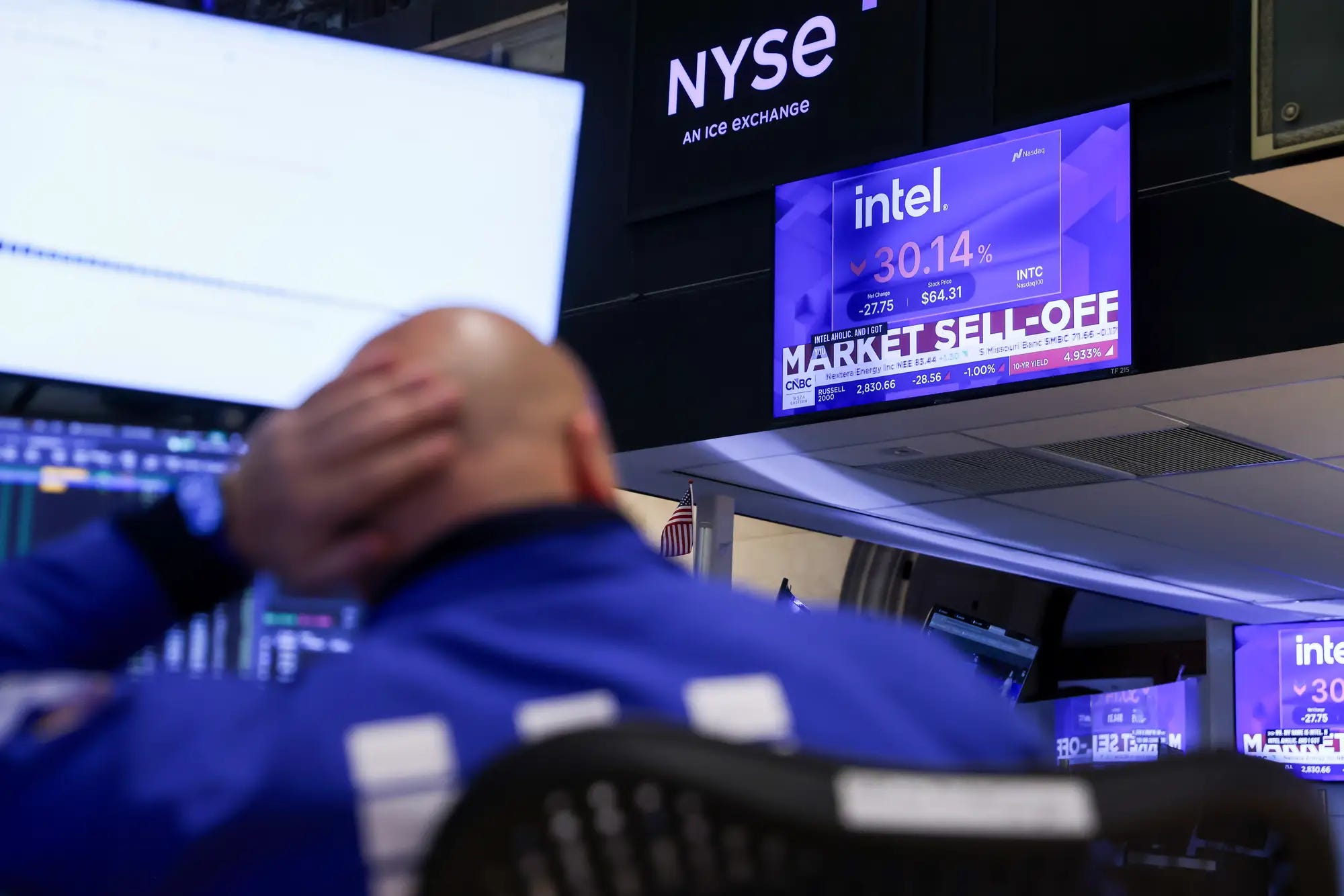
Now, I’m 51 years old with a family. The market started flashing crazy red signals last week; Intel lost 29% of its stock market value in a day and numerous tech stocks were in the red as they reported being cash flow negative to fund AI infrastructure. Then, just yesterday, tech stocks declined sharply. Investors are trying to figure out who is going to pay $3 trillion for the AI buildout and how. I, personally, have long been dubious. I’ve believed that two things could be true at the same time: AI is a game-changing technology AND the market has gotten way ahead of itself.
Think about the Internet circa 2000 – it did indeed change the way we live, shop and work. Amazon did eventually become a trillion-dollar company. But there was a bubble, it popped, and Pets.com, Global Crossing and dozens of other public companies were washed away as the Nasdaq shed 60% of its value. I literally attended liquidation events for dot-com companies that I’d attended launch parties for just months earlier as a hanger-on looking for free food.
AI is in the process of changing the way we think, work and love – for better or worse – and will shred millions of jobs. Also, these valuations and investments don’t make any sense. You can’t conjure up another $80 billion in revenue for Anthropic and OpenAI when companies and individuals can accomplish most tasks with cheaper open-weight models that are fine for 85% of use cases at a tiny fraction of the costs. How much are you personally spending on AI? How much is your company spending or willing to spend? Indeed, it’s crystal clear that Anthropic and OpenAI’s compounded growth rates are already slowing. A lot of the money that is being spent right now will never be paid back. Billions of dollars are being squandered.
One clue as to what was happening was in January 2025, when DeepSeek, a Chinese AI company, announced it could achieve comparable results to ChatGPT at a small fraction of the cost. Nvidia lost 17% immediately and the tech sector shed $590 billion in value over fears that the infrastructure buildout costs were excessive. DeepSeek was banned in many U.S. agencies due to privacy concerns. But the fear that open-weight models could do a lot of lower-order work for pennies on the dollar never actually got addressed.
I’ve got a newsflash for everyone but . . . most work is lower-order work.
When I was raising money for Noble Mobile, multiple investors said to me, “Andrew, if you start something with AI in the name, I’ll cut you a seven-figure check right now. But I can’t invest in a feel-good consumer play.” Perhaps because I’m somewhat contrarian, this made me feel better about what we were doing . . . and also that numerous AI companies were going to be funded that were never going to make it. By the way, Noble Mobile is up to eight figures in annual revenue and growing and isn’t going anywhere unless people decide they can do without a cellphone. I wanted to start something that would save the average consumer money and improve their outlook and mental health; I have the feeling that we’ll only do better in tough times. History is repeating itself.
Much of the growth is once again illusory. Get ready for cascading loss of value at a scale that has not been seen in eighteen years. Dozens of billion-dollar companies are about to go up in smoke. The folly of some of our most exalted figures will be on full display, but hey – most of them made money on the way up.
TL;DR - When a bubble bursts, it’s merciless and you don’t want to be anywhere near it. Act accordingly.
For 6 months off your mobile bill with Noble Mobile, click here or email matt@noblemobile.com and use my name to switch or explore. It will save you money and time – hundreds of dollars for the average American. Look up.