Labor on the Run

Follow into
Save into
Follow into
It’s Labor Day, which is a fine occasion to reflect on where we are. Many leaders are waking up to the fact that our economic system – capitalism – is becoming unduly harsh and punitive for millions of Americans.
And these critiques are coming from hard-nosed business leaders:
Ray Dalio: “Capitalism is not working for the majority of people.”
Marc Benioff: “Capitalism as we have known it is dead.”
Warren Buffett: “The economic system... rewards people with specialized talents in an extraordinary way that didn’t exist 50 or 100 years ago. That prosperity has not trickled down to everybody who is willing to work hard.”
The percentage of GDP that goes to workers is declining and has been for decades – it’s trending down to 50% which would be the lowest ever. AI is going to push it below that level in the coming months as more value heads into the cloud.
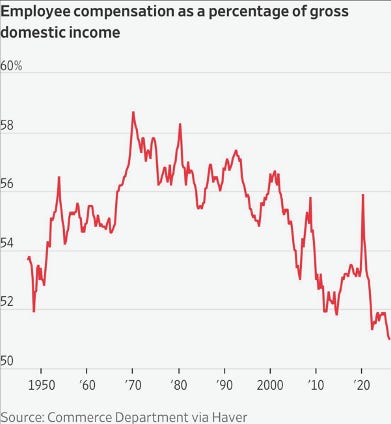
More than $3 trillion is being spent on AI which is going to soak up more and more of the value that used to go to workers. That’s clear from what’s happening right now to recent college graduates, almost half of whom are presently underemployed.
I was on a panel in Las Vegas this summer, and the head of an economic research non-profit said, “Well, we used to hire multiple research assistants to help research our reports, but now we don’t have to because of AI. So has it thinned out our staff? Yes it has.” Multiply that times a million organizations of all shapes and sizes and you get the idea.
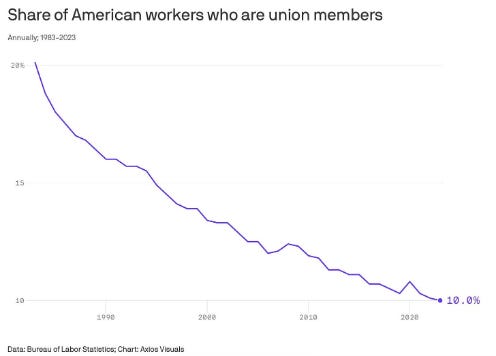
One of the traditional counterweights and distributors of economic gains has been labor unions. However, the percentage of American workers who are members of a union has declined precipitously from over 20% in the 80s to only 10% today.
Labor Day was inaugurated in 1894 by Congress as a national holiday in response to the Pullman Strikes of railroad workers that killed dozens and caused the equivalent of $3 billion worth of damage in today’s dollars. Railroad workers had their wages cut and were protesting.
Today, wages might be staying level or increasing slightly, but inflation feels out of control. Grocery prices have gone up 30% in the past 10 years, gas prices are biting, and housing feels increasingly unaffordable to millions. Healthcare costs are up 76% in this same period.
At this point, socialism is becoming more and more appealing to folks. In recent polling, 58% of Democrats and about half of young Americans have a favorable view of socialism. I get it. If all I’d seen is the last 10 years I’d be angry and frustrated about the status quo too. Most corrective measures that people suggest amount to nipping at the edges.
I would summarize the challenge as this: “How do we get the American economic system working for the vast majority of its people even as AI arrives and begins decimating jobs?” The labor force participation rate is declining as you read this, to 61.4% in July, aberrantly low among industrialized countries. In Europe, it’s around 75%. One-third of working-age American men are out of the workforce right now, and that problem is getting worse as young men disengage.
If you follow me, you know that my answer is to distribute the gains of technological advances quickly and broadly to the American people through a dividend or universal basic income. If you look at the numbers, it’s one of the only answers that makes sense.
Today is Labor Day. Increasingly, trading our time for money is going to become less and less central to the way our economy generates value. How families get by during this time is an open question that is dying for a response. In the meantime, the anger will rise.
I interview local currency expert and small business advocate DW Ferrell this week on the podcast. To check out Forward Party candidates including Todd Achilles, Seth Bodnar, and Brian Bengs click here. A new poll has Brian Bengs tied with the incumbent! For 3 months off your mobile bill with Noble Mobile, click here or email matt@noblemobile.com and use my name to switch or explore. It will save you money and time. Couldn’t you use more of both?