
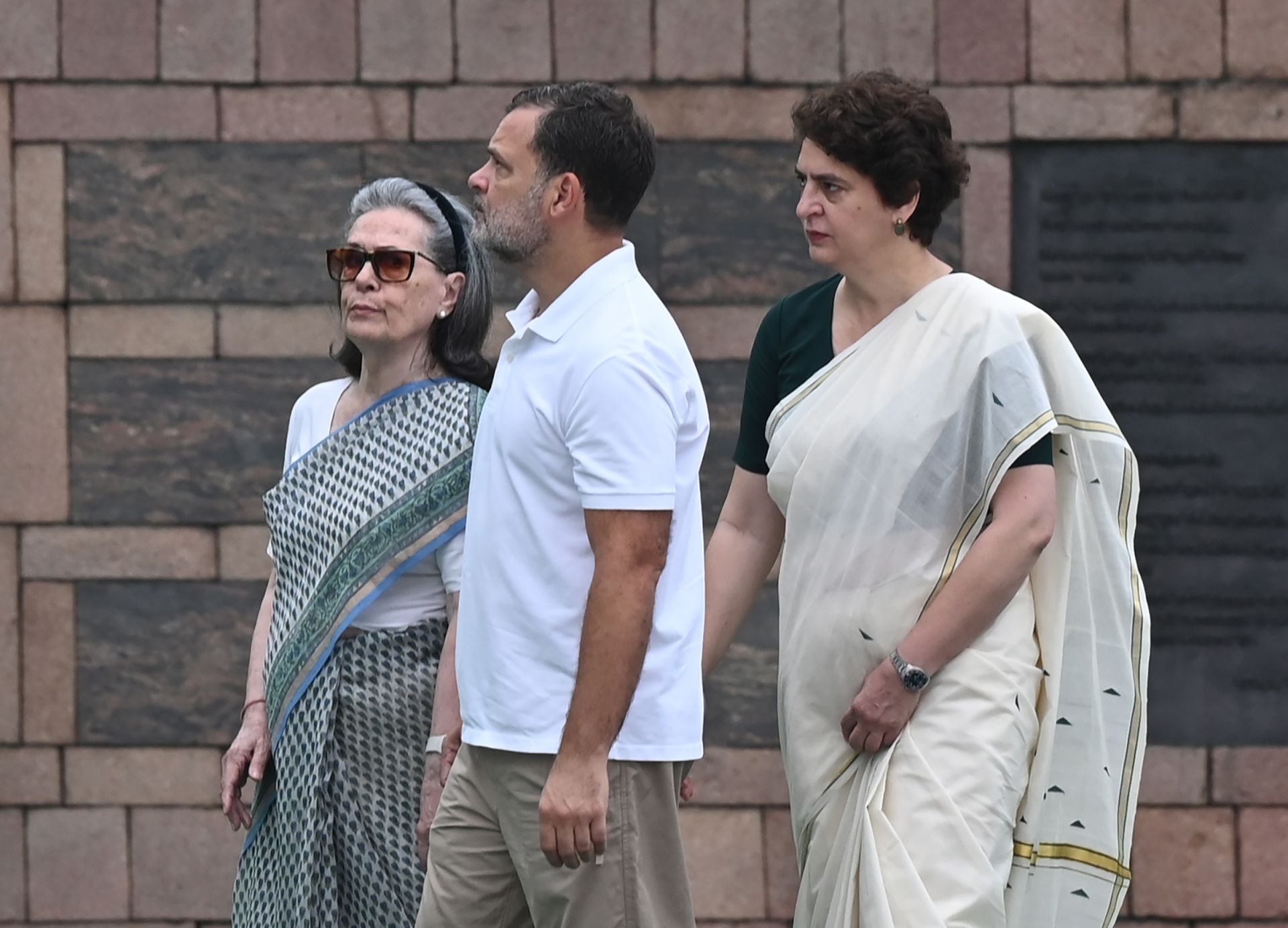
On Sept. 7, 2022, Rahul Gandhi stepped out for a walk. What followed was a journey of 2,500 miles over 145 days, starting from Kanyakumari, the southernmost tip of India, and traversing the whole country. For weeks, he walked through villages, towns and cities, listening to farmers, students, workers and activists along the way. In a country where leaders traditionally address carefully curated crowds from a heavily barricaded stage, this was groundbreaking. Here was a man, born into India’s most recognizable political family, talking to them without any political theater.
This was evident on the evening of Oct. 2, the birth anniversary of Mahatma Gandhi (no relation to Rahul Gandhi), when the Bharat Jodo Yatra (Unite India March) rally through Mysuru in Karnataka was marred by rain. And yet, as water poured down, Rahul addressed the crowd, his voice booming over the chaos. The image of a drenched leader addressing an equally drenched crowd stayed on the phones of his supporters for months.
Four days later, in Mandya, his mother, Sonia Gandhi, joined the march. When Rahul noticed that her shoelace had come undone, he bent down to tie it himself, creating a tender moment that quickly went viral. During a second march, the Bharat Jodo Nyay Yatra, as Bharatiya Janata Party (BJP) workers in Madhya Pradesh greeted him with chants of “Modi, Modi” and “Jai Shri Ram” (Hail Lord Rama), attempting to needle him, Rahul got down from his vehicle and shook hands with them.
The march helped to retire Rahul’s image as a part-time politician who appeared before elections and vanished afterward, replacing it with that of a man willing to spend months on the road, listening before speaking. Rather than resorting to difficult-to-follow jargon in news interviews, he spoke of opening a “mohabbat ki dukaan” (“shop of love”) in a “nafrat ka bazaar” (“marketplace of hate”).
Now, as massive protests against the Modi government spread across India, first over education and unemployment and then over the revision of electoral rolls, Rahul, as the leader of the opposition, has become the face of the movement. His sister, Priyanka Gandhi Vadra, is his sharpest ally, in Parliament and on the street. Their mother, Sonia, the longest-serving president of the Indian National Congress, who now sits in the Rajya Sabha, the upper house of Parliament, is the party’s matriarch, stepping in when needed and building consensus across the opposition ranks.
The Gandhi family has become relevant once again, and the question it faces is whether it can organize the opposition into a credible alternative to Modi.
Rahul entered politics in 2004 as the heir to a formidable legacy. He is the son of former Prime Minister Rajiv Gandhi and Sonia Gandhi, the grandson of former Prime Minister Indira Gandhi, and the great-grandson of India’s first Prime Minister Jawaharlal Nehru. While the Gandhi name opened doors, it also set an impossible standard of comparison.
At 40, Rahul’s father, Rajiv, was the youngest prime minister of India. When Rahul was 40, he was general secretary of the Congress party, as it is commonly referred to, fielding questions from TV anchors about why he would not join Prime Minister Manmohan Singh’s Cabinet. In January 2014, his first extended television interview before the national elections was widely mocked because of his halting, vague answers.
It cemented his image as “Pappu,” a messaging campaign run successfully for years by the BJP to portray Rahul as incompetent. Much of mainstream television preferred the clipped joke to his full speech. A 40-minute address would often be reduced to a 10-second stumble and played on loop.
In 2014, the Congress party shrank to just 44 seats in the Lok Sabha, the lower house of the Parliament, suffering its worst-ever electoral defeat, as the BJP, led by Modi, secured a clear majority. For the first time, the Congress party was no longer the pole around which Indian politics turned. Many opposition leaders expected the 2019 election to produce a correction. Instead, the BJP won 303 seats on its own, while the Congress party managed 52. The BJP has since dominated India’s politics, including beyond the ballot, cementing the belief that Modi represented the future and the Congress party was fading fast.
In 2024, however, cracks began to show. Even as Modi became prime minister for a third consecutive term, a feat achieved only by Nehru before him, the BJP fell short of a majority on its own. It won only 240 seats and had to rely on coalition partners. The Congress party almost doubled its tally to 99 seats; Rahul became the leader of the opposition, and whatever the party’s limits, it showed that it could not be written off.
Just as the momentum built in 2024 was being lost after a series of election defeats and splits and defections within the opposition, in the summer of 2026, medical examination irregularities set off a youth-led agitation. A new group, the Cockroach Janata Party (CJP), organized a sit-in demanding that the education minister, Dharmendra Pradhan, resign. In parallel, Rahul had launched “Chhatron Ki Goonj,” or “Voice of the Students,” in June, as an open conversation with young people on education and unemployment.
On July 20, however, after a police crackdown on the CJP-led march to Parliament, Rahul joined the movement by leading a sudden sit-in protest outside Modi’s residence along with Priyanka, Congress party President Mallikarjun Kharge and other opposition parliamentarians, forcing many mainstream TV news channels, otherwise hostile to Rahul, to grant him uninterrupted coverage. The images of his subsequent detention went viral.
For the first time since 2014, Modi appeared to be on the defensive, unable to control the narrative. The CJP and the Congress party demonstrations were never formally coordinated, but running on parallel tracks, they kept the government under sustained pressure. After days of nationwide protests, Pradhan was out.
Since then, Rahul’s student dialogue program has been drawing huge crowds. At Prayagraj, his first event after the protests, thousands of students turned up. More cities have followed since, and students have found a safe space to express anguish. In Pune, he called on young women to “smash the patriarchy,” a phrase conservative politicians once dismissed as woke vocabulary.
Soon after, in September, as the long-running fight over revision of the electoral rolls and conduct of the Election Commission came to a head, the outrage gave new life to the argument Rahul made last year over voter manipulation.
Since then, he has been leading a series of protest marches in Delhi, accusing not only the chief election commissioner, Gyanesh Kumar, but Modi, too, of treason. He has been detained three times. Tens of thousands joined his “March for Democracy” on Oct. 12, and on Nov. 1, Rahul led the biggest opposition rally seen in the capital since 2014. His words are now traveling further than they have before. By one estimate, his YouTube channel drew more than 100 million views in a single month recently.
Leaders from across the opposition alliance, the Indian National Developmental Inclusive Alliance (INDIA), appear to have accepted Rahul as first among equals. He is no longer presented, even by his critics, as a dynastic successor waiting for power, but as an opposition leader setting the daily agenda. CVoter’s long-running tracker of whom voters prefer as prime minister shows the gap narrowing between Modi and Rahul. Between 2014 and 2019, Modi commanded around 60% support to Rahul’s 30%. Now Modi is below 50%, and Rahul is close to 40%.
Lately, many have also been asking whether Rahul has changed. The Congress party’s language hasn’t changed, and neither has the man who speaks it. What has changed is the “hawa,” the political air, which is finally making people take notice.
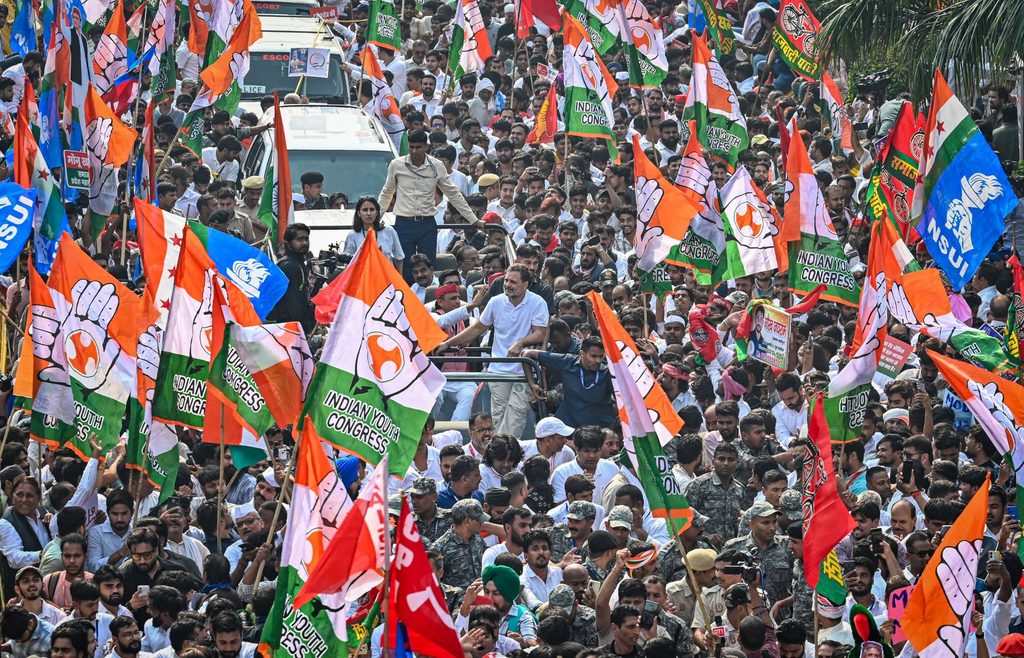
Rahul Gandhi, along with other INDIA bloc leaders, participates in a march ahead of the alliance’s mega rally in New Delhi, India, on Sunday, Nov. 1, 2026. (Sanchit Khanna/Hindustan Times via Getty Images)
In 2024, Rahul’s hand was strengthened by his younger sister, Priyanka Gandhi Vadra, who has become a key Congress party talisman, star campaigner and parliamentary crisis manager.
She has been campaigning in the family’s strongholds of Rae Bareli and Amethi since 1999, and for years, the question of when she would formally enter politics was the Congress party’s favorite parlor game. At one point, posters demanding “Priyanka lao, Congress bachao” (“Bring Priyanka, save the Congress”) were a common sight outside party offices. In 2019, many expected her to take on Modi in Varanasi. She declined, however, saying she would do so only when she felt it from within.
In the 2024 election, though, she showed that Modi could be countered. While she sat out of the contest herself, she ran one of the party’s most demanding campaigns. By the party’s count, she addressed 108 public meetings and roadshows across the country, more than her brother, and gave over 100 media appearances and half a dozen interviews. Priyanka entered electoral politics months later, contesting a by-election for a seat in Wayanad, which Rahul, who had also won in Rae Bareli, passed on in favor of the Gandhi family bastion. She won by about 410,000 votes, a bigger margin than his 364,000.
For many Congress party supporters, her rise carries echoes of another era. With her physical resemblance to her grandmother Indira and her ability to connect with crowds on a personal level, many expected her to become the party’s most effective mass campaigner. During the 2024 national election, social media chatter and a section of Congress party workers went further, asking whether the party had put the wrong sibling in front.
For a long time, her challenge had been to convert recognition into a sustained political organization. She often had spikes of visibility during elections, fading away between them.
But this dramatically changed once she entered Parliament. The presence of two Gandhis in the lower house has kept Modi on the defensive. The siblings now play complementary roles: Rahul, as leader of the opposition, sets the attack, and Priyanka, with a sharper turn of phrase and an instinctive connection with the gallery, delivers the sting. The siblings’ recent appearances protesting on the streets have drawn considerable attention.
Their joint mobilization has strengthened the perception of a coordinated leadership, but whether it can help the Congress party build a more effective political and electoral strategy remains an open question. Less than two years apart and with no natural order of succession, there are unofficial Rahul and Priyanka camps within the party, who prefer either as a prime ministerial nominee. Some leaders privately say Priyanka has greater appeal among the cadre.
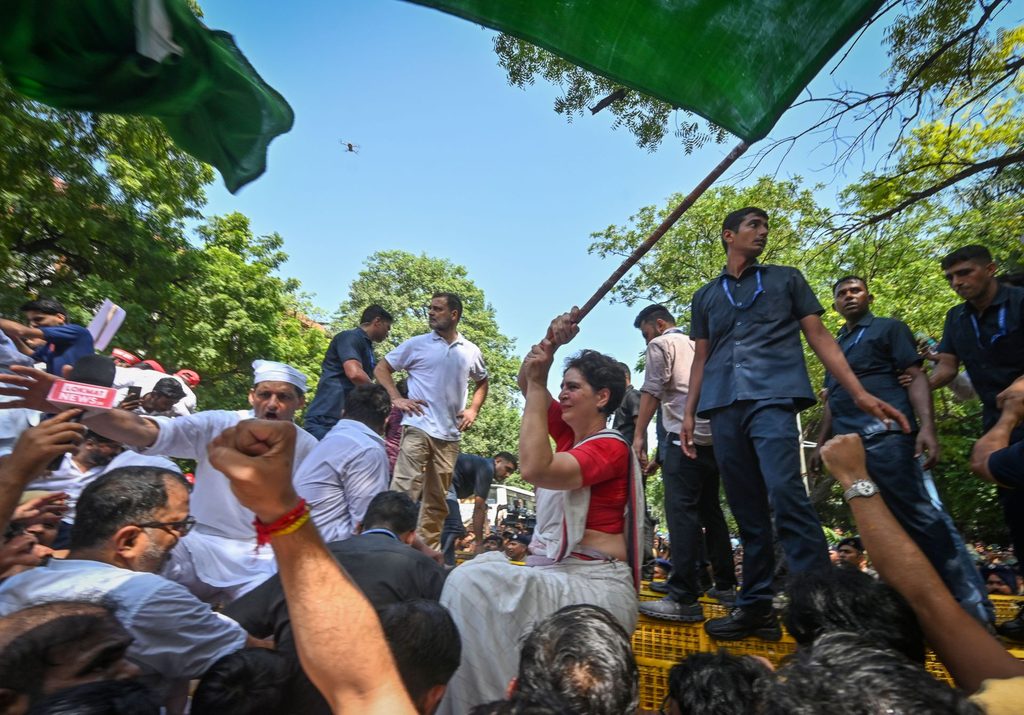
Congress party leaders Priyanka Gandhi Vadra and Rahul Gandhi take part in a protest march from Parliament toward the Election Commission on Oct. 6, 2026 in New Delhi. (Sanchit Khanna/Hindustan Times via Getty Images)
If Rahul represents the Congress party’s attempt at reinvention and Priyanka its unrealized potential, Sonia represents its institutional memory. Her importance lies not only in the office she held, but in the political relationships she cultivated. The Sonia years, after all, were built around coalition management.
Sonia, who was born in Italy, moved to India after marrying Rajiv in 1968, and the couple lived with his mother, Indira, who was by then prime minister. For more than a decade, they kept their distance from politics. Rajiv flew planes for Indian Airlines, while his younger brother, Sanjay, was Indira’s political heir and closest adviser. But when Sanjay died in a plane crash in 1980, Rajiv entered politics reluctantly, over his wife’s vehement objections.
When Indira was assassinated by her own bodyguards in 1984, Rajiv became India’s youngest prime minister at 40. Seven years later, he too was assassinated, by a suicide bomber linked to the Liberation Tigers of Tamil Eelam. Many assumed the Gandhi family’s political chapter was over. But fate had other plans.
For years, Sonia resisted calls from Congress party leaders who believed that only the Gandhi name could revive the party. In 1996, its tally had slipped to 140 seats in the Lok Sabha. From 1995 to 1998, four breakaway groups emerged, state governments were destabilized, and the party headquarters at 24 Akbar Road in Delhi looked deserted. In a party with no single ideology to bind it, the family name was the only glue.
After nearly seven years of refusals, Sonia took over as party president in 1998 and inherited a party struggling to stay competitive in the era of coalition politics. Meanwhile, Atal Bihari Vajpayee’s BJP had strengthened its position as a serious national alternative. In 1999, Sonia won her own seat in Parliament and became leader of the opposition. She then moved the party away from its go-it-alone resolution, and in 2003, it formally embraced the idea of coalitions.
In 2004, despite the BJP’s confident “India Shining” campaign and most predictions, the Congress party-led United Progressive Alliance surprised everyone and formed the government. As the chairperson of this coalition, Sonia held together parties with sharply different ideologies and regional interests.
Her foreign birth had been the single most potent charge against her. In 1999, three senior leaders of her own party publicly objected that a person born outside the country should not lead India. The BJP’s Sushma Swaraj vowed to shave her head if a foreign-born Sonia took the oath. In 2004, as the coalition prepared to name her prime minister, Sonia faced the moment that would define her. She declined the post, citing her “inner voice,” and Manmohan Singh, an architect of India’s economic reforms in the 1990s, became the prime minister.
She understood early that a party that had lost its majority had to learn the language of partnership. The government depended on outside support from 61 parliamentarians of the leftist bloc, and she kept them on board for four years, until the nuclear deal with the United States broke the camel’s back in 2008. When the leftist bloc walked out, Sonia’s staff found new support within days. The Samajwadi Party, the Congress party’s then-rival in Uttar Pradesh, switched sides, and the government survived a confidence vote.
In 2026, Sonia’s skill of building bridges between rival interests may matter again. The INDIA bloc is ambitious but fragile, and its contradictions are obvious. Its members oppose the BJP nationally, but often compete against one another in their own states.
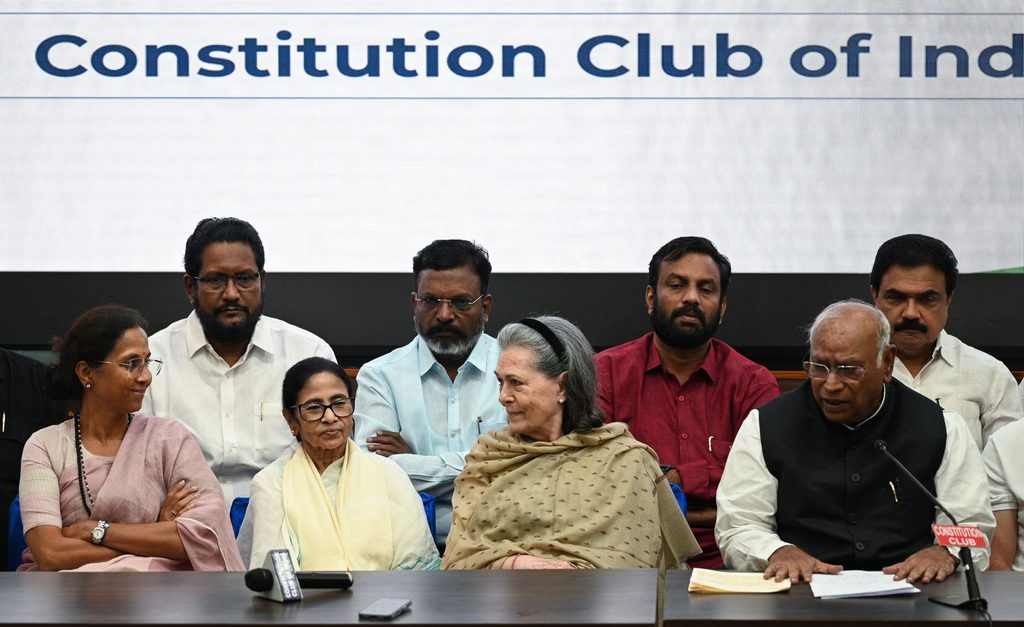
Congress party President Mallikarjun Kharge (far right), along with Congress Parliamentary Party Chairperson Sonia Gandhi, during a press conference after a meeting of the INDIA bloc in New Delhi, Sept. 30, 2026. (Arun Kumar/The India Today Group via Getty Images)
For someone who held so much power for so long, Sonia has said remarkably little about herself. Her memoir, “Belonging: A Journey of Love,” to be published by Alfred A. Knopf in the U.S. and HarperCollins in India on Nov. 10, will be the first time she tells her story at length. It runs from her girlhood in postwar Italy, meeting Rajiv in Cambridge and marrying into the Gandhi household, to the two assassinations and her years leading the Congress party.
The first real clue about the book’s contents came in late August, when Penguin Random House India, which shares a parent company with Knopf, backed out of publishing it, reportedly over changes and deletions about Modi and his politics that Sonia refused to make. But in interviews this weekend, Sonia explained that the book was not only her and Rajiv’s love story. It is also about “how I grew to love Rajiv’s family and the country to which they belonged, and then I too came to belong in it. And of how this love brought me into public life,” she told N. Ram, former editor-in-chief of The Hindu newspaper.
In an excerpt published in the same newspaper, she wrote about her dilemma over formally joining politics, amid Rahul and Priyanka’s vehement opposition to it. In the end, however, it was the “Bhagavad Gita,” one of the most prominent Hindu scriptures, that had a profound influence on her decision to join. In an interview with The Guardian, she accused Modi of being an “authoritarian force bent upon changing the very nature of our country,” and said the BJP had “systematically dismantled our democratic institutions.”
Meanwhile, political commentators have a long list of questions waiting to be answered. Why, after her husband’s death, did Sonia’s relationship with Prime Minister P.V. Narasimha Rao sour into one of the defining feuds of 1990s Congress party politics? What broke the Gandhi family’s once-close relationship with the Bachchans, one of Hindi cinema’s most famous families? Why did Sonia choose Singh over the party’s more seasoned leaders in 2004? Why was Rahul, not Priyanka, groomed as heir? And in 2014, did she fail to see a Modi wave coming?
Sonia, who joined Instagram at 79 to promote her book, has said, “There’s bound to be some tamasha [spectacle] when this book comes out. After all, others have spent decades telling my ‘story’, now it’s my turn.” Memoirs rarely move votes, but in a political culture where contempt for the Gandhis has circulated online for years, a first-person account from the woman at its center may at least complicate the caricature.
The 2024 election results did not change a central reality. Modi is one of the most formidable leaders India has ever produced. Any assessment of the Congress party’s future must begin by acknowledging how thoroughly the BJP has transformed Indian politics. In the last 12 years, the BJP has gone from governing seven states to leading governments in 21 with its allies, 15 of them on its own, and has turned national elections into presidential-style referendums on a single face.
By contrast, the Congress party has struggled to make its vision of India’s future compelling. Its traditional language of secularism, social justice and institutional balance still matters to many voters. But in a political atmosphere shaped by emotion and identity, the party has often struggled to make its ideas land with the same force as the BJP’s.
The Congress party’s organizational decline is just as central to understanding the Gandhi dilemma. The family continues to provide the party with national recognition, but that alone cannot win elections in contemporary India. The BJP’s strength lies not only in Modi’s popularity but in a vast network of workers and grassroots structures built over decades. It is structured almost like a corporation that happens to be in the business of competing for elections. The Congress party has no equivalent machine.
As opposed to the institutional dynamism of the BJP, the Gandhi family remains the Congress party’s greatest asset and, to some, its greatest vulnerability. The name evokes long-standing trust, along with allegations of nepotism.
National elections, due in the summer of 2029, may well be an existential challenge for the Indian opposition. But the central challenge before the Gandhis is not simply electoral. Rahul’s political journey suggests that reinvention is possible. But one person’s reinvention is not enough to revive a party.
The Congress party’s strongest periods were not built around the charisma of one leader. They were built through a network of regional leaders, grassroots workers and social alliances that gave it a presence in every corner of the country. A revival will depend on whether the Gandhis can create that ecosystem again.
The post Can India’s Oldest Political Dynasty Find a New Mandate? appeared first on New Lines Magazine.