
Buses passed the burned-out metal structures of Iranian aircraft on the tarmac of Tehran’s Mehrabad Airport, remnants of the fleet Israel bombed in March this year. They were carrying passengers to two waiting Soviet-designed airlifters — an Antonov An-74 and a giant four-engine Ilyushin Il-76.
The flights, which took place in late October, were conducted by the Aerospace Force of the Islamic Revolutionary Guard Corps (IRGC). Yet the passengers consisted of more than 300 volunteer medical personnel and doctors on a health aid mission — tightly crammed on rows of benches pulled through the carrier. Less than two hours later, they had landed in Shiraz, in southern Iran.
For the next three consecutive days, they spread out across six rural areas in the proximity of Shiraz, and a number of less affluent suburbs of the city, to provide medical aid. To this end, rural schools, religious congregation halls and sports halls were repurposed into makeshift clinics.
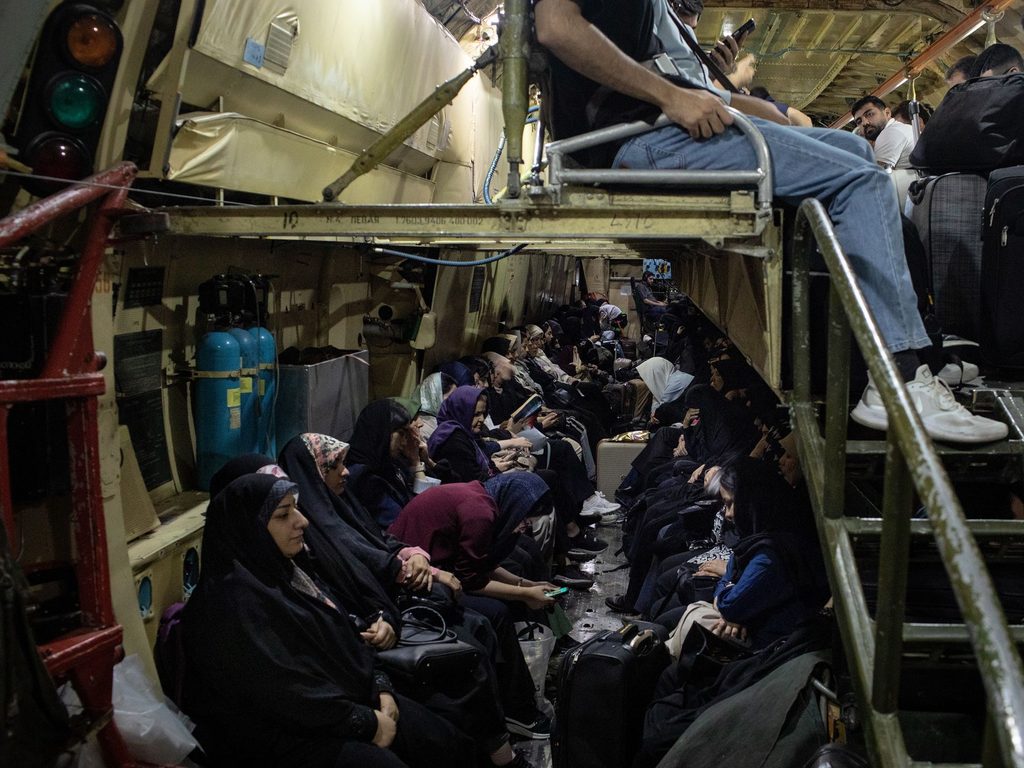
Volunteers sit on board an Islamic Revolutionary Guard Corps Aerospace Force Ilyushin Il-76 on their way from Tehran to southern Iran‘s Fars province. (Kaveh Rostamkhani)
Given the amount of medical equipment that needed to be transported, the endeavor was a mammoth logistical task, so the volunteers had teamed up with the IRGC Aerospace Force. The force is well known for being in charge of Iran’s missile capabilities and strategic deterrence. Yet with its fleet of airlifters and helicopters, it is also well-versed in the rapid deployment of personnel and logistics. That is a crucial but lesser-known quality of the force, and one that has come to the fore during a number of major crises since the devastating earthquake in Bam in 2003.
Nearly 20 miles south of Shiraz, in Bid Zard, this delicate aspect of the cooperation was palpable. There, next to the main road, a derelict caravanserai is one of the few traces remaining of the Sassanian road network, which then connected the empire with its Mesopotamian capital. But 14 centuries later, during the 40 days of the war in March 2026, an entire residential area on the upper side of the road was ordered to evacuate as a precaution, because it lies adjacent to the outer limits of an IRGC missile facility.
Fences on the surrounding hills mark its limits. The community of approximately 7,000 households witnessed and endured the horror of heavy bombings. When residents returned to their buildings, they found only shattered glass and some cracks in the plaster, though the horror remained with them. Now, a makeshift clinic had been set up at the local hussainiya, or Shiite congregational hall, with logistical assistance and sponsored medical supplies from the force in charge of the neighboring missile facility — a gesture of solidarity with the destitute community.
A queue of around 80 people was pressing against the doors of the local hussainiya, seeking dental treatment. “We are waiting in the queue until grass grows under our feet,” said Maryam Bayat, a 45-year-old resident of Bid Zard, as she complained about the long waiting hours for treatment at the makeshift clinic. She had come with her 8-year-old son Amir-Mohammad and mentioned that she herself had been coping with toothache for a year already.
Bayat continued: “I take any pill that I can get hold of, only to relieve my pain. And it has been three or four months since the rear teeth of my son started to rot. For him I apply a clove spray.” She works as a day laborer washing vegetable produce in a nearby village. Her husband is employed as a day laborer in construction. Together they earn an unsteady average monthly income, equivalent to less than $100, for their household — a figure below the poverty line of roughly $120 a month for the country outside Tehran, as cited by a researcher at the Iranian parliament’s research center in September.
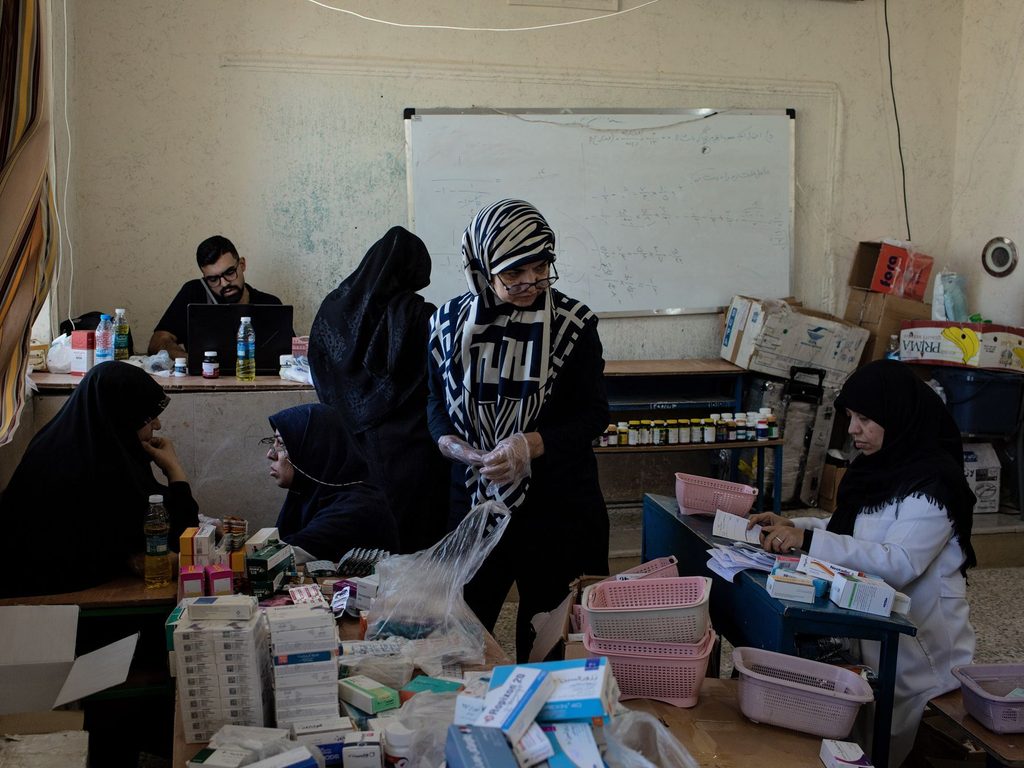
Volunteers use a classroom at a local high school as a makeshift pharmacy for general medicine that they distribute among locals. The materials were sponsored by the IRGC Aerospace Force in support of the campaign. (Kaveh Rostamkhani)
Admitting that proper dental treatment would represent a financial burden to her, Bayat bemoaned that there is also no dental clinic in the community, making the volunteer campaign ostensibly a welcome opportunity for her. The closest place she could have sought treatment for her son and herself was Shiraz, at an estimated cost equivalent to $226 — a sum disproportionate to their household’s income.
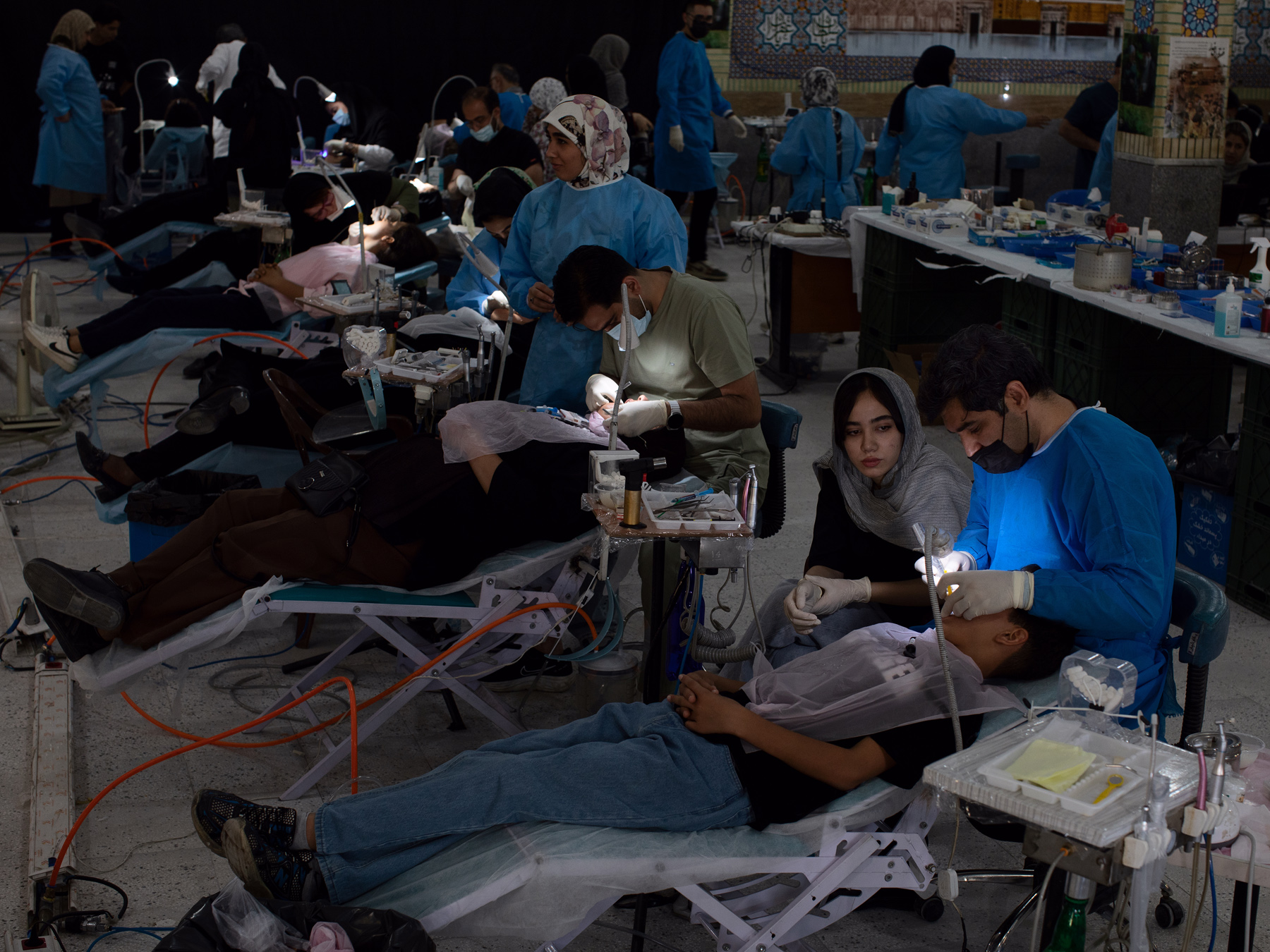
On the other side of the gate, inside the hussainiya, about 30 dental units were installed all around under improvised lighting and equipped with suction tools, effectively establishing a conveyor belt for dental services. Alongside other doctors, Abolfazl Ghaempanah performed a root canal treatment on Sina, a schoolboy from the community.
Ghaempanah, a Saint Petersburg-educated general dentist, usually treats patients in his dental practice in the western Iranian town of Hamadan, roughly 550 miles away from Bid Zard. Like many other medical personnel from various places in Iran, he drove to Tehran to board the Ilyushin. In Bid Zard, he was hosted by local residents alongside other medical personnel. “It’s 12 or 13 of us who sleep [on the floor] in a living room,” he said.
Structural poverty and limited access to healthcare are not new phenomena in rural Iran. In the autumn of 2026, with the prospect of renewed military escalation, the force largely responsible for Iran’s missiles has an unwritten interest in the goodwill of the rural communities that live alongside its bases, as well as those near the areas bombed by the U.S. and Israeli militaries during the recent war.
The medical campaigns continue a long history, reaching back to more than a decade before the 1979 revolution, when the state conducted health and vaccination campaigns. In the wake of these initiatives, it also carried out literacy and development aid programs with the aim of placating the more marginalized elements of the population.
After the revolution, the development efforts were continued with an altered ideological motivation. In fact, on the day the shah’s government was overthrown, Feb. 11, 1979, the provisional government ratified the Organization of Construction Jihad. For over two decades, the organization, which was later turned into a ministry of its own, carried out an ambitious rural development campaign, but also disseminated Islamic revolutionary and religious ideals. Religious fervor and the urge to spread Islamic values in the countryside had become the motives for development aid. A common aim before and after the revolution, however, was to contain the spread of socialist and Marxist ideals among the peasantry in the midst of the Cold War.
During a brief break, while sitting on a prayer carpet and talking about why he would choose to close his practice for half a week, drive nearly four hours to Tehran, board an uncomfortable and extraordinarily loud airlifter and join a campaign that brings no financial benefits for him, Ghaempanah looked up and calmly said, “It’s a trade-off with God.” That was enough for him to have joined his 10th campaign in three years.
Elsewhere, people continued to queue. In Zafarabad, another rural community, roughly 6 miles west of Bid Zard as the crow flies, rowdy scenes took place among the waiting crowd in the yard of the hussainiya. Inside, another makeshift dental clinic was at work in a slightly smaller setting. The walls were decorated with posters depicting the children from all over Iran who were killed by U.S. and Israeli bombs during the war.
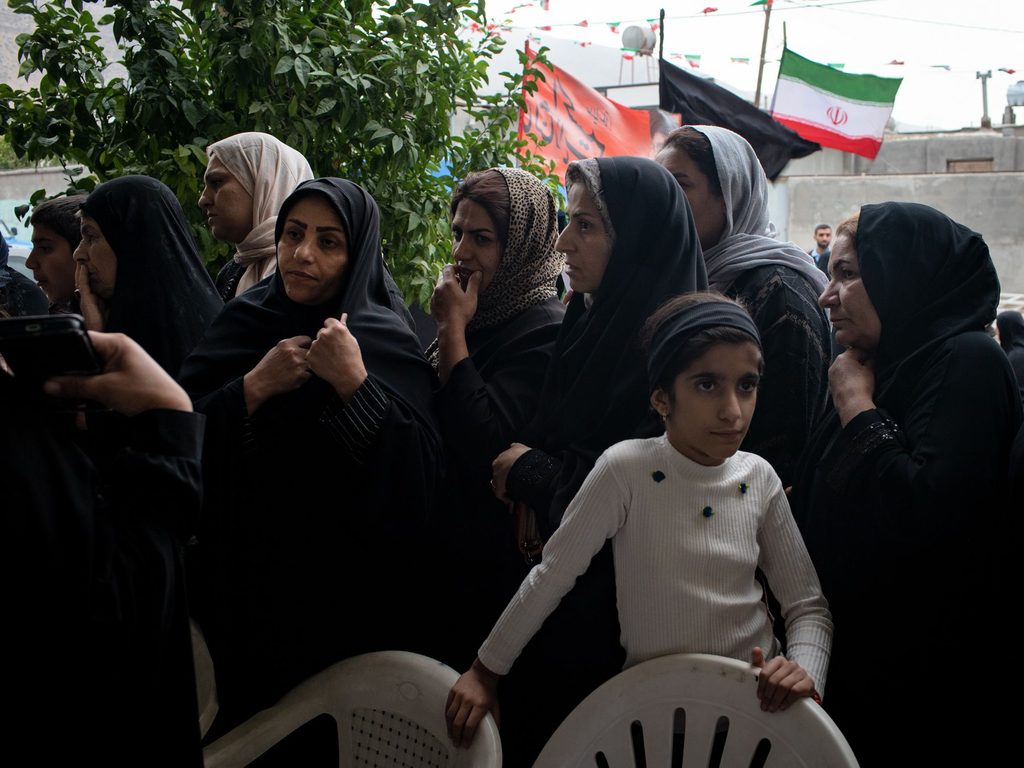
Locals line up for examination and treatment at a local hussainiya repurposed as a makeshift dental clinic. (Kaveh Rostamkhani)
In a corner, a 60-year-old doctor from Tehran with a pair of magnifying binoculars attached to his forehead worked meticulously on a young patient. Alireza Nikbin sees his commitment to development campaigns as a way of supporting the country in wartime, and puts it succinctly: “This dental unit is my missile launcher.”
“It makes a great difference, whether you are in Tehran or come to help in a place that has been hit directly,” Nikbin continued. Pointing at the queue outside, he said, “Our presence is not enough. There must be a queue of aid volunteers.” In his view, this helps the people at the margins of society feel valued.
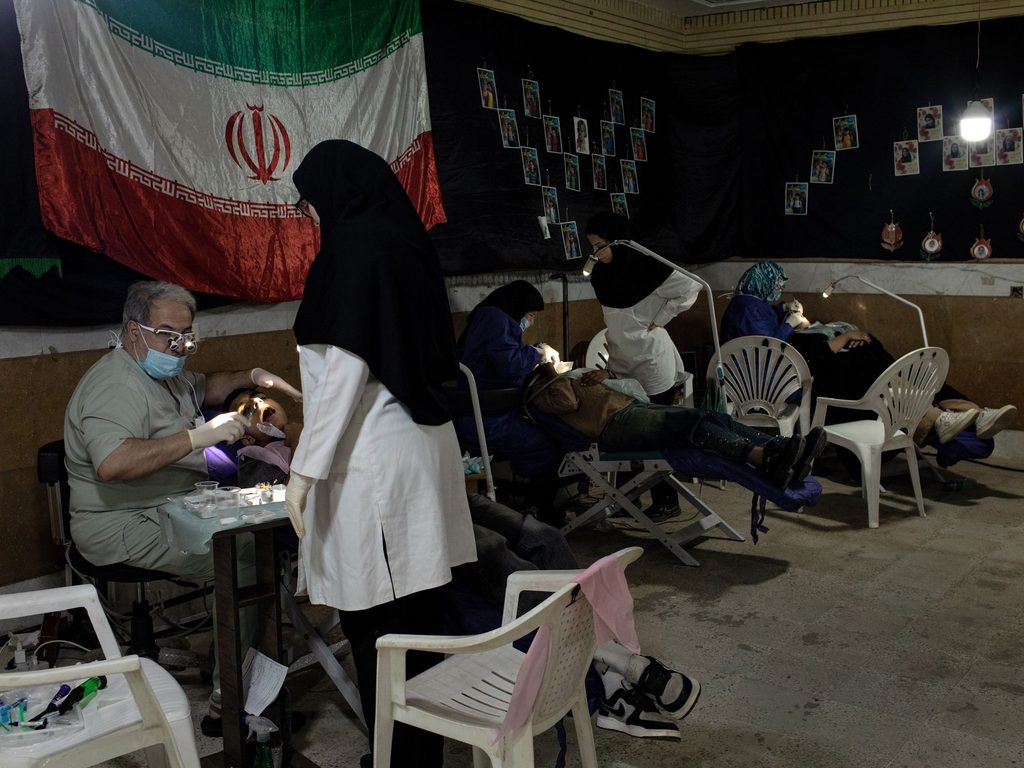
Alireza Nikbin, left, treats locals at a dental clinic. (Kaveh Rostamkhani)
Over the course of the three days that the makeshift clinic operated in Bid Zard, it examined 709 dental patients — roughly 3% of the community’s population. In Zafarabad, 2,340 people had registered for dental treatment, but only 500 were examined and treated in three days. These figures highlight the dire need for healthcare access, education and development in the area.
Parallel to the demise of the Soviet Union, Iran’s economic policies moved toward neoliberal reforms and privatization, rendering the aims of state-run development campaigns under the Construction Jihad less relevant. It was eventually merged with the Ministry of Agriculture in 2001. Grassroots volunteer groups aiming to conduct development aid were given the ability to do so under the auspices of the paramilitary arm of the IRGC, the Basij.
The reality on the ground during this three-day campaign demonstrated the dire need for more sustainable and long-lasting development efforts to expand a functional healthcare network, education and medical prevention. At the same time, in a country hit by war, financially isolated and sanctioned to a great extent, and now with all its transit routes increasingly constrained by a siege aiming to choke its economy, these rapid-response development campaigns are an important signal to the people, letting them know that they are cared for.
The post Volunteer Dentists, the Revolutionary Guards and Rural Development on Iran’s Home Front appeared first on New Lines Magazine.