
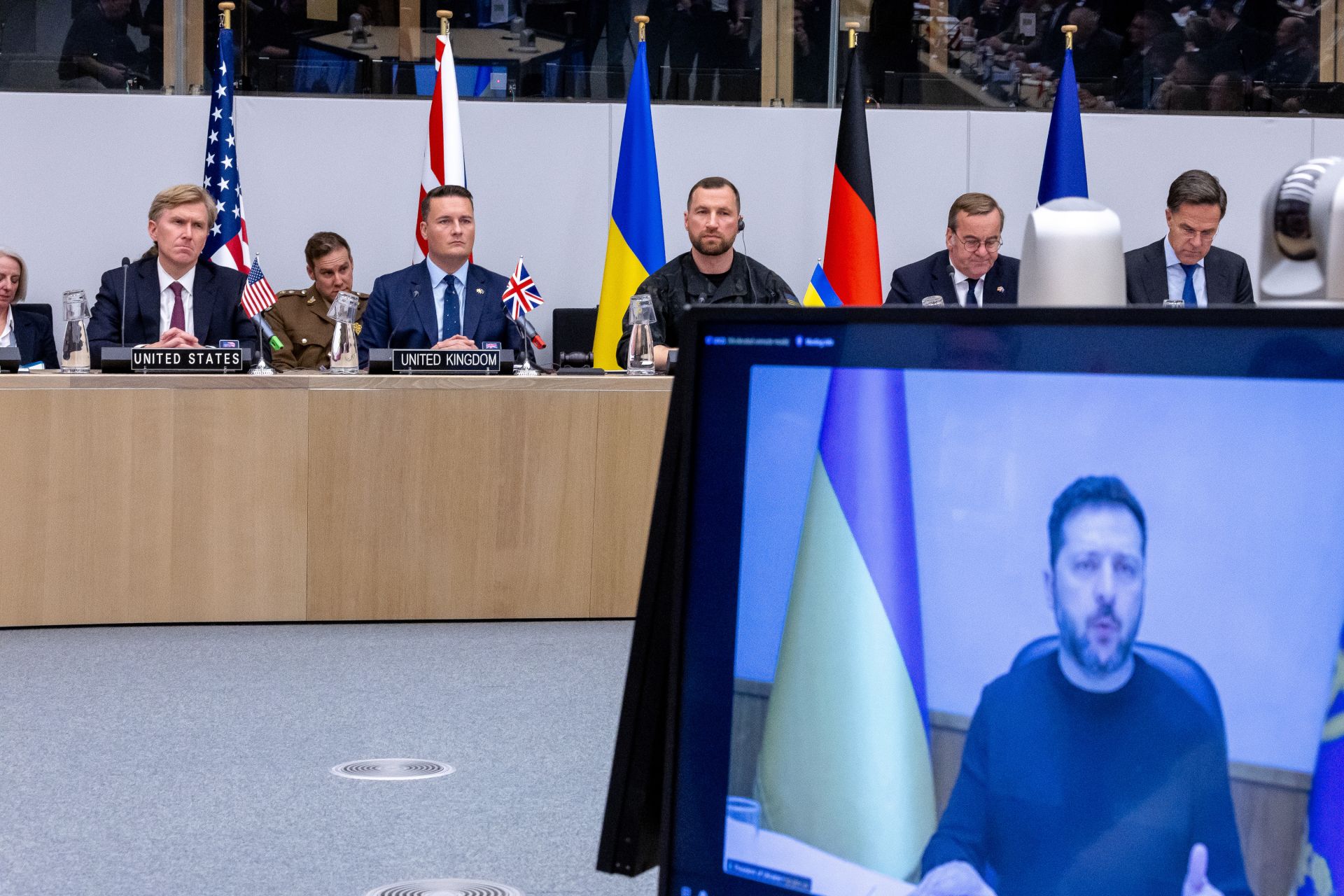
On Oct. 13, Democratic Rep. Jim Himes, the soon-to-be chair of the House Permanent Select Committee on Intelligence, was speaking on a panel at the Warsaw Security Forum when he was asked a question from a member of the audience: What should Europe expect from a future Democratic administration?
Himes’ response was probably not what those gathered at Poland’s leading transatlantic conference wanted to hear, but it was honest. “Superficially, everything is different,” he said. “There will be no threatening of Denmark. There will be no attacking Canada. All of the ludicrous, circus-like activities of the current president that serve no real purpose, in fact are counterproductive, are gone. We will return to our more diplomatic, globalist self.” But underneath the surface, Himes explained, “the truth is that the American people have realized, and Trump capitalized on this, that we paid a very large cost for the defense umbrella over a generation. And so there will be a continuation on the part of Americans to keep pushing the Europeans to assume more of a role.”
Europeans, by and large, awoke on Nov. 4 gratified to see the pole finally kicked out from under the MAGA big top. Democrats flipped both the Senate and House in a sweeping political victory that defied even optimistic expectations for a midterm rebuke of a deeply unpopular lame-duck president. Europe has borne much of Trump’s bombast and imperialist bravado, which has taken the form of antagonizing long-standing American allies and ingratiating himself with their main adversary, Russia, a beneficiary of that antagonism. Apart from threatening to go to war with Denmark over Greenland and turn Canada into “the 51st state,” Trump has toyed with withdrawing the United States from NATO, of which it is both a founding member and primus inter pares. Barring that, he’s said he might not honor the invocation of Article V, the collective security provision of the North Atlantic Treaty, if he deems the ally invoking it a deadbeat unworthy of aid, or if he just doesn’t feel like honoring it at all. (Article V has been invoked only once since NATO’s founding in 1949, by the United States after 9/11.)
Trump has also made no secret of his effort to fashion a kind of MAGA International by supporting aligned parties and political interests in Europe, even if that has meant intervening in their sovereign, democratic affairs. His 2025 National Security Strategy prioritized “cultivating resistance” in Europe, a template for soft regime change within two European blocs, NATO and the European Union, which represent, respectively, America’s strongest strategic partnership and its largest trade partner. Trump has displayed “resistance” most acutely through interventions in elections in Germany, Poland and Hungary. Vice President JD Vance gave a stump speech for the far-right Alternative for Germany party at the Munich Security Conference in February 2025, shocking his audience, including Friedrich Merz, the leader of the Christian Democratic Union, which won a modest victory in the federal election a week later. Both Trump and Vance campaigned for Viktor Orbán during Hungary’s parliamentary election last April, with Vance headlining a rally in Budapest in the waning days of that decisive race.
Trump has also picked fights with Europe by siding against himself. Since his first term, he’s preached European energy independence from Russia — a matter of great urgency because of Russia’s full-scale invasion of Ukraine in 2022 and an EU policy that mandates the phasing out of Russian liquefied natural gas imports by Jan. 1, 2027, along with Russian pipeline gas by Sept. 30, 2027. Then, in October, under the pretext of the rising price of gas at the pump, Trump cut his own energy deal with Vladimir Putin to import Russian diesel into the U.S., waiving sanctions. Now his envoys Steve Witkoff and Jared Kushner are reportedly dangling the prospect of reactivating dormant or destroyed Russian energy pipelines through Europe, via Ukraine, as an incentive to the Kremlin to end the war of conquest it started, now in its fifth year. Trump is bargaining with Putin using things he does not control, such as EU-frozen Russian assets totaling around $230 billion. According to Kushner, Trump’s post-midterm plan to end the war involves “practical arrangements that address the security concerns of all sides,” including “an enduring framework for long-term European security and stability.”
Europeans had long thought such a framework already existed — namely, an American-led NATO that worked with allies, not against them, in deterring Russia. “If you don’t understand how Russia ripped apart the European security architecture of the last 35 years, you won’t succeed at building a new one,” Michael Carpenter, the U.S. ambassador to the Organization for Security and Co-operation from 2021 until 2024, told New Lines. “It’s like trying to operate on a patient without understanding anatomy.”
Trump, he added, has little to no credibility in trying to get Russia to adhere to future security agreements. The current administration has not only eliminated almost all security assistance to Ukraine, it has also delayed transfers of materiel pre-authorized by the Biden administration. Burden-sharing, a tenet of the Trump administration’s advertised approach to NATO, is in reality wholesale burden transfer. The European allies, along with Canada, now pay the United States for almost all American military equipment sent to Ukraine via NATO’s Prioritized Ukraine Requirements List program. In return, Trump has imposed tariffs on almost all his buyers, who have otherwise met with lousy customer service.
The U.S. war in Iran has eaten away at critical American weapons systems, such as Patriot interceptors, with overseas shipments intended for Kyiv delayed due to stockpile shortages, sluggish manufacturing timelines or bureaucratic meddling. Volodymyr Zelenskyy, Ukraine’s president, told a Ukrainian broadcaster on Nov. 5 that $16 billion in preexisting American commitments still hadn’t been received. A new consignment of 500 PAC-3 MSE missiles, the variant of interceptor used to shoot down Russian ballistic missiles, was priced at $2.1 billion and purchased mostly with EU funds — except the first shipment won’t arrive in Ukraine until 2030 at the earliest. Ukraine’s inventory of PAC-3 MSEs is nearly exhausted, and the country faces a punishing winter of Russian missile and drone strikes.
Europe’s reliance on U.S. defense technology with built-in American kill switches has already proved dicey, if not potentially catastrophic. A mere 24 hours after Himes spoke in Warsaw about superficial tweaks to the transatlantic relationship, Ukrainian military officials noticed that their Starlink internet satellite terminals, which they rely on for everything from command and control at the front to counter-drone air defense, had been throttled. Germany and Poland are the largest financiers of Starlink in Ukraine. The disruption in service, reportedly the work of SpaceX CEO and former de facto DOGE administrator Elon Musk, who spent $445 million on mostly failed Republican midterm campaigns, would last for 10 days. It’s hard to know how many Ukrainian civilians were killed as a result of Starlink’s throttling, but many more Russian drones got through during that 10-day disruption than usual, including one that killed an infant in her stroller and her mother, in a park in Nova Vodolaha in the Kharkiv region.
Right now, there is no alternative to Starlink because SpaceX has put more satellites into low Earth orbit — some 11,500 — than all the world's governments combined. By contrast, the EU’s counterpart program, IRIS², envisages 348 satellites by 2030, with a dedicated layer of 66 satellites in low Earth orbit, which the European Commission believes will increase secure governmental communications by 60% within the EU and 54% globally. The goal isn’t to compete with Starlink in the commercial space, but to ensure uninterrupted service for government users such that “no foreign executive can switch it off, throttle it, or make its continued operation a bargaining chip in someone else's negotiation,” in the words of the outlet EU Insider. Yet even in early stages of planned communications sovereignty, the U.S. demands Europe remain on Washington’s hook. Andrew Puzder, the U.S. ambassador to the EU, warned of “devastating” retaliation if the bloc went ahead with plans to limit SpaceX’s access to the European mobile satellite band. Ironically, SpaceX has claimed a limit would harm Ukraine’s connectivity, even as Musk was doing that by himself.
On Oct. 22, 48 hours before Starlink’s operations returned to normal in Ukraine, Nokia, a Finnish telecommunications company, and ICEYE, a Finnish satellite maker, signed a letter of intent with Ukraine’s Defense Ministry to scale up European satellite systems as an alternative to SpaceX. “We already have the satellite cooperation where the French and German companies are involved, the IRIS² cooperation,” Ville Niinistö, a Finnish member of the European Parliament (MEP), told New Lines. “But then, the Americans are unhappy again that we’re doing exactly what they wanted us to do and taking our security into our own hands.”
“The countries of Central and Eastern Europe, Scandinavia and the Baltic states now realize that reliance on the United States for our defenses is untenable,” João Cravinho, the former Portuguese foreign minister, told New Lines. “That simple sentence would not be at all consensual a few years ago. And now it is, but that doesn't mean that everybody arrives at the same conclusions from it. Because still there is a divide between those who want to move fast in developing autonomous reaction capacity and those who remain terrified that by doing so they will be giving the wrong signals to the U.S., and allow the U.S. to pull out or encourage the U.S. to pull out.”
Many Americans would be surprised to learn just how far back that encouragement goes. “If in 10 years, all American troops stationed in Europe for national defence purposes have not been returned to the United States, then this whole project will have failed,” Gen. Dwight Eisenhower, NATO’s first Supreme Allied Commander Europe, wrote in 1951, two years after the founding of the alliance and the year before he was elected U.S. president.
Grand designs with implicit timeframes have a way of fostering complacency. America’s troop presence in Europe peaked in the late 1950s, at 475,000, before dipping for three decades and then rising again in the late 1980s to almost 350,000. The post-Cold War security architecture — something Putin has made no secret of wanting to relitigate in negotiations ostensibly over Ukraine — has seen fewer military personnel in total, but a closer and closer proximity to Russia’s borders, as NATO expanded to encompass former Warsaw Pact nations and former Soviet republics.
The NATO definition of “failure” today is implicitly seen as the opposite of what Eisenhower intended: a large-scale or precipitous withdrawal of U.S. troops from Europe before Europe is in a position to fend for itself. Within the EU, defense spending has increased roughly 63% from 2020 to 2025, from $257.84 billion to $419.82 billion. The lion’s share of the increase is in equipment and research and development, rather than personnel, with three countries — Germany, the Netherlands and Poland — accounting for roughly two-thirds of the total.
“For too long, we loved the status quo arrangement because it allowed us to drink our Aperol spritzes on the beach while America did the dirty work of protecting us from the Russians,” Teun Janssen, an assistant to Dutch MEP Reinier van Lanschot, told New Lines. “We got used to it, like an addiction. Now we're back to first principles, the Eisenhower plan.”
On Jan. 26, 2026, NATO Secretary-General Mark Rutte, known for his obsequious approach to handling Trump’s temper tantrums and threats against the alliance, addressed the European Parliament in Brussels. “If anyone thinks here again, that the European Union, or Europe as a whole, can defend itself without the U.S. — keep on dreaming. You can’t.” A group of about 50 MEPs gathered in response to Rutte’s speech. As Janssen put it to New Lines, “We decided to see what we could dream.”
One iteration of that dream was the “Blueprint for a European Defence Union,” published in September and written by van Lanschot with Janssen’s input. It envisages a European military chain of command marsupially bundled within the current U.S.-led NATO structure, but built to operate as its own autonomous defense mechanism in the event that Europe has to go to war without immediate American assistance — or without any assistance whatsoever. So in addition to the North Atlantic Council, NATO’s main decision-making body, there would be a European Security Council, whose collective security trigger would be Article 42.7 of the Treaty of the European Union, the EU’s mutual defense clause, which obligates all members to use “all the means in their power” to assist one of their own in the event of an attack. (Article 42.7 was invoked once by France in 2015 after the Islamic State group massacre at the Bataclan theater in Paris.)
In NATO, the Supreme Allied Commander Europe, or SACEUR, is always a double-hatted American four-star general who simultaneously serves as the head of United States European Command. Gen. Alexus Grynkewich currently holds both positions. Accordingly, the Deputy SACEUR, always a European four-star — currently Air Chief Marshal Sir John Stringer of the Royal Air Force — would also command European Military Headquarters.
Article V, of course, could still be activated, in which case the European Defense Union's forces would automatically come under SACEUR's command and Article 42.7 would be activated in parallel. But in the event of an attack on Europe in which Article V was not activated, the European Security Council could still activate Article 42.7, and the European Defense Union could operate separately from NATO, with the European Military Headquarters functioning as the brains, backbone and muscle of a collective response.
As the “Blueprint” notes, NATO has already become more Europeanized. In February, it was agreed that all three of its Joint Force Commands — in Norfolk, Naples and Brunssum — should be headed by Europeans. The goal of the blueprint is to create important redundancies to allow Europe to either fight on its own or to fight with the Americans in the lead, with additional enablers and a European reaction force to supplement the U.S. V Corps, the U.S. Army's forward-deployed corps headquarters in Europe.
A European Defense Union might be sent to war on the basis of an EU provision, but it needn’t consist exclusively of EU member states. How could it, if the Deputy SACEUR is British? Nor would NATO membership be a requirement. Countries that belong to one organization but not the other, such as the United Kingdom, Norway, Turkey, Montenegro and Iceland, could qualify, as could those who don’t belong to either just yet. Ukraine, for instance, would be given a seat in the European Security Council, according to the blueprint.
“I don't think that the EU can develop into the kind of primary collective security body within the next five to 10 years, because for that you would also have to meet command structure, you have to have integrated forces, and I only can envisage that in the really very long term,” Stefan Lehne, a former Austrian official and now a senior fellow at Carnegie Europe specializing in EU foreign policy, told New Lines.
If the Americans were to pull out rapidly, or fail to enforce Article V, Lehne foresees more of an ad hoc European coalition of the willing emerging. All five Nordic nations, for instance, have a defense cooperation agreement. France has a mutual defense agreement with Poland, and Emmanuel Macron has invited European countries under France’s nuclear umbrella by deploying nuclear-enabled French Rafale jets, along with supporting communications and infrastructure for their use, throughout Europe. To date, 10 countries have joined, including three that share borders with Russia: Finland, Norway and Poland.
The need to create a European-run theater-wide security bloc, “separable but not separate” from NATO, is growing more exigent. Secretary of Defense Pete Hegseth is winding down a six-month Europe Force Posture Review, which will almost certainly lead to a drawdown of the approximately 80,000 U.S. troops currently stationed on the continent. Early news reports suggested that the withdrawal could be between 25,000 and 40,000 — a third to half the current figure, though any attempt to reduce U.S. troops below a 76,000 threshold for more than 45 days would require congressional and NATO consultation, per the 2026 National Defense Authorization Act. Perhaps that hiccup, combined with the stunning political about-face in the midterms, has lowered expectations. Bloomberg now reports that the actual figure to be withdrawn will be closer to 5,000.
The review is being run by Elbridge Colby, Hegseth’s under secretary of defense for policy, whose buzzword for this revised force posture is “NATO 3.0.” Broadly, NATO 3.0 is predicated on the division of conventional and nuclear deterrents, with the Europeans providing the bulk of the former and America forcing it to by drawing down its troop presence in Europe. Rutte has characterized this as a “rebalancing” of traditional military responsibilities, whereby the burden of any conventional defense of Europe is shifted onto the Europeans.
Critics of Colby’s brainchild argue that lowering America’s presence in Europe would simultaneously make it harder for the Europeans to fight a conventional war with Russia beneath the nuclear threshold, while also weakening the credibility of America’s strategic deterrent. (A recent article in Foreign Policy by Rebecca Lissner and Turner Ruggi also noted that the Russians don’t differentiate their deterrent capabilities as neatly as Colby does: Factored into the Russian military doctrine is a NATO conventional counterstrike on Russia’s nuclear arsenal.)
Another problem with NATO 3.0 is that the Pentagon has already politicized a process meant to be dispassionate and strategic. The force posture review consists in part of a questionnaire given to all NATO allies. One of the questions asks if an ally is “publicly supportive of U.S. foreign policy priorities,” which include the war in Iran, Trump’s questionable approach to ending the war in Ukraine and even the thuggish threat to invade Greenland — a policy priority that saw Denmark, backed by the U.K., France, Norway, Sweden and the Netherlands, prepare for a very real scenario of war with the United States. Even before the questionnaire was sent out, one country discovered what answering that question disobligingly might mean for “rebalancing” NATO security.
In May, Hegseth ordered 5,000 U.S. troops to be withdrawn from Germany, which currently hosts 36,400, about half of America’s total presence in Europe. The move was widely read as retaliation against German Chancellor Friedrich Merz for saying that America had no convincing strategy in negotiations to end the war in the Persian Gulf and that its negotiators had been “humiliated” by the Iranian regime. Weeks later, Hegseth signed a memo canceling the planned rotation to Poland of a 4,000-strong armored brigade from the 1st Cavalry Division, then stationed at Fort Hood. That cancellation, per NATO officials, technically counted toward the 5,000 being withdrawn on the back of Merz’s criticism, meaning that Warsaw was going to sustain punishment intended for Berlin.
Leaving aside that Poland is one of the few nations now on track to meet Trump’s 5% GDP benchmark on defense spending, the absurdity here was compounded by the fact that, unique among other allies in Europe, it eats a chunk of the logistical costs for hosting U.S. troops on its soil, including for food, housing and equipment infrastructure. Because of Trump’s chummy relationship with Poland's right-wing populist president, Karol Nawrocki, the U.S. president announced an “additional” 5,000 U.S. troops intended for Poland, which are most likely to be culled from the same 2nd Armored Brigade out of Fort Hood. The back-and-forth confusion about U.S. rotational deployments not only underscored the petty and mercenary approach of NATO 3.0 in practice, it also showed that even in a seemingly quid pro quo approach to a diminished Pax Americana, Trump is clearly not above playing favorites.
Before the Iran war, according to the Stockholm International Peace Research Institute, Europe accounted for 38% of U.S. arms exports between 2021 and 2025, making it “the largest regional destination for American weapons.” The U.S. also supplied nearly 60% of arms imports by European NATO countries. Some technology, such as the Patriot or F-35 fighter jet, cannot be replaced or supplemented with European equivalents just yet. But Europe’s attempt to take on more responsibility for its own conventional capability has meant procuring more materiel closer to home. In 2025, the year Trump returned to office, the European Commission unveiled its ReArm Europe Plan/Readiness 2030, aimed at mobilizing over €800 billion ($878 billion) in defense spending. Its €150 billion loan instrument, Security Action for Europe (SAFE), carries a “Buy European” requirement: At least 65% of the component costs of procured equipment must originate in the EU, the EEA-EFTA states (Iceland, Liechtenstein and Norway) or Ukraine.
You might think such an initiative would be met with favor by the anti-free-rider caucus in the U.S. government. But you’d be wrong. In response to the EU’s procurement strategies, the U.S. Defense Department wrote to the European Commission attacking “protectionist and exclusionary policies that strong-arm American companies out of the market.” For Brussels, this translates into being told you're on your own in the event of war, but also still on the hook to “buy American, or else.”
Germany, which is rearming and remilitarizing at a faster pace than at any point since World War II (it’s allocated $147 billion on defense this year, the most in cash terms among all European NATO allies), is evidently terrified of Trumpian retaliation. An internal German Defense Ministry memo obtained by Politico states that autonomy in arms production must not come at the expense of gemutlich ties with Trump.
One workaround solution to bolstering European defense without freezing out America’s military-industrial complex is joint procurement, whereby several foreign governments team up to buy a single defense product in such bulk that it often requires building new facilities in Europe to accommodate the order. This can happen one of two ways: European countries investing together to buy something European, or doing so to buy something American. An example of the latter was the 2024 purchase of up to 1,000 Patriot PAC-2 GEM-T interceptors, procured by Germany, the Netherlands, Romania and Spain through NATO’s Support and Procurement Agency. The contract went to COMLOG, a joint venture between Raytheon, the American firm that makes the Patriot, and MBDA Deutschland, which is building a production line for the missiles in Bavaria.
“Joint procurement solves a lot of issues, both financial and in terms of interoperability, for most of the important stuff,” Joeri Maas, a parliamentary assistant to the Dutch MEP Thijs Reuten, told New Lines. Per the SAFE program, EU money should be spent on procuring European hardware — or 65% of it should be. But U.S-European dependencies cut both ways. Components for the F-35, for instance, come from several different European countries, most of them in the EU.
That means both sides of the Atlantic profit from the manufacturing and purchase of state-of-the-art American airframes. By the end of 2025, 12 European countries had either ordered or preselected for purchase 466 F-35s.
In the longer term, Maas said, newer options will inevitably become available from European marketplaces. One is already in the works: the Freyja, an antiballistic missile platform developed jointly by Fire Point, a leading Ukrainian defense startup, which will make the missile component, and European partners supplying the targeting, radar and command-and-control systems. The Freyja was conceived as a low-cost, high-volume alternative to the suddenly scarce Patriot PAC-3. On Nov. 13, Zelenskyy declared the system “overall” to be ready for use.
Ukraine has come up in every conversation I’ve had with Europeans about the future of European security, underscoring the importance to Brussels that it remains independent and impervious to another attempt to destroy it at the end of the present war, whatever form that end takes. Ukraine today is a center of gravity for military-technical innovation, from drones and counter-drone systems to new cruise and ballistic missiles. Its standing army is also the most combat-effective. “The Ukrainian armed forces are the strongest, most powerful armed forces in all of Europe,” U.S. Secretary of State Marco Rubio said in May. And because of that fact, Ukraine features in every theoretical discussion of how Europe might defend itself in the absence of American soldiers participating in a shooting war with Russia. That contingency is now treated as somewhere between a likelihood and a given in most European defense ministries and intelligence agencies.
Recent leaks suggested that the CIA has determined the Russians might be ready to test NATO’s responsiveness well before Europe has had a chance to offer a credible military alternative to it, possibly by launching a “limited” missile, drone or cyber strike on allied territory — or, at the extreme end of the spectrum, a “small-scale land incursion.” During an unexpected and brief visit to Moscow in August, CIA Director John Ratcliffe reportedly warned his Russian counterparts against trying any of the above. Estonia, whose national security apparatus is devoted almost exclusively to the threat posed by Russia, has pushed back strongly on any suggestion that Putin is preparing or willing to expand his war beyond Ukraine. One senior European intelligence official told New Lines that the CIA has since revised its assessment, judging these scenarios as less likely than when allies were briefed on it in the late spring.
“I don’t think that we're going to have tanks rolling over borders and missile attacks,” Cravinho, the former Portuguese foreign minister, said. “I think it is going to be an escalation of more deniable, or at least denied, actions by the Russians, and they’re doing it clearly to test resolve, to test when NATO would intervene and when it might not.”
Article V may not even be a consideration under those circumstances. One U.S. official, speaking on the condition of anonymity, told New Lines there is near-unanimous recognition that a Russian “hybrid” attack will, sooner or later, result in a mass casualty event, especially given that the Russians rely on using remote-recruited amateurs to carry out their operations. According to the official, allied capitals are preparing for this contingency but broadly want to avoid invocation of Article V, preferring instead to retain national control over decision-making on responses to these attacks.
In other words, a European coalition of the willing, if not a de facto defense union, may be forced into being regardless of whether America’s force posture changes, or Europe is ready to inherit the burden.
The post Europe’s Growing Need for Self-Reliance in Defense Will Outlast Trump appeared first on New Lines Magazine.