
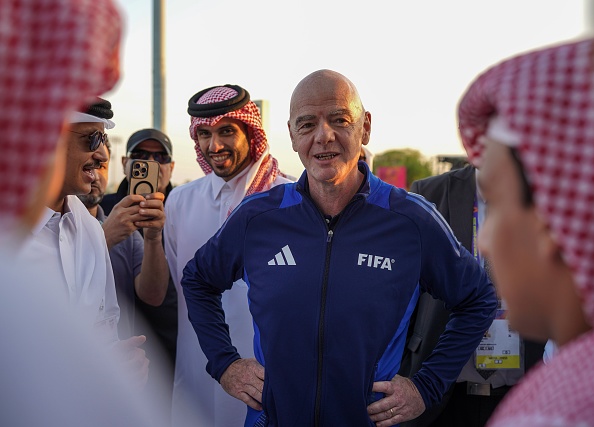
FIFA President Gianni Infantino was probably feeling confident and content on the morning of Nov. 19, even though the organization’s media department had just confirmed that the 56-year-old soccer chief would face two opponents in his reelection bid next March.
One of those is Phillippe Diallo, the French Football Federation boss. He was named just before the Nov. 18 deadline, a few days after Japan’s Kozo Tashima threw his hat in the ring.
Dissatisfaction with Infantino is partly due to his closeness to U.S. President Donald Trump, symbolized by the creation of a FIFA Peace Prize that was handed to the American leader last December during the draw for the 2026 World Cup, co-hosted by the U.S.
There was outrage during the tournament when FIFA intervened to overturn a red card given to the U.S. team’s star player, Folarin Balogun, so he could play in the round of 16 clash with Belgium. Trump revealed that he had called Infantino to make it happen.
In July, Infantino’s plan to sell off part of the World Cup to private investors was leaked. The backlash was fierce, despite those plans soon being scrapped. Three soccer confederations — representing Asia, Europe, and North and Central America and the Caribbean — signed an open letter calling for change.
It looked as if Infantino’s days were numbered, but nothing happened. Meanwhile, the president took to the campaign trail. In October, his smiling face appeared with various presidents — of both associations and governments — in press release after press release and in Asian capital after Asian capital.
Asia is a crucial battleground. If the confederations representing Europe and the Americas were against Infantino (it’s always hard to say if their members are completely united), and if Africa and South America were in favor, then Asia was split.
Infantino was so successful on his travels that, on Oct. 23, the Asian Football Confederation’s leadership, recognizing that he had the backing of most of its members, performed a public U-turn and pledged its support.
"You've visited a lot of countries in Asia,” the confederation’s president, Sheikh Salman bin Ibrahim Al Khalifa, said to Infantino. “I've spoken to a lot of members within this continent. I know your feeling and I think your commitment is clear as well. My feeling is, I'm sure, the feeling of most of my members.”
It wasn’t just about the Swiss Italian’s efforts, though. Also key to his turnaround was the lack of action from the European confederation, which didn’t follow through on its threatened boycott of FIFA competitions and, more importantly, did not put a candidate forward until this month. In the meantime, the anti-Infantino momentum had died down.
Critics have said that the incumbent owes his support to the money he showers on smaller associations, and it is true that the likes of Bhutan depend almost entirely on funds provided by FIFA and the Asian confederation.
But Infantino is personally popular in Asia and spends a lot of time there. He is seen as being less Eurocentric than previous FIFA leaders. There have also been tournaments given to Asia — the U-20 World Cup to Indonesia and, of course, the 2034 World Cup to Saudi Arabia.
He has support in the Gulf region, in particular. Qatar, which now hosts the U-17 World Cup every year, and Saudi Arabia have made efforts to become international sporting hubs, with soccer a major part of those ambitions. As such, having Infantino onside has been appreciated. There are similarities in Africa, too — with Morocco, for example, becoming a major force in soccer on and off the field.
Asia and Africa are likely to tip the balance in favor of Infantino. If so, his opponents may wonder why they took so long to act.
The post Infantino’s Path to a Fourth FIFA Presidency Runs Through Asia appeared first on New Lines Magazine.