The History of English Podcast
The Spoken History of a Global Language
Episode 187: Islands and Sea
31 Dec 2025
In this episode, we explore the influence of seafaring on the English language in the early 1600s. We also look at events in the latter half of the 1620s, which included the first permanent English
Episode 186: A Dutch Treat
31 Oct 2025
In this episode, we explore two important developments in North America. First, we examine the legendary story of the Pilgrims' arrival in New England in 1620 and the establishment of the Plymouth
Episode 44: The Romance of Old French
6 Jun 2014
The modern French language evolved from a Latin dialect spoken in Gaul during the period of the late Roman Empire. That language ultimately became mixed with Old English after the Norman Conquest of
Episode 43: Anglo-Saxon Monsters and Mythology
21 May 2014
Many Anglo-Saxons believed in a world inhabited by monsters and mythological creatures. They also believed in the power of sorcery and witchcraft. These ideas are reflected in the literature of the
Episode 42: Beowulf and Other Viking Ancestors
7 May 2014
The Viking-era states of Denmark, Sweden and Norway emerged from several North Germanic tribes in Scandinavia. These tribes also included the Geats who were prominently featured in Beowulf. In

Bonus Episode 5: Odds and Ends
25 Apr 2014
In this bonus episode we explore a few odds and ends which didn’t make into the earlier episodes. We examine the Old English words related to knowledge and wisdom. And we also look at the
Episode 41: New Words From Old English
8 Apr 2014
The Anglo-Saxons created new words within Old English through the use of compound words, as well as standard prefixes and suffixes. This process expanded the vocabulary of Old English and enabled
Episode 40: Learning Latin and Latin Learning
21 Mar 2014
Long before the Normans arrived in England, the Anglo-Saxons were borrowing Latin words from the monastic culture which was emerging in the 7th and 8th centuries. In this episode, we explore the
Episode 39: Not Lost in Translation
5 Mar 2014
The early Christian Church in Britain gradually embraced English as a way to spread to the message of the Church to the masses. This required the translation of Christian words and concepts from
Episode 38: Nobles, Nuptials and a Cowherd Poet
17 Feb 2014
The kingdom of Northumbria emerged as a center of scholarship and learning during the 7th century. We explore the political and religious events which led to the Northumbrian Renaissance. We also
Episode 37: Seafarers, Poets and Traveling Minstrels
21 Jan 2014
Old English poets were ‘word weavers’ who often created new words to comply with the strict requirements of Germanic poetry. In this episode, we explore the role of the traveling minstrel in
Episode 36: Finalizing the Alphabet
23 Dec 2013
We complete our look at the first Old English alphabet by exploring the remaining letters of the original alphabet. The north-south divide resulted in distinct letters and different spelling
Episode 35: English Sounds and Roman Letters
12 Dec 2013
As the sounds of English evolved in the 7th century, the first English scribes began to write the language with the Roman alphabet. But the English scribes had to invent ways to represent the
Episode 34: Sounds Like Old English
27 Nov 2013
The sound of English began to change as soon as the first Anglo-Saxons arrived in Britain. We explore the specific sound changes which occurred and the impact which those changes had on modern
Episode 33: Missionaries and Manuscripts
7 Nov 2013
In this episode, we explore the events which led to the first document written in the English language – the laws of Aethelbert of Kent. We look at the rise of monasteries, the role of St.
Bonus Episode 4: Let Me ‘Buoy’ Your Spirits
29 Oct 2013
How do you pronounce ‘buoy’? In this bonus episode, we explore the history of the word and the reasons why the word is pronounced differently in various parts of the English-speaking world.
Episode 32: The Oldest English
18 Oct 2013
We explore the early Anglo-Saxon kingdoms and their regional Old English dialects. The ‘Saxons’ soon become the ‘English.’ And ‘English’ provides the name of a new nation.

Episode 31: Saxons, Franks and Other West Germans
25 Sep 2013
During the period of the Anglo-Saxon migrations, the West Germanic tribes of northern Europe continued to fight for power against the Romans and against each other. This period saw the emergence of
Episode 30: The Celtic Legacy
6 Sep 2013
We explore the linguistic legacy of the native Celtic Britons on Modern English. The historical legacy of the legendary Celtic king named Arthur is also examined. TRANSCRIPT: EPISODE 30
Episode 29: The Anglo-Saxon Invasion
12 Aug 2013
The Anglo-Saxons arrived in the British shores as permanent settlers in the 5th century. They encountered native Britons who spoke Latin and Celtic languages. The two groups soon fought for control
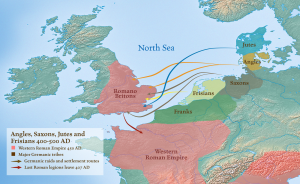
Episode 28: Angles, Saxons, Jutes and Frisians
18 Jul 2013
We explore the origins of the Angles, Saxons, Jutes and Frisians in the North Sea region of northern Europe. The early raids on the coasts of Britain and Gaul set the stage for the later mass
Episode 27: Broken Empire and Fractured Languages
24 Jun 2013
Parchment books begin to replace papyrus scrolls as the Western Roman Empire crumbles. New Germanic Kingdoms emerge in the west, but Latin remains the dominant language in Western Europe. Latin
Episode 26: Imperial Crisis and the Goths
8 Jun 2013
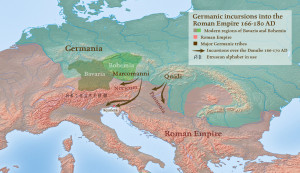
Rome is racked by ‘Imperial Crisis’ while strong Germanic tribes gather along the Rhine and Danube. The Alamanni, Franks, Vandals and Goths rise to power and provide us with many words in modern

Episode 25: Germanic Markings and the Runes
28 May 2013
We explore the expansion of Germanic tribes into the Danube region where the Germans encounter the Etruscan alphabet. The Germanic runes develop and provide the first opportunity for the Germanic
Episode 24: Germanic Mythology
5 May 2013
The role of Germanic mythology on modern English is explored. Germanic gods and religious traditions are examined with an emphasis on words and phrases which are still found in modern English.
Episode 23: Tacitus and Germanic Society
2 Apr 2013
We explore the Germanic languages during the 1st century AD. The society of the early Germans is examined in the context of ‘Germania’ by the Roman historian Tacitus. Modern English words
Episode 22: Early Germanic Grammar
21 Mar 2013
We look at the grammar of the early Germanic tribes. The decreasing use of inflections is explored. Elements of modern English grammar are identified within the original Germanic language.
Episode 21: Early Germanic Words
5 Mar 2013
We look at the first inscription found in a Germanic language and the vocabulary of the early Germanic tribes. The impact of Grimm’s Law on the early Germanic language is examined. TRANSCRIPT:
Bonus Episode 2: History of the Alphabet
24 Feb 2013
Kevin discusses the new History of the Alphabet series. An excerpt from the series is included. The history of the ‘constant consonants’ (B,D,L,M,N,P,R,T) is explored.
Episode 20: The Early Germanic Tribes
5 Feb 2013
The first Germanic-speaking tribes emerge in northern Europe. We explore the connection between these tribes and the original Indo-Europeans. We then look at the expansion of the Germanic tribes
Episode 19: The Romanization of Britain
23 Jan 2013
The Roman Empire emerges following the death of Julius Caesar. Emperor Claudius sets his sights on Britain, and the native Celtic culture becomes Romanized. We look at the evolution of Latin
Episode 18: Keeping Time With The Romans
2 Jan 2013
We explore the origin of modern English words related to time. A direct connection is made to the calendar reforms of Julius Caesar. The etymology of English words related to time illustrate the
Episode 17: Ancient Celts and the Latin Invasion of Gaul
15 Dec 2012
We look at the arrival of Celtic speaking people in Europe, and the invasion of Celtic Gaul by the Romans. Celtic is replaced by Latin in Western Europe, leading to the modern Romance languages.

Episode 16: The Rise of Rome – and Latin
30 Nov 2012
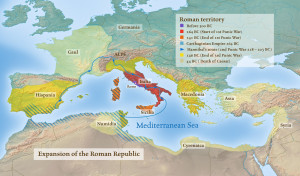
We look at the rise of the Roman Republic from a small Italian city-state to the dominant political and military power of the Mediterranean. The expansion of Rome also led to the expansion of Latin
Episode 15: Etruscans, Romans and a Modified Alphabet
13 Nov 2012
The first Indo-Europeans settle into Italy, but they encounter an existing civilization known as the Etruscans. The Etruscans borrow the alphabet from the Greeks, and soon pass it on to the Romans.
Episode 14: The Greek Word Horde
1 Nov 2012
The Classical Greek period is explored with an emphasis on Modern English words which originated during this period of Greek history. TRANSCRIPT: EPISODE 14
Episode 13: Greece, Phoenicia and the Alphabet
17 Oct 2012
Mycenaean Greek writing disappears during the Greek Dark Age, but the Greeks encounter the Phoenicians and adopt their alphabet. The Greek alphabet results in the spread of literacy. Modern English

Episode 12: Early Greek, Hittite and the Trojan War (Extended Version)
5 Oct 2012
The first Greek and Hittite civilizations emerge from Indo-European tribes in the eastern Mediterranean. The Greeks adopt an early form of writing and fight the Trojans. An alphabet allows the

Bonus Episode 1
19 Sep 2012
Kevin Stroud updates listeners regarding the podcast and the website for the podcast. Kevin also answers some questions posed by listeners.
Episode 11: Germanic Ancestors
9 Sep 2012
We look at the emergence of the Usatovo culture which spoke an Indo-European dialect believed to be the ancient ancestor of the Germanic languages – including English. We also look at the later

Episode 10: Early Indo-European Migrations
5 Sep 2012
The emergence of the first Indo-Europeans and the early migrations of these steppe herders is examined. The specific advantages favoring the expansion of these people is explored in detail.
Episode 9: Who Were the Indo-Europeans?
24 Aug 2012
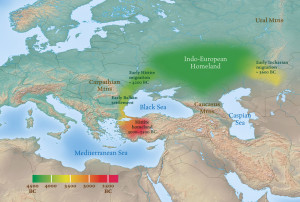
The evidence is examined to determine when and where the original Indo-Europeans lived. Based upon this evidence, the probable identity of the first Indo-Europeans is revealed. TRANSCRIPT: EPISODE
Episode 8: Indo-European Grammar (Where have all the inflexions gone?)
16 Aug 2012
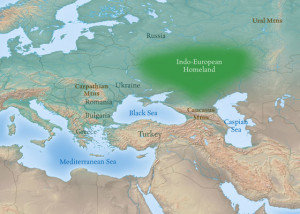
The grammar of the original Indo-European language is compared to Modern English. We explore the word endings called ‘inflexions’ which were a prominent feature of the original Indo-European
Episode 7: More Indo-European Words
9 Aug 2012
We complete our review Indo-European words which have impacted modern English. Social terms are explored to provide an insight into Indo-European society and culture. TRANSCRIPT: EPISODE 7
Episode 6: Indo-European Words
26 Jul 2012
A look at words used by the original Indo-Europeans and the clues such words provide to the identity of the first Indo-Europeans. The etymology of modern English words is explored in relation to
Episode 5: Centum, Satem and the Letter C
18 Jul 2012
A look at the early division of the Indo-European languages into the Centum and Satem languages. The sound shift which marks the division of the Centum and Satem languages is then explored in the
Episode 4: A Grimm Brother Resurrects the Dead (…language)
11 Jul 2012
The famous fairy-tale collector Jacob Grimm formulated the rules which help modern linguists reconstruct the ancient Indo-European language. In this episode, we look at Grimm’s Law and how the
Episode 3: The Indo-European Family Tree
2 Jul 2012
A look at the family tree of Indo-European languages and the relationship of English to those related languages. The closest relatives of English are highlighted, including the Germanic languages,

Episode 2: The Indo-European Discovery
25 Jun 2012
The story of the discovery of the ancient language which gave rise to most of the languages of Europe, including English. TRANSCRIPT: EPISODE 2
Episode 1: Introduction
18 Jun 2012
In this introductory episode, we look at the emergence of English as a global language and the evolution of the language from its Germanic origins. TRANSCRIPT